The Legal Argument Package: Forensic or Clinical Psychology

Things are changing. 

We are shifting from a forensic psychology non-solution to a clinical psychology solution for complex family conflict surrounding divorce.

This is not a child custody issue.  The conflict surrounding child custody is a symptom. The issue is family pathology that is creating complex attachment-related  pathology in the family; complex family conflict surrounding divorce.

This is a family pathology and treatment issue.  Conducting family therapy is the domain of clinical psychology, treating attachment pathology in the family is the domain of clinical psychology (a child rejecting a parent is an attachment-related pathology), treating the expression of parental personality disorder pathology in parenting and the family is the domain of clinical psychology, and treating the trans-generational transmission of complex trauma is the domain of clinical psychology.

This is a clinical psychology issue, diagnosing and treating family pathology; the attachment system, family systems therapy, personality disorder pathology, complex trauma.  Clinical psychology.

The DSM-5 diagnosis for pathogenic parenting that is creating significant psychopathology in the child is V995.51 Child Psychological Abuse.  Diagnosing and treating child abuse is the domain of clinical psychology.  This is not a child custody issue; it’s a child protection issue. 

The clinical psychology concern is the significant degree of psychopathology being created in the child by the pathogenic parenting of the allied narcissistic-borderline personality parent… assessing, identifying (diagnosing), and treating psychopathology is the domain of clinical psychology.

Following divorce, a spouse is using the child as a weapon of revenge and retaliation against the other spouse-and-parent in the divorce, in order to inflict severe emotional abuse on the other spouse-and-parent through the psychological trauma of losing their child (traumatic grief).  This pathology is a form of domestic violence (Intimate Partner Violence; IPV), the emotional abuse of the ex-spouse using the child as a weapon of spousal revenge and retaliation for the divorce, and in the process psychologically abusing the child by creating severe pathology in the child.

The assessment, diagnosis, and treatment of Intimate Partner Violence (IPV; domestic violence) and child abuse is the domain of clinical psychology.

This is not a child custody issue.  The child custody conflict is a superficial symptom of much deeper clinical pathology in the family.  The issue is one of psychopathology, that’s the domain of clinical psychology.  The clinical psychology argument package represents the return of clinical psychology to court-involved consultation, court-involved assessment of pathology, and court-involved treatment of pathology.

Identification of pathology is called diagnosis.  Assessment leads to diagnosis, and diagnosis guides treatment.  Treatment solves conflict and restores the child’s healthy family context and healthy development.

We are shifting the legal argument package that is being presented to the court.   Parents and their attorneys will be asking the court for a clinical psychology assessment of family pathology, not a forensic psychology assessment for child custody.

The Forensic Package

Up until now there has been only a single option for parents and their attorneys, the forensic psychology legal argument package that frames the issue as one of custody and visitation.  That has changed.  There is now an alternative approach; a treatment focused approach from clinical psychology.

The clinical psychology legal argument package is grounded on a different set of constructs in professional psychology (Bowlby; Minuchin; Beck) than is the forensic psychology argument package (arbitrary and unknown foundations), and the clinical psychology option seeks a different remedy from the court than the forensic psychology argument package. 

Since the focus of the forensic psychology legal argument is on child custody, the initial forensic psychology remedy moves inexorably into a “child custody evaluation” as the only means to obtain the input of professional psychology into the question of the child’s non-compliance, and potentially influenced child behavior regarding compliance, with the custody visitation orders of the court.

The task of each parent then becomes proving their position regarding the child’s rejection of a parent to the child custody evaluator, who will decide on the “evidence” presented to the custody evaluator regarding the relative merits of each party’s position, and will decide on the custody and visitation schedule for the family – thereby ABROGATING the duties of the judge… to hear argument and evidence, to make a determination of fact, and to render a decision regarding the custody visitation schedule.

All done by the custody evaluator – not the judge.  The judge may either then accept or reject and alter the ruling of the custody evaluator – typically without benefit from a second opinion from professional psychology regarding the family symptoms and family pathology.

Custody and visitation decision-making has essentially been assigned out of the courts to forensic psychology, and the only approach available from forensic psychology is an invalid (no inter-rater reliability) six- to nine-month forensic child custody evaluation costing between $20,000 to $40,000. 

Each parent tries to influence the custody evaluator to their position.  The position of the allied parent (supported by the child) is that the targeted parent is “abusive” and “deserves to be rejected” by the child.  The position of the targeted parent is that the child’s attitudes and behavior is being influenced and controlled by the allied parent as a means to inflict emotional suffering on the targeted parent for the divorce (that the child is being used as a weapon of spousal revenge and retaliation for the divorce).

The custody evaluator meets with everyone to hear their “arguments” – exposing the evaluator to their influence and efforts at manipulation of the evaluator’s opinion.  This is a deeply concerning assessment process because of its vulnerability to the unconscious biases of the evaluator (called counter-transference in clinical psychology). 

Counter-transference (unconscious bias) from the psychologist ALWAYS exists, in all cases, in all contexts.  The introduction of the psychologist’s own unconscious biases are identified as “schemas” in professional psychology.  Personal biases in the assessment of information is always present, and is entirely unconscious to the person.  This is a fact of psychology, and of all assessment processes.

In the forensic psychology process, the custody evaluator acts as the “judge” regarding the relative arguments offered by each parent, and the custody evaluator makes a determination of fact – typically whether a poorly defined construct called “parental alienation” is present and to what degree – and decides on the remedy based in the child’s custody visitation schedule with each parent.

Note: There is no pathology known as “parental alienation” in clinical psychology.  That is a new form of pathology that is entirely the construction of forensic psychology.  It does not exist.  In clinical psychology, defined knowledge exists, and the identification of pathology (called diagnosis) is based solely on the established constructs and principles of professional psychology (attachment; family systems therapy; personality disorder pathology; complex trauma).

The alternative focus on the treatment of family pathology will move this into clinical psychology and a clinical psychology assessment of pathology. 

Which legal argument and remedy package to present to the court is a decision for parents and their attorneys.

The Challenge of the Forensic Psychology Argument

The focus of the forensic psychology argument for the targeted parent is to prove a pathology (“parental alienation”) to a judge in order to obtain the remedy, typically a reversal of custody from the supposedly “favored” parent to the currently rejected targeted parent. 

That is the burden, proving the family pathology of “parental alienation” to a judge at trial.  The sole means to prove “parental alienation” to a judge at trial is through a forensic psychology child custody evaluation.  A child custody evaluation costs between $20,000 to $40,000 and takes between six- to nine-months to complete.

There is no other option from the forensic psychology legal argument package.  No second opinion is available because of the expense ($20,000 to $40,000) and length of time required (six to nine-months) for a child custody evaluation.

This approach is hardly ever successful for the targeted parent.  This approach typically takes years of litigation and potentially hundreds of thousands of dollars in legal costs, with substantial damage to both the parent-child relationship and the family’s financial foundations during and throughout the years of litigation required by the forensic psychology approach.

Successful resolution of the family conflict is exceedingly rare using the forensic psychology legal argument package, because it’s not a treatment focused approach.  Treatment is clinical psychology, and a clinical psychology assessment of pathology has not been conducted.

The forensic psychology approach typically only achieves success in the most severe cases of “parental alienation” in which the pathology of parental influence on the child is clearly evident, and then only after years of conflict and litigation have already robbed the child of a normal-range and healthy parent-child relationship with a loving and beloved parent (their mom or their dad; the targeted parent), and the loss of a normal-range childhood of healthy emotional and psychological development (bonded in loving relationships with both parents).

The forensic psychology approach offers no solution, it is destructive of families and children’s healthy emotional and psychological development, and this approach needs to change – because it offers no solution.  It is not treatment focused.  Treatment of child and family pathology is the domain of clinical psychology.

Clinical Psychology Argument

Clinical psychologists create change.  We create change in individuals (individual therapy) and we create change in families (family therapy).  Clinical child and family psychologists solve complex family conflict.  That’s what we do.   We solve complex family conflict.  It’s called family systems therapy.  Solving complex attachment-related family pathology surrounding divorce requires a solution from clinical psychology.

Clinical psychology can absolutely – 100% – solve this family pathology (cross-Slide52generational coalition; emotional cutoff; narcissistic-borderline parent (“splitting”); multigenerational transmission of complex trauma). 

The solution requires the application of professional knowledge from four domains of professional psychology: the attachment system, family systems therapy, personality disorder pathology, and complex trauma.  So it is not easy to solve. But it is entirely solvable with the application of the established knowledge of professional psychology.

Attachment – family systems therapy – personality disorder pathology – complex trauma.  Established knowledge in professional psychology.  Bowlby – Minuchin – Beck – van der Kolk.

I have posted a Curriculum Knowledge Checklist to my website that identifies the books from professional psychology that contain the professional knowledge needed to solve complex family conflict surrounding divorce.

It is a complex and difficult pathology.  But it is both understandable and solvable.

Court Involvement

Solving this pathology will require a cooperative relationship between clinical psychology and the Court.  The narcissistic-borderline parent will lead this family conflict into the court system by manipulatively creating and then exploiting the child’s refusal to comply with court orders for custody and visitation.  Once the child begins refusing visitation contact with the targeted parent (with the tacit support of the allied narcissistic-borderline parent), the targeted-rejected parent must then return to court seeking enforcement of the existing court orders for custody and visitation.

That’s how the pathology of one spouse-and-parent (the allied parent who forms a cross-generational coalition with the child) drives the post-divorce family into the family court system.  The family pathology will enter the legal system because the targeted parent needs to seek enforcement of the existing court orders for custody and visitation as a consequence of the child’s (manipulated and psychologically coerced) refusal to cooperate with the court orders for custody and visitation.

Since the issue is superficially the enforcement of orders for child custody and visitation, the issue will present to the court as one of “child custody” – but it’s not about custody and visitation.  Court orders already exist.  It’s about parental pathology in the family creating attachment-related pathology in the child in order to exploit the child’s symptoms to manipulate the court’s orders for custody and visitation (using the pathology – the rejection of a parent – created in the child).

This is a family pathology issue.  That’s the domain of clinical psychology.

Victimized Child – Influenced Child

Upon entry into the legal system, the narcissistic-borderline parent will present the “victimized child” argument to the court; that the child is supposedly being “victimized” by the allegedly “abusive” parenting of the targeted parent, and the remedy sought by the allied narcissistic-borderline personality parent will be to severely limit the other parent’s time with the child ostensibly to limit the child’s contact with the supposedly “abusive parent.”

The targeted parent, on the other hand, will present the court with the “influenced child” argument surrounding the child’s refusal of contact, and the targeted parent will seek the remedy of limiting and restricting the child’s time with the allied and “favored” parent in order to resolve the “influenced child” refusal of the court-ordered custody and visitation.

The judge will need to resolve between these two argument packages; “victimized child” offered by the allied and supposedly “protective” parent, and the “influenced child” argument offered by the targeted and rejected parent.  Once the judicial decision is made regarding the arguments, an appropriate remedy will then need to decided upon by the Court.

Adjusting the Argument Package

The clinical psychology argument package adjusts both the focus (treatment of family pathology rather than child custody schedules) and the framing for how the “influenced child” argument is presented to the court.

The clinical psychology argument will NOT use the construct of “parental alienation” – and indeed, the use of the construct of “parental alienation” would be considered beneath professional standards of practice in clinical psychology.  In clinical psychology, if a psychologist wants to apply a “new form of pathology” (such as “parental alienation”) to the interpretation of symptoms, this is done only AFTER having applied the standard and established knowledge of professional psychology; the attachment system literature, constructs from family systems therapy, personality disorder pathology, complex trauma, and the DSM diagnostic system.  After.

The clinical psychology argument does NOT use the construct of “parental alienation” (because this construct is non-supported in the scientific literature of professional psychology), and is instead based entirely and solely on the solidly established constructs and principles of professional psychology (the attachment system, family systems therapy, personality disorders, complex trauma) – (Bowlby, Minuchin, Beck, van der Kolk, Millon, Kernberg, Perry, Haley, Bowen, Madanes, Linehan, Ainsworth…) – the standard and established knowledge of professional psychology applied to the symptom features of the pathology.

Up until now, the only option available to targeted parents and the court for obtaining input from professional psychology surrounding complex family conflict has been through forensic psychology and a child custody evaluation regarding the structure of the child custody schedule – and NOT the resolution of the family pathology issue.

The legal argument presented to the court is changing – from a forensic psychology package to a clinical psychology legal argument package.  Parents and their attorneys are now beginning to ask for a clinical psychology assessment of family pathology; the pathology that is creating the complex family conflict that has entered the legal system.

The narcissistic-borderline parent has forced the targeted parent to return to court to seek enforcement of the existing child custody orders because the child has become severely symptomatic and non-cooperative with the established custody visitation schedule.  This is the manipulative set-up by the narcissistic-borderline spouse-and-parent to make this about custody and visitation, driving the conflict into a forensic psychology approach focused on child custody (possession of the child) rather than a clinical psychology approach of diagnosis and treatment of pathology.

That is changing.  An alternative legal argument package is available from clinical psychology for a treatment-focused assessment of the family.  The referral question for the clinical psychology assessment is:

Referral Question: Which parent is the source of pathogenic parenting creating the child’s attachment-related pathology, and what are the treatment implications?

This clinical psychology referral question can be answered by a limited-scope clinical psychology assessment, typically requiring about six sessions and costing approximately $2,500 to complete.  It is structured around two symptom documentation instruments, the Diagnostic Checklist for Pathogenic Parenting and the Parenting Practices Rating Scale.

The relatively low cost (~ $2,500) and short time frame (six to eight weeks) for the clinical psychology assessment allows for a second opinion assessment if desired, and the use of structured symptom documentation instruments (the Diagnostic Checklist and Parenting Practices Scale) allows for easy and clear comparison of findings from a first and second opinion report from clinical psychology.

The targeted parent is still offering the “influenced child” argument to the court, but is changing how that argument is structured and presented for the court’s consideration. Instead of using the incredibly weak construct of “parental alienation” that will drive the assessment into forensic psychology, the clinical psychology argument is solidly grounded in the established knowledge of professional psychology: the attachment system, complex trauma, and family systems therapy.

Of note is that the clinical psychology argument package presented to the court will not be using the personality disorder information sets from professional psychology in the argument presented to the court.  The personality pathology information from professional psychology will emerge over time within the broader background understanding within the legal and mental health systems that develops from increasing familiarity with the pathology.

From the perspective of a clinical psychology family therapy solution, we do not want to emphasize the other parent’s pathology.  There are other ways.  Identifying pathology is important, because diagnosis guides treatment – but diagnosis is only important because it guides treatment.  We do not want our focus to be on diagnosis, but on treatment.  We want to pivot as quickly as we can away from identifying pathology (the diagnosis) and over to treatment.

The clinical psychology approach is solution focused; not problem driven.  How do we fix things, how do we restore healthy parent-child bonds of affection, how do we restore the child’s normal-range and healthy childhood development?  Solution focused.

What’s the pathology?  A cross-generational coalition and emotional cutoff (attachment pathology).  Minuchin’s diagram provides strong support for this argument.  It displays exactly the pathology of concern.

Slide52The Family Pathology: The child’s “triangulation” into the spousal conflict through the formation of a “cross-generational coalition” with the allied parent against the targeted parent, resulting in an “emotional cutoff” of the child’s relationship to the targeted parent (Minuchin; Haley; Bowen; Madanes; family systems therapy).

This type of family pathology is caused by “multigenerational trauma” (Bowen), also referred to as the trans-generational transmission of trauma in the attachment and complex trauma literature (Bowlby; van der Kolk).

The clinical psychology argument package presented to the court is that significant family pathology is resulting in the obstruction of court orders for custody and visitation.  The remedy sought by the targeted parent is a treatment focused, trauma-informed, clinical psychology assessment of the family pathology.

That’s quite the mouthful for the assessment description. 

Treatment Focused:  The “treatment focused” indicator shifts the focus of the assessment off of the false child custody issue over to identifying a treatment oriented solution for the complex family conflict (through a written treatment plan for the resolution of child and family pathology; identified by the assessment). 

Trauma Informed:  The indicator of “trauma-informed” ensures that proper information sets from professional psychology are applied by the assessment. 

Clinical Psychology:  The clinical psychology orientation is to move the family conflict out of forensic psychology that offers no solution and over to clinical psychology for the identification (diagnosis) and treatment of the (“high-conflict”) pathology in the family.

The initial remedy sought is:

Initial Remedy:  A treatment-focused, trauma-informed, clinical psychology assessment of complex family conflict surrounding divorce.

The clinical psychology referral question is:

Referral Question:  Which parent is the source of pathogenic parenting creating the child’s attachment-related pathology, and what are the treatment implications?

The focus is NOT child custody (which parent should “possess” the child following the divorce), it’s treatment.  How do we restore normal-range and healthy child development?  The targeted parent is making a treatment-focused argument to the court; that the custody violations to the court orders are a symptom of family pathology, and the targeted parent is seeking a clinical psychology assessment of the family pathology (along with the enforcement of existing court orders for custody and visitation) as the remedy.

This clinical psychology argument package effectively nullifies the “victimized child” argument offered by the narcissistic-borderline parent, since the treatment-focused, trauma-informed, clinical psychology assessment addresses the arguments from each parent and provides remedy for both.

If the child is indeed being victimized by an abusive parent (thereby justifying the child’s reluctance to be with the rejected parent) as is alleged by the allied parent and child, then a trauma-informed, treatment focused assessment from clinical psychology is just the assessment to identify this child abuse and victimization of the child by the targeted parent.

The narcissistic-borderline parent is using (exploiting) the child’s induced pathology (the child’s rejection of a mother or father) to make the issue about child custody (“possession” of the child following divorce; who’s the “better parent” – who “deserves” possession of the child).  The targeted parent is altering this, and is instead using the induced child pathology created by the other parent to make the issue about the diagnosis and treatment of pathology. 

Since both agree on the existence of pathology, just not its causal source, a clinical psychology assessment and diagnosis, that identifies the treatment implications, is entirely warranted as the initial remedy for both arguments.  Let’s find out what’s causing the child’s attachment-related pathology following the divorce – that’s a clinical psychology issue – identifying pathology is called diagnosis.

A clinical psychology argument package will extract targeted parents from the court system and return the assessment, diagnosis, and treatment of complex family conflict to clinical psychology, and it will prevent families with newly emerging divorce-related conflict from entering years of litigation in the family courts surrounding child custody, by making identification of the pathology in the family the first order from the court.  Identify (diagnose) what is causing the child’s attachment-related pathology surrounding the divorce.

Initial Orders Sought for Remedy

Custody and visitation are not the focal point, they are symptom features of the complex family conflict.  We need a treatment focused assessment from clinical psychology to determine what is going on, what the source for the complex family conflict is – using the standard and established knowledge of professional psychology (a trauma-informed assessment of complex family conflict).

A secondary remedy sought by the targeted parent is the enforcement of existing court orders for custody and visitation (and possibly sanctions on the allied parent for their responsibility in creating the breaches to the court orders).

In response to the clinical psychology argument package from the targeted parent, that carries a secondary remedy of enforcement and possible sanctions surrounding existing court orders for custody and visitation, the judge may decide to wait until the results of the clinical psychology assessment of family pathology before making a ruling on the custody orders from the court, and the judge will likely rule in favor of the targeted parent’s request for a “trauma informed, treatment focused, clinical psychology assessment of the complex family conflict.”

Second Opinion

The other party will possibly argue against this clinical psychology assessment.  The rebuttal to this argument that can be offered by the attorney for the targeted parent is “second opinion”; that the opposing party is free to obtain a second opinion, a second trauma-informed clinical psychology assessment of the complex family conflict.

If someone is concerned about a diagnosis in clinical psychology, get a second opinion.  That’s how it’s done in clinical psychology (and health care generally). Get a second opinion if you’re concerned about the accuracy of diagnosis.

Child Protection Issue

Child pathology and child protection is the framing for the clinical psychology legal argument package.

The “custody” symptom (the child refusing court orders for custody and visitation) is a symptom of the family pathology.  This is not a child custody issue, this is a child pathology issue.  Is the targeted parent an “abusive” parent creating the child’s rejection, or is it the allied parent who is creating the child’s pathology through pathogenic parenting of psychological control and manipulation?

The referral question for the (“trauma-informed”) clinical psychology assessment is:

Referral Question: Which parent is the source of pathogenic parenting creating the child’s attachment-related pathology, and what are the treatment implications?

If the pathogenic parenting of the allied parent is creating significant developmental pathology in the child (attachment system suppression; diagnostic indicator 1), personality disorder pathology in the child (narcissistic personality traits; diagnostic indicator 2), and delusional-psychiatric pathology (encapsulated persecutory delusion; diagnostic indicator 3), the DSM-5 diagnosis is V995.51 Child Psychological Abuse, Confirmed, and the considerations shift to child protection.

In all cases of child abuse, physical child abuse, sexual child abuse, and psychological child abuse, the professional standard of practice and duty to protect requires the child’s protective separation from the abusive parent.  The child’s healthy development is then recovered and restored, and once the child’s healthy development is stabilized, contact with the formerly abusive parent is reestablished with sufficient safeguards to ensure that the child abuse does not resume once contact is restored.

This is true for physical child abuse, this is true for sexual child abuse, this is true for psychological child abuse.

That’s the shift that is occurring.  The legal argument package being presented to the court, both in its foundations (Bowlby, Minuchin, Beck) and in the remedy sought (a clinical psychology assessment; psychological child abuse diagnosis; protective separation period and treatment recovery) is shifting to a clinical psychology legal argument package of solution

The world is changing.  An attachment-based and trauma-informed model of complex family conflict surrounding divorce represents the return of clinical psychology to court-involved practice.

Craig Childress, Psy.D.
Clinical Psychologist, PSY 18857
The door of empathy…

I’m going to share something very important from clinical psychology for all the targeted parents, but I’m going to do it off the record.

The reason I want this off the record is because I do NOT want to imply in any way, shape, manner, or form that the targeted parent is doing anything to create the child’s attachment pathology.  Nope, nope, nope.

Nor do I want to give targeted parents advice on how to get the child to love them, which would only expose the child more fully to their psychological brutalization from their narcissistic/(borderline) parent – we must first protect the child before we can ask the child to reveal authenticity.  The child is doing what the child must do to survive.

There is a reason for psychological defenses. We do not take away a defense until there is no need for the defense.  Right now, coping with the pathology of a narcissistic/(borderline) parent requires the child to say and do things.  This is a deeply disturbing aspect of the pathology.  Deeply disturbing, and it rises to the level of a confirmed DSM-5 diagnosis of Child Psychological Abuse

This is a trauma pathogen.  Complex trauma is born in an absence of parental empathy, and it is solved through it’s antidote, the opposite, the application of abundant empathy for the child.

When we ask others to understand our pain… that’s not empathy.  When we put our pain aside and seek to understand the child’s world… that’s empathy.

But we’re afraid.

Trauma pathology is also a world of fear.  Anxiety rules in trauma, and anxiety pulls us into our self-absorption of our own experience.  Anxiety captivates us and constricts our ability to flow outward into others, into empathy.  Anxiety motivates a self-focus, how do I keep myself safe?  Anxiety stops empathy.

Empathy is available when we are in a relaxed and calm state.  For a trauma mental health team that goes in after a major mass shooting or bombing, the trauma therapists have to be calm and composed.  We’re the ones bringing the empathy to the psychological treatment of trauma.  We need to be relaxed and composed, otherwise we lose the capacity for the very empathy that heals.

It doesn’t help any of the victims of trauma if the mental health trauma team is running around flustered and overwhelmed.  In trauma, someone needs to remain grounded.

In complex family conflict surrounding divorce (“parental alienation”; AB-PA), we’re dealing with a trauma pathogen, the ripple of trauma through the generations.  Complex trauma (relationship-based trauma) is born in the absence of parental empathy for the child.

The treatment of complex trauma is abundant authentic empathy for the child.

Not empathy for the pathology.  The pathology is a delusion; a false trauma reenactment narrative being imposed on the child by the unresolved childhood attachment trauma of the narcissistic/(borderline) parent.  A false reality.

Instead, treatment is a resonant empathy for the authentic child alive beneath the pathology.  An empathy that draws forth this authentic child, because we, through our empathy, we see the authentic child – and the child sees their own self-authenticity reflected in our empathy.

What I want to share with targeted parents is an important – extremely valuable – communication skill.  It’s the empathy skill.  It’s simple, oh so simple.  And it will be one of the hardest things you will ever do.

Because you have buttons that can be pushed that will trigger your anxieties, and you will act from your (unconscious) anxieties and fears, and our anxieties and fears stops our empathy.

“But, but, but…”  Wait, these are your anxieties.  See how early they come.  The mere mention of your buttons and anxieties and up they pop, “but, but, but…”  Wait, calm… listen.

If you develop this empathy communication, magic opens up. I’m a clinical psychologist, it’s a healing magic.  It is one of the most magnificent communication skills you can possibly use.  I use it whenever I have the opportunity as a clinical psychologist, always with wonderful results.

Are you ready? Okay, here it is.

Don’t become defensive.

Simple. Isn’t that simple? When something is said, don’t defend.

“Well, what if…”

I know.  I told you it would be one of the hardest things you will ever do.  Didn’t I tell you that?  And right out of the gate you start hitting me with “what if… and what if… and am I just supposed to accept it?…” anxiety.

So I’ll wait.  When your anxiety is exhausted, we’ll move on.  No worries.  Anxiety starts us spinning, we don’t push past it, that just creates more anxiety and spinning.

The antidote is the opposite. Anxiety is up-arousal, the opposite is down arousal.  Relax.  Allow.  Notice the anxiety, and just let it float on by.

Ready?

Why don’t we defend?  It’s important for you to understand the why.  That’s really important, because it will help you.  Knowing why, you’ll catch yourself defending and go, “dang,” and then you’ll relax and self-correct (that’s a Dorcy term; my psychology term is “self-regulate” – I like hers better; no worries, just self-correct and move on).

When we defend we make the child absorb us, the child must understand us.  The empathy is flowing the wrong direction.  I don’t care what the content is, I’m talking the flow of empathy; which direction?  In severe family pathology like this, we shouldn’t put the burden of solution on the child.  That’s not what the child needs. The child needs empathy FROM us.  The child needs us to understand them.  But when we defend, we’re asking them to understand US.

See?   Does that make sense about the direction for the flow of empathy, from the parent to the child?

So to help the child, to rescue the child from the quicksand, we stand on the bank and we extend a branch of understanding – of our empathy – and say, “Here, take this empathy and hold on, I’ll pull you out.”

We don’t need the parent jumping into the quicksand with the lost and confused child, that’s not going to help.  Nor do we need the parent asking the child to understand the parent’s world, that’s like throwing the child a boulder and saying, “Here, grab hold of this rock” as they sink under its weight.

Yeah, okay, you threw them something, but not something they can use to get out of the quicksand that they’re stuck in.

We need a parent.  That other parent isn’t such a good parent.  With that parent, the child gets all twisted up and confused.  The child needs a parent to help the child get un-twisted and un-confused.  That’s you.

How do you do that?  Off the record… Don’t respond defensively.

The child says, “You’re a bad parent” and you say, “No I’m not” – ahhhh, see.  You’re defensive.  You just got defensive.

“But what am I’m supposed to do? Am I supposed to agree with the child?”

I know. That’s your anxiety again.  I told you, it’s really simple… and oh so hard.  We’ll wait while your anxiety clears.  It’ll spin you for a while, just relax, don’t fight against anxiety – that’s just adding more tense.  Anxiety goes away when we relax and accept, notice the experience, and let it go by.

Dorcy calls it spinning.  I like that term.  In my psychology-speak I’d call it anxiety or self-regulation.  I think she has better terms for this stuff; self-correct, spinning. They’re good ways of describing the process.

So, have you calmed down from your anxiety and regained self-regulation?  Yuch, ugly word… Has the spinning stopped?  Okay.

So you don’t want to defend.  The child is full of the other parent’s nonsense (Dorcy calls it garbage; again, a better term).  The child does NOT need you adding your stuff by asking the child to understand you and your world.  So do we have that clearly understood?  No defending.

Anxiety all gone, ready to listen?

So then how do we respond with empathy and without defending?

Yay!  Woo hoo.  You’ve done it.  You’ve broken through to an amazing opportunity for solution… simply by asking the right question.

There’s probably half a dozen ways to respond with empathy and without defending, but you will NEVER find them or use them unless you first ask the question… unless you want to know.

Whew.  So we’re through the first important step – don’t defend, and have made it through your first round of anxiety (“but, but, but…”).  So if there’s six to eight things we can do, let me share a couple…

First, the one I use most often is, “Tell me more about that.”

Did I agree with what the child said?  No.  Did I defend?  No.  What did I do?  I cared about the child’s experience. I asked to learn more about the child.

As I learn about the child, I am bringing something valuable to the child… it’s called the “eyes-of-the-other” – the eyes-of-the-other is like the lantern that old man in the tarot cards holds, or on that Led Zeppelin album, you know that guy?  The eyes-of-the-other is like bringing that lantern into the darkness of the child’s self-experience.

Hmmm, I wonder what’s over here?  What’s this?  I’m learning about the child, and so is the child.  I’m not pushing, or going, or teaching, or doing anything at all.  I’m just following, curious.  I wonder, because I care.  What’s it like to be you?  I want to understand.

That’s empathy.

The child’s experience is all twisted up in some way.  What’s up with that?  I want to find out more.  That’s called caring and empathy for the child’s world.

From the degree of the child’s emotionality, that must be a very painful place to live in, the child.  What is the pain, and what can we do about it?  Let’s find out.

Oh, but then you know what’s going to happen if I ask the child to tell me more?  The child is going to say all this untrue and foul stuff.  I know.  That’s all the garbage from the other parent, isn’t it.  Boy oh boy, that must feel awful in the child to be holding onto all that garbage.

I bet the child needs to get that garbage out of them.  But where can it go?… to you.

Yep.  We need a parent.  The child is all full of this emotional garbage, and is all hurt and confused.  Yep, the child needs a parent to help sort this out.  And it’s not going to be the other parent, they’re the one that’s twisting up the child in the first place. It’s going to have to be you.

So then, how do we respond to this next round of assault from the child, all that garbage that’s being spewed at you and into your home?  Well, we know one thing… non-defensive.  So how do we respond non-defensively and empathically to nonsense garbage?

Well, sometimes no response is needed (another Dorcy construct that is wonderful; to disengage), and we allow the child to recognize the nonsense and self-correct.  No need to escalate the nonsense by us getting all wrapped up in it.

Sometimes, allowing the self-correct is all that’s needed.  The garbage is out, you allow the child to self-correct, “You done?” “Yeah.”  Then you move on – you take the garbage out of the kid and you dispose of it.  Don’t you hold on to it too.  No, no, no.  That’s garbage from the other parent, take it outside and get rid of it.

It was in the child.  The child gives it to you.  You take it from the child (through your empathy and caring) and now it’s out of the child.  Don’t escalate, don’t hold onto it yourself.  Allow the child to self-correct and then return to normal.

But there’s more you can do than just no-response-necessary.  But the good stuff is changing your buttons.  Once we change your buttons, well… good stuff starts to happen.  Dorcy refers to this is as changing how you show up.  Nice words for the constructs… changing how you show up, you show up differently.  Interesting.

But this is where it’s going to get hard.  It’s not really, but it’s going to seem that way until you stop making it hard.  You thought non-defensive was hard… this buttons place is where all the trauma anxiety marbles are.

So here it is… You need to not spin (not become dysregulated) in response to the trauma-triggers that the child is going to throw at you.  You’ve got buttons.  They’re not bad.  In any other situation, no worries whatsoever.  We all have our buttons.

They come from our childhood experiences.  I call them micro-traumas; totally normal.  They form us psychologically.  They form our unconscious beliefs and expectations about ourselves and others.  They’re unconscious, so we don’t know about them.  But other people can see them.  And we project them all the time.  No worries, totally normal.  The problem is…

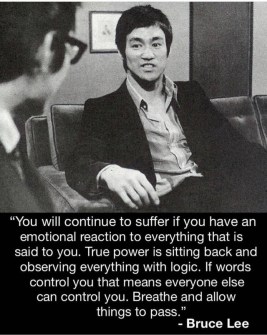
Your ex- knows your buttons.bruce lee quote

The narcissistic and borderline personality seeks vulnerability.  Your buttons make you vulnerable. See what Bruce Lee says.  He’s right.  You know he’s right.  He’s talking about your buttons.

The other parent is implanting button-pushing pathology into your child, and sure enough, guess what happens – the child pushes your buttons and off you go, responding defensively instead of empathically.  Whenever you’re asking the child to understand you, you’re responding from the trauma-triggers, which keeps the garbage in the child.

If you’re a clinical psychologist following along, notice the structure of the pathogen in the role-reversal relationship; a child being used to meet the needs of a parent.  On the one side is the child being used by the narcissistic/(borderline) parent (the pathogen), and this then sets up the other parent to SEEK the child’s nurture (the child’s love and affection); the child meeting the parent’s needs.  On both sides, the child is being asked to meet the emotional needs of the parent.  That’s the pathogen.

Once you see that this is a trauma pathogen and its structure, every detail becomes crystal clear and the pathology is clearly evident.

The solution is empathy for the child.

We have to get the garbage out of the child and straighten out the twisty.  We need a parent to respond non-defensively and guide the child in the child’s self-awareness back into the child’s self-authenticity – NOT into understanding what the pathology is (the child already knows that), that just puts the child smack dab in the middle of the loyalty conflict and the child’s emotional suffering.  Don’t make the child “understand.”

Help the child find self-awareness, and through self-awareness to find self-authenticity.  We need a parent.  We need a guide.  A calm and confident guide for the child’s emotional twisty.

The other parent is not a good parent.  We need you to be a parent to the child.  I know the child is mean to you, and says untrue and hurtful things.  That’s all the garbage from the other parent, trapped in the child.

In my therapy with normal everyday sorts of family conflicts, the child will sometimes tell the parent, “You’re not listening to me” and the parent says, “Yes I am.”

I stop it right there and say, “No you’re not.”  If you had said, “Tell me more about that” you would be listening to the child and what the child just said would then actually be wrong.  You do listen to the child because you just demonstrated it.  Instead, what you said discounted what the child said as being untrue.

This is important… we dispute the child NOT with our words, but through our actions, through what we do.  The child is wrong not because of what we say, but because of what we do.

“I do, I do, I do, I say this, I tell the child that…”  The anxiety again.  That’s the only thing that makes it difficult.  But it does and there’s no way around that.  Trauma solutions are always going to bring anxiety.  That’s just the way of it.  Once you learn anxiety release skills though, it becomes a whole lot easier to just allow and relax and stop spinning.

Better?

See, communication is not the words we say.  In the series: You don’t listen – Yes I do – that’s not listening… that’s disagreeing.  Listening is, “Tell me more about that.”  That’s listening.

You’re a bad parent — No I’m not — Yes you are, you do x and y and z that’s bad — I don’t do those things, you’re exaggerating and making things up. — No, that’s what happened, and you’re a bad parent. — That’s not what happened, I’m not a bad parent, I love you. — You’re a liar, that’s so fake. — That’s not fake, I do love you…

Do you hear any listening?  I don’t.

So, for communication, we need someone listening.  Who shall we ask to do that first? Somebody is going to have to start listening, who’s it going to be?  Shall we ask the child to listen to the parent, or the parent to listen to the child?

Shall we ask that the child listen to the parent?  Is that the directional flow of empathy we want, from the child to the parent?  The child taking care of the parent?  Is that where we should start?

No.  We never start with the child.  Parents are bigger, stronger, and more mature, we need an adult, we need a parent, we start with having the parent understand the child.  I don’t care what the content is, we start with the parent giving empathy to the child.

Is the child’s reality true?  No.  Do we agree with a false reality?  No.  So how do we disagree without becoming defensive?  Yay, wonderful question.  See how, as you relax your anxieties, you find really productive questions.

We solve this with empathy.  What appears to be locked by the trauma pathology, is unlocked by empathy.  We don’t have to convince the child of anything.  We lead with a lamp into their own authenticity.  Awareness brought from our honest and sincere desire to understand the child’s world from the child’s experience.

Do we agree with delusions?  No.  Do we know where they come from?  Yes.  Does the child need to know?  No.  The child simply needs to become re-anchored in reality.  So we need you in reality, not spinning in the trauma pathology of your ex- like the child is.  Your ex- is trapped, the child is trapped.  Don’t you be trapped too.  We need someone who is grounded.

First though, we have to ask the right questions that will lead us through the right door; the door of empathy for the child.  Then we have to get over the anxiety of our own stuff.  Anxiety is the remnant stuff of trauma world, the ripple of trauma.

Next… and here’s where we arrive, we have to identify our own buttons so we can remove them, move them to a different location, disconnect their wires, whatever we have to do so that your ex- can’t find and push your buttons anymore (through the child; your ex is pushing your buttons by manipulating the child to do it).

Yes, I entirely agree, your ex- is manipulating the child in awful ways.  Bad parent.  Stop it.  And… you’re the one with the buttons.  It’d be helpful if you hid those or got rid of them somehow so your ex- can’t find them all the time using the kid.  That we have buttons is normal, that your ex- is manipulating the child to push those buttons… it would be helpful if we altered those buttons so your ex- can’t do that anymore.  That will free you from the trauma pathogen, and then you can free the child.

It doesn’t help the child in quicksand if you jump in too.  Then we just have two people in the quicksand.  Stand on solid ground and hold out your empathy for the child to grab on to.  Use the light from your empathy (your “eyes-of-the-other”) to help bring self-awareness into the discovery of self-authenticity.

Remember, the child is doing what the child must do to survive with the narcissistic/(borderline) parent.  The child didn’t choose this parent.  You chose this parent for the child.  It’s not the child’s fault the child has to cope with this parent.  The child is in a difficult position having to cope with the pathology of their parent surrounding divorce.  Empathy for the child.  We must be able to protect the child before we can ask the child to reveal their self-authenticity.

The kid’s not the kid, you know that.  That’s your ex- pushing your buttons.  Bad ex-, bad parent.  Stop it.  And… they’re your buttons.  If you can remove them, move them, or disconnect them then you can short-circuit the pathology.  Once you’re out of the loop of crazy; Yay, one’s free.  And you can then guide the child out of crazy.

Let me be clear, none of this attachment pathology surrounding divorce is being caused by the targeted parent.  The targeted parent is a target of domestic violence – emotional spousal abuse using the child as a weapon.

Furthermore, in weaponizing the child the allied parent is creating such severe psychopathology in the child that it rises to the level of a confirmed DSM-5 diagnosis of child psychological abuse (V995.51; p. 719).

The family pathology in complex family conflict surrounding divorce is a cross-generational coalition of the child with a narcissistic-borderline parent who is using the child as a weapon against the other spouse-and-parent.  It is the responsibility of professional psychology to fully assess, accurately diagnose, and effectively treat this pathology

It is a trauma pathology.  The trans-generational transmission of trauma.  The ripple of trauma across the generations.

Complex trauma is created by the absence of parental empathy for the child.  It is solved by parental empathy for the child – not for the delusion – empathy for the child.

For therapists, start with some basic human empathy for the targeted parent, the victim of the intimate partner violence.

Craig Childress, Psy.D.
Clinical Psychologist, PSY 18857


AB-PA: The Scientific Method

AB-PA is the scientific method.   Did you know that?  It is.  AB-PA is science.

The pathogen thinks AB-PA (an attachment-based model of “parental alienation”) is a new theory.  That’s because the pathogen is stupid.  It’s a trauma pathogen and trauma is simply pattern, it can’t reason.

The pattern the pathogen is familiar with is Gardner’s PAS, that’s the model that shaped the defensive structures of the pathogen.  Gardner proposed a “new theory” of pathology, Parental Alienation Syndrome.  The pathogen attacked the “new theory” of Gardner’s proposal and the eight unique new symptoms he created for a supposedly unique new form of pathology he called “parental alienation.”  Gardner’s PAS is a new theory; AB-PA is not… AB-PA is diagnosis.

I knew the pathogen would attack any “new theory” proposal, so I simply didn’t propose a new theory.  Instead, I used the standard and established constructs of professional psychology – attachment, personality disorder pathology, family systems therapy, and complex trauma, to work out the explanatory pathway (the diagnosis) for the child’s pathology (a child rejecting a parent following divorce).

It wasn’t all that hard.  It’s just that no one ever seems to have done that before, apply the standard and established constructs and principles of professional psychology to the child’s symptoms of rejecting a parent surrounding divorce.  I have no idea why they haven’t.  Diagnosis is standard of practice, yet no one is diagnosing – everybody is running with this “new theory” proposal of Gardner.

AB-PA is not a “new theory” – it’s diagnosis.  Diagnosis is the application of standard and established constructs and principles to a set of symptoms.  Diagnosis.

Gardner didn’t do that.  He skipped the step of diagnosis – he skipped applying standard and established constructs and principles to a set of symptoms – and instead he took a lazy approach of proposing a “new theory” for a new form of pathology, a pathology that is supposedly unique in all of mental health.  In doing that, Gardner led everyone away from the path of established professional standards of practice for assessment, diagnosis, and treatment, and he led the entire field into the wilderness of “new theory” forms of pathology.

He shouldn’t have done that.  It’s great that he identified the pathology, but he shouldn’t have broken professional standards of practice by proposing a “new theory” – first he should have diagnosed the pathology by applying the standard and established constructs and principles of professional psychology to the set of symptoms.

Establishment psychology tried to tell him, but he wouldn’t listen.  Nor would his followers, the Gardnerian PAS “experts.”  They just don’t listen.  They’re very locked up into being “experts” about something, and apparently it’s too hard to be an expert in something real, like attachment or trauma, because there’s already established experts in those fields.  But if there is a “new pathology” then these Gardnerians have something to be “expert” in – the pathology the think they’re “discovering.”

I didn’t do that.  I listened to the constructive feedback of establishment psychology – which, by the way, I agree with.  Gardner’s 8-symptom PAS model is a horrific model for a pathology.  If a student had submitted Gardner’s PAS to me as a professor, I’d have given it a D-. The only reason it’s not an F is because the student turned in something.  He tried.  So I’d give it only a D-.

If you’re curious as to HOW bad Gardner’s 8-symptom model for a “new theory” of pathology is, I did a video series discussing each of the eight symptoms:

Gardner’s PAS Series

Gardner’s 8-symptom “new theory” of pathology model is simply awful.  That’s why it is “controversial” even after 40 years of using it, and that’s why it doesn’t work to solve the pathology, even after 40 years of using it.  It is NOT a good descriptive or explanatory model for a pathology.

Gardner proposed a “new theory” – I’m not.  AB-PA remains entirely within established constructs and principles that are fully supported by mountains and mountains of scientific evidence – attachment, personality pathology, family systems therapy, complex trauma.

AB-PA is not “new theory” – it’s diagnosis.  But the pathogen doesn’t recognize that, because it’s stupid as sin.  That’s because the trauma pathogen neurologically inhibits frontal lobe executive function systems – the logic and reasoning systems of the brain… trauma doesn’t think, it repeats patterns.

AB-PA is also science.  In science, an explanatory model (like AB-PA) makes a prediction which is testable – provable or disprovable – by the evidence.  Then the evidence is collected.  If the prediction is confirmed by the evidence, then the explanatory model that made the prediction is confirmed.  That’s called the scientific method for proving something:

Make a prediction – collect the evidence – and see if the prediction is confirmed.

AB-PA is grounded in the scientific method.  It’s science.  AB-PA makes a prediction – three impossible symptoms will be present in the child’s symptom display.  Now we simply need to collect the evidence and see if the evidence supports the prediction.

Did you know that all three diagnostic indicator symptoms of AB-PA are impossible?  They are.  All three symptoms of AB-PA are impossible.  They never show up anywhere – ever.  They are all impossible symptoms.

The expected prevalence for Diagnostic Indicator 1 (attachment system suppression toward a normal-range parent) is zero.  We never see this.  Maybe sometimes we see attachment suppression toward a severely abusive parent – but a severely abusive parent is NOT normal-range.  We never see a child’s attachment bonding suppression toward a normal-range parent.  There is no pathway by which that could occur.  Bad parenting creates an insecure attachment, never a suppression of the attachment system.

There is no explanatory path for Diagnostic Indicator 1… it is an impossible symptom… it never happens… and yet the AB-PA explanatory diagnostic model predicts that this – impossible symptom – will be present in the child’s symptom display.  So… is it?

Let’s play scientists and test the prediction… is Diagnostic Indicator 1, a suppression of the child’s attachment system toward a normal-range parent, is that predicted symptom present, absent, or somewhat present in the child’s symptom display?

Scientific method.  AB-PA makes prediction.  Test it.  Is the predicted symptom present, absent, or somewhat present?

Prevalence rates for Diagnostic Indicator 1 in the general population are zero.  It is an impossible symptom.  And yet, it is the symptom predicted by an AB-PA explanatory model for the pathology.

Diagnostic Indicator 2 – the five narcissistic personality traits – is also a provable or disprovable prediction from AB-PA, and a narcissistic personality disorder is also impossible in a child.  We would never expect to see five narcissistic personality traits in a child’s symptom display because a narcissistic personality disorder in a child is not possible.

In the general population, the prevalence of children with five narcissistic personality disorder traits is zero.  We will never find that.

Yet… AB-PA predicts this impossible symptom.  This prediction of the AB-PA explanatory model is ALSO testable by the evidence.  Are these five narcissistic symptoms present, absent, or somewhat present in the child’s symptom display?  Simple.  We would expect the answer to be no in 100% of cases, because five narcissistic personality disorder symptoms in a child’s symptom display is impossible.  It never happens.

So then, let’s look.  Are they present?  Because if they are, that is proof – empirical evidence – for the explanatory model that predicted exactly this set of impossible symptoms.

And then, there’s Diagnostic Indicator 3; the trauma reenactment symptom of the child’s persecutory delusion toward a normal-range parent.  There is absolutely no pathway to a normal-range parent creating a persecutory delusion in the child.  Can’t happen.  It is an impossible symptom, we never-ever see it, it never happens.

In the general population, the prevalence of child persecutory delusions toward a normal-range parent is zero.  It never happens because it is an impossibility.

And yet… AB-PA is predicting exactly this impossible symptom. And not just one impossible symptom… AB-PA is predicting THREE impossible symptoms – that never occur – they are impossible.  The expected prevalence in the general population for any of these predicted child symptoms is zero.

So, let’s test the predictions of AB-PA with the evidence.  Are these three symptoms present, absent, or somewhat present in the child’s symptom display.

Aren’t you curious what we’ll find?  I know, I am too.  It’s called scientific curiosity.  Isn’t it wonderfully exciting, science.  We make a prediction, then we test it with empirical evidence… empirical means we look to see if something’s there, and document it if it is.  I love science.

If AB-PA is wrong – then none of these symptoms will be present because no other pathology in all of mental health produces these predicted symptoms – they are impossible symptoms.  So… let’s put AB-PA to the test – the scientific method.

Are the predicted symptoms of AB-PA present?  That is so simple to test. If people say they want proof of AB-PA, okay… let’s put AB-PA to scientific proof… are these three impossible symptoms that are predicted by AB-PA present or absent in the child’s symptom display?

If AB-PA is not true as an explanatory model, then the three predicted impossible symptoms won’t be present, and since each of the three symptoms is actually impossible, that’s what we would expect… that none of the three symptoms will be present in the child’s symptom display.

It’s called the scientific method.  An explanatory model (AB-PA) makes a testable prediction that is provable or disprovable by the evidence.  Then the evidence is collected, and the explanatory model is proved or disproved.

So.  Collect the evidence:

Diagnostic Checklist for Pathogenic Parenting
http://www.drcachildress.org/asp/admin/getFile.asp…

It’s called science.  If someone doesn’t think AB-PA is true as an explanatory model of the pathology – conduct the experiment for yourself.  Are the three impossible symptoms of AB-PA present or not?  Simple proof or disproof.  Check, check, check – yes, no, somewhat.

If the predicted symptoms aren’t there – which they shouldn’t be – we would expect them to not be there in 100% of cases because they are all impossible symptoms – then AB-PA is wrong.

If… on the other hand… the three symptoms predicted by AB-PA are present… then this proves the explanatory model that predicted them.

It is called the scientific method.  Make a prediction.  Collect the data to prove or disprove the prediction.

If these three symptoms ARE present in the child’s symptom display… then they have to be explained.  How did the child develop these three specific symptoms, each of which is impossible? 

There is no other explanatory path to these three symptoms other than AB-PA – which PREDICTS exactly these three – impossible – symptoms.  Try it.  Try to explain the presence of all three of these diagnostic indicator symptoms; how did the child acquire all three of these symptoms?  See.  There is only one explanation, AB-PA, which not only explains the presence of all three impossible symptoms, AB-PA predicts them.

So for anyone who doubts that AB-PA is true… try it.  Do the experiment for yourself.  Collect the data to prove or disprove AB-PA.  If AB-PA is not true, that’s easy enough to prove… none of the three impossible symptoms will be present; and since they are all three impossible, that’s what we would expect.  The prevalence rate for impossible is zero, so none of these three symptoms should be present in the evidence – in the child’s symptoms.

If… on the other hand… these symptoms ARE present… then they require an explanation for how these impossible symptoms… are possible… because you have confirmed the evidence for their existence – the child has exactly the three symptoms predicted by AB-PA.

There is only one explanation.  It’s proven by the scientific method.  The explanatory model makes a prediction that can be proven or disproven based on the evidence.  So… collect the evidence for yourself.  Do the experiment.  Are these three predicted symptoms present or not?

Isn’t it fun being a scientist, it’s so exciting.

For the critics of AB-PA who don’t think it’s true… my goodness, it’s easy-peasy to disprove AB-PA as an explanatory model for the child’s pathology, the three predicted and impossible symptoms WON’T be present.  Easy as pie to disprove AB-PA.  Let’s give it a try, let’s do the experiment.  Are these three symptoms present – yes or no.

It’s called the scientific method.  Science is a good thing.

Craig Childress, Psy.D.
Clinical Psychologist, PSY 18857

Director of Psychological Services,
Conscious Co-Parenting Institute;
Custody Resolution Method

The Legal Argument Package

Forensic psychology gives parents and the courts only one legal argument option, and it seeks its particular goal by marshaling a particular set of evidence to present to the court in favor of that goal.

The goal of the legal argument package from forensic psychology is to obtain a court order for a reversal of custody away from the allied and “favored” parent, over to the targeted and rejected parent, and the evidence to support this desired reversal-of-custody court order is through proving, at trial, to a judge, that “parental alienation” is the cause of the child’s rejection of the targeted parent.

Up until recently, this forensic psychology legal argument approach has been the ONLY option available for parents and for the court.

Things have changed.

Parents and the court now have two separate legal argument packages, seeking different orders from the court, and there are now three separate approaches for marshaling evidence in support of the sought-for court orders.

The Forensic Psychology Legal Argument

This is the standard legal argument approach used for the past 40 years.  It seeks to prove “parental alienation” at trial and it asks for the remedy of a change in custody.  Since it seeks a change in custody, this legal argument package leads directly to a child custody evaluation.

The parents and children then present their “evidence” to the child custody evaluator who makes an arbitrary decision as to whether “parental alienation” is present based on vague criteria arbitrarily applied.  Typically, the evaluator reports a mix of “parental alienation” and “estrangement” (both made up constructs without clear definition).  Rarely (almost never) will the evaluator recommend a reversal of custody based on an opinion of “parental alienation.”

Occasionally, after years of fighting in court, a second or even third custody evaluation may find that the “alienation” is so severe that the evaluator is compelled to recommend a reversal of custody – but this is rare, and this point is typically reached only in the most severe cases.

The forensic psychology legal argument is built around proving “parental alienation” in court through an extended court trial.  This is an exceedingly expensive and long process, usually requiring years of “high-conflict” litigation, with each parent trying to prove the other parent is unfit, creating even more spousal hostility and further entrenching “sides” in the family conflict.  This process is NOT supportive of a successful family transition to a healthy post-divorce separated family of collaborative co-parenting. 

This forensic psychology legal argument package is seeking to identify and prove complex family pathology to a legal professional, the judge, by rules of evidence in a court trial.  The forensic psychology approach is seeking a court-solution to family pathology.  This is the wrong system for solution.  The diagnosis of pathology is not through trial in the legal system, the diagnosis of pathology is through the principles and practices of clinical psychology.

In the forensic option, the entire time the legal conflict drags on the child is either actively caught in the middle of the spousal conflict, or the child is in the sole custody and entirely under the influence of the pathogenic allied parent who is creating the severe psychopathology in the child, who is creating severe suffering and grief for the targeted parent (which is the purpose of weaponizing the child into the divorce), and who is irrevocably damaging the child’s emotional and psychological development – the lost years of childhood cannot be recovered.  Childhood once gone is lost.  Years of severe family conflict and lost parent-child love are extremely damaging to the child, yet that is the requirement imposed by the forensic psychology solution.

The goal of the forensic psychology legal argument package is a reversal of custody because of “parental alienation.”  

Gardnerian Caused Confusion:  The Gardnerian “experts” are seeking to sow confusion by co-opting the term “protective separation” from the AB-PA legal argument package and applying it to the “parental alienation” legal argument package as the supposed remedy – but it doesn’t apply when transferred across diagnostic models, they know it, and they are deceiving parents by using the term “protective separation” for the Gardnerian “parental alienation” legal argument package.  They are doing this intentionally to sow confusion among parents and attorneys between the two legal argument approaches.

Explanation:  The three diagnostic indicators of AB-PA, an attachment-based model for the family pathology, results in a confirmed DSM-5 diagnosis of V995.51 Child Psychological Abuse.  It is this confirmed DSM-5 diagnosis of Child Psychological Abuse that represents the legal and mental health argument justification for a protective separation period (a protective separation from the abusive parent is the standard of practice response to a DSM-5 diagnosis of child abuse – to protect the child from child abuse – a protective separation).

The Gardnerian Lie:  The identification of Gardnerian “parental alienation” does NOT lead to a DSM-5 diagnosis of V995.51 Child Psychological Abuse.  The Gardnerian PAS “experts” wish it would, but diagnostically, it doesn’t.  They know this.

However, the Gardnerian “experts” are feeding on the vulnerability and lack of knowledge of targeted parents to sow confusion and prevent solution, because the moment parents start using a non “parental alienation” legal argument (an apporach other than proving “parental alienation” in court trial), then these “parental alienation” “experts” cease to be “experts” – because they are not actually real experts in any real forms of pathology, like attachment, or personality disorders, or complex trauma.  So they make up a “new form of pathology” so they can pretend to be “experts” in something.

The protective separation construct does NOT apply to the construct of “parental alienation” – the “parental alienation” legal argument package seeks a reversal of custody; not a protective separation. 

The Gardnerian “experts” know this, they are simply being obstructionists by sowing confusion – intentionally – to delay parents from recovering their children so that these “experts” can remain “experts” in their supposedly new form of pathology.

Thousands of children and families will be hurt, families will be destroyed, and parent-child bonds will be lost because of the confusion that is intentionally being sown by the Gardnerian “experts” regarding the protective separation construct – it doesn’t apply to the Gardnerian 8-symptom “parental alienation” diagnostic model – before we will be able to clarify for parents their multiple options. 

But the Gardnerian “experts” (led by Bill Bernet, Karen Woodall, and several others) will continue to sow confusion and seek to obstruct any solution that does not make them an “expert.”  So the confusion they are generating is simply a fact that we must overcome.  That’s up to parents and attorneys.  It’s your choice which legal argument package you pursue.

Forensic Package:  Proving “parental alienation”

Since the forensic legal argument package of proving “parental alienation” is a court-driven solution, it requires targeted parents to collect and present the proof of “parental alienation” to the court (step one) to then ask for the remedy of a court-ordered reversal of custody (step 2).

The forensic psychology approach (the one used for the past 40 years without success and which continues to be the approach advocated by the Gardnerian PAS “experts”) requires convincing the court of three things (all three):

1) That “parental alienation” exists as a pathology;

2)  That “parental alienation” is occurring in this family and is responsible for the child’s rejection of the targeted parent (as opposed to the bad parenting of the targeted parent);

3)  Then – after proving the first two – the next level of proof required of the targeted parent will be to convince the judge that the remedy for the parent-child conflict is a reversal of custody in which the targeted parent is given sole custody while contact with the currently “favored” parent is blocked.

So there are multiple significant barriers of legal proof required – all for a normal parent simply to love the child.

So far, in the 40 years this legal argument package has been used, it is rarely successful.  And it is the only option offered through the “parental alienation” forensic legal argument package. 

Since the “parental alienation” legal argument package seeks a reversal of custody, it will lead directly to a child custody evaluation since ONLY a child custody evaluator is permitted to talk about child custody and visitation schedules (clinical psychologists will lose our license if we discuss custody and visitation; that’s a bad thing that needs to stop because it is silencing your advocates and it isolates you from clinical psychology and professional knowledge.  Clinical psychology refuses to work with your children and families because our license is threatened by forensic psychology if we do; “I don’t work with high-conflict divorce” is the statement you will hear from clinical psychology).

Only forensic psychology is allowed to render an opinion about custody and visitation issues, and only after having conducted a six to nine-month set of procedures costing between $20,000 to $40,000.  Can you see the financial conflict of interest in this?  It’s pretty blatant.  Forensic psychology is feeding off of vulnerable parents purely for financial gain, and they are preventing any sort of competition from clinical psychology or escape of parents to clinical psychology by threatening the license of clinical psychologists if we express an opinion about custody and visitation.

The Forensic Child Custody Evaluation

A child custody evaluation answers the referral question: What should the child’s custody and visitation schedule be? 

The targeted parent using this approach is seeking to prove “parental alienation” as the justification for a reversal of custody.  The targeted parent is hoping the custody evaluator will “see” the alienation and will make a recommendation for a reversal of custody over to the targeted parent.  Meanwhile, the child and allied parent put on their display for the custody evaluator hoping the evaluator will side with them in seeing the targeted parent as a “bad parent” who “deserves” to be rejected for past parental failures.

The targeted parent is put on the defensive by this process and must prove a negative; that their parenting is NOT “abusive.” So the whole child custody evaluation becomes a procedure to evaluate if the targeted parent is “abusive” and “deserves” to be rejected – with minimal vague attention given to the “parental alienation” concerns of the targeted parent.

There is no inter-rater reliability to child custody evaluations, meaning that two different evaluators can reach entirely different conclusions and recommendations based on the exactly the same data – which means that the results and recommendations from a child custody evaluation are entirely arbitrary and completely dependent on the attitudes, beliefs, and biases of the evaluator – including any personal mommy-issues or daddy-issues, cultural biases, and gender biases the evaluator may bring to the evaluation process from the evaluator’s own family of origin.

No standard constructs and principles of professional psychology are applied to the data of a child custody evaluation.  The conclusions and recommendations are entirely the sole arbitrary opinion of one person – the evaluator.  And, in my review of child custody evaluations as an expert consultant in these legal cases, the conclusions and recommendations from child custody evaluations are almost always wrong.

The forensic custody evaluation industry is a corrupt exploitation of families.  Forensic child custody evaluators are exploiting vulnerable families to financially feed off of these families… $20,000 to $40,000 per evaluation – with no oversight or review of their work for accuracy, knowing that child custody evaluations lack validity.  An assessment procedure cannot be valid if it is not reliable; child custody evaluations have zero inter-rater reliability – the conclusions and recommendations of custody evaluations cannot possibly be valid – that is an established psychometric fact.  The conclusions and recommendations of child custody evaluations are not valid, they are simply the opinions of one person.

The child custody evaluation industry is corrupt at its core, it exploits vulnerable families for obscene financial gouging, a trough to feed, and forensic child custody evaluations are in violation of the APA ethics code, Principle D: Justice.

Custody Evaluation Violation of Principle D: Justice

The conclusions reached by a typical child custody evaluation will usually find a mix of some “alienating behaviors” by the allied parent and some “estrangement” caused by the targeted parent.  Both of these terms are made-up constructs in forensic psychology with no actual grounding in any real forms of pathology.

The typical recommendations from child custody evaluations are to make the current de-facto sole custody of the allied parent (created by the child’s refusal to comply with court-ordered visitation) into the permanent custody arrangement, with “reunification therapy” recommended to fix the child’s relationship with the targeted parent.

A form of therapy called “reunification therapy” does not exist.  The court and all clients should ask for a reference book citation to the type of therapy that is being used by the therapist.  There is no book or article that has ever described a form a therapy called “reunification therapy.”  It doesn’t exist.  Like many things in forensic psychology, the forensic psychology mental health people are simply making stuff up.

Reunification therapy (it doesn’t exist) has no impact because the therapist is just making up what they are doing without any grounding in actual forms of psychotherapy.  After a year to two years of failed therapy, a second “update” child custody evaluation will typically be ordered (if the targeted parent’s financial resources have not been entirely depleted).  This second evaluation will take another six months to complete and cost another $10,000 to $20,000. This second evaluation may sometimes now assert that “parental alienation” is occurring (after approximately three years of the child refusing contact with the targeted parent and two years of failed “reunification therapy”) and may – may – recommend a change in custody.

However, some second (or third) “update” child custody evaluations will say that the child’s supposedly “bonded relationship” to the allied and “favored” parent is so extensive and is for so long (since the divorce), that it would be “traumatic” to the child to reverse custody now – even though severe parental alienation has been identified as the cause of the child’s rejection of the targeted parent.  So even in cases of severe “parental alienation,” the recommendations (remedy) from the custody evaluation are not always assured.  They simply make stuff up.  I’ve read their reports.

The recommendations of the custody evaluator are at the sole discretion of this one person – the evaluator – who is not required to know or apply standard information from attachment, family systems therapy, personality disorder pathology, or complex trauma, nor even the DSM diagnostic system of the American Psychiatric Association.  The forensic child custody evaluators believe that they are exempt from applying any of this knowledge to their evaluation – they just decide based on personal ideas and biases.

If the child custody evaluation does not result in the decision sought by the targeted parent, then overturning this child custody evaluation decision becomes an additional burden placed on the targeted parent.

Proving “parental alienation” using a child custody evaluation will usually require an attorney and a long trial.  Trial and attorney’s fees will be exceedingly expensive, and the outcome of obtaining a reversal of custody is only seldom achieved, and only in the most severe and egregious cases of “parental alienation.”

This is the only option that has been available to parents and the courts for the past 40 years.  This legal argument package and approach has been used extensively for 40 years with only occasional success in restoring the child’s bonded relationship with the targeted-rejected parent.  This is the approach recommended by the Gardnerian “experts” who will be more than happy to take your money to testify at trial to prove “parental alienation” – because they’re “experts” – they say so, so it must be true, right?

There are now alternatives.  Alternative legal arguments, alternative goals, and alternative paths to solution.

The Clinical Psychology Legal Argument Package

An alternative approach comes from clinical psychology and involves a treatment focused clinical psychology assessment of the family conflict, to identify the treatment needs of the family for solution.

A clinical psychology assessment answers the referral question:

Clinical Psychology Referral Question: Which parent is the source of pathogenic parenting creating the child’s attachment pathology (rejection of a parent), and what are the treatment implications?

A clinical psychology assessment and diagnosis of pathology can typically be accomplished in around six sessions for a cost of about $2,500.  If desired, the more limited scope and focused nature of clinical psychology assessments of pathology allows for second opinions using the same symptom identification and documentation.

The goal of the clinical psychology legal argument package is to obtain a court order for an appropriate – trauma-informed – clinical psychology assessment of the family conflict, in order to answer the referral question of which parent is creating the child’s attachment pathology, and what are the treatment implications?

Makes sense, right?  There is conflict in the family, each parent is claiming the other parent is responsible, the child is displaying attachment bonding pathology (rejecting a parent) – let’s get a clinical psychology assessment and workup, which parent is causing the child’s attachment pathology, and what are the treatment implications?

That is the legal argument.  Obtaining a trauma-informed clinical psychology assessment of the family conflict is the goal of the clinical psychology legal argument package.

A clinical psychology assessment of pathology documents symptoms, and then applies the standard and established constructs from established domains of professional psychology – attachment pathology – family systems therapy – complex trauma – personality pathology – to the child and family symptoms in a structured, consistent, and standardized way to diagnose pathology.

A clinical psychology assessment of attachment-related family pathology (a child rejecting a parent) can reliably identify which parent is creating the child’s pathology and can identify the treatment implications using the standard and established knowledge of professional psychology (attachment, family systems therapy, personality pathology, complex trauma).

Child Abuse Diagnosis

If the pathogenic parenting of the allied parent is creating significant psychopathology in the child (such as severe developmental pathology, severe personality pathology in the child, or severe psychiatric pathology in the child), then the degree of pathogenic parenting may rise to the level of a confirmed DSM-5 diagnosis of V995.51 Child Psychological Abuse.

If this is the case, then the assessing mental health professional will make a DSM-5 diagnosis of Child Psychological Abuse – consistent with this mental health professional’s duty to protect.  The standard of practice in clinical psychology is to always provide a DSM-5 diagnosis in all cases, and this becomes an especially prominent professional responsibility surrounding the DSM-5 diagnosis of child abuse.

If child abuse is present, the assessing mental health professional who is conducting a clinical psychology assessment will diagnose child abuse.

If a mental health professional makes a confirmed DSM-5 diagnosis of V995.51 Child Psychological Abuse, this diagnosis serves as the professional and legal justification for a protective separation period to 1) protect the child, and 2) allow treatment and recovery of the child from the psychological and emotional damage caused by the abuse. 

Once the child’s healthy development is recovered and stabilized, the pathogenic parenting of the abusive parent can be reintroduced with sufficient safeguards to ensure that the psychological abuse of the child does not resume once contact with the abusive parent is restored.

It is a confirmed DSM-5 diagnosis made by a mental health professional that provides the legal and mental health justification for a limited protective separation period.

It is important to be clear on the distinction of the two approaches.  The protective separation is based on a confirmed DSM-5 diagnosis of Child Psychological Abuse.  If there is a question about this diagnosis, a second opinion can be sought (six sessions; structured data collection and documentation).

This is how diagnosis works.  Document the symptoms.  Apply the diagnostic criteria.  If there is dispute, seek a second opinion that documents the symptoms and applies the diagnostic criteria.

A clinical psychology assessment is NOT assessing for “parental alienation” – the construct of “parental alienation” does NOT exist in clinical psychology.  In clinical psychology, the construct most people are calling “parental alienation” represents a combination of standard family systems constructs: a cross-generational coalition and an emotional cutoff (Bowen; Minuchin; Haley; Madanes).

Clinical Psychology Definition:  The child is being triangulated into the spousal conflict through the formation of a cross-generational coalition of the child with the allied parent against the targeted parent, that is resulting in an emotional cutoff in the child’s relationship with the targeted parent.

The goal of the Clinical Psychology legal argument package is to obtain a proper, trauma-informed, clinical psychology assessment of the family conflict – with its treatment implications.  The goal is to identify the treatment needs of the family.

Different Legal Argument Goals

The forensic psychology legal argument package of “parental alienation” seeks an entirely different goal from the clinical psychology legal argument package.

The forensic psychology legal argument package seeks to prove “parental alienation” in court in order to obtain a court order for a reversal of custody – giving physical custody to the targeted parent and restricting contact with allied and “favored” parent – by proving “parental alienation” to a judge in trial, and then also proving to this judge that a reversal of custody is the only possible remedy.

The clinical psychology legal argument package of psychological child abuse (AB-PA) seeks a court order for a limited-scope trauma informed clinical psychology assessment of the family’s conflict.  If a confirmed DSM-5 diagnosis of V995.51 Child Psychological Abuse is made by the assessing mental health professional, then the issue becomes one of child protection.

The clinical psychology legal argument package moves the assessment and diagnosis of pathology out of the courtroom and returns the diagnosis of pathology to clinical psychology – and to the professional standards of practice in clinical psychology for symptom documentation and the application of scientifically grounded psychological constructs and principles to the symptom data – attachment – family systems therapy – personality pathology – complex trauma.

The goal of the clinical psychology legal argument package is NOT to prove anything in court trial.  It is not to prove who is the better parent and which parent “deserves” the child.  The goal of a clinical psychology assessment is to diagnose pathology in order to identify the treatment needs of the family.  The goal is the resolution of pathology and the creation of healthy, affectionate, and bonded relationships across the family (parent-child, aunts, uncles, grandparents, on both sides of the family) – a healthy family… that’s the goal of clinical psychology.

The child refusing custody visitation with a parent following divorce is not a legal-custody issue, it is a psychopathology-treatment issue.  The first step to a solution is to diagnose the source of the child’s symptom display.  This is accomplished through a proper trauma-informed assessment of the family relationships.

Custody Resolution Method

The Custody Resolution Method from Dorcy Pruter is a method for compiling data from emails, texts, written reports, declarations, and documents based on structured categories of symptom features.  This data compilation of large data sets produces a summary data profile of frequencies for the categories of interest.

The Custody Resolution Method (CRM) simply compiles and organizes large amounts of documented data into easily recognized categories, revealing the patterns in the data.

These compiled CRM data profiles are then further tagged by an independent psychologist consultant to CRM for issues of psychological concern evidenced in the data profile and data set, and a consultant’s report on the compiled data is provided to CRM.  The compiled data profiles and data analysis is then provided by CRM to the attorney-client and parent-client, who can then provide this data summary to the court in support of the legal argument package being sought.

These compiled data profiles from the mountains of emails, OFW, texts, letters, documents, declarations, mental health reports, etc. can be used by the client-attorney and client-parent of CRM to support the clinical psychology argument package being presented to the court by the attorney and parent; that a treatment focused clinical psychology assessment is warranted and needed.

The CRM compiled data profiles and consultant psychologist’s report on the compiled data can also be used to support the DSM-5 diagnosis of Child Psychological Abuse made by a mental health professional, or can be used to challenge the absence of a Child Psychological Abuse diagnosis that was NOT made by a mental health professional.

Data is data, and data speaks.  CRM is simply what the data says, it is simply a procedure (data tagging of “archival data”) for compiling large data sets into organized categories for ease in understanding and interpretation.

Before data compilation into categories, the  voice of data is masked in chaos.  Compiling the data into frequencies for pre-specified and pre-defined categories brings clarity to the voice of data from out of the chaos.  Data speaks.  The scientifically based data compilation procedures of the Custody Resolution Method bring clarity to the data for all to see.  It’s simply what the data says, and for court, it’s evidence.

Dr. Childress:  Director of Psychological Services; CRM

Dr. Childress is the Director of Psychological Services for the Conscious Co-Parenting Institute; Custody Resolution Method.  My role with the Custody Resolution Method is to provide leadership and professional protocols for a team of six to eight independent consultant psychologists for the Custody Resolution Method data profiles.  I will be the psychology interface between these independent psychologist consultants and the client, Dorcy Pruter and the Custody Resolution Method.

My role is to develop the professional protocols for psychology tagging of the data and the structure for the professional consultant’s reports generated for the client, the Conscious Co-Parenting Institute; CRM.  As the Director of Psychological Services for CRM, I will co-sign all consultant reports, so if there is testimony required about any aspect of CRM or the reports generated, as Director of Psychological Services for CRM Dr. Childress will be available to provide that testimony support.

If one of the consulting psychologists wants to gain experience in court testimony for their own professional development, they can ask to testify in support of their reports and I will provide whatever mentorship support they wish regarding the procedures of court testimony for a clinical psychologist.  I will also be providing training seminars for the consulting team of psychologists in attachment pathology, family systems therapy, personality disorder pathology, and complex trauma.

The goal of CRM is not to “win” a court battle – it’s to make “winning” unnecessary because everyone has reached stipulated agreements for a clinical psychology solution to the family conflict.  It’s about finding solutions that work.

The goal of clinical psychology and CRM is to reach collaborative agreements that keep the family OUT of court.

And also,… if court involvement is needed (which is often probable with parental narcissistic and borderline pathology), then the goal of CRM and clinical psychology is to provide the court with reliable, valid, and documented evidence that leads quickly out of the court system and returns the family to a defined (written) treatment plan from clinical psychology… treatment that solves the family conflict pathology for the child.

Options: Forensic or Clinical Psychology

There are now two main paths, and three options.  The primary choice is which legal argument package the attorney and parent choose to present to the court:

1.)  The Forensic Psychology legal argument package seeks to prove “parental alienation” at trial, with the ultimate goal of obtaining court orders for a reversal of custody to the targeted-rejected parent.

2.)  The Clinical Psychology legal argument package seeks a court order for a limited-scope, trauma-informed assessment from clinical psychology to answer the referral question:

Referral Question: Which parent is the source of pathogenic parenting creating the child’s attachment pathology, and what are the treatment implications?

The Custody Resolution Method offers a third alternative that simply allows the data to speak for itself, a neutral compiling of all documented data for presentation.  These CRM data profile reports will contain input on solutions from professional psychology, with the goal of supporting a healthy separated family of shared love and bonding following divorce.

Craig Childress, Psy.D.
Clinical Psychologist, PSY 18857

Director of Psychological Services
CCPI; Custody Resolution Method


Standards

To my professional colleagues in forensic psychology, I have this statement from clinical psychology.


Cardiologist: If you go to a cardiologist for the diagnosis and treatment of your heart problems, the cardiologist is expected to know everything there is to know about heart disease – everything – and then to stay current on developments by reading professional journals.

Oncologist: If you go to an oncologist for the diagnosis and treatment of your cancer, the oncologist is expected to know everything – everything – there is to know about the diagnosis and treatment of cancer, and then to remain current on developments by reading professional journals.

Clinical Psychologist: In clinical psychology, if we work with attachment pathology we are expected to know everything – everything – about the attachment system, and then we remain current on developments by reading professional journals.

Clinical Psychologist: A clinical psychologist working with trauma pathology is expected to know everything – everything – about trauma, its diagnosis and treatment, and then to remain current on developments through professional journals.

Clinical Psychologist: In clinical psychology, if we work with personality disorder pathology we are expected to know everything there is to know about personality disorders, their origins, diagnosis, and treatment, and then we remain current on developments through professional journals.

Clinical Psychologist: In clinical psychology, if we conduct family therapy we are expected to know everything – everything – about family therapy, then we remain current on developments through seminars and by reading professional journals.

To my professional colleagues in forensic psychology, I would assert that these same standards of practice apply to you; that your client is court-involved is not relevant.  These standards of professional practice still apply to you.

To my colleagues in forensic psychology… if you think these standards of professional practice don’t apply to you because you are somehow “special” and “exempt” from standards of professional practice, please explain why that is.  Why is forensic psychology exempt from standards for knowledge?

Because if you are not exempt from standards of professional practice for knowledge and competency, then you have a lot of reading to do.

Primary Literature:

Bowlby: attachment
Ainsworth: attachment
Research on attachment
Minuchin: family systems
Bowen: family systems
Haley: family systems
Madanes: family systems
Satir: family systems
Kernberg: personality disorders
Beck: personality disorders
Millon: personality disorders
Linehan: personality disorders
van der Kolk: trauma (complex)
Perry: childhood trauma
Briere: childhood trauma
Fonagy: parent-child relationship
Stern: parent-child relationship
Tronick: parent-child relationship

That is the primary literature every forensic psychologist should know. 

If not, why not?  To my professional colleagues in forensic psychology… tell us why you are exempt from knowledge?

Dr. Childress knows all of that.  Is it too much knowledge?  Is it too hard for you?  Do you think you don’t need knowledge to do what you do?  Does it require too much effort and you’re simply too lazy?  Tell us why you are exempt from knowledge because you are a “forensic psychologist”?

Because if you are not exempt from knowledge as a standard of professional practice, then you have a lot of reading to do… quickly.  Because your client, the one you’re seeing next week, needs you to know all of that before your next appointment.

Those are called standards of professional practice.  Welcome to the world of clinical psychology.

Craig Childress, Psy.D.
Clinical Psychologist, PSY 18857

Child Abuse is Serious

So I’ve told you of the power of diagnosis.  Let me begin to reveal its power.

I’m a licensed clinical psychologist – a legally authorized pathology giver, and I’ve given your children a pathology:

DSM-5 V995.51 Child Psychological Abuse, Confirmed (pathogenic parenting).

Now when a pathology giver gives someone a pathology, the person has it.  I’m a pathology giver, I’ve given your child the pathology of child abuse.

The question now becomes… why isn’t everyone else giving your child the DSM-5 diagnosis of Child Psychological Abuse?

Either I’m wrong, or they are.

If other mental health providers are NOT diagnosing your children with DSM-5 V995.51 Child Psychological Abuse, Confirmed (pathogenic parenting)…

…why not?

I’m diagnosing Child Psychological Abuse, they’re not.  One of us is wrong.

If they’re wrong…

If they’re wrong, that is really bad for them, because then they are failing in their duty to protect… and you can sue them.

Look it up, it’s a legal case… Tarasoff.  Failure in the duty to protect.

In Tarasoff, it’s a failure in the duty to protect because the therapist did not warn a potential victim of the danger posed to them by the client, and most people think of this as a “duty to warn” case.  It is.  But the duty to warn the victim is based on the more fundamental obligation – the duty to protect.

In the Tarasoff case, the therapist failed in their duty to protect by not warning the potential victim.  It’s a failure in the duty to protect.

Well, that would be you too.  Therapists, all therapists, have a duty to protect.

Your child is being psychologically abused.  That is a fact.  How do we know that is a fact.  Because I said so.

It’s a fact because Dr. Childress said so.

But Dr. Childress, you’re just one person. Don’t other people need to agree with you?

No.  I’m a licensed clinical psychologist.  It is V995.51 Child Psychological Abuse… because that is my diagnosis.

I am not on the defensive.  They are.  I’ve made a diagnosis, why aren’t they?

I have diagnosed the pathology.  The moment I give a person their pathology, that’s truth.  I have defined reality with my diagnosis.  The child did not have ADHD when the child entered my office.  When the child leaves my office the child has ADHD.  Because I said so.

That… is the power of diagnosis.

I’ve said your children have V995.51 Child Psychological Abuse, Confirmed.

Anyone, any mental health professional who is involved with one of your children who does NOT make a DSM-5 diagnosis of V995.51 Child Psychological Abuse Confirmed, (pathogenic parenting) is failing in their duty to protect.

Remember Tarasoff?  That’s not a good thing, to fail in one’s duty to protect the client.  As a licensed mental health person, you can get in a lot of trouble if you fail in your duty to protect.

If your client says they are suicidal and you don’t do a risk assessment with the client, you’ve failed in your duty to protect.  When the patient’s family sues you because you failed to protect your client, they’re going to subpoena your charts.  You better have documentation that you did a suicide assessment with the client, or you could be in big trouble.

You failed to protect your suicidal client by not doing a proper risk assessment. There’s all sorts of questions you’re supposed to ask a suicidal patient to assess their risk; if there is a plan; what means would they use; past attempts; family history; alcohol and drugs…

I spend one whole class session in my Assessment and Treatment Planning class for graduate students covering risk assessment for suicide.  We have a duty to protect.  It is taken very seriously.

I’ve given your children V995.51 Child Psychological Abuse, Confirmed (pathogenic parenting).  They have it, child abuse.  You’re children are now being psychologically abused… because I say so, and I’m a legally authorized pathology giver.

But Wait

Oh… but wait… you still have to get the child’s shadow, their pathology, attached to them… because I’m only allowed to give someone their pathology in person.

In a recent case, the parent got a court order for me to personally do a trauma-informed six-session clinical psychology assessment of the family.  I gave the child a DSM-5 diagnosis of V995.51, Child Psychological Abuse, Confirmed (pathogenic parenting).  I testified to that.  So, in that case, the child now has confirmed psychological child abuse… because I saw them in person.  

That is now reality.  I personally attached the shadow in that case

But in your case… you’re going to need a local mental health professional to attach the child’s shadow, their pathology.

So you’ll have to get the child’s shadow attached… but now, look what happens…

Sewing Shadows

All of you are going to start asking mental health professionals to confirm… confirm… the pathology I have given you, just like you are asking a different trauma-ish psychologist to confirm your diagnosis of PTSD (complex trauma; traumatic grief). Just like for that, you need a trauma-informed assessment of your children and families…

…to confirm or dis-confirm the diagnosis of V995.51 Child Psychological Abuse.

After all, if there is any concern about possible child abuse… we should at least look, right?  At least look.

At first, they’re going to say, “The child is bonded to the allied parent, that’s not psychological child abuse.” And I’m going to say, that’s because your assessment is not… trauma-informed.

This is a trauma pathology, I’ll say… it’s all a lie… a trauma dream… a trauma reenactment.  I’ll tell them that.  And then I’ll say, “The trauma symptom is Diagnostic Indicator 3 on the Diagnostic Checklist for Pathogenic Parenting, the delusion.”

Uh-oh for them.  All of them will now need to look to see if Diagnostic Indicator 3, the encapsulated persecutory delusion, is present… and it is… you’re not an abusive parent.  That’s not true.  I know the child believes that, and they say that over and over, a thing that just isn’t true… do you know what that’s called?  A delusion.  A fixed and false belief that is maintained despite contrary evidence.

So they are all going to have to look.  Because one of us is wrong – them or me.

And if they’re wrong…. uh-oh for them… because then they are failing in their duty to protect… and you can sue them.  Uh-oh for them if they’re wrong.

I opened the line of ethics, now I’m opening the line of duty.

So it’s them or me.  Dr. Childress is playing serious hardball.  Because child abuse is serious.

If they don’t diagnose V995.51 Child Psychological Abuse (pathogenic parenting) when it’s there, when it’s real, when the child is actually being abused, then they didn’t protect that child… they failed in their duty to protect.

Remember Tarasoff?

Oh my goodness, if they fail in their duty to protect… you could possibly sue them… that’s not good.  Failure in the duty to protect is not licensing board, it is but… it’s lawsuit.  They better look.   And when they look, they’ll see.

So now, – we have them looking for the trauma symptom of the dream… the lie… you’re not an abusive parent.

It then becomes the Escher paradox, the pathology identifying itself.  

We are asking the pathogen to identify itself, but it can’t because of its psychological defenses.  The therapist’s brain with the pathogen will collapse in response to trying to diagnose Diagnostic Indicator 3, the delusion.

A brain without the trauma pathogen will see the truth and will confirm the diagnosis of Psychological Child Abuse.  The brain without the pathogen will attach your child’s shadow, the child’s diagnosis.

For a brain with the trauma pathogen but that is close to breaking free, the Escher paradox will pop them out of the trauma matrix of lies, and they will confirm the diagnosis and attach your child’s shadow, the child’s diagnosis.

But for the brain with the pathogen and that is living in the trauma matrix… it will enter a feedback loop with its own psychological defenses against recognizing the lie, the trauma reenactment narrative.  

They won’t make the diagnosis… they’ll say that the lie is true… they’ll say you are a “bad parent” and you “deserve” to be rejected.  That’s what the pathogen brain will say.

Do you know what I’ll say?  I’ll say, “Show me.”  Tell me, using the Parenting Practices Rating Scale, tell me… what type of “bad parent” are they?

Do you see what I’m doing?  I’m anchoring truth.  They have to say – specifically, what type of “bad parent” you are.  They won’t be able to do that, because it’s a lie, and they’ll move to their next defense… but we won’t let them.

We won’t leave this point, we’ll make them tell us, specifically, what type of “bad parent” you are.  They won’t – they can’t – because what they’re saying is a lie.  You’re not a “bad parent.”

Tell us, we’ll say… tell us, we’ll demand.  If you’re a bad parent… tell us how.

This will be the collapse of the lie.  The Parenting Practices Rating Scale.

But I don’t think it will even get that far.  It think once they start looking for the trauma symptom, Diagnostic Indicator 3, then we’ll have therapists popping out of the trauma dream all over the place, pop, pop, pop.

That’s the situation that diagnosis puts them in.  Have you noticed all of these little double-bind situations.  They’re knots in the pathogen code, the points of lie.  Release them, and my-oh-my. 

This one… this lie, is the biggest lie of all… that you are a “bad parent.”

That’s Diagnostic Indicator 3, the delusion, the trauma dream symptom. 

I’m using the power of diagnosis.  I’ve given your children a pathology of Psychological Child Abuse. 

Truth.

If they don’t diagnose the child abuse… then that could represent a failure in their duty to protect… and you might be able to sue them.  Uh-oh for them if they’re wrong.  They’d better do a trauma-informed assessment of your child and family pretty quick, don’t you think?

And boy-oh-boy, if I’m a therapist, and a parent sues me for a failure in my duty to protect because I didn’t do proper trauma-informed assessment, and because of that I didn’t properly or accurately diagnose child abuse – and then there’s harm… my oh my – I know if I were sued, I’d definitely want proper documentation in my chart that I did a trauma-informed assessment and what the results were.

Because if I have documentation of the trauma-informed assessment in my chart, then whatever happens, one way or the other, whew, I’m safe.  Because I did a proper trauma-informed assessment with the family and it’s documented in my chart, just like I would do a suicide assessment for a suicidal patient.  So then, no matter what I find in my trauma-informed assessment of the child and family, I’d be safe from being sued because I did a trauma-informed assessment and it’s documented in my chart.

So they better look, and they better document that they looked, don’t you think?  Probably a pretty good idea.  Risk management, it’s called.  And when they look, they’ll see.

And then they will all begin waking from the false trauma dream of abuse and victimization – the abuse and traumatization of you.  I’ll be sitting at their bedside as they start to wake up, with some juice and cookies, and I’ll say, “That red pill… boy, it’s something, isn’t it.  Here, have some juice.”  That’s what I’ll say.

Because if they don’t even look… then they’ve failed in their duty to protect… and, who knows, parents may be able sue therapists for failure to protect (citing Standard 9.01a of the APA ethics code regarding conducting an adequate assessment – in this case a “trauma-informed” assessment – to support their diagnostic statements.  Look it up.)

If they fail to find child abuse… tell us why… specifically, tell us why… because if they are wrong… you can sue them for failing to protect your child.

Mental health professionals are supposed to protect you, and they’re supposed to protect your child.  That’s called our “duty to protect” – it is a very serious thing. Tarasoff serious.

What about you?  What about your trauma, your diagnosable PTSD trauma?  They failed to protect you too, didn’t they?  Yes, they did.  They failed to protect you.

This is not good.  Professionally, this is not good.

When people begin waking… uh-oh.  Things weren’t as they appeared, were they?  Uh-oh, for them.  They were supposed to protect… and they didn’t… uh-oh. 

I’m not waiting 10 years to get your kids back.  I want your kids back today.  Now.  Let’s get a six-session trauma-informed clinical psychology assessment for all of your families, let’s identify the pathology, and let’s get this fixed – as fast as is humanly possible.

I’m dead cold serious.  Your abuse stops.  The child abuse stops.

If you are a mental health professional, and you’re hurting one of these kids and one of these parents… uh-oh for you. 

Dr. Childress has made a confirmed DSM-5 diagnosis of V995.51 Child Psychological Abuse (pathogenic parenting) for these children… I just can’t personally attach it… but I will if needed.

If you’re not making that diagnosis… why not?  Tell us.

Duty to protect.  Look it up.  Tarasoff.

Craig Childress, Psy.D.
Clinical Psychologist, PSY 18857


Major Winters

When I worked as a pediatric psychologist on medical staff at Children’s Hospital, I would be called to consult in various divisions of the hospital, to provide psychology assistance with medically involved children and families. 

That can be emotionally hard (called “vicarious trauma”), working with children and families receiving the diagnosis of cancer, for example.  You have to be careful to keep your empathy under control, available and active enough, but guarded, otherwise the potential for your own trauma from being with theirs would make the work impossible.  I learned about vicarious trauma, trauma to the therapist, working with kids and their families in Children’s Hospital. 

I was called a “psych consult” – “We should get a psych consult on this.” And then they’d call me.

When you’re a pediatric psychologist in a Children’s Hospital, you learn to deliver the news of diagnosis – tough diagnosis – to children and families.  You learn how to tell a family that their child has cancer or a major birth defect, or brain damage.  Because I’m the one delivering the diagnosis.  I suppose you thought the medical physician delivers the diagnosis. 

The physician is in the room when the diagnosis is initially told to the family, and the physician is the person on the treatment team who formally tells the family what the diagnosis is, but why do you think they called for a “psych consult”? The physician is going to leave the room after telling the family what the diagnosis is, and as the fog of the initial statement – “your child has cancer” – or “your child has brain damage” – wears off, that’s why I’m there.  To deliver the diagnosis.  I’m the “psych consult.” 

Usually the process of the lifting trauma-fog created by the initial words “cancer” or “brain damage” takes about two to five minutes.  Mostly during that first trauma-fog stage, I’m helping with the emotional… impact.  That’s the point of most danger for my personal vicarious trauma, during the initial impact.  I have to keep a pretty tight lid on empathy during the trauma-fog stage of the first couple of minutes.  But there’s not much to do at that stage except to acknowledge and respect that it’s a tough thing to absorb, that your child has brain damage, or cancer, or a birth defect.

Then, as the trauma-fog of the initial impact clears, they have questions, how much?, how long?, how bad?, and then they cry some more.  That’s my role, everything after the physician tells them their child has cancer… we’d better get a “psych consult.”

Only a top-tier Children’s Hospital has their own Psychology Department.  After all, they’re medical facilities.  Most hospitals refer out the psychology part of medical to community agencies and clinics.  Only top-tier Children’s Hospitals have their own Psychology Departments.  I’ve worked at two, Children’s Hospital of Los Angeles where I received two years of training, and Children’s Hospital of Orange County were I was on medical staff as a pediatric psychologist in their Psychology Division.

Each of the pediatric psychologists at the hospital have our own particular “rotation.”  We cover each other’s rotation if the other person is tied up or is not at the hospital at the moment (that’s being “on call” – “who’s on call?” – remember pagers?).  But if something was happening with a patient who was in our clinical rotation, we’d handle it first unless we were busy, and then it would go to the on-call person.  My rotation was the spina bifida clinic.

Spina bifida is that spinal cord birth defect that puts kids in wheelchairs, some of the kids can walk with the help of leg braces and those two cane things.  Some of the kids, the more serious spina bifida kids, are totally paralyzed from the neck down and they’re bedridden from birth to death. The parents of these severe kids have to do everything for that child for the rest of the child’s life.  How severe the disability is depends on the location on the spinal cord of the birth defect, the incomplete closure of the spinal cord in the womb.

When the parents came to the hospital, they thought they were having a baby.  They were so happy.  The parents first learn that something is wrong in the delivery room, just moments after the birth.  All of a sudden, the medical people start doing things really fast, and it’s obvious to the parents that it’s something important because they’re doing things quickly and talking in a crisp language that the parents don’t understand… and they don’t give the baby to mom, but they’re doing something with the baby… that’s when parents first find out that their baby, their precious child, has a major birth defect and may never walk, and also that they are a child, your baby.

When the medical staff start acting with purpose in the delivery room, the parents ask, “What’ wrong, what’s wrong?” But no one tells them anything, they’re all too busy with the baby.  Then more doctor people come into the room and go straight to the baby.  The parents say, “What’s wrong, what’s wrong.”  A nurse goes to the mother, she’s a wonderful nurse.  She’s going to spend time just focused on the mother, offering support, for the next… period of time… going back to the baby from time to time… but mostly with the mother.  This nurse is going to begin to help the mother… adjust to the news.  She’ll start gently, “There’s something wrong with the baby, it’s going to be okay.”  You always want to provide straight and honest information, followed by a statement of the implications.  Hopefully the implications are, “it’s going to be okay.”

Is it going to be okay?”  Yes.  Well, no.  Yes… sort of.  The parents have a beautiful new baby, and that’s wonderful.  And the child who’s life and destiny has just entered the world, well the child is a child, a person.  So that’s wonderful too.  But the child will never walk.  The child will always be confined to a wheelchair their entire life, and the child’s parents are going to have to learn an awful lot of medical care-giving stuff to take care of their child.  That’s not wonderful.

When the baby with spina bifida is born… they call for a psych consult.  That’s my rotation, those are my kids and parents.

That’s where I first learned about traumatic grief, a grief so large, a sadness so deep and for so long, that it is traumatic.  I learned about traumatic grief working with the parents on the spina bifida rotation at Children’s Hospital.

That’s your trauma too, you know, traumatic grief.  I’d be hard pressed to say who’s trauma, who’s traumatic grief is worse, yours or those parents whose children are born with a major birth defect.  That’s like saying, would you rather be boiled in oil or impaled on a stake.  Hard to choose.  But I think, of the two, if it was me, I’d rather go through the traumatic grief of the parents at Children’s Hospital than yours. 

Yours must be so awful for you.  I’m sorry.  Things are going to be okay.

When I first discovered you were here, I was stunned.  Somebody should have called for a psych consult.  Your trauma is immense.  It’s called traumatic grief.  You knew you were being traumatized, but no one told you, and no one believed you when you told them (that’s makes it even more horrible).  They did the worst thing they could possibly do… then acted like you weren’t being traumatized… when you are.

That’s not good.  That was a very bad thing for them to do… and Dr. Childress is going to have a very stern talk with them once they leave the trauma-dream that has captured them… and I’m going to make sure they leave their trauma-dream. 

They traumatized you by taking your children away.  You know that.  They don’t… yet. That’s a bad thing for them to do, traumatizing you with traumatic grief like that.  Even if they needed to do it, which the absolutely didn’t need to do, if they needed to do it then they should have had a trauma support team in here to work with you and help you recover from your traumatic grief… that they are inflicting on you… by their abuse of you… that is occurring…. right now.

I will tell them that was a bad thing to do to you, once they’re out of the trauma-dream of abuse and victimization that has captured them.

Somebody should have called for a psych consult for you.  I’m sorry, I’m here now.

You’ve been abused.  Did you know that?  In fact, the abuse is continuing right now, you’re being abused right now.  I know you feel abused.  Do you know why that is?  It’s because you’re being abused.  Right now.  It’s pretty traumatic, isn’t it?  We need to make the abuse stop as fast as we possibly can.  That’s what I’m working as hard as I can to make happen – we need to stop abusing you, we need to get your children back to you, and we need to do this as fast as we possibly can.

Haven’t you heard me saying that?  I’ve been saying that from the very beginning.  Haven’t I been saying that from the beginning, that we need to make this stop as fast as we possibly can?  Haven’t I been using words like “appalling” and “shocked”?  Haven’t I been working a lot on your behalf, just free stuff up on me webpage – letters you can use, diagnostic packages you can seek.  Why?  Because I’m a clinical psychologist and I’ve just found active and ongoing abuse and trauma – active abuse.

With my kids in the foster care system, when I treated them, they came to us after they were rescued from the abuse… although the foster care system has it’s own level of challenges in store for these children, for my kids in foster care.  Still, at least the period of active abuse was over, and now we just had the trauma that remains from the period of abuse.

You’re still in the active phase of abuse.  I’ve discovered traumatized parents – you – being abused and traumatized – and it’s still active and ongoing.  It’s still in the active phase of abuse.  I’m a clinical psychologist with trauma knowledge – I have responsibilities to you.

Even if you’re not my “clients” – I am a clinical psychologist with trauma knowledge – I still have responsibilities to you… just like I’d have responsibilities to my little girl if I discovered she was being abused by a sexual predator, I’m not going to walk away from her because she’s not my “client.”  I have professional and moral responsibilities to the child to make the abuse stop, even if the child is not my “client.”  I’m a clinical psychologist with trauma knowledge, I can’t just walk away from you when you are in an active and ongoing abuse phase, creating massive amount of trauma… in you.. that needs to stop.

At the very least, the emotional and psychological abuse – of you – must stop.

Everybody has been focused on the child and the “custody” situation… because you’ve all been living in a trauma dream – a false reality.  

You know that now, right?… But the world has been really crazy, right?  It’s true.  What you’ve been feeling, that you are being abused and traumatized and that the world has been really crazy.  All of that, is true.  You’ve been in the world of trauma and abuse.  It’s crazy… and it’s horrible.

Isn’t it.

I know.

I’m from the trauma recovery team.  Dorcy is too.  You should never have gone though this.  Nobody should have ever made you go through this.  But before I could rescue, I had to awaken your abusers to their trauma-dream enactment of abuse and victimization… not to the child… to you.  You’re the target of the abuse and victimization.  You are the one being abused.  You are being traumatized.

Do you think this is about child custody?  No.  It’s about abusing you.  Pretty good job, right? 

I know. 

This is serious.  Professionally, this is serious.

So, when I first found you – now, mind you, I’m used to just one trauma case at a time – when I found you, tens and tens of thousands of parents – you – being abused and traumatized – traumatic grief.  I was… what’s the word I’ve been using – that I’ve been saying over-and-over again, all the time, from the very first… stunned.

I am stunned.  I am astounded.  I am so sorry this happened to you.  We will make it stop as fast as we can, and we will do everything in our power to make sure this never happens to anyone else ever again.

Seriously, it’s the feeling from the Band of Brothers when the soldiers discover the death camp in the woods, the starved and emaciated survivors of trauma. Don’t read any more… watch:

Dr. Childress: The Awakening Discovery

I asked you to watch that, not to compare the degree of trauma, not even. 

I asked you to watch that because we must never forget.  We must never forget what the absence of empathy and cruelty does.

I am not comparing traumas.  I am Major Winters.  I’m comparing my response to your trauma, to his response in discovering the trauma of cruely.

Notice the first solider when they arrive, the one that’s on his knees, Bull, overcome with the emotions… that’s vicarious trauma.  And the soldier at the end too, the one sitting there… that’s vicarious trauma.  It’s tough.

There’s that stunned disbelief.  What is this?  The trauma-fog period. That was exactly my feeling when I discovered your families.  Notice too, as the stunned disbelief starts to wear off, how that one lieutenant starts to swing into action (that’s the pediatric trauma nurse – she’s no nonsense trauma – that lieutenant swings immediately into trauma recovery mode – barking orders – getting triage set up – that’s Dorcy).

That’s the type of thing the psych trauma team does at something like the Boston Marathon bombings or the Parkland school shooting. There’s a psych trauma response.  The news media doesn’t cover it, but you better believe psych trauma is in when those things happen.

But you… you’ve been abandoned.  The abuse is ongoing.  That’s not good.

So I’m like Major Winters… seriously that is exactly my feeling… I’m also like that lieutenant, swinging into trauma recovery mode… but… but, wait… your abuser is forensic psychology.  The source of your abuse, the motivation for your abuse, is the malevolence of your ex-spouse… but the instrument, the instrument of your abuse is forensic psychology.

My people – psychology.  I’m so sorry.  This never should have happened.  Once we stop your ongoing abuse by psychology, I’m certain there will be… review… within upper levels of professional psychology about what happened here… and how we allowed ourselves to be the instruments of your abuse for so long, and why no one responded to your traumatic grief – your grief that is so large, your pain that is so deep and for so long… that it’s traumatic.

At the very least, if psychology is going to emotionally and psychologically abuse you – (don’t you feel emotionally and psychologically abused?) – then the least they could do is send in trauma recovery teams to help you with your traumatic grief.

Traumatic grief is a grief so large, a sadness so deep and for so long, that it is a trauma.  I know.  That was my rotation at Children’s Hospital, spina bifida and the traumatic grief of parents.  Just like with my parents at Children’s Hospital, only different… almost more terrible.  Their traumatic grief was delivered by God… your’s comes at our hands. 

I’m Dr. Childress.  I’m on your trauma recovery team.  Everyone else, forensic psychology… we’ll… we can’t count on them for help… they’re your abusers, and they’re still in the trauma-dream of your abuse.  I’m going to wake them up (I’m starting to do that with this post).  But I needed to wake you up from the trauma dream first.  And I didn’t want to wake you to your abuse and trauma until we had stuff in place to help, because if we do that we simply expose you to even more terrible levels of abuse as the pathogen tries to hide the abuse, and protect its feeding on the child.

Look how hard it’s been for me to wake you from the trauma-dream, and you’re the victims of the abusive psychological violence.  Imagine how hard it is to awaken your abusers?  It’s impossible.  We need to get you help from the outside.  I’m Major Winters.  We just found lots and lots of trauma.

I’m not comparing your abuse to the holocaust, heavens no, no, no.  I’m saying massive trauma… of a lot of people… and nobody knew… because it was hidden in the forests… I’m Major Winters… I’m sane… and I discover… oh, my god.

I’m not saying you are the holocaust (although the pathogen, the abuse pathogen of violence-and-shame is… of the same strain), I’m saying that I feel like Major Winters, massive trauma, on a large scale, and no one sees… it’s hidden in the forests, away from view… in “forensic psychology – child custody.”

It is also important to always remember where the absence of empathy and the capacity for cruelty can lead.  It is good to be reminded.  We must never forget.

Look how hard it has been for me to wake you from the trauma-dream, I’ve had to convince you that you don’t have to prove “parental alienation” in court.  That’s part of the abuse, that you had to prove an impossibly weak diagnosis by the standards of legal evidence in a full court trial at excessively high financial cost… and if you want psychological input – that specifically and intentionally does NOT diagnose pathology, that too is made exceedingly expensive and excessively long.  And there is no other option available to you.

That’s part of the abuse, to make it as hard as possible for you to have a relationship with your child.  All of forensic psychology is participating.  All of them.  Is an alternative being offered to you?

You don’t have to prove anything.  You simply need a diagnosis for your child and family.  When you get a trauma-informed DSM-5 diagnosis for your children and families, the DSM-5 diagnosis is V995.51 Child Psychological Abuse, Confirmed.

A diagnosis is made by a mental health professional, not by the court.  You don’t have to prove anything in court.

Well then… why isn’t a mental health professional making a diagnosis?… see.

And when I found you, you were all passive, just like those… other victims of abuse. That’s what abuse and trauma does, the trauma pathogen makes the victim passive so they stop struggling and go more… passive, it’s kind of like a psychological venom – like spiders use to paralyze their victim, so the victim’s not dead… it just stops… struggling.

My little sexually abused girl, her predator creates a psychological domination that overwhelms, cuts her off from rescue and support, she’s alone, and he preys and feeds, he abuses her, and no one protects.  She surrenders, psychologically she surrenders to her abuser, surrenders to the feeding, surrenders to her… situation.

You had that same… surrender… the trauma kind of venom in your bloodstream.  I recognize the pathogen of trauma and what it does to its victims, to my little girl.  She can’t speak… because there is no one there to listen.

Do you want to see the venom?  Don’t you feel dominated?  Do you feel powerless, like there is nothing you can do… sort of… helpless. Do you feel that?  That’s the venom.

But you struggled, didn’t you.  You fought.  You’re fighting so hard.  I know.  And look what’s happening to all of your strength and fight… it’s being channeled into the legal system, the most expensive and impossible place to fight this… in court. 

How… convenient.

You just need a diagnosis of the pathology in your families.  Why are you fighting this in court?  Do you see, are you waking?

Well then… let’s get a diagnosis… where do we get a trauma-informed diagnosis?  From forensic psychology… are you waking?  It’s the red pill.

This isn’t about child custody.  This isn’t even about the child.  This abuse… this trauma… is about you.  You are the intended target.  You knew that.  You knew that all along.  You were not a “bad parent” – they were using that to take your children away from you… so you would suffer… because you were “bad”… and you deserve to… suffer.

I’m Major Winters.

We have to get you someone here to listen, to see, to witness your abuse.  When there is support in place for my sexually abused little girl, trapped by her cruel and malevolent predator, when we have someone there, to listen to her… then we ask her to speak.  When someone is listening.

Wendy, would you please speak the voice of your trauma, both the child’s… and of the parent.  Rod, would you please speak the voice of your trauma, both the child’s… and of the parent.

Dr. Childress isn’t doing therapy with your families right now.  I’m providing witness – church people, you know that word.

The world needs to know what’s happened here, to you, and we need to make sure that what has happened to you, never happens to anyone else ever again.  Traumatic grief.  A grief so large, a sadness so deep and for so long… it’s a trauma.  Traumatic grief.  Look it up.

You are the intended target for the abuse.  Why do you think you’re called the “targeted” parent… isn’t it obvious?  You’re the target for the abuse.  The abuse is aimed at you.  This whole charade isn’t about child custody, it’s about you – it is meant to abuse you.  You knew that.  You told them.

No one listened.

It was not your fault.  You did nothing wrong.  Bad people did bad things to you.  It was not your fault.  You’re a good person.  It’s going to be okay now.  Good people will be here soon, and they’ll help.  It was not your fault.

You thought I was van Helsing?  No. I’m Major Winters.

I’m meeting with Dorcy tomorrow, all day.  You know that lieutenant who jumped into trauma recovery mode, barking orders, taking charge of the recovery… yeah, that person, I’m meeting with her tomorrow.

That’s a good thing.

You could not speak… because no one was listening.  That’s the pathogen.  It doesn’t want its abuse of you and your victimization exposed, it hides… it in the forests… in my little girl’s bedroom… away from view… while in the world outside, everything seems normal (unless you look). 

Can the victims complain to their captors about their abuse and victimization?

Victimization and trauma cannot speak to an absence of empathy, victimization and trauma cannot speak to cruelty.  Victimization and trauma can only speak to morality and to empathy.  We must first rescue you from your captors… forensic psychology.

And we must find you a moral compass in professional psychology.

Forensic psychology, there is shame coming.  The sooner you see, the sooner you awaken… as individuals… the less will be the shame. 

I am not excluded.  My share of shame is that I abandoned these parents and their children.  I didn’t… see.  When the family down the street… went away… my world carried on.  Where are your children?  Gone.  Where did they go?  Never mind, it doesn’t matter.

The bystander.  I’m sorry I didn’t care, that’s my part of shame.

To my credit, when I did see, I’ve acted, I’ve acted to stop the abuse and respond to the trauma – the ongoing abuse of you and your trauma – traumatic grief. 

I’ll continue to press for the recognition of your children’s ongoing psychological abuse, that is a whole different level of appalling and shocking.  But there is also your trauma, the abuse and traumatization of you.  That’s been the purpose of everything – to abuse and shame you as “bad” – the “outcast” – the “rejected” one that carries your “shame” as a “bad parent.”  Made to suffer for your shame, you are brutally… rejected.

The savage psychological abuse of you – parents- needs to stop and we need to begin trauma recovery support with you.

I’m Major Winters.  I’m not comparing your trauma to the holocaust, not even.  I’m comparing my response to first encountering your families to Major Winters.  Trauma, immense trauma.

I’m Dr. Childress, I’m a clinical psychologist with trauma recovery knowledge and expertise.  I’m the first of the trauma-informed recovery team that will be forming for you over here in clinical psychology.  We’re going to get you help soon. 

Don’t worry, your children will be okay too, we’ll protect your children too and recover them, they’ll be safe. 

Do you remember when they asked where the women were… I’m asking you the same type of question… where are your children?  Over in the forest over there?  Okay, we’ll go over there with a protective separation order and get them back.   And then you’ll cry… just like that person who misses his wife.

We’ll have your kids back to you as soon as we possibly can, hopefully today, maybe tomorrow… but as soon as we possibly can we’ll have your children back to you.

I remember a story I heard once, of parents walking up to some sort of magistrate or something, a table I think, with some important person sitting behind it.  And when they reached the table with their children, the important magistrate person told the children to go one way and the parent to go another.  The magistrate separated the children from the parent.  I didn’t think that was the right thing to do, when I heard that story.  I don’t think we should separate parents from their children… that’s not a good thing.

I heard another story, just the other day.  Seems some parents were traveling with their children from one place to another.  I think I heard that the parents wanted to make things better for their children, and that’s why they were traveling.  Whatever.  But when they got to this place they were traveling to, the people there told them to go away… and then they took their children away.  I don’t think that was very good either, to take their children away, to separate parents from their children.  That’s not good.

But that story, about the traveling parents and their children, that story has a happier ending than the other story does, about parents being forcibly separated from their children by “magistrates,”  In the traveling parents story, I heard that a whole lot of people got very upset at the “magistrates” who separate parents from their children, and they made them stop doing that.  Even the APA told the “magistrates” to stop doing that.  The APA was very clear in telling the “magistrates” about the damage that’s caused when we separate parents from children. 

So in the traveling parents story, they’re making the “magistrates” stop doing that with the traveling parents, separating parents and children.  I think that’s a very good thing. 

That other story though, I remember that other story doesn’t have such a happy ending… until the very very end… when the parents and children are reunited again.  That’s my favorite part of that story, when that happens.  It makes me cry.

Funny, I hear that they then became traveling parents too, like the other ones sort of.  But even that has happier ending too I hear.  I hear they find a new home somewhere.  I’m glad.  I like stories that end with family and home. 

But sometimes the road getting there can be scary, and painful, and hard.  We’re working to return your children to you as fast as we possibly can.  I don’t think it’s a good idea when we have “magistrates” separating children from parents, ever.  Do you?

Am I Professor van Helsing.  No silly, I’m not some super-hero vampire hunter guy.  Am I Major Winters?  Now you’re just being absurd.  Nothing is as bad as that.

No silly, I’m just Dr. Childress.  I’m a clinical psychologist.  I’m heading up the trauma recovery team.  For you.  Your trauma.  You’re traumatic grief.  You know, the whole purpose of this entire “child custody” charade… to abuse you… to make you suffer… that.  I’m leading the trauma recovery for that – traumatic grief.

I’d put it in the attachment pathology domain.  It’s called pathological mourning in attachment.  We’ll have time to talk down the road.  Here, have some food, a little water.  Everything is going to be okay.

Craig Childress, Psy.D.
Clinical Psychologist, PSY 18857


Professor van Helsing

I’m professor van Helsing,  you know, that vampire hunter guy… that’s me, PsyD trauma, child abuse. 

There’s three primary trauma pathogens, violence, sexual abuse incest, and neglect.  I know all three.  Only sexual abuse incest is a vampire, it feeds on the child’s soul.  The sexual abuse incest pathogen isn’t about sex, it’s about sadism, violence, a gratification from feeding, a gratification from the psychological violation and destruction of the child. 

The rippling of the generational transmission of the sex abuse incest pathogen was unknown… until recently.  It’s you. It’s your families. The “high-conflict” in your families is the generational rippling transmission of the sex abuse incest child abuse pathogen.  The abuse entered a generation or two earlier, and now the consequence of that incest is rippling through the generations, carried in deviant parenting practices of psychological violation and psychological “incest” (the allied parent with the child).

The violence trauma pathogen isn’t a vampire, it’s a large and frightening monster with claws and teeth, that savages the child.  But violence does not attack the soul.  To reach the child’s soul, the pathogen of violence must do a lot of damage before it reaches that level of the child.  The generational transmission ripple of the violence pathogen is in juvenile justice.  The violence abuse pathogen begets violence as its symptom.  We know where the generational ripple of violent child abuse is, its in the children of our juvenile justice system.

I hate the neglect pathogen, it’s the most destructive of the child. There is no generational transmission of the neglect pathogen because the neglect pathogen so fully destroys the child. This is the pathogen that flows through infant trauma, from drug addicted mothers. It also arose in Eastern European orphanages, and in some Asian adoptions.  I’ve also seen its generational ripple in families from Eastern Europe, the generational ripple of the Armenian genocide and Stalin’s atrocities – the neglect pathogen is the ripple of starvation.

There is also a great deal of unprocessed traumatic grief in Russia, rippling through the generations from Stalin.  The trauma in Russia is locked right now.  No access.

You remember those children who were rescued from the Romanian orphanages after the fall of the Soviet Union, and stories about how some of the kids out of these orphanages were adopted in the U.S., and how these kids had horrible and massive problems because of the neglect in the orphanage?  I’ve worked with those adoptive families.  I hate the neglect pathogen, it’s damage is so profound, and deviant… with only narrow widows for recovery, and only limited recovery.  

The neglect pathogen is hard to treat, and it’s also hard on the treatment provider.  Vicarious trauma, the trauma experienced by the treatment provider who is in the trauma world healing the child, is also higher with the neglect pathogen.  I hate the neglect pathogen.

When children report child abuse or are discovered and rescued, and everyone is happy, who do they send these traumatized children to for treatment and recovery from their abuse and trauma?  When the media leaves, and CPS leaves, and the schools leave, and everyone leaves, they’ve rescued the child. Who do they send these children to for treatment, for recovery from their trauma?

To me.  They came to my clinic, where we recovered children from the traumas of child abuse.  They were brought to me and to my team of professionals, and I would lead this treatment team in the recovery of these children from all forms of child abuse trauma.  When the children are rescued, they’re sent to me.  I’m Professor van Helsing, and I’m an expert in vampires and monsters.

I didn’t come here to help you, although that’s top on my agenda at the moment.  I’m hunting.

When a hunter is hunting, do they make a lot of noise so the prey knows it’s being hunted?

The predatory violence of the sex abuse incest monster, a vampire feeding on the child’s soul, has my precious little girl, right now, somewhere, and it’s isolating her, and she can’t talk, she can’t tell us, there is no rescue, no one is coming to rescue her.  Are you coming for her?  Are any of you trying to find and rescue that little girl from the horrific monster that is feeding on her soul.  No.  The bystander role.  She’s abandoned.

You’ll help her certainly… once she reports, once she somehow finds the courage and strength to break free of the pathogen’s psychological control and reports, you’ll help her then.  But what about now?  Are you looking for her, or waiting for her to free herself?  Have you ever tried to free yourself from the psychological control of a vampire?  She is abandoned.  She is alone.

So are you.  I know this pathogen. I’m van Helising, I hunting.  I’m looking for that little boy or girl being held by the vampire feeding on them. 

The sex abuse incest pathogen is abandonment.  The little boy, the little girl, is being abandoned to the feeding.  No one is rescuing the child.  No one is coming to find them. No one cares.

Sound familiar?  It’s your pathogen too.

I’m Professor van Helsing.  I operate the clinic where the children are sent when we rescue them from monsters and vampires, they send these children to me for healing, because I know the trauma and abuse pathogens, and I’m the best at healing them, extracting the trauma from the child.  But I don’t wait for my child to report, to have the tremendous courage it takes for a child to break free of control and report their abuse.  I don’t wait for us to rescue, I find.  I’m Professor van Helsing.  I hunt.

You know about professor van Helsing from the Dractula stories, but now, imagine if you didn’t know any of that stuff from the Dracula story, and you were actually in the story, so you’re in the village, and this malevolent vampire monster is feeding on you, feeding on the people of your village, and no one can make  it stop.

This vampire, you never see it, but it is savage.  You know its savagery.  It’s feeding on your village pretty brutally, and often.  Your whole village is essentially just the feeding stock for the malevolence of the vampire, ripping the souls of victims and  feeding on them.  This vampire, your vampire, doesn’t simply drain your life, it feeds on your soul.

And it’s pretty much having it’s way with your village, and your town constables and magistrates are totally powerless to protect you.  The vampire feeds at will; when and where it wants.  You all go to your local mayors and town leaders, and they’re at a loss too on how to stop the vampire.  The local doctors and professors are totally baffled too. They tell you to try various amulets, charms, and magic incantations, but none of these have any effect.

And, then, into your village comes an outsider, a stranger that no one knows much about.  But he seems to have a lot of knowledge about vampires and monsters. That’s lucky, isn’t it, that this stranger with a lot of knowledge about vampires shows up in your village.  He starts doing things, a lot of things. He’s very active. And sometimes, that stops the vampire. Sometimes, when the things the stranger is doing are used, they stop the feeding, here or there. But the feeding is so vast. 

The outsider seems very active, doing things, building things, writing incantations.

The local doctors and experts tell you not to listen to this outsider, that you shouldn’t trust him. They tell you to continue to use their amulets and incantations, the ones you have been using and that don’t stop the vampire’s feeding. 

But something’s different since this outsider came.  You can feel it.  The fog is less… dense.  There’s more sun coming through during the days, there seems to be more light reaching you.

And then the stranger reveals as van Helsing.  “It’s not an accident I’m here,” he says.  I’m hunting.

And van Helsing begins to tell you about the vampire that’s feeding on your village.  It is not just a vampire in your village, it is one of the supreme of the abuse pathogens, it’s the one who feeds on souls. This one is exceptionally vicious, and exceptionally good at hiding, at not being seen.

When I locate that girl or boy, my child, trapped in the feeding of the vampire, I stalk and hunt. This is long before disclosure. She can’t disclose. She can’t talk.  The vampire makes sure of that, it’s feeding on her, it must have its food.

The vampire isolates my child, my little boy, my little girl, it isolates them from rescue and quiets them into silence through fear and intimidation, through lies and manipulation, through love, twisted abusive love.  Through surrender.  It… seduces… my child into surrender to the feeding, not willingly… but surrender to control. My child can’t talk.  There is no rescue coming.  No one cares.  The child is abandoned.  The vampire has its food, and it feeds.

I’m van Helsing.  I hunt vampires.  I don’t wait.  I hunt.

I’m here hunting.  When we kill this thing here, this thing that is feeding on you and your children.  When it is dead… I’ll leave.  I’ll start hunting again.  Do you think a top tier-trauma expert is here by accident?  When a hunter is hunting, are they noisy or quiet?  I’ve been hunting.

When does the hunter stop being quiet?  When it kills its prey.

When I find my little girl, trapped by the malevolent abuse from her father, she hasn’t disclosed, she can’t disclose. She trapped, she’s isolated, she’s alone, without hope of rescue.  She has only one hope, if she can send a message to anyone looking for her, that’s she’s in trouble and needs us to rescue her.  Her signal has to be hidden, it can’t be obvious or the pathogen will see… and then it’s feeding becomes terrible.  It’s dangerous for my child to disclose, with the vampire so close, so powerful, and feeding.

It’s too dangerous for the child to disclose, that too hard.  The child needs us to come.

The child calls to me, my precious little girl, my boy.  They have “symptoms” that concern people.  A clinical psychologist is called by symptoms.   Most often the child has school symptoms, sometimes the child stops working entirely (extreme), sometimes my child becomes very angry and hostile (extreme). Sometimes the child becomes very depressed (extreme).  My little girl, my captive boy, screams for me to come, desperate for rescue, with their anger, depression, cutting, and suicide threats.  The moment I hear them, I’m there in an instant.  Finding the vampire feeding on my child.

When I find my child, my captive child, the pathogen in the malignant parent still has her, the monster, the vampire is still feeding on her soul.  She’s not strong enough (yet) to tell us, she needs support.  I’m van Helsing, I hunt vampires, I find ways of getting my child the support they need to tell us of their nightmare.  I hear you, I’m coming.  You are not alone, you are not abandoned.  I’m coming.

When I first find my child, it might be six weeks before I can construct the support for my child to report, probably to the mother, maybe to a teacher, maybe to an aunt or uncle.  Then, when the child finally has the support of strength needed to break free of the control, needed to tell us, to speak, I want to have everything in place to secure the forensic evidence – because I don’t want that vile monstrosity ever having anything to do with this little boy or girl ever again.  I need to make sure of that. I need to make sure the forensic evidence of the child’s reporting is secured.  And I want the child to tell us the story – once.  We will make that little girl or that little boy do this only once, so we need to be ready for them. 

I’m van Helsing.  I hunt vampires.

While I’m constructing the rescue, though, I’m meeting with the family for “therapy.” I’m not really doing therapy, not when there’s a vampire feeding on my child.  I’m hunting, I’m rescuing.  But I don’t want the monstrosity to know it’s being hunted, I don’t want it to flee, or to increase its hiding, or its control of the child.  I want the vampire, the foul malignancy of parent, to be relaxed as I stalk.

I’ll meet with with all three, and mother and father together, the child alone, the father alone… and the mother alone.  The mother is where I want to build support to the child to disclose.  The mother knows.  She’s just not protecting… she’s sacrificing.

When I meet with the child… I must be careful, I cannot elicit, but I can be available for disclosure. But the child can’t speak.  Not yet.  That little boy, or my precious little girl, has surrendered to the feeding and psychological control of the vampire.  And my child is afraid, so afraid of the vampire – no one sees the vampire – no one sees my child’s fear.

It’s what I construct in the individual sessions with the mother that I want to conceal from the pathogen’s sight, under the veil of “therapy.”  My sessions with the mother look like family sessions, after all, I’m meeting with everyone.  But this is where my focus of rescue is, with the mother.  I need to unlock the mother as the child’s protector, to give my child an avenue, a resource, to support. 

The mother cannot elicit, we protect the forensic evidence… and the mother also knows.  An invitation from the mother for the child’s disclosure will be received gladly by the child.

This pathogen hides. I hide too, from the pathogen, when I need to… when I’m hunting.

I’m not hiding anymore.  When the time comes, we act to rescue that little boy or girl from the malignancy of the pathogen.  That’s when the pathogen of the father knows exactly who I am.  I’m van Helsing, you’re a malignancy, and you’re going to jail – I hope for a very long time.  Your feeding on this sweet precious child is done.   

He thought we were doing family therapy.  He’s surprised.  No, I’m hunting.

I know, it looks like I’m Dr. Childress, doesn’t it?  I’ve been busy, haven’t I?  We have AB-PA and Foundations and new solutions… shhh, I’m stalking.

You know how van Helsing has all his stakes, and crosses, and holy water things to fight vampires.

Doesn’t it seem curious that there are all these double-bind knots sort of things emerging for all of your adversaries.  When people look back to analyze this, they’ll probably find about five of six of the double-bind knots.  There’s a few more, I can’t remember.

The really interesting one is the Escher paradox – you know, the hands drawing each other.  Diagnostic Indicator 3, the persecutory delusion, is the trauma symptom.  That’s the symptom that will have the pathogen diagnosing itself.

When we ask the pathogen to diagnose itself with Diagnostic Indicator 3 – to identify the trauma reenactment narrative – the brain that contains the trauma pathogen is being asked to gain sufficient distance and perspective from the trauma reenactment narrative to see the narrative structure.  Brains that do not contain this particular trauma pathogen will be able to do that. 

For brains with the trauma pathogen, but which are close to escape from their trauma narrative, the pressure applied by diagnosing Diagnostic Indicator 3 will pop them out of the trauma narrative as they gain psychological perspective and distance, and they will identify and diagnose the pathology.

But what happens in the brain of the mental health professional that contains the malignant trauma pathogen when it is asked to identify the trauma reenactment narrative, itself, by Diagnostic Indicator 3, the trauma symptom of the delusion?

Diagnostic Indicator 3 puts the pathogen-brain in a feedback loop with its defenses, with each cycling through the loop increasing the intensity of psychological defenses Slide2against awareness, until the defenses are either shattered and awareness dawns, or the defenses collapse into their most primitive – dissociation and denial.

Diagnostic Indicator 3 of AB-PA asks the pathogen-brain to diagnose the presence of the reenactment narrative.  The psychological defenses of the pathogen brain will not allow recognition of the reenactment narrative.  As this Escher loop cycles, the defenses against awareness and recognition will be amplified, until perception breaks from the pathogen’s domination, or the defenses collapse into dissociation and denial.

I wonder what will happen with the Escher paradox of Diagnostic Indicator 3?  Let’s find out.

I hunt vampires.  I found one.  I’m going to put a stake through it’s heart.  The stake is called… diagnosis.  I’m van Helsing, I hunt.  I rescue my little boy, I rescue my little girl.  The feeding on them stops, and their nightmare ends.

I’m van Helsing.  I hunt the vampires of child abuse and trauma.  You have one here.  But then… you knew that already, didn’t you.

Craig Childress, Psy.D.
Clinical Psychologist, PSY 18857

My Experience with Dorcy Pruter

This post has been a long time coming, and I’m glad we’re finally here.  I’ve been hiding under the cover of Dorcy taking all of the vitriol of the pathogen, happy that the pathogen hadn’t seen the threat I pose to it from diagnosis. But as an AB-PA argument package enters the family courts, the pathogen is going to become more acutely aware of its exposure by diagnosis.

I am a top trauma expert, specifically in the trans-generational transmission of trauma.  The best way to acquire professional expertise in trans-generational trauma is in infant mental health, and to get there you have to go through the neuro-development of the brain, lots of science stuff, brain systems, neurological networks and processes.

Once you get through all of the neurological brain stuff and the psychology stuff of early childhood, then you’re ready to go infants.  To work infant mental health requires the top expertise in all of clinical psychology.  There is a lot of neuro-developmental stuff going on in the first 12-months, brain systems coming on-line all over the place in infancy.  It’s challenging to assess infants and there are limited paths for intervention.

Assessment in infancy is complex.  Administering a Bayley scale – the standard infant assessment instrument – needs two people and several hours to administer, one person keeping track of the test materials and handing them to the examiner, and the examiner actively engaging the infant through several hours of the assessment. It is a very skilled test-assessment to administer, the Bayley.  If you can do the Bayley, there probably isn’t an instrument you’re not familiar with and can’t administer.

And treatment in infancy is completely on the generational transmission of trauma. 

First, think about all the different types of things, the types of abuse, neglect, physical abuse, trauma, that could get a six- or nine-month old child into the foster care system.  Then, what’s the treatment for a 9-month old with trauma?  I can’t talk to the child.  I’m not a bonded person to the child so the child is not interested in me.  What can I do, how can I access and heal the trauma? 

Through the mother.  She has psychological access to the child.  I treat the infant through the mother.  But the mother is often the abuser.  I’m entirely in the world of trans-generational trauma, changing the trauma patterns in the mother so she responds differently to the child, and so that she will respond to the child in ways that heal the child’s trauma.  That is highly sophisticated psychological therapy work, infant psychology takes a very high level of skill and knowledge.

I’m establishing that I know what I’m talking about.  I’m one of the best clinical psychologists, top notch, top training, top knowledge. 

Why would I stake all of my professional credibility on a coach?  Have you ever wondered that? 

There are two parts of my endorsement of Dorcy Pruter, one is my endorsement of the content of what she does, the other is the strength of my support for her.  Doesn’t it seem a little odd that I am so strongly in support?  Does that make sense?

I can endorse Dorcy and the High Road without staking my entire professional reputation on her.  After all, she’s not a psychologist, she’s just a coach.  She’s not licensed, she’s not part of the club. Fine, maybe she has a nice thing that she does, I could just say that… Dorcy has a nice thing she’s doing and that’s it, get back to my stuff.

If this were a card game, I’d only need to bet 20 on Dorcy.  Instead, I’m pushing my entire stack of chips to the center of the table, all in. Why am I doing that?  I don’t need to do that.  To endorse Dorcy only takes 20, but I’m going all in.  Why?  Does that make sense to you?

You all would be terrible clinical psychologists. For a clinical psychologist like me, things have got to make sense.  If they don’t make sense I just stay on it.  What’s going on, that doesn’t make sense.  That’s what I do as a clinical psychologist, things have to make sense, and if they don’t… I just keep on that until they do.

Let me puzzle you a little more.  There’s a turf thing between coaches and psychologists I want to orient you to.  Psychologists are licensed.  We go through three years of doctoral coursework and a year of supervised internship training to get our doctorate.  But we’re not licensed yet.  To get our license we have to go through another year of supervised internship training after we receive our doctorate, the post-doc year.  But wait, that only allows us to now sit for the licensing examination which is a test of our knowledge in psychology – a doctoral level test of psychological knowledge as a gateway to licensure – that’s a hard test.

Only when we pass that test, then we get our license as psychologists.  Three years of doctoral coursework, two years of supervised training, and a comprehensive test of our psychological knowledge base.

And in that context, along comes a profession called coaching, somewhere about the 1980s and 90s.  It gained particular traction in business – a personal coach for the business person.  Licensed psychology couldn’t really stop this from happening, but licensed psychology was not all that happy with new, untrained, and unmonitored people coming in, calling themselves coaches and avoiding all responsibility, and then doing kind of psychology-like change with people.  It can be a little professionally tense between psychologists and coaches.

On the other side, big figure coaches like Anthony Robbins were off the chart popular (I think of it as a coach when working with an individual; and a motivational speaker to a group).  So these top tier motivational speakers and coaches prevented licensed psychology from using their clout to claim “practice without license.”  Psychology quivered on the edge of playing “practice without a license” on coaches, but that chance to play “practice without license” passed long ago .  Yet coaching world is still mindful of the “practice without license” threat of licensed psychology, and psychology world is none too pleased with coaching.

So into this context, Dorcy Pruter enters my life.  You know me, I know a lot of stuff.  I also don’t suffer ignorance well in colleagues, and I can be… shall we say, direct in my critique of a colleague’s work.  Dorcy comes up to me after a presentation on AB-PA, and she says some social nicety stuff, and then she says she disagrees with me regarding my statement on treatment, when I said that it would take six to nine months to treat this pathology.  Dorcy tells me that she can resolve the child’s symptoms in a matter of days, in a 4-day workshop.

That’s not possible for psychology to do.  I’m a clinical psychologist.  This is spot-on my pathology; trans-generational trauma.  I am top tier trans-generational trauma… and a coach is telling me I’m wrong about treatment.

And your name is?  That is how I met Dorcy Pruter. 

Now I’m not huffy puffy psychologist about coaches on anything… except quality.  There is no way to ensure quality.  Coaching has increasingly developed certification programs and training, but who knows on the quality of those either, so that doesn’t reassure much.  I’m old-school conservative clinical psychologist, I just want to protect vulnerable people from charlatans and frauds. 

One of the ways that coaching has handled quality is by results.  If you’re a coach and you get results for your clients, you get more referrals.  Actually, I think that’s an excellent way to establish quality.  So at top coaching levels, I’m okay with quality assurance.  What’s my proof.  If they’re getting a lot of referrals it means a lot of people are happy with their work, and that’s all that matters… results.

There are psychologists who produce no change and no growth, no results.  They’re pretty worthless.  There are coaches who produce change, success, and solutions.  They’re valuable.  So that’s my position on licensed psychology and coaching – old-school conservative puffy professional.  I’m not prejudiced, some of my best friends are coaches.

So Dorcy makes her pronouncement of her abilities to me, and I had a few moments… so I asked her some questions, because a 4-day intervention that completely resolves the child’s symptoms simply isn’t possible. I know all the forms of psychotherapy.  I know the pathology, it’s my specialty – high-level expertise knowledge. There is not a psychotherapy on the planet that can solve the child’s symptoms and restore the child’s normal-range bonding in just a couple of days.  So I remember the thought I had at the time, let me ask her a couple of questions to see where the nonsense is.

She answered my questions, and I was surprised.  Nothing in what she said would invalidate the possibility of her claim.  I thought for sure her answers to my questions would reveal the nonsense… but no nonsense.  Hmm.  Curious.  I don’t yet have insight into how she would accomplish it, but nothing she said so far was nonsense.

I agreed to meet Dorcy at my office.  I knew she wanted to talk to me about the High Road… but after she survived my questions without giving me nonsense, now I wanted to talk to her as well. Something didn’t make sense, how did she navigate my questions without invalidating herself?

So she arrived at my office, somewhere around two in the afternoon I think. I had an open afternoon and evening schedule that day.  I figured we’d talk for maybe two hours, I’d look at what she had, I’d see the flaw, offer some suggestions and that would be it.  Plus… she’s a coach working in my pathology… who are you and are you going to hurt people.

Now I’m a clinical psychologist.  If I’m working, you don’t have casual conversation with a clinical psychologist.  You may think it’s a casual conversation, and it might sound like a casual conversation.  If I’m working I’m doing a clinical assessment, I’m not “talking” about stuff. 

I’m meeting with a coach who is making a pretty interesting claim about my domain of pathology.  I’m working.  You might think we’re talking, we’re not.  I conducted a clinical assessment of Dorcy.  Who is she.  She may be talking to me.  I’m assessing her.  Did she know that?  Who knows, probably not.  She might just be finding that out now as she reads this. Surprise.

A coach is making a claim about my pathology that I know to be impossible to do in clinical psychology.  I’m doing a clinical assessment of this person’s psychological… material.  Two hours, more than enough time to get pretty much everything I need. 

Well I was pleasantly, oh so pleasantly surprised by who was sitting in my office.  Dorcy Pruter is one of the top trauma interventionists on the planet.  I’d say best. That’s the word we’d use to describe what Dorcy is doing over in trauma world, she’d be a trauma interventionist, a para-professional delivering a non-therapy trauma recovery intervention.  Dorcy doesn’t have to call herself that.  She can describe what she does.  In trauma world, she’d be known as a trauma-intervention specialist.

Consider this, Dorcy Pruter is able to accomplish what Dr. Childress, with all my puffy psychology knowledge, cannot accomplish.  And, get this… I have never, not once, asked Dorcy to train me in how to do the High Road.  I would be terrible at it.  I can’t help myself, I’d fall into being a psychologist and I’d screw it all up.  Seriously.  I know exactly what she’s doing and I know exactly how she’s achieving her results, and if I tried to do it I’d just make a big mess.

She doesn’t train psychology people to administer the High Road, with absolutely solid reasons that I totally agree with.  This is a job for coaches.  Do you know how to judge the quality of a coach?  Results.  Solutions.  Change.  Kind of like a PsyD, you don’t judge a coach on puffy vitae… you judge a coach on results.

So I’m assessing the psychological… material of Dorcy, wondering about any nonsense in her psychological stuff.  No nonsense.  Pretty remarkable.  Dorcy Pruter is a very healthy human.  I’d place her right about top level healthy.  In the psychology world of healthy, we turn to humanistic-existential psychology to get a gauge on degree of healthy.  That’s the best information sets for what makes for a healthy human.  Dorcy is a seriously healthy human.  Open, honest, lots of integrity, authentic, present and aware, sharp mind.  And boy does she love your kids.  She was one of your kids once.  I went all over the place with her on that. She’s a remarkable human.

I asked how she did it.  How did she survive deep trauma and emerge so fully actualized and healthy – don’t get me wrong, she’s quirky, and fun, and odd, and grumpy just like we all are… but she’s both grounded and in flow at the same time, alive.  But that doesn’t make sense, not from the trauma background she comes from.

Trauma leaves damage, and it can be substantial damage.  Even if healed, there are psychological scars.  But I don’t see any damage.  From the trauma she comes from as a child… that doesn’t make sense.  We never see this degree of healthy come out from that degree of trauma.  Doesn’t happen.

Things have to make sense to me.  That didn’t make sense.  Kids in that kind of trauma world don’t come back to healthy, and certainly not remarkably healthy.  How?  How did this child of deep trauma, not only recover, but now prosper?  She told me of the price she paid for trauma physically.  I understand.  That makes complete sense.  When last I left trauma world I was incorporating Perry’s work on the localization of trauma in muscles and the body.  Perry describes that deep trauma is captured in the body, and deep muscle massage, rhythmic deep muscle, assists in organizing the traumatized nervous system.  Trauma goes to the body level of the brain through the fight-and-flight system, and it can devastate physical body systems.

Clinical psychologists learn our knowledge from pathology.  We spend the first years of our doctoral program in book-learning, preparing our knowledge for the real learning, then learning directly from pathology.  After our book-learning phase, we enter two years of supervised training doing therapy with pathology.  This is where we learn therapy, through mentoring from more experienced therapists.  Then we go into the world and work with the pathology directly.  The pathology that psychologists work with is the one that calls us, and typically that’s because it’s our stuff, and we begin learning of pathology directly from assessing, diagnosing, and treating the pathology.  In clinical psychology, we learn directly from the pathology.

Dorcy also learned complex trauma directly from the pathology.  She has acquired some deep knowledge for trauma from the pathogen itself.  She doesn’t have the book-knowledge of Dr. Childress, but her trauma knowledge is spot-on accurate.  She absolutely knows what she’s talking about.  She doesn’t think like a psychologist, which is a really good thing.  She sees.  All of us psychologists, we learned stuff that now boxes in our perception, we can now only see what our psychology minds allow.

Psychology training is not the path Dorcy traveled to get here, and its not the path she walked into her wisdom.  She has wisdom, she has solution.

For us psychology people, we learn from the pathology at a distance.  In assessing  pathology we learn its features, in treating the pathology we learn its core.  Dorcy took a different path for her knowledge.  A more dark and difficult path.  She was a child of trauma.  She was there.  She was that child.  That’s a special kind of learning.  Better than mine.

There’s a problem with that type of learning, though.  When you go deeply into trauma, deep enough to get the really good knowledge… it destroys the child.  They don’t come back, not all the way… not from deep trauma, severe trauma.  So while you may acquire the knowledge of deep trauma from experience, you can’t use it because it has distorted you in its discovery.

But Dorcy came out.  How did you come out of that?  Nobody comes out from that.  Oh, I understand.  You paid a price in physical for the protection of psychological.  The destruction that was meant for your soul, was able to be contained in the body.  I understand.  That explains your remarkable self-actualization, pain is the origin of transformation.  Lots of pain provides the higher order transformations.  Most people don’t get that much pain because it destroys them psychologically.  That must have been very hard on that little girl, and on you.  I understand why you don’t want it to happen to any other child.  Makes total sense.

So after about four hours of talking with Dorcy, I finally asked to see her protocol.  My impressions of Dorcy the person at that point were that she is solid and no nonsense authentic.  And she’s smart.  Four hours of talking to her, high level.  Not one bit of nonsense out of her.  She knows her stuff.  I trust her.  Within the scope of who she is from my assessment of her, she warranted substantial trust, which is uncommon for me.

She opened her computer and began to walk me through the High Road protocol, explaining and showing me, step-by-step, what she does in the High Road.  Three minutes in I’m impressed, five minutes in and I fully understand what she is doing, and it is going to work.  It is not like anything we do in clinical psychology.  I cannot do what Dorcy does.

Is it complicated?  No, not particularly.  There is a degree of artistry to it.  Can it be learned by para-professional coaches?  Yep, that would actually be the appropriate instructor level, trained para-professional.  The activities are just watching videos of stories, like you might see on Saturday morning TV, and educational videos about how we form beliefs and attitudes, and structured workshop activities in healthy communication and problem-solving.  The media pieces and workshop activities are very average and mundane, but each has a type of effect, some open compassion, some support critical thinking.  It’s both the effect, and the sequencing.  I’d describe the High Road protocol as elegant trauma recovery work.

No talk of the past.  No blaming.  Nothing at all remotely like therapy.  Just normal educational interesting kind of stuff.

Somewhere in the middle of the second or third day, the child’s normal attachment system pops back, and then hugs and crying, and the parents will cry, and Dorcy will cry.  The final part of the workshop is the family jointly planning together for stabilizing their family when they get home.

It’s not a complicated thing.  If you were to see it, you wouldn’t see anything special.  Just watching videos, some communication workshop stuff.  Nothing particularly remarkable.  But what’s going on in the seemingly unremarkable videos and activities of the High Road workshop is actually quite remarkable. 

The pathogen saw Dorcy early.  She’s out there rescuing the children. She’s recovering the child’s healthy authenticity.  The pathogen can’t have that.  It came after her early and savagely.  It wanted her entirely nullified as a threat. 

The pathogen unleashed a malevolent and vicious component of allies, the brown-shirts of the Nazis, the thugs, the ones I labeled flying monkeys from the popular culture term.  Their function in the trauma pathogen is to lie and abuse, to intimidate by vile assault.  They attack relentlessly with lies and slander, seeking to nullify the threat.

The purpose of the pathogen’s attack is not to score points on attack, the pathogen can’t think, it can’t form an attack on a target.  Instead, the purpose of the attack is to put the target on the defensive.  As long as the target is defending, the threat from the target is nullified.  It doesn’t matter what allegation is hurled, only that it makes the target begin defending. 

When you hear the attacks on Dorcy, they’re obviously not credible, but credibility is not the purpose.  The purpose is to sow confusion by slander and to make Dorcy defend herself against some wild accusation, because when she defends herself from the accusation she’s amplifying the allegation by attending to it, but if she doesn’t answer it then it stands unchallenged.  Do you recognize the double-bind?  That’s a classic symptom of trauma pathology.  Either way is bad, no escape. 

The pathogen doesn’t want people poking around who might locate it, so it distracts away from itself by making the target of its attack the focal point of everyone’s attention.  Parents, look at what is happening to you with this pathology, people aren’t focused on the manipulative and destructive parenting of your ex-, everyone is instead focused on whether you are a bad parent.  It’s put you on the defensive of trying to prove that you’re not “abusive,” and defending yourself that you’re not a bad parent who “deserves” to be rejected.  You’re on the defensive, with therapists, with the court, with the “bystander” role in the trauma-reenactment, and as long as you’re defending yourself, the pathogen remains hidden from the view of others, hidden from the rescuers.

The trauma pathogen assaulted Dorcy pretty violently through the flying monkeys, not physical violence, although the threat is ever-present, but savage emotional and psychological assault.  I’m choosing my words with intent – violence and assault.   It’s not physical violence, and hopefully it will stay contained, but she has definitely endured a prolonged period of violent assault from the pathogen.  And the lies have been relentless.

The pathogen must discredit and nullify Dorcy at all costs, because she carries the solution, the way to gently and effectively extract trauma from people.

I used my authority as a psychologist to protect her from slander.  I anchored truth.  The Gardnerian “experts” also launched an assault on her.  A more insidious and hidden one.  They tried to nullify her by general expulsion from the club of “parental alienation,” the bona fide expert nonsense.  My credibility as a psychologist prevented the pathogen from gaining access to her and kept her from being excluded by puffy vitae psychology. 

The pathogen didn’t like that.  It turned its flying monkeys on me for a while, seeking to somehow get past me to get at Dorcy, but it couldn’t find a way past me.  The content of attacks on me from this flying monkey period are because I support Dorcy, they’re not directly at me because the pathogen can’t think, so it doesn’t know what AB-PA is.  The pathogen hadn’t noted my threat to it.  I was not the target.  It just wanted to get past me to get to her.

During this period, I’m learning huge amounts of information about the flying monkey aspect of the pathogen. That’s not a characteristic of any other pathology.  At its upper reaches, the flying monkey psychological assault can move into gang-stalking and a severely abusive form of malignant narcissism.

Flying monkeys… you’re going to be famous.  I’m sure it will be wonderful for you.

Dorcy’s had to endure their aggressive assault on her for several years.  Again, I choose my words… assault.  While I could protect Dorcy somewhat from the most dangerous of the pathogen’s attack, she still had to endure the savage and brutal assault of the pathogen through the malevolence, slander, and lies of flying monkeys.  Not a pleasant work context, Dorcy is top trauma, she doesn’t miss a step.

I’ve been exploiting the pathogen’s focus on Dorcy to fly under the radar, to not be recognized as a threat, or at least to distract the pathogen into thinking that I am a known threat of no importance.  From the pathogen’s perspective, I’m the Dorcy protector that must be eliminated in order to destroy Dorcy.  The pathogen hadn’t seen my threat posed by diagnosis.  That’s changing as I’m entering the court system as an expert witness and an AB-PA argument package is being formulated in the family courts.  The pathogen sees my threat now, and I’m expecting it to more directly seek to discredit me and the threat I pose.

But now here’s the puzzlement I pose to you.  I could accomplish everything by just keeping Dorcy standing in response to the pathogen’s attacks and by offering the High Road my endorsement… that’s only a bet of 20 from my professional credibility on her for me to do that.  Why am I going all in with all my chips on Dorcy, putting my professional credibility entirely on the line for a coach?  I don’t need to do that.  Does that make sense to you?

Let me help you make sense of that seemingly odd behavior of Dr. Childress.

I am a top trauma expert.  Personally, I’d say I’m top, but who’s quibbling.  Dorcy Pruter is the real deal.  Her work is solid and substantial professional work and is an impressive professional achievement.  In my view as clinical psychology, Dorcy Pruter is a top tier trauma interventionist.  Best I’ve seen.  I don’t know how she’d feel about that label, but from my world that’s the term for it, a trained and knowledgeable para-professional who specializes in work with trauma.  That’s called a trauma interventionist in trauma world. 

For example, it might be the pediatric nurse working with a trauma infant or toddler through home visits, employing advanced trauma knowledge with the parent and young child to resolve trauma, in both.  The role of that pediatric nurse would be considered a trauma interventionist, a para-professional who is delivering high-caliber trauma recovery intervention, most likely the pediatric nurse would be part of a larger multi-disciplinary trauma recovery team of professionals.

Dorcy can call herself whatever she wants, I’m not putting her in my psychology box.  She’s not part of my psychology box.  But she’s top trauma.

Her integrity is exceptional and beyond reproach.  She is a solid, healthy, and actualized person.  She is authentic.  She loves your kids.  She was them.  She is a remarkable human, wonderfully unique with enlightenment.

I didn’t go all in on Dorcy because it serves a purpose.  A lesser level of support would have served the same purpose.  I pushed all my chips to the center of the table because I recognize the truth, Dorcy Pruter is a top trauma interventionist, I’d say the best.

That’s why we went to the AFCC.  I hope to have the opportunity to present with her at the APA at some point.  I would look on that as a distinct honor and delight, and if I have my way the seminar would be entirely about her body of work, it is warranted.

The pathogen likes to try to demean her by attacking her educational level, she’s “just a high school graduate.”  I’m a doctoral psychologist.  I find that line of attack on her exposes the cruel malevolence of the pathogen, and it’s also amusing, and it’s not one that has any landing spot in her.

As a clinical psychologist who knows lots and lots of really doctoral level stuff… I would describe it this way, Dorcy Pruter does not have a doctoral degree, and thank god.  Think about this carefully, Dr. Childress cannot accomplish what Dorcy does.  I don’t even try.

I would consider Dorcy Pruter my professional peer.  I have learned from her, I would seek her consultation, and I would value her consultation.  She has endured great slander, psychological assault, and the lies of the pathogen with courage and professionalism.  I would frame it this way, Dorcy Pruter is my professional peer, she doesn’t have a doctoral degree.

I am most impressed with her parenting curriculum, Higher Purpose Parenting.  Her parenting curriculum is some of the most sophisticated trauma work I’ve ever seen.  It is subtle, elegant in its simplicity, and powerful in its formulation. 

The pathogen lives in lies.  Lies can damage.  Truth is stronger.  Truth takes time, but truth is stronger.

So bring all the attention from lies and slander you want stupid pathogen, because Dorcy’s the real deal.  I didn’t go all in on her for a purpose.  I pushed all my chips to the center of the table because she’s the truth.  Dorcy Pruter is a top tier trauma interventionist, with top tier knowledge, and she’s produced some strong and remarkable work. 

Give credit where credit is due.

Craig Childress, Psy.D.
Clinical Psychologist, PSY 18857


A nice enough guy…

There was a young man, a nice enough guy.  Not outgoing, but confident enough.  Sweet actually, a nice guy with a good heart.  His career was okay, a stable guy making good money, quiet temperament, with a kind heart and kind of sweet disposition.

He meets a sparkling young lady.  She’s so vivacious and fun. She laughs easily, and she’s just so up-energy, happy, and loving.  She’s very loving. That’s one of the things he finds so captivating, is how free and open she is with affection.  He tends to be a little shy and reserved, but she’s so easy with love and affection that it makes him feel special and relaxed with intimacy.  She clearly loves him a lot, she’s always doting on him and attending to him, making him feel special.

It’s not long before he wants to marry her.  He finds her vibrant personality captivating, and the sex with her is very satisfying, she’s so free and available that it makes him feel relaxed (and he typically tends to be a little anxious with intimacy; he’s a nice guy).  But with her, he’s relaxed and intimacy is full and deep.  What he most likes is how much she loves him.  He’s never had someone love him so much, and she so attractive and bubbly and vivacious. They marry.

Things are okay during the first year, but there were several times where his wife got demanding, and when he tried to work things out reasonably with her, she flew off in an angry tirade, accusing him of not loving her and being a bad husband.  They didn’t really fix these fights, they just kind of ended and everyone went back to the way it was before, and make-up sex was incredible.  So he wasn’t very worried, probably just normal marital bumpy stuff.

They have a child together and things change.  His wife has now become heavily involved with the child. That’s a good thing, and he likes that. She’s being a good mother.  But attention to him has dropped to zero.  If he mentions something to her about wanting more time and attention, she flies into a rage, berating him for being a bad husband and father.  He learns not to bring up his needs, because this just provokes a fight.  She’s a good and devoted mother… a little too devoted, but that’s a good thing, right?

But things continue to deteriorate in the marriage.  His wife becomes more and more demanding of him, in unreasonable ways.  When he tries to have a calm discussion with her about her unreasonable demands, she flies into rages, berating him for his failures.  When he tries to stand up for himself, things just become worse and her anger goes into supersonic levels.  He’s not an assertive guy generally, so he tries to handle her anger with appeasement and keeping her in a good mood.

That kind of helps for a while, but not much.  The child is now a toddler young school-age child, and the mother’s hostility is difficult to contain.  The mother wants another child. The father is concerned about the deteriorating marriage but already has a young child.  The father is a nice guy, he wants to be a good dad.  He doesn’t want to divorce the mother and create a broken home for his child, he wants to make his family work.

He decides to have a second child with her in hopes that by giving her what she wants she will be happy, and he’ll get back that fun and vivacious, loving woman he married, rather than the demanding hostile shrew he currently seems to have.

With the birth of the second child, the mother becomes entirely absorbed with the children, but in an odd way.  She doesn’t really provide for their care, and the father has to do a lot of basic caretaking for the children, because the mother is rather neglectful as a caretaking parent.  But she is super-involved with everybody, telling everybody what to do, becoming angry if they don’t do it, but then changing her mind later and becoming angry that they did do it.  It becomes increasingly hard to work with the mother because she is demanding and judgemental, nothing is ever right, and she gets angry easily and goes into angry rages easily, sometimes lasting hours or more.

By the time the youngest child is in toddler years, the eldest is in primary school, the father is emotionally exhausted by the mother’s constant need for attention and high-drama.  The anger and verbal abuse are the hardest to endure.  There are times of bonding in between, where she seems to forget about all the conflict like it never happened, but then it’s right back into the drama and conflict.

She’s also not a very good parent.  She doesn’t take care of any of the children’s basic needs, she doesn’t make sure the kids are involved in any activities, and she’s never involved in the children’s homework.  The father has to step up in all these domains of parenting with the children.  The mother, however, flutters about the children, controlling, intruding, and demanding.

The dad has a good relationship with both children.  He’s more of the quiet reserved kind of guy, so the bond with the kids has that quiet reserved quality, and he’s patient as he works with them on their homework, and he makes sure they’re fed and bathed and at school on time.  But it’s getting hard on him emotionally to have to deal with his wife’s chaos and high-drama.  He tends to be a logical rational guy, and her emotional tirades are becoming intolerable.

Finally, when his youngest is in primary school and his eldest child is entering middle school, the father simply can’t take the angry tirades, instability, and verbal abuse anymore and he files for divorce.  The divorce creates a lot of fights and arguments.  The level of the wife’s attacks and verbal abuse increase, and there was that one incident where the wife became irrational and angry, and she assaulted the father, slapping him and hitting him on his chest and shoulders, trying to scratch his face, but the father prevented it by blocking her, and the father in return grabbed her by the wrists and pushed her aside so he could leave the house, which he did.

Initially, the custody visitation schedule was for 50-50%.  But then there  was an abuse report filed by the school, apparently one of the children told the school counselor about some touching, and the school counselor filed a suspected child abuse report with CPS.  The mother then abruptly and unilaterally halts the father’s visitation with the children, claiming she is “‘protecting” the children.  The mother tells the CPS investigator, and therapists, and teachers, about the fight where the father grabbed her and threw her to the ground, because the father is controlling and dominating and abusive.

She says that she doesn’t know what the child is reporting, exactly, but that the child said the father touched her, and the mother is only listening to the child, and we need to protect the child because the father is abusive, like the time he grabbed her and threw her to the ground.

During the CPS investigation the father’s visitation time is placed on monitored supervision, because CPS doesn’t yet know if he is an abusive parent.  He meets his children at an agency for a couple of hours each week. It’s really odd and unnatural, and it’s so short.   And expensive too, to pay for the supervisor.  The father hopes the investigation concludes quickly so they can get back to normal.

The investigation takes three months and comes back with “inconclusive.”  The mother tells the school personnel and the eldest child’s soccer coach that the father has been accused of sexually abusing the child and has been put on supervised visitation.  After the inconclusive CPS report, the father expects that the visitation schedule will return to normal, but the children are now saying they don’t want to visit with their father because they are “afraid” of him.

The mother now withholds visitation, saying that the children are afraid of their father, that he has a history of domestic violence and the child is saying he molested the child.  When the father comes to the door to pick up the children they remain behind a closed door and scream at him to “go away, we’re not coming with you.”  The mother says she can’t do anything about that, “What can I do, I can’t force the children to go with him. What am I supposed to do, drag the children kicking and screaming to the car?”

The father returns to court to seek the mother’s compliance with the court-ordered visitation schedule, and the mother files an order for sole custody because the father is abusive, the children are afraid of him, and the children are refusing to go on visitations with him because they are afraid.  The court orders a child custody evaluation, and continued supervised visitation for the father pending outcomes of assessments.  The court also orders “reunification therapy” to restore the father’s bond to the children.

The “reunification therapy” starts slowly, with the “reunification therapist” meeting individually with the children and individually with the father.  The father thinks the reunification therapist met with the children and the mother, but he’s not sure.  After several months of individual sessions, the “reunification therapist” tells the father that the children are “not ready” because they are “afraid” of him.  When the father asks what the children are afraid of, the “reunification therapist” offers a vague answer that doesn’t really answer the father’s question.

The father describes to the reunification therapist all the bonded times with the children before the divorce, doing homework and coaching the eldest child’s soccer team, normal-range dad stuff.  The father tells the “reunification therapist” that there is no reasonable or rational reason for the children to be afraid of him.  The therapist tells him that the children’s fear is their perception, and we need to validate their feelings.

The father agrees to try to work with “reunification therapy” in whatever way he is instructed.  Each child is also assigned an individual therapist to work on their “trauma” and fear created by their father.  In the individual therapy, the child plays games with the therapist to build a “therapeutic relationship.”

When the individual therapists raise the issue of the father and home, the children tell their therapists a story about how the father was mean to them so they are afraid of him.  Sometimes the story doesn’t even need to describe anything specific, just that he was mean to them and that’s why they are afraid of him now.  Mostly, though, the individual therapists work on the child’s “self-esteem,” helping the child to “label emotions” by building the “therapeutic relationship” with the child.  Meaning they play the card game Uno for an hour… “building the therapeutic relationship” of trust.

After all, the children are anxious and frightened.  We don’t want to push things or go quickly.  We have to take our time and be gradual, because the children are very anxious and frightened.  Four months into “reunification therapy,” the father has had three individual sessions with the “reunification therapist” and no sessions with his children.

The custody report comes back and says the father likely did not sexually abuse the child, since the CPS report was “inconclusive.”  The evaluator says that the mother is showing some “alienating” behaviors, and that the father’s relationship with his children should be restored.  The custody evaluator recommends that the current custody visitation be maintained, after all, the children are very anxious and scared and we wouldn’t want to disrupt their current sense of security with their protective and loving mother.  The evaluator also recommends “reunification therapy” to help restore the father’s bond to his children, and the custody evaluator includes an admonition to both parents to cooperate for the “best interests of the child.”

The eldest child begins demanding that the father stop coming to the child’s soccer games.  The child says that the father watching the child play soccer makes the child “stressed,” and the child doesn’t want him there and the child wants him to “respect the child’s wishes.”

Three years later, the father hasn’t seen his children in three years.

Five years later, the father hasn’t seen his children in five years.

The eldest child is now too “fragile” to “stress” the child with a relationship with the father.  The child has reportedly made suicidal threats if the child is “forced” to have visitation contact with the father, and the father thinks there may have been a psychiatric hospitalization of the child but he’s not sure because no one is telling him anything about his child and it’s hard to get information.

Craig Childress, Psy.D.
Clinical Psychology, PSY 18857