Associated Clinical Signs: ACS-1 “Forced”

In my afternoon talk in Dallas, I began to more fully unpack the diagnosis of AB-PA.

Professional diagnosis is more than simply the identification of symptoms. Diagnosis involves recognizing the underlying causal origin of the pathology that leads to the pattern of symptoms.

In my Dallas talk, I drew the analogy of diagnosis to putting together the pieces of a puzzle.  The symptoms are the variously shaped and colored puzzle pieces.  The diagnosis is the completed picture that’s made when all the puzzle pieces are put together.

Imagine different types of puzzles (analogous to different types of pathology).  There’s the puzzle Cats in the Garden that depicts three cats playing in a garden among flowers and butterflies.  There’s a different puzzle depicting a train traveling through the mountains, and there’s another type of puzzle of boats sailing on a lake. 

With each puzzle there are a set of characteristic puzzle pieces (diagnostic indicators) that can be used to identify the puzzle.  But the puzzle is more than this limited set of characteristic pieces.  The type of puzzle (the type of pathology) is the actual picture that’s made when ALL the puzzle pieces are put together.

Diagnosis of pathology is knowing how the puzzle pieces fit together to create a picture when all the puzzle pieces are assembled.  It’s the puzzle Cats in the Garden because the puzzle pieces create a picture of three cats playing in the garden.  It’s not a picture of a train in the mountains.  It’s not a picture of boats on a lake.

Sometimes the puzzle Cats in the Garden has four cats instead of three.  And sometimes there’s a watering can over in this area, and sometimes there isn’t.  The cats can even be different colors sometimes.  But the puzzle Cats in the Garden is always a picture of cats playing in the garden.  In Cats in the Garden, there’s always flowers in this area, there’s always a couple of butterflies over here, and there’s always a wooden fence along this side.

When the entire symptom picture is put together, Cats is the Garden is never a picture of a train, and Cats in the Garden never depicts boats sailing on a lake.

In addition, the puzzle Cats in the Garden ALWAYS has three characteristic puzzle pieces that always show up in the puzzle Cats in the Garden, and that NEVER show up, all three together, in any other puzzle (in any other form of pathology).  In the puzzle Cats in the Garden, there is always a yellow piece in this location, a blue piece in this location, and a red piece in this location.  None of the other puzzles have these three specific pieces in these specific locations.

So if these three specific puzzle pieces are present (these three specific symptoms), then the puzzle MUST be Cats in the Garden, because no other puzzle has all three of these pieces (all three of these symptoms) in these specific locations.

But at the professional level of diagnosis, the puzzle isn’t Cats in the Garden simply because of these three pieces alone.  It’s the puzzle Cats in the Garden because when you put ALL the puzzle pieces together they create a picture of three cats playing in the garden, with butterflies over here, and a fence over here.  It’s not a picture of a train in the mountains, and it’s not a picture of boats on a lake.

In my descriptions of the diagnosis of AB-PA up until now, I have limited my discussion to the three definitive diagnostic indicators of AB-PA: 

1.)  Attachment System Suppression:  The suppression of the child’s attachment bonding motivations toward a normal-range and affectionally available parent;

2.)  Narcissistic Personality Traits:  The presence in the child’s symptom display of five specific narcissistic personality traits;

3.) Encapsulated Persecutory Delusion:  A fixed and false belief evidenced in the child’s symptom display regarding the child’s supposed “victimization” by the normal-range parenting practices of the targeted-rejected parent (an encapsulated persecutory delusion).

Up until now, I’ve not wanted to extend the discussion into the 12 Associated Clinical Signs of AB-PA because I didn’t want to confuse the issue of diagnosis.  The DSM-5 diagnosis of V995.51 Child Psychological Abuse, Confirmed is based solely on the presence of the three characteristic and definitive diagnostic indicators of AB-PA.  No other pathology in all of mental health (no other type of puzzle) will create this specific set of three symptoms other than AB-PA as described in Foundations.  If these three symptoms are present in the child’s symptom display, the puzzle must be Cats in the Garden.

However, it’s not a clinical diagnosis of AB-PA simply because of these three puzzle pieces.  It is a clinical diagnosis of the attachment related, personality disorder, family system pathology of AB-PA because when all the puzzle pieces are put together they create a picture of three cats playing in the garden.  The 12 Associated Clinical Signs represent some of the other puzzle pieces that are often present in the attachment-related pathology of AB-PA (the butterflies, the flowers, the watering can).

Sometimes the puzzle of Cats in the Garden has a watering can over here, and sometimes it doesn’t.  So sometimes one of these Associated Clinical Signs may be present, and sometimes not.  But the puzzle Cats in the Garden (the pathology of AB-PA) ALWAYS has three specific puzzle pieces (the three definitive diagnostic indicators of AB-PA).

The Associated Clinical Signs

The time has come for me to now start unpacking and describing the 12 Associated Clinical Signs of AB-PA. 

In addition to the three definitive diagnostic indicators of AB-PA and the 12 Associated Clinical Signs, there are also other diagnostic features that also create the overall picture of the pathology, such as the construct of “stimulus control” drawn from behavioral psychology that can be used to differentiate authentic from inauthentic parent-child conflict, and the construct of the “inverted family hierarchy” drawn from structural family systems therapy that identifies the presence of a cross-generational coalition within the family,

Foundations provides an overarching description of the origins of the pathology and its symptoms from within and across three distinct and separate levels of analysis (the family systems level, the personality disorder level, and the attachment system level).  This overarching description of the pathology serves as the foundation for understanding the complex origins of the pathology that lead to the diagnostic symptom pattern.  In my upcoming book, Diagnosis, I will more fully describe the professional assessment process and the complete diagnostic picture created by AB-PA.  Beginning with this blog post though, I want to begin describing the 12 characteristic Associated Clinical Signs of AB-PA.

ACS-1 Use of the Word “Forced”

This is a very common associated clinical feature of AB-PA.  ACS-1 is a symptom feature most often displayed by the allied narcissistic/(borderline) parent, although the child will often evidence this symptom feature as well.  In its most common form, the allied narcissistic/(borderline) parent will characterize the situation surrounding the child’s relationship with the targeted parent using the specific word “forced,” such as:

N/(B) Parent:  “I can’t force the child to go on visitations with the other parent.”

N/(B) Parent:  “I can’t force the child to get in the car.”

N/(B) Parent:  “The child shouldn’t be forced to have a relationship with the other parent.”

This latter statement is often accompanied by ACS-2 of empowering the child:

N/(B) Parent:  “The child shouldn’t be forced to have a relationship with the other parent.  The child should be allowed to decide whether the child wants to go on visitation with the other parent.”

This  symptom of characterizing the child as being “forced” to be with the other parent represents a sophisticated manipulative control of language to both define the other parent as “abusive” and to disempower therapeutic efforts to create a positive relationship of the child with the targeted-rejected parent.

Narcissistic and borderline personalities are masters at manipulation.  There is none better.

By manipulatively characterizing the child as being “forced” to go on visitations with the targeted parent, this subtly but clearly defines the targeted parent as being an “abusive parent” and the child as being a “victimized child” within the false trauma reenactment narrative.

Why else would the child need to be “forced” to be with the other parent if it weren’t for that parent being a bad and “abusive” parent?  We don’t have to “force” children to be with a loving and kind parent.  If we are having to “force” the child to be with the other parent, it must be because of the bad and “abusive” parenting practices of the other parent.

In addition, mental health professionals are typically respectful of people’s autonomy and decision-making rights.  Mental health professions don’t want to “force” someone to do something.  By characterizing treatment-related efforts to foster the child’s development of a positive relationship with the targeted parent as “forcing the child,” this disempowers the mental health professional’s ability to encourage the child’s involvement and contact with the targeted-rejected parent.

When this symptom feature is displayed by the child, it is often accompanied by the phrase “I’m not ready” and occasionally with the offer of a possible future reconciliation if the child is allowed to reject the parent now:

Child:  “I shouldn’t be forced to spend time with the other parent if I don’t want to.  I’m not ready to be with that parent.  Maybe if the other parent listens to me and lets me stop visiting now, then maybe in the future I’ll be ready at some point.”

This offer of possible future relationship if the child is allowed to reject the targeted parent now represents bait for the naïve and ignorant mental health professional. When combined with the characterization of the child’s relationship with the targeted parent as the child being “forced” to be with the targeted parent, the ignorance and naivete of an incompetent mental health professional will lead them into becoming an ally of the narcissistic/(borderline) parent in enacting the pathology:

MH Professional:  “The child “isn’t ready” for visitations yet.  The child needs more time become “ready.”  The child should receive additional individual therapy to help the child become “ready.”

Narcissistic and borderline parents are masters at recruiting allies.  The narcissistic personality recruits allies with the presentation of powerful self-assurance and a gregarious self-confidence.  The borderline personality recruits allies through the presentation of helpless vulnerability and victimization that manipulatively elicits nurturance and “protection” from ignorant and naïve mental health professionals.

Once this manipulative ploy of “not being ready” is accepted by the naïve and incompetent mental health professional, the child will never be “ready,” and the pathology of a child rejecting a normal-range and affectionally available parent will be locked into place by the ineffective and pointless therapy conducted by an ignorant and incompetent therapist.

The Truth

Sharing and receiving love between a parent and child is always a good thing.  The targeted parent simply wants to love the child.  There is nothing at all wrong about a child receiving love from a parent.  That’s a good thing.  Children want to be loved by parents.  For a child not to want to be loved by a parent is really weird and it is a prominent indicator of significant pathology, either from the targeted parent (i.e., child abuse) or from the pathology of the allied parent (AB-PA).

In assessing this symptom feature, since the characterization of “forcing” the child to be with the targeted parent carries the implication of child abuse by the targeted parent, it is important to first rule out actual child abuse by the targeted-rejected parent as the source of this symptom feature. 

Q:  Is there any credible indication that the targeted parent presents a risk of physical or sexual abuse of the child?

If the targeted parent does present a credible risk of physical or sexual child abuse, or of severely problematic parenting (Categories 1 or 2 on the Parenting Practices Rating Scale), then this parental risk to the child needs to be fully and appropriately addressed, and the family pathology is not likely to be AB-PA because the targeted parent is not a “normal-range” parent required to meet diagnostic indicator 1 for AB-PA and the child’s belief in victimization has a reality base and is not delusional, so the child will not meet diagnostic indicator 3 either.

As part of all clinical assessments, the parenting practices of the targeted parent should be documented using the Parenting Practices Rating Scale.  The documentation chart notes in the patient record that accompany the clinician’s ratings on the Parenting Practices Rating Scale should include examples of the parenting practices that justify the rating made by the clinician.  In all cases of clinical assessment for AB-PA, the problematic or normal-range parenting by the targeted parent should be documented on the Parenting Practices Rating Scale.

If the clinical assessment of the parenting practices of the targeted parent – documented with the Parenting Practices Rating Scale – indicates that the parenting practices of the targeted parent are broadly normal-range, then the characterization by the allied parent of the child being “forced” to be with a normal-range and affectionally available targeted parent represents a clinical sign of a manipulative use of language consistent with narcissistic and borderline manipulation, and consistent with an effort to implicitly create the false trauma reenactment narrative of AB-PA pathology (“abusive parent”/”victimized child”/”protective parent”).

When the narcissistic/(borderline) attempts to manipulatively characterize the child as being “forced” to have a relationship with the normal-range and affectionally available targeted parent, the immediate response from mental health and legal professionals should be to reframe this characterization into a normal-range and accurate characterization of the child having “the opportunity” to have a positive relationship with both parents.

N/(B) Parent:  “What can I do?  I can’t force the child to go on visitations with the other parent.”

MH/Legal Professional:  “The child isn’t being ‘forced.’  The child is being given the ‘opportunity’ to have a loving and bonded relationship with both parents.  That’s a good thing.”

Resistance by the N/(B) Parent

While normal-range parents have empathy for their children and will recognize that it is emotionally and psychologically healthy for children to have a positive relationship with both parents, the narcissistic/(borderline) parent is completely absent of authentic empathy for the child, and the narcissistic/(borderline) parent will therefore be unable to recognize that the child’s having a positive relationship with both parents is emotionally and psychologically healthy for the child.  Instead, the narcissistic/(borderline) parent will characterize the loss of the child’s relationship with the other parent as being a good thing because the other parent “deserves” to be rejected (ACS-11).

In an appropriately skilled interview, the mental health (or legal) professional can elicit additional Associated Clinical Signs by pressing the issue of the child being given the “opportunity” to have a loving and bonded relationship with the targeted parent.  When it is suggested that the child be provided with an opportunity to bond to the targeted parent, this activates both the abandonment anxiety and the childhood trauma anxiety associated with the underlying borderline personality processes of the narcissistic/(borderline) parent.  With skilled clinical questioning, the interviewer can elicit a variety of additional AB-PA features emanating from these core parental anxieties.

If the issue of providing the child with the “opportunity” to bond to the targeted parent is pressed by the mental health professional who is conducting the interview, two of the most common Associated Clinical Signs to emerge are:

ACS-2 Empowering the Child: The narcissistic/(borderline) parent will respond in a way that empowers the child to reject the targeted parent (“the child should be allowed to decide“);

ACS-10 Role-Reversal Use of the Child: The narcissistic/(borderline) parent abdicates parental authority and hides their manipulative parental influence of the child behind the child’s supposed “decision” (“I encourage the child to go, but what can I do?  I can’t force the child to go on visitations.  It’s not me, it’s the child who…”).

Additional Associated Clinical Signs that may emerge if the issue of “opportunity” to bond is further probed in skilled questioning are:

ACS-5 The Unforgivable Event: The narcissistic/(borderline) parent justifies the child’s rejection of the targeted parent by citing a past “unforgivable event” or incident between the child and targeted parent.

ACS-7 Themes for Rejection: The narcissistic/borderline parent will offer one of the characteristic themes for the child’s rejection of the targeted parent, such as the targeted parenting being “too controlling” or that the targeted parent’s relationship with his or her new spouse takes away from the child’s special time with just the targeted parent. 

In some cases, the narcissistic/(borderline) parent will offer a clear display of psychological boundary dissolution between the experience of the parent-as-a-spouse and the experience of the child by offering a supposedly supportive statement that, “I know just what the child is going through.  The other parent was just like that with me during our marriage.”

ACS-8 The Unwarranted Use of the Word “Abuse”:  Sometimes, if the clinical interviewer presses the reframing of “forced” into the child being given the “opportunity” to bond to the other parent, the abandonment anxiety and childhood trauma anxiety of the narcissistic/(borderline) parent will be revealed in the unwarranted use of the word “abuse” to characterize the parenting of the targeted parent (ACS-8).  All allegations of abuse must always receive a full and proper assessment.  In addition, borderline personality pathology frequently characterizes the actions of other people as being “abusive.”  When the word “abuse” is used to characterize someone’s behavior, two differential diagnoses immediately emerge, 1) authentic abuse, 2) borderline personality processes.  Both differential diagnostic possibilities should receive full and appropriate assessment whenever the word “abuse” is used to characterize the actions of another person.

ACS-11 Targeted Parent “Deserves” to be Rejected:  This is also a very common response from the narcissistic/(borderline) parent in response to being pressed on providing the child with an “opportunity” to bond to the other parent.  The narcissistic/(borderline) parent will not display an understanding for the important emotional and psychological benefits to the child from an affectionally bonded relationship to the other parent, but will instead advance the theme that the targeted parents “deserves” to be rejected.

Providing the child with an opportunity to form an affectional attachment bond to the targeted parent directly activates substantial anxiety in the narcissistic/(borderline) parent for a variety of clinical reasons (Foundations).  As a result, clinical interviewing that presses this reframing of the child being given the “opportunity” to bond to the targeted parent will often result in a wide display of Associated Clinical Signs and other characteristic features of the pathology, such as the almost obsessive need of the narcissistic/(borderline) parent to be the “protective parent.”  In addition, a skilled clinical interviewer can often draw out a complete display of the false trauma reenactment narrative of “abusive parent”/”victimized child”/”protective parent” just in the skilled exploration and elaboration of ACS-1 Use of the Word “Forced.”

Skilled clinical interviewing will also often elicit a highly characteristic triad combination of Associated Clinical Signs:  ACS-1 – ACS-2 – ACS-10, often beginning with the abdication of parental power and authority:

N/(B) Parent:  “What can I do?  I can’t force the child to go on visitations with the other parent.  I encourage the child to go, but it’s not me, it’s the child who doesn’t want to go, and I’m merely respecting the child’s decision.  The child should be allowed to decide whether to go on visitations with the other parent.  I’m just listening to the child.  Ask the child. We need to listen to the child.”

A professional-level diagnosis is based on the entire picture that’s created when all the symptom features are put together.  The picture that’s created is of three cats playing in the garden, with a watering can over here, and butterflies over here above these the flowers.  Sometimes there are four cats instead of three, and sometimes the flowers are blue instead of yellow.  But the picture is always of cats playing in the garden.  It’s not a picture of a train in the mountains, and it’s not a picture of boats on a lake.

And the picture will ALWAYS have three specific pieces (three definitive diagnostic indicators) in specific locations:

1.)  Attachment System Suppression toward a normal-range and affectionally available parent (diagnostic evidence of an attachment-related pathology created by pathogenic parenting);

2. )  Narcissistic Personality Traits in the child’s symptom display (representing the “psychological fingerprints” in the child’s symptoms of the coercive psychological control and influence on the child by a narcissistic parent);

3.)  An Encapsulated Persecutory Delusion regarding the child’s supposed “victimization” by the normal-range parenting of the targeted parent (diagnostic evidence for the false trauma reenactment narrative of AB-PA).

No other pathology in all of mental health will produce this specific set of symptoms in the child’s symptom display other than AB-PA as described in Foundations.

In addition, a professional-level diagnosis involves a full and complete professional-level understanding for the causal source of the symptom features (Foundations) that allows the mental health professional to assemble the entire picture created by the pathology – it’s the pathology of Cats in the Garden because the assembled puzzle pieces (symptom features) create a picture of three cats playing in the garden.

Special Population: Professional Expertise

AB-PA is a complex pathology.  It is also a consistent pathology.  When the mental health professional knows what signs, symptoms, and features to look for, the pathology jumps out into clear view.  But for mental health professionals who lack the necessary training, knowledge, and expertise, the pathology can remain hidden behind the exceptionally manipulative psychological control and influence on the child by the narcissistic/(borderline) parent.

“Parental psychological control is defined as verbal and nonverbal behaviors that intrude on youth’s emotional and psychological autonomy.” (Stone, Buehler, & Barber, 2002, p. 57)

“Psychological control refers to parental behaviors that are intrusive and manipulative of children’s thoughts, feelings, and attachment to parents.” (Barber & Harmon, 2002, p. 15)

“Psychological control has historically been defined as psychologically and emotionally manipulative techniques or parental behaviors that are not responsive to children’s psychological and emotional needs.  Psychologically controlling parents create a coercive, unpredictable, or negative emotional climate in the family.” (Cui, Morris, Criss, Houltberg, & Silk, 2014, p. 48)

“The central elements of psychological control are intrusion into the child’s psychological world and self-definition and parental attempts to manipulate the child’s thoughts and feelings through invoking guilt, shame, and anxiety.  Psychological control is distinguished from behavioral control in that the parent attempts to control, through the use of criticism, dominance, and anxiety or guilt induction, the youth’s thoughts and feelings rather than the youth’s behavior.” (Stone, Buehler, and Barber, 2002, p. 57)

“Unresolved tension in the marital relationship might spill over to the parent-child relationship through parents’ use of psychological control as a way of securing and maintaining a strong emotional alliance and level of support from the child.  As a consequence, the triangulated youth might feel pressured or obliged to listen to or agree with one parent’s complaints against the other.  The resulting enmeshment and cross-generational coalition would exemplify parents’ use of psychological control to coerce and maintain a parent-youth emotional alliance against the other parent (Haley, 1976; Minuchin, 1974).” (Stone, Buehler, and Barber, 2002, p. 86-87)

The attachment-related pathology of AB-PA is sufficiently complex that it warrants this group of children and families receiving the professional designation as a “special population” who require specialized professional knowledge, training, and expertise to competently assess, diagnose, and treat.

All mental health professionals who are assessing, diagnosing, and treating this complex attachment-related, personality disorder, family systems pathology should possess professional-level knowledge in the following domains of professional practice needed for professional competence:

1.)  The Attachment System: The nature, functioning, and characteristic dysfunctioning of the attachment system;

2.)  Personality Disorder Pathology: The nature, development, and expression of personality disorder pathology in family relationships, particularly surrounding divorce and loss;

3.)  Family Systems Therapy: The characteristic processes of family systems involved in their healthy adaptation and functioning in response to transitions and change, and in their development of maladaptive and dysfunctional patterns of relating;

4.)  Complex Trauma: the authentic (and inauthentic) features of complex trauma exposure, including trauma reenactment processes.

Failure to possess the necessary professional expertise in the domains of professional competence required to conduct an appropriate assessment that leads to an accurate diagnosis and effective treatment for this attachment-related family pathology surrounding divorce would likely represent practice beyond the boundaries of professional competence in violation of professional standards of practice.

Craig Childress, Psy.D.
Clinical Psychologist, PSY 18857

Barber, B. K. and Harmon, E. L. (2002). Violating the self: Parenting psychological control of children and adolescents. In B. K. Barber (Ed.), Intrusive parenting: How psychological control affects children and adolescents. Washington, DC.: American Psychological Association.

Cui, L., Morris, A.S., Criss, M.M., Houltberg, B.J., and Jennifer S. Silk, J.S. (2014). Parental Psychological Control and Adolescent Adjustment: The Role of Adolescent Emotion Regulation. Parenting: Science and Practice, 14, 47–67.

Stone, G., Buehler, C., & Barber, B. K.. (2002) Interparental conflict, parental psychological control, and youth problem behaviors. In B. K. Barber (Ed.), Intrusive parenting: How psychological control affects children and adolescents. Washington, DC.: American Psychological Association.

Professional Competence Applies to the Gardnerians Too

It became abundantly apparent to me the other day that it’s reached the point that the continuing intransigent ignorance of the Gardnerian PAS “experts” needs to be fully addressed.

The Gardnerian PAS model is in the process of being replaced by the more professional sound and scientifically grounded AB-PA model described in Foundations.  These “experts” in Gardnerian PAS will soon become irrelevant because the model they’re holding onto will become irrelevant.  We are going to completely solve the pathology of “parental alienation” without reference to the Gardnerian PAS model.  Everything is going to be solved.

But it has become apparent to me that the continued propagation of the flawed constructs of Gardnerian PAS actually presents a risk to my kids – (your kids ARE “my kids”) – so I need to take active steps to address and counter the ignorance and professional incompetence surrounding Gardnerian PAS as well.

The professional requirement that ALL mental health professionals be knowledgeable and competent applies to ALL mental health professionals, including the Gardnerians.  They too must be knowledgeable in the attachment system, personality disorder pathology, and family systems constructs at a professional level, and they too MUST assess for pathogenic parenting associated with an attachment-based pathology in ALL cases in which attachment-related pathology is evident.

Notice I did not use the term “parental alienation” in any of that statement – we are returning to standard and established constructs and principles of professional psychology to which all mental health professionals – ALL, including the Gardnerians – can be held accountable.

If the Gardnerian “experts” believe themselves to be “exempt” from professional standards of practice regarding professional competence (Standard 2.01a of the APA ethics code) because they are somehow “special” – they’re not.

And if the Gardnerian PAS “experts” think that they are exempt because of their “specialness” from the professional requirements of Standard 9.01a of the APA ethics code regarding their assessment and diagnosis of attachment-related and personality disorder related pathology surrounding divorce – they’re not.

Failure to conduct a proper professional assessment for pathogenic parenting associated with an attachment-related pathology would represent a violation of Standard 9.01a of the APA ethics code for ALL mental health professionals, including the Gardnerian PAS experts.

The statements contained in Slides 43-45 from my Keynote address in Dallas apply equally to the Gardnerian PAS “experts” as they do to every other mental health professional.

Slide 43:  Attachment System Competence

Mental health professionals who are assessing, diagnosing, and treating attachment-related pathology need to be professionally knowledgeable and competent in the attachment system, what it is, how it functions, and how it characteristically dysfunctions.

Failure to possess professional-level knowledge regarding the attachment system when assessing, diagnosing, and treating attachment-related pathology would represent practice beyond the boundaries of professional competence in violation of professional standards of practice.

Gardnerian PAS “experts” are not exempt from standards for professional competence in their assessment, diagnosis, and treatment of attachment-related family pathology.

Slide 44: Personality Disorder Competence

Mental health professionals who are assessing, diagnosing, and treating personality disorder related pathology as it is affecting family relationships need to be professionally knowledgeable and competent in personality disorder pathology, what it is, how it functions, and how it characteristically affects family relationships following divorce.

Failure to possess professional-level knowledge regarding personality disorder pathology when assessing, diagnosing, and treating personality disorder related pathology in the family would represent practice beyond the boundaries of professional competence in violation of professional standards of practice.

Gardnerian PAS “experts” are not exempt from standards for professional competence in their assessment, diagnosis, and treatment of personality disorder pathology as expressed within family relationships.

Slide 45: Family Systems Competence

Mental health professionals who are assessing, diagnosing, and treating families need to be professionally knowledgeable and competent in the functioning of family systems and the principles of family systems therapy.

Failure to possess professional-level knowledge regarding the functioning of family systems and the principles of family systems therapy when assessing, diagnosing, and treating family pathology would represent practice beyond the boundaries of professional competence in violation of professional standards of practice.

Gardnerian PAS “experts” are not exempt from standards for professional competence for family systems constructs and principles in the assessment, diagnosis, and treatment of family pathology.

Professional knowledge and competence is required from ALL mental health professionals, including the Gardnerian PAS “experts.”

Gardnerian-Based Ignorance

The need for professional competence from the Gardnerian PAS “experts” became evident to me from a recent website post by Michael Bone, Ph.D., a self-proclaimed “expert” in Gardnerian PAS.

Michael Bone: The Eight Symptoms of PA: Absence of Guilt over Cruelty to and/or Exploitation of the Alienated Parent

I don’t pay much attention to the Gardnerians.  Their continued intransigence in holding onto a failed and inadequate model of pathology is simply irrelevant.  Gardnerian PAS is going to be replaced by AB-PA.  That’s just a fact.  So if they choose to hold onto Gardnerian PAS in an effort to remain relevant as “experts” in an outdated and inadequate model of pathology, rather than contribute their professional effort and voices to creating an actual solution to the pathology (AB-PA), then they will ultimately simply recede into irrelevance along with their model of pathology as it’s replaced by the more professionally sound and scientifically grounded model of AB-PA (as described in Foundations).

But I became aware of this article by Dr. Bone when it was linked in a parent support group.  The information Dr. Bone presented in this article is deeply troubling because it has the potential to hurt my kids – your kids ARE “my kids.”

The information shared in this article by Dr. Bone was so troubling that I had to respond directly to it in the support group and correct this misinformation propagated by Dr. Bone (who is relying on a Gardnerian model of PAS).  Here is my response that I posted in this parent support group:

I generally try not to comment on information shared in support groups as I don’t want to intrude into the discussion. However, in this case I feel obligated to say something to protect the child. This statement is not exactly accurate. The symptom is not an absence of guilt, the symptom is an absence of empathy (a narcissistic trait acquired through the psychological control of the child by a narcissistic/(borderline) parent).

The child actually feels a lot of guilt surrounding having to reject the beloved targeted parent. The child is in a psychological hostage situation. Imagine a wartime hostage who is forced by his or her captors to make derogatory statements about the United States. That soldier feels tremendous guilt about making those statements, even though it was under coercion. That soldier feels like a traitor.

The child of alienation feels tremendous guilt. And in moving forward with the recovery of the child’s healthy love and bonding to the formerly targeted-rejected parent, it is vital for all of the involved adults – therapists and recovered parents alike – to fully understand and provide empathy for the child’s feelings of guilt. We understand. No worries, sweetie. Things got a little out of hand, We can move forward, no worries about it.

In recovering the child, and in providing the child with authentic empathy, we must understand the deep-deep guilt that the child feels for rejecting the beloved targeted parent. Grief and guilt are central to the child’s experience.

The symptom is NOT an absence of guilt. It is an absence of empathy during the active phase of the pathology due to the psychological influence and control of the child by a narcissistic parent who characterologically lacks the capacity for empathy. The child’s symptom of an absence of empathy is coming from the allied narcissistic parent’s absence of empathy.

The authentic child loves the targeted parent, and the authentic child feels tremendous guilt over rejecting the beloved targeted parent. We must be aware of the authentic child in order to provide authentic empathy to the authentic child who is caught in a terrible situation. Empathy heals trauma.

I normally don’t like to intrude, but my client children would want me to clarify this for them. I understand what Gardner was going for with that symptom (i.e., the absence of empathy), but it’s incorrect if we frame it as the absence of guilt.

Craig Childress, Psy.D.
Psychologist, PSY 18857

It was this troubling ignorance from Dr. Bone that made me realize that the time has come to apply standards for professional competence to ALL mental health professionals, including the Gardnerian PAS “experts.”  Professional ignorance – and the subsequent incompetence that comes from ignorance – is no longer acceptable… from anyone.

When I read further from this article by Dr. Bone I was also deeply troubled by his apparent absence of professional acumen in his reliance on constructs derived from “mysticism” rather than from professionally established constructs and principles of professional psychology.  In his article, Dr. Bone abundantly references the child entering a “trance state” when criticizing the targeted parent. The use of such loose “mystical” terminology by a mental health professional is troubling.  Mental health professionals are just that – professionals.  We should be describing pathology using the standard and established constructs and principles of the profession. Reliance on constructs derived from “mysticism” – such as “trace states” – is simply unacceptable from a mental health professional.

I understand what Dr. Bone is trying to get at.  The proper professional term is a “dissociative state.”  Dissociative symptoms are associated with identity disorders, trauma disorders, and are loosely associated with both psychotic disorders and thought disorders. There is a general constellation of pathology in which dissociative symptoms might be evident.  Interestingly, dissociative symptoms have also been associated with the psychological decompensation of borderline personality pathology in response to stress:

From: Carlson, E.A., Edgeland, B., and  Sroufe, L.A. (2009). A prospective investigation of the development of borderline personality symptoms.  Development and Psychopathology, 21, 1311-1334

“Correlational analyses confirmed expected relations between borderline symptoms and contemporary adult disturbance (e.g., self-injurious behavior, dissociative symptoms, drug use, relational violence) as well as maltreatment history.” (p. 1311)

“Trauma and maltreatment undermine the child’s capacity to attend to, recognize, and interpret accurately the cues and affective states of others and by extension, the self. Dissociative processes instill a sense of passivity whereby events are perceived as happening to the individual or controlled outside of the self (i.e., without volition; Breger, 1974; Bowlby, 1969/1982). Children become hypervigilant to the attitudes and intentions of others, further compromising emergent self-awareness, a sense of authorship, and the ability to attend to internal cues, emotional needs, and thoughts.” (p. 1314)

If Dr. Bone, a mental health professional, is going to use “mysticism” terms to describe the child’s symptoms as a “trance state,” then he should at least indicate that he understands the professional pathology he’s describing by referencing the professional terminology of “dissociative state.”

If I wanted to use the construct of a “trance” (and trust me, I wouldn’t) in a sentence to describe the child’s symptom, I might say something like, “In many respects, severely alienated children operate in a kind of trance state (called a dissociative state) where they too may believe the things they are saying, when they are saying them.”  This would represent professional practice of indicating that Dr. Bone at least understands the professional construct and it’s associations.

I understand what Dr. Bone is reaching for.  The underlying symptom that Dr. Bone is identifying is the encapsulated persecutory delusion of the child (diagnostic indicator 3), and he more directly references this in the second part of his sentence that “they too may believe the [false] things they are saying.”

But Dr. Bone is not applying an AB-PA model.  He is trying to fit the child’s pathology into the inadequate Gardnerian PAS model.  So he wanders off into “trance states” and absence of guilt rather than remaining professionally grounded in the established professional constructs of dissociative symptoms, encapsulated persecutory delusions, and the absence of empathy associated with narcissistic personality pathology.

It was this display of troubling professional ignorance by Dr. Bone in falsely asserting that these children have an “absence of guilt” and then wandering into the mysticism of “trance states” that made me realize that the time has come to hold ALL mental health professionals accountable to standards for professional competence – even the Gardnerians.  The troubling assertion that these children are absent a sense of guilt might lead to efforts to trigger guilt in these children, which would be both cruel and would likely provoke increased rejection symptoms.  The use of mystical constructs such as “trance states” rather than a reasoned professional description explaining the presence of dissociative symptoms also further damages our collective professional credibility with establishment psychology (such as with the APA).

Mental health professionals are NOT ALLOWED to be ignorant and incompetent in the assessment, diagnosis, and treatment of your children and families.  None of them.  Not even the Gardnerian PAS “experts.”  It’s time to require professional competence from ALL mental health professionals, even the Gardnerians.

Boundaries of Professional Competence

So I decided to look into this a bit more by examining Dr. Bone’s vitae for evidence of professional competence in the attachment system, personality disorder pathology, and family systems therapy.

Based on my review of Dr. Bone’s vitae, I see no evidence of training or education in the attachment system, personality disorder pathology, or family systems therapy which would be required for professional competence in assessing, diagnosing, and treating attachment-related pathology involving parental personality disorder pathology expressed within family relationships.

Is it any wonder then, that Dr. Bone continues to maintain and propagate a flawed and inadequate Gardnerian PAS model of the pathology, since once the paradigm shifts to AB-PA his “expertise” in Gardnerian PAS will not suffice.  Once AB-PA replaces Gardnerian PAS, Dr. Bone will actually need to develop a new expertise in the attachment system, personality disorder pathology, and family systems therapy.  It’s much easier, I suppose, to simply hold onto Gardnerian PAS than it is to expend the professional effort needed to obtain true competence in established forms of pathology.  With Gardnerian PAS, everyone can just kind of make stuff up without the annoying limitations imposed by having to explain anything using the standard and established constructs and principles of professional psychology.

But the problem is that under the model of professional accountability I described in my Dallas Keynote address, Dr. Bone’s absence of knowledge regarding attachment-related pathology, personality disorder pathology, and family systems constructs would represent a violation of Standard 2.01a of the APA ethics code.  Well that’s unfortunate for Dr. Bone.  If we establish domains of professional knowledge necessary for professional competence, then he’ll fall into the incompetent area of not knowing what he’s talking about.

I can see why he wouldn’t want AB-PA to become established.  But AB-PA offers an immediate solution to the pathology.  Quite the dilemma for Dr. Bone.  Remain an “expert” or solve “parental alienation.”  By his recent post, he’s appeared to have chosen to remain an “expert” in Gardnerian PAS at the sacrifice of a solution to the family pathology of “parental alienation.”

But then, wouldn’t a violation of Standard 2.01a of the APA ethics code make him vulnerable to a licensing board complaint?  Yes it would… if Dr. Bone was licensed.  But it appears that Dr. Bone isn’t licensed.  He apparently surrendered his license in 2007 in order to avoid sanctions.  So at this point, as far as I know, Dr. Bone is simply a self-proclaimed “expert” in Gardnerian PAS.  And as soon as Gardnerian PAS is replaced by AB-PA, Dr. Bone’s sole “expertise” vanishes.

Curiosity then captured me.  What about some of the other prominent Gardnerian PAS “experts,” such as Dr. Bernet, a leading and continuing advocate for Gardnerian PAS?  Does he possess the necessary background and training in the attachment system, personality disorder pathology, and family systems therapy necessary to meet professional competence criteria for assessing, diagnosing, and treating attachment-related pathology manifesting through parental personality disorder pathology being expressed in family relationships?  So I looked at Dr. Bernet’s vitae for evidence of knowledge, training, and experience in attachment-related pathology, personality disorder pathology, and family systems therapy.

I could find no evidence of a professional level of knowledge or training in the attachment system, personality disorder pathology, or family therapy in Dr. Bernet’s vitae either.

Based on the standards set forth in my Dallas Keynote address that ALL mental health professionals who are assessing, diagnosing, and treating attachment-related and personality disorder pathology that is being expressed within the family need to possess professional-level knowledge of the attachment system, personality disorder pathology, and family systems therapy (Slides 43-45), wouldn’t Dr. Bernet’s seeming absence of professional-level knowledge in these domains mean that he is practicing beyond the boundaries of professional competence in violation of Standard 2.01a of the APA ethics code?  Yes it would.

Well that’s unfortunate for Dr. Bernet.  So should we just not establish professional standards for knowledge and competence so that Dr. Bernet can continue to be an expert?  Or maybe should we provide Dr. Bernet with a “special exception” to the requirement for professional knowledge needed for professional competence?  Or should we simply hold ALL mental health professionals accountable to the same standards of practice for professional competence, and ask Dr. Bernet to become knowledgeable about the attachment system, personality disorder pathology, and family systems constructs in order to be considered professionally competent in assessing, diagnosing, and treating this form of attachment-related, personality disorder related, family systems pathology?

But still, wouldn’t the violation of Standard 2.01a of the APA ethics code make Dr. Bernet vulnerable to a licensing board complaint?  No.  Because Dr. Bernet is an M.D. psychiatrist, not a clinical psychologist, so Dr. Bernet is not subject to the same professional requirements for competence that would bind a clinical psychologist.  Whew.  Lucky for Dr. Bernet.

What about Amy Baker?  So I decided to look at the vitae of Amy Baker.  What’s important to note about Amy Baker is that she is not a licensed clinical psychologist.  She is a researcher.  So she’s never actually assessed, diagnosed, or treated any form of pathology.  So her vitae is full of research articles, but no actual experience with assessing, diagnosing, and treating any form of pathology.  As I reviewed the titles of her research studies, there are some studies regarding sexualized behavior in children, some studies of children in residential treatment facilities, some studies surrounding Head Start programs.  These types of topics are peripherally related to the attachment system.  But there is no clear evidence of any studies or professional expertise acquired regarding attachment-related pathology.  No reference to insecure attachment types in any of her studies.  No indication of the Adult Attachment Interview being used in any of her studies.  And there is clearly no indication of any reference to personality disorder pathology or family systems therapy in any of her research.

So if Amy Baker doesn’t have a professional-level of knowledge, training, and expertise in the attachment system, personality disorder pathology, and family systems therapy, wouldn’t that mean she is practicing beyond the boundaries of her competence?  No.  Because she is not a clinical psychologist who is conducting any sort of assessment, diagnosis, or treatment regarding this form of attachment-related family pathology.  She is merely a researcher, and her primary area of research expertise appears to be in trying to document a proposed new form of clinical pathology that is supposedly unique in all of mental health called “parental alienation.”

I will admit that all three of these Gardnerian PAS “experts” are clearly “experts” in Gardnerian PAS.  Problem is, there’s actually no such thing in clinical psychology as PAS.  I’m a clinical psychologist.  I know this sort of stuff.  That’s my job.   There’s no such thing in clinical psychology as PAS.  There’s attention deficit-hyperactivity disorder, there’s autism spectrum pathology, there’s oppositional-defiant and conduct disorder pathology, there are trauma and complex trauma pathologies, there are anxiety disorders, and depressive disorders, and psychotic disorders.  There’s all sorts of stuff in clinical psychology.  There are even attachment-related pathologies arising from insecure attachments and pathogenic parenting.  There’s just nothing about PAS in actual clinical psychology.

Psychological control? Oh yeah, there’s a lot of literature and research about the psychological control of children (see for example, Barber, 2002).  There’s stuff about the Dark Triad personality of narcissism, psychopathy, and Machiavellian manipulation, and research that links the Dark Triad personality to revenge in romantic relationships and high-conflict patterns of communication.  There’s a lot of research surrounding psychological boundary violations in parent-child relationships and families, including role-reversal relationships in which the child is used to meet the emotional and psychological needs of the parent.  All that stuff exists in clinical psychology.  Just not PAS.

If we turn to family therapy, there’s the “triangulation” of the child into the spousal conflict through the formation of a “cross-generational coalition” with one parent against the other parent that results in an “emotional cutoff” in family relationships as described by the preeminent family systems therapists Murray Bowen, Jay Haley, and Salvador Minuchin.  Family systems therapy is one of the four primary schools of psychotherapy (the others being psychoanalytic, cognitive-behavioral, and humanistic-existential therapy), and family systems therapy is the ONLY school of psychotherapy that addresses the process of resolving current family relationship problems.  All the other schools of psychotherapy are individual-oriented models of psychotherapy.

Murray Bowen, Jay Haley, and Salvador Minuchin are among the preeminent figures in family systems therapy, and all of them have addressed, described, and defined this form of family pathology.  In fact, on page 42 of his 1993 book, Family Healing, the preeminent family therapist Salvador Minuchin even provides a structural diagram of the family involving triangulation, a cross-generational coalition, and emotional cutoff.
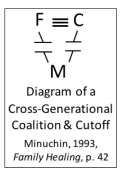
So there’s all sorts of stuff in actual clinical psychology.  There’s just no established and defined pathology of PAS, which is unfortunate for the Gardnerian PAS “experts” because it means that they’re “experts” in a nonexistent form of pathology.

So what happens when we return to standard and established constructs and principles of professional psychology to which ALL mental health professionals can be held accountable?  What happens when Gardnerian PAS is replaced by AB-PA?  What happens to their status as “experts”?  It vanishes.  Poof.  Once the mythical pathology of “parental alienation” vanishes (notice I’ve always put the term in quotes, from the very beginning of my writing on this topic), so too does their “expertise” because none of these Gardnerian PAS “experts” are expert in actual true forms of attachment-related, personality disorder related, family systems pathologies.

Well, no wonder that none of these Gardnerian PAS experts have come forward to support AB-PA.  Why would they support AB-PA if this means they cease to be “experts” in “parental alienation.”  I suppose bringing an end to the pathology of “parental alienation” might possibly be a motivation for supporting AB-PA, but obviously not motivation enough.

It’s clear that they want to stop AB-PA from taking hold.  They’re trying as hard as they can to simply ignore AB-PA in hopes that it will just go away.  I’ve worked in the professional worlds of schizophrenia, and ADHD, and autism, and this is the most interesting thing I’ve ever seen, where a group of professionals act as though significant advancements simply don’t exist.  I’m like Lord Voldemort – he who cannot be named.  It’s really fascinating to watch.

Allies of the Pathogen

I also find it interesting that there are two groups that want to stop AB-PA.  The flying monkey allies of the pathogen, and the Gardnerian PAS experts.  Don’t you find that interesting?  That these two groups should be on the same side in wanting to stop the solution afforded by AB-PA?

We are reclaiming the citadel of professional psychology for targeted parents and your children.  By defining this attachment-related pathology entirely from within standard and established constructs and principles of professional psychology, AB-PA identifies clear domains of professional competence needed for the competent assessment, accurate diagnosis, and effective treatment of this attachment-related, personality disorder family pathology.  In defining established domains of knowledge needed for professional competence in the assessment, diagnosis, and treatment of this pathology, AB-PA activates the Standards of the APA ethics code for you and your families, so that you can now hold ALL mental health professionals accountable.

When Gardner led everyone away from the path of professional psychology and into the wilderness of “new forms of pathology,” he allowed the citadel of professional psychology to become infected by the pathogen through its allies, who have effectively disabled the mental health response to this family pathology.

This attachment-related (trauma-related) pathology generates two types allies, the overt “activating ally” and the covert “enabling ally.”

The flying monkey allies of the pathogen are the overt “activating allies” of the pathology who actively collude in the creation of the pathology in order to meet their own (unconscious) psychological needs to be the “protective ally” of the allied narcissistic/(borderline) parent and supposedly “victimized” child.

The Gardnerian PAS “experts” are the covert “enabling allies” of the pathology who (unconsciously) enable the activation of the pathology in order to meet their own (unconscious) psychological needs to play the role of the “protective ally” of the targeted parent and the child.  By leaving the path of established professional psychology, the Gardnerian PAS contingent have enabled the profound professional ignorance and incompetence that has effectively disabled the mental health response to this pathology for 30 years.

If the Gardnerian PAS experts are allowed to just make stuff up, then everyone is allowed to just make stuff up, which has led to the rampant and unchecked professional ignorance and incompetence currently surrounding the assessment, diagnosis, and treatment of this attachment-related family pathology.  Gardnerian PAS acts to enable the pathogen’s expression by allowing rampant professional ignorance and incompetence that effectively disables the mental health response to this form of attachment-related family pathology.

The supposedly protective “activating ally” of the pathogen who actively colludes with enacting the pathology, and the supposedly protective “enabling ally” who is supposedly the “helpless and ineffectual” ally of the targeted parent and child, are simply flip sides of the same trauma-reenactment coin.  Both are meeting their own personal unconscious psychological needs to be the “protective other” in the kabuki theater display of a trauma reenactment narrative.

In order to solve this attachment-related family pathology we must leave the wilderness of “new forms of pathology” and return to the established path of standard and established professional constructs and principles – to which ALL mental health professionals can be held accountable – including the Gardnerian PAS experts.  No mental health professional is allowed to just make stuff up.  No one.

So Michael Bone, if you want to assert that these children evidence an “absence of guilt,” you’re going to have to explain to me – in detail and at a professional level of analysis – exactly the mechanisms by which the child acquires an “absence of guilt” surrounding the rejection of a parent, because I’m telling you that the symptom displayed by the child is NOT an absence of guilt, it’s an absence of empathy associated with the psychological control of the child (Barber; Kerig) by a narcissistic/(borderline) parent (Beck, Kernberg, Millon) who is the actual source of this symptom display by the child.

I will describe – in detail and at a professional level of analysis; using the standard and established constructs and principles of professional psychology – exactly the mechanisms by which each of the diagnostic indicators and associated clinical signs of AB-PA are created.  That’s the standard for professional competence.

So Michael Bone, if you’re going to assert that these children enter a “trance state,” then you’re going to have to explain to me – in detail and at a professional level of analysis – exactly the mechanisms by which this “trance state” is created and triggered.  Because I can explain to you – in detail and at a professional level of analysis – exactly how dissociative symptoms emerge from complex trauma, an encapsulated persecutory delusion, and the collapse of parental borderline personality pathology as a result of psychological stress.  I can also link these dissociative symptoms to identity pathology in the attachment networks and the trans-generational transmission of trauma.

We are done making stuff up.  Done.  That applies to ALL mental health professionals, even the Gardnerian PAS “experts.”  Bring your “A” game or go away, because these children and families deserve our absolute best.  Nothing less is acceptable.

We lead by example.  If we expect all mental health professionals to evidence the highest standards for professional knowledge, expertise, and competence, then we must display ourselves the highest standards of professional practice and professional competence.  Nothing less than our absolute “A+” game is acceptable.

Domains of Knowledge and Competence

So to Bill Bernet, Amy Baker, Michael Bone and all of the continuing Gardnerian PAS “experts,” you need to identify – specifically – what component of Slides 43-45 from my Dallas Keynote address is wrong.

Because if the statements contained on these Slides are correct, and they are, then you will need to explain why these standards of practice don’t apply to you; why, of all mental health professionals, you are “entitled” to not be competent in the assessment, diagnosis, and treatment of an attachment-related pathology.

If you assert that a child’s rejection of a parent is not an attachment-related pathology, then you will have to explain – in detail and at a professional level of analysis – why a child rejecting a parent is not an attachment-related pathology and you will have to explain – in detail and at a professional level of analysis – why Bowlby’s statement that the “deactivation of attachment behavior” is a key symptom of “pathological mourning” is not true.

Professional competence applies to ALL mental health professionals – Gardnerians included.   We lead by example.  No mental health professional is exempt from standards of practice for professional competence.

If Gardnerians PAS “experts” are allowed to just make stuff up, then everyone can just make stuff up and we dissolve into rampant and unchecked professional ignorance and incompetence.

The Gardnerian PAS experts are unconsciously acting as covert “enabling allies” of this attachment-related family pathology who are colluding with the disabling of the mental health response to this form of attachment-related family pathology.

All mental health professionals – each and every single one – must now be professionally knowledgeable and competent in the attachment system, personality disorder pathology, and family systems therapy.  If you don’t want to bring your absolute “A+” game to the assessment, diagnosis, and treatment of this attachment-related family pathology, then go away, because nothing less than that is acceptable.

We are returning to the path of professional psychology in which all – ALL – mental health professionals will be expected to assess for pathogenic parenting surrounding an attachment-related pathology (using the Diagnostic Checklist for Pathogenic Parenting), including mental health professionals who continue to hold and espouse a Gardnerian PAS model for the pathology.  There is no excuse or justifiable reason for ANY mental health professional, including Gardnerian PAS “experts,” not to assess for the three diagnostic indicators of AB-PA pursuant to Standard 9.01a of the APA ethics code for professionally competent assessment.

If you are not going to assess for pathogenic parenting associated with an attachment-related pathology, then you must provide a cogent justification at a professional level of analysis as to WHY you refuse to even assess for pathogenic parenting when assessing attachment-related pathology.

We are leaving the wilderness of “new forms of pathology” and we are returning to the world of professional competence.

If you wish to argue that you are somehow entitled (a narcissistic symptom) to be exempt from the rules that govern all other – “ordinary” – mental health professionals (also a narcissistic symptom) because you alone somehow occupy a special status or elevated position (also a narcissistic symptom), you can try – but it’s not going to work.  ALL mental health professionals are accountable to standards of professional practice – including you.

“As a means of demonstrating their power, narcissists may alter boundaries, make unilateral decisions, control others, and determine exceptions to rules that apply to other, ordinary people.” (Beck et al., 2004, 251)

Slides 43-45 of the Dallas Keynote apply to ALL mental health professionals. There are no “exceptions to rules that apply to other, ordinary people” regarding the professional obligation for professional knowledge and competence.  I don’t care how important and special you may think you are (grandiosity is a narcissistic symptom), the rules of professional competence apply to you as well.

The statements made in Slides 43-45 of my Dallas Keynote address apply to ALL mental health professionals.

Craig Childress, Psy.D.
Clinical Psychologist, PSY 18857

Dallas Keynote Address

Slide 43:  Attachment System Competence

Mental health professionals who are assessing, diagnosing, and treating attachment-related pathology need to be professionally knowledgeable and competent in the attachment system, what it is, how it functions, and how it characteristically dysfunctions.

Failure to possess professional-level knowledge regarding the attachment system when assessing, diagnosing, and treating attachment-related pathology would represent practice beyond the boundaries of professional competence in violation of professional standards of practice.

Slide 44: Personality Disorder Competence

Mental health professionals who are assessing, diagnosing, and treating personality disorder related pathology as it is affecting family relationships need to be professionally knowledgeable and competent in personality disorder pathology, what it is, how it functions, and how it characteristically affects family relationships following divorce.

Failure to possess professional-level knowledge regarding personality disorder pathology when assessing, diagnosing, and treating personality disorder related pathology in the family would represent practice beyond the boundaries of professional competence in violation of professional standards of practice.

Slide 45: Family Systems Competence

Mental health professionals who are assessing, diagnosing, and treating families need to be professionally knowledgeable and competent in the functioning of family systems and the principles of family systems therapy.

Failure to possess professional-level knowledge regarding the functioning of family systems and the principles of family systems therapy when assessing, diagnosing, and treating family pathology would represent practice beyond the boundaries of professional competence in violation of professional standards of practice.

Unpacking Dallas and Leaving OZ

Richard Gardner recognized a pathology.  But he too quickly abandoned the professional rigor required for professional diagnosis.  Diagnosis is the application of standard and established constructs and principles to a set of symptoms.

Instead of applying standard and established constructs and principles to a set of symptoms, Gardner proposed that what he was seeing represented a completely “new form” of pathology that was unique in all of mental health – a “new syndrome” – which was identifiable by a new set of symptoms that he made up for this specific pathology alone based on his anecdotal clinical experience, symptoms that were equally unique in all of mental health.

The moment he proposed a “new syndrome” rather than apply the professional rigor necessary for a professional diagnosis, Gardner led everyone AWAY from the path of professional psychology and into the wilderness of “new forms of pathology.”  And when he did that, he invited the profound level of professional incompetence we’re currently witnessing surrounding the assessment, diagnosis, and treatment of this attachment-related family pathology.

If Richard Gardner can simply make up a “new form of pathology,” then everyone can simply start making things up.  What we see right now is that every individual mental health professional is free to simply make up whatever they want surrounding the pathology of “parental alienation.”  They can deny that it exists.  They can say it exists but use a hodge-podge of symptoms.  They can blame both parents for the “parental alienation” (using another entirely made up construct – “justified estrangement”).

They can just make stuff up.  Whatever they want.  They can even make up a new form of therapy – “reunification therapy” – that is totally without any guiding principles and description for what it is.  They can just make it up as they go and call it “reunification therapy.”

Everyone – each mental health professional individually – can simply make stuff up.  From assessment, to diagnosis, to treatment, they can just make up whatever they want, and do whatever they want, because no one is required to ground their assessment, diagnosis, or treatment in established professional constructs and principles.  They just use the term “parental alienation” (or its associated made up form of therapy: “reunification therapy”) and then they just make stuff up.

This made up world of supposedly “new forms of pathology” leads to the profound professional incompetence we are currently witnessing in the assessment and diagnosis of “parental alienation.”  And under the Gardnerian model of PAS, a supposedly “new form of pathology,” targeted parents are unable to hold mental health professionals accountable to any domains of professional competence.

Since each individual mental health professional is simply allowed to make up whatever they want about the construct of “parental alienation,” there are no defined domains of knowledge that we can require for professional competence, which then allows professional ignorance and incompetence to run rampant and unchecked.

With AB-PA I am leading us out of the wilderness, out of the swamps and quagmires of professional incompetence, and placing us back onto the path of professional psychology.  Once we return to the path of professional psychology, the attachment-related family pathology commonly called “parental alienation” becomes immediately solvable.

Once we return to the path of professional psychology, we can identify the professional domains of knowledge needed for professional competence:

Attachment pathology
Personality disorder pathology
Family systems pathology
Complex trauma pathology

If a mental health professional is not knowledgeable in each and all of these domains of professional psychology, then that professional is practicing beyond the boundaries of their professional competence, in violation of professional standards of practice (APA Standard 2.01a).

APA Ethics Code
Standard 2.01 Boundaries of Competence
(a) Psychologists provide services, teach and conduct research with populations and in areas only within the boundaries of their competence,

If a mental health professional has not acquired an understanding for AB-PA – and note, it’s been two years since the publication of Foundations, and there are free online seminars available on AB-PA (California Southern University Masters Lecture Series) from three years ago, and Dr. Childress also offers to consult with any mental health professional without charge, and parents are providing mental health professionals with books and handouts on AB-PA – then that professional has not undertaken “ongoing efforts to maintain their competence” in violation of professional standards of practice (Standard 2.03).

APA Ethics Code
Standard 2.03 Maintaining Competence

Psychologists undertake ongoing efforts to develop and maintain their competence.

Since the attachment system ONLY becomes dysfunctional in response to pathogenic parenting, if a mental health professional has not even assessed for pathogenic parenting surrounding an attachment related pathology (note I did not say “parental alienation”), then the diagnostic statements and forensic testimony of that mental health professional cannot possibly be based on “information and techniques sufficient to substantiate their findings,” which is in violation of professional standards of practice (Standard 9.01a).

APA Ethics Code
Standard 9.01 Bases for Assessments
(a) Psychologists base the opinions contained in their recommendations, reports and diagnostic or evaluative statements, including forensic testimony, on information and techniques sufficient to substantiate their findings.

If a mental health professional is not basing his or her professional work on the “established scientific and professional knowledge” of the attachment system (Bowlby), personality disorder pathology (Beck, Kernberg, Millon), and family systems therapy (Bowen, Haley, Minuchin), then that mental health profession is in violation of professional standards of practice (Standard 2.04).

APA Ethics Code
Standard 2.04 Bases for Scientific and Professional Judgments

Psychologists’ work is based upon established scientific and professional knowledge of the discipline.

If the ignorance and incompetence of the mental health professional then results in harm to the client child and targeted parent caused by the professional’s ignorance and incompetence (such as by supporting the pathology and not resolving the lost affectional attachment bond between the child and the normal-range and affectionally available targeted parent), then the mental health professional is in violation of professional standards of practice (Standard 3.04).

APA Ethics Code
Standard 3.04 Avoiding Harm
(a) Psychologists take reasonable steps to avoid harming their clients/patients, students, supervisees, research participants, organizational clients, and others with whom they work, and to minimize harm where it is foreseeable and unavoidable.

If a mental health professional refuses to engage in professional-to-professional consultation to address their areas of professional ignorance and incompetence, they are in violation of professional standards of practice (Principle B).

APA Ethics Code
Principle B: Fidelity and Responsibility

Psychologists consult with, refer to, or cooperate with other professionals and institutions to the extent needed to serve the best interests of those with whom they work.

If the ignorance and incompetence of the mental health professional results in their not properly assessing for and accurately diagnosing child abuse, then that mental health professional may also be in violation of their “duty to protect,” which is one of two foundational obligations (“duties”) incumbent upon ALL mental health professionals (the other being a “duty of care”).

Leaving the Wilderness

Once we leave the conceptual and diagnostic wilderness of “parental alienation” into which Richard Gardner led us with his proposal for a “new form of pathology” that was unique in all of mental health – a “new syndrome” – and once we return to the path of established psychological constructs and principles of professional psychology, we can now hold mental health professionals accountable for professional competence.

Three critical slides from my Dallas Keynote – critical and turning point slides – are slides 43, 44, and 45.

Slide 43:  Attachment System Competence

Mental health professionals who are assessing, diagnosing, and treating attachment-related pathology need to be professionally knowledgeable and competent in the attachment system, what it is, how it functions, and how it characteristically dysfunctions.

Failure to possess professional-level knowledge regarding the attachment system when assessing, diagnosing, and treating attachment-related pathology would represent practice beyond the boundaries of professional competence in violation of professional standards of practice.

Slide 44: Personality Disorder Competence

Mental health professionals who are assessing, diagnosing, and treating personality disorder related pathology as it is affecting family relationships need to be professionally knowledgeable and competent in personality disorder pathology, what it is, how it functions, and how it characteristically affects family relationships following divorce.

Failure to possess professional-level knowledge regarding personality disorder pathology when assessing, diagnosing, and treating personality disorder related pathology in the family would represent practice beyond the boundaries of professional competence in violation of professional standards of practice.

Slide 45: Family Systems Competence

Mental health professionals who are assessing, diagnosing, and treating families need to be professionally knowledgeable and competent in the functioning of family systems and the principles of family systems therapy.

Failure to possess professional-level knowledge regarding the functioning of family systems and the principles of family systems therapy when assessing, diagnosing, and treating family pathology would represent practice beyond the boundaries of professional competence in violation of professional standards of practice.

The turning point of Dallas is in holding ALL mental health professionals accountable for professional-level knowledge and professional competence in the assessment, diagnosis, and treatment of this attachment-related, personality disorder related, family systems pathology.

Notice I did not say “parental alienation.”  We cannot hold them accountable for “parental alienation.”  We can ONLY hold them accountable when we define the pathology entirely using standard and established constructs and principles.  That’s what AB-PA does.  It gives you the constructs you need to hold all mental health professionals accountable to the Standards of the APA ethics code requiring professional competence.

AB-PA activates the Ethics Code Standards of the APA for you.  Understand?

Gardnerian PAS does not.  Is that clear?  If you try to use the term “parental alienation” you will fail.  The construct of “parental alienation” does not activate the APA Ethics Code Standards for you.

With AB-PA you can now hold ALL mental health professionals accountable for their knowledge in certain defined domains of professional psychology – the attachment system, personality disorder  pathology, and family systems therapy – NOT “parental alienation.”  Understand?

By leaving the wilderness of Gardnerian PAS and returning to the yellow brick road of established professional constructs and principles (follow the yellow brick road of AB-PA), we can find our way out of OZ and return back home to be reunited with our loved once more.

And in truth, you had the power the entire time.  John Bowlby identified and described the attachment system in the 1970s, Otto Kernberg was describing narcissistic and borderline personality pathology in the 1970s, Jay Haley, Salvador Minuchin, and Murray Bowen were describing cross-generational coalitions and emotional cutoffs in the 1970s.  This solution has been available for nearly 40 years (which then begs the question, why didn’t any of the Gardnerian PAS experts ever take this solution?… and why are they resisting it now?  Why are they insisting on a “new form of pathology” that provides no solution whatsoever?  I know exactly why.)

You are more powerful than you know.  Write to the APA. The key slide in Dallas for the APA is slide 33.

Slide 33:  The APA

The American Psychological Association should provide clear guidance to all of its members that specialized professional knowledge and professional competence is required in the assessment, diagnosis, and treatment of attachment-related and personality disorder related family pathology surrounding divorce.

Notice I did not say “parental alienation.”  We must return to the path of established psychological principles and constructs.  There is NO power in the construct of “parental alienation.”  Understand?  The ethics code of the APA ONLY becomes active if you use standard and established constructs and principles – which is what AB-PA gives you.

If you try to use Gardnerian PAS, you will fail.

Clear?

But if you use AB-PA, the solution becomes immediately available.

What you want to ask for from the APA is contained in Slide 34.

Slide 34: The APA Position Statement

Change to their official position statement on “Parental Alienation Syndrome

1. )  Acknowledge that the pathology exists – by whatever name they want to call it;

2.)  Designate children and families experiencing this form of attachment-related pathology as a “special population” requiring specialized professional knowledge and expertise to competently assess, diagnose, and treat.

Achieving Competence

Assessment leads to diagnosis.

Diagnosis guides treatment.

The final slide I want to highlight from the Dallas Keynote is slide 70.

Slide 70:  DSM-5 Child Psychological Abuse

Pathogenic parenting that is creating significant developmental pathology in the child (diagnostic indicator 1), personality disorder pathology in the child (diagnostic indicator 2), and delusional-psychiatric pathology in the child (diagnostic indicator 3) in order to meet the emotional and psychological needs of the parent represents a confirmed DSM-5 diagnosis of V995.51 Child Psychological Abuse.

Assessment leads to diagnosis.

The statement contained in Slide 70 is the lynchpin between the assessment of the three diagnostic indicators of AB-PA and a DSM-5 diagnosis of Child Psychological Child Abuse.

Standard 9.01a requires assessment “sufficient to substantiate” their diagnostic statements.  Identification of the three diagnostic indicators of AB-PA requires a DSM-5 diagnosis of V995.51 Child Psychological Abuse, Confirmed.  See the linkage?

AB-PA activates the APA Ethics Code.  The APA Ethics Code requires appropriate assessment.  Appropriate assessment then leads to an accurate DSM-5 diagnosis as Psychologcial Child Abuse.   The dominoes fall, one after the other, from AB-PA.

We are requiring – requiring – professional competence – once we switch from a Gardnerian PAS model to an AB-PA model.  Understand?  See how it works?

By defining the domains of professional competence, we can then require – REQUIRE – under Standard 9.01a of the APA ethics code (Slides 59-60) that ALL mental health professionals assess for “pathogenic parenting associated with an attachment related pathology” (Slide 62).

Assessment leads to diagnosis (Slide 70).

Diagnosis then guides treatment.  Which was my afternoon talk, and I’ll unpack that in future blog posts.

We are not giving them a choice any longer to be ignorant and incompetent.  If they choose to remain ignorant and incomptent, then file a licensing board complaint for violations of Standards 9.01a, 2.01a, 2.03, 2.04, 3.04, Principle B, and failure in their “duty to protect.”

The licensing board doesn’t care about the specifics of your case.  The licensing board ONLY cares about what standards of practice were violated – Standards 9.01a, 2.01a, 2.03, 2.04, 3.04, Principle B, and failure in their “duty to protect.” Make the licensing board tell us, over-and-over again, that they will not enforce professional standards of practice.  Make the ignorant and incompetent mental health professional play Russian roulette, over-and-over again, with their license on the line.

Mental health professionals are not allowed to be ignorant and incompetent.  Make the APA and the licensing board tell you, over-and-over again, that they will not enforce their ethics code and standards of practice, that it’s okay with them that mental health professionals are profoundly ignorant and incompetent in the assessment, diagnosis, and treatment of your children and families.

BUT – BUT – this ONLY becomes available to you if you use the proper constructs.  If you try to hold mental health professionals accountable for “parental alienation,” you will fail.  Understand?

THAT is the importance of Dallas.  There is a before Dallas, and an after Dallas.  The paradigm has shifted to AB-PA and we can now hold mental health professionals accountable, but only if you use the constructs of AB-PA to define the attachment-related family pathology.

You have more power than you know.  It is time to live into your power to recover your beloved children from the attachment-related, trauma-related, personality disorder and family systems pathology of AB-PA.

It’s a complicated pathology.  No doubt about that.  But we absolutely know what it is (and I fully describe it in Foundations).

And don’t ever let anyone tell you that this pathology (label it whatever you want) is not in the DSM-5.  It most certainly is in the DSM-5.  On page 719.  V995.51 Child Psychological Abuse, Confirmed.

It is time we start calling this pathology by its proper name; Child Psychological Abuse.

This is NOT a child custody issue, this is a child protection issue.

You are more powerful than you know.  Let’s go get your beloved children back.

Craig Childress, Psy.D.
Clinical Psychologist, PSY 18857

Dallas Powerpoints

Before the Dallas Symposium on Parental Alienation, we were focused on the problem of “parental alienation.” 

Now – after the Dallas Symposium – we are focused on the solution to “parental alienation.”  Every step we now take is a step closer to the solution.

We are on a different path now.

My deep appreciation to Wendy Perry and to her husband Rob, and to all of your many colleagues who helped you to put together and host a wonderful event in Dallas.  It was a delight and privilege to be invited to speak.

It was also my deep pleasure to meet so many parents, step-parents, and families affected by “parental alienation.”  I am honored that so many of you traveled such distances to attend the event.  My appreciation.

I also want to acknowledge Rod McCall and his son Eryk – who lives in Rod’s heart, and now in mine as well.  It was an honor to hear Rod’s story of love.  Rod has written a book For the Love of Eryk: Surviving Divorce, Parental Alienation, and Life After.  It was my deep privilege to meet Rod and his son Eryk who lives in his love.  I recommend that everyone buy and read For the Love of Eryk.

From Dallas on, we are now moving toward the solution.

The solution to the attachment-related pathology of “parental alienation” is available right now, today.  The ONLY thing preventing the solution is the profound degree of ignorance and incompetence in professional psychology.

We absolutely know what this pathology is, and once we return to the proper professional path of established psychological principles and constructs – to which ALL mental health professionals can be held accountable, this form of attachment-related pathology surrounding divorce becomes completely solvable, right now.  Today.

Our only enemy is ignorance.  The solution is knowledge.

I have posted my Powerpoint slides from my morning and afternoon Dallas talks to my website.

Dallas Keynote Powerpoint: 4/29/17

Dallas Second (Afternoon) Presentation Powerpoint: 4/29/17

They belong to you.  The knowledge belongs to you.  You have a right to expect and receive professionally knowledgeable and competent assessment, diagnosis, and treatment for your children and families.  That is your right, and that is the right of your children.

In order to achieve professional competence, we must define the pathology using standard and established constructs and principles of professional psychology to which ALL mental health professionals can be held accountable.  AB-PA accomplishes that.

Mental health professionals are NOT ALLOWED to be ignorant and incompetent. Every ethics code of professional psychology has a Standard that requires professional competence.  Professional competence in the assessment, diagnosis, and treatment of your children and your families is your right.

Pathogenic parenting that is creating significant developmental pathology in the child (diagnostic indicator 1), personality disorder pathology in the child (diagnostic indicator 2), and delusional psychiatric pathology in the child (diagnostic indicator 3) is a DSM-5 diagnosis of V995.51 Child Psychological Abuse, Confirmed.

Don’t let anyone ever tell you that the pathology of “parental alienation” is not in the DSM-5.  It absolutely is in the DSM-5.  On page 719.  V995.51 Child Psychological Abuse, Confirmed.

I will be posting more discussion about my Dallas Powerpoint slides in the days to come.  I’m still on the road, I have another presentation in Houston tomorrow – Texas is rockin’ – don’t mess with Texas.  In fact, the entire country is rocking.  I’m hearing ripples of change occurring in many-many locations.

I need to get back to work preparing for tomorrow’s talk in Houston.  But I wanted to say thank you to Wendy and to everyone who helped make Dallas such a wonderful experience, and I want to make my Powerpoints available to everyone.  They belong to  you.

Things have changed.  We are now on the path to the solution.  This pathology ends.  That is a certainty.

Craig Childress, Psy.D.
Psychologist, PSY 18857

I am standing right beside you

I was asked to provide a letter of support to the Parents on the Dutch – Belgian Ride to End Parental Alienation.  This is my letter to them, and to all parents who are fighting for your children. 


4/25/17

To: Parents on the Dutch – Belgian Ride to End Parental Alienation

From:  Dr. Craig Childress

We are miles away, and I am standing right beside you.  You are not alone.

We are worlds apart, and yet I am standing right beside you.  You are not alone.

We will not stop.  We will not relent.  We will recover your children, your beautiful children.  You are not alone.

We stand together, side-by-side, with you and with your children.  Your children are not alone.

It is with joy that I write this letter to you because we stand together today with clarity, with truth, and with love.  Though worlds apart, you are in my thoughts and prayers, and our prayers have power because they are born in your love.

Though worlds apart, I hear you.  I know your love.  I hear your voice.  We will not stop until all of your children are back in your arms.

Over the course of my professional career I have worked with all the various forms of child and family pathology, ADHD, autism-spectrum disorders, angry-aggressive families, child abuse and trauma.  The pathology of “parental alienation” is one of the cruelest pathologies I have ever encountered.  It must end.  Its cruelty must end.  Alienating a child from a loving and beloved parent is psychological child abuse, and it must end. 

And it will end.  Even as we stand together today, it is ending.  Our road to recovering your children is clear. The pathogen that takes your children can no longer remain hidden in the dark crevices of its secrecy as it spreads its lies and its cruel manipulation of the child.  We are exposing it to the light.  We are exposing its lies and manipulation.  We are exposing it from beneath its veil of concealment.

The lies, the manipulation and exploitation of the child – the psychological abuse of the child – can only occur when it is not seen – when it remains hidden.  Once it is exposed, it loses all of its power.  We are exposing it.  Day by day the darkness of professional ignorance and incompetence recedes.  Each day – with each mile we travel on our road – we are nearing the solution.

This pathogen is extremely dangerous, but it is stupid as sin.  That’s why this pathology thrives in ignorance.  It seeks allies in ignorant people, and it survives because of the continued profound professional ignorance and incompetence in mental health.  Our enemy is ignorance.  Our weapon is knowledge.

This pathology currently thrives in the profound professional ignorance of metal health persons whose ignorance and incompetence allows the pathogen to remain hidden and unseen. The level of professional ignorance and incompetence out there is appalling.  The current level of professional incompetence in assessment and diagnosis results in little more than voodoo assessment – rattle some beads, recite some incantations, and read the entrails of a goat, – “Bring me a goat, please, I’m doing a family assessment of ‘parental alienation’ and I need to augur the signs.”

As for treatment, professional practice is positively medieval – “Bring me some leeches, we need to bleed the patient.” The current level of professional ignorance and incompetence out there is positively medieval.

And this particular pathology thrives in ignorance.

But each of you today are the living light of love and knowledge.  Through your loving light, and through your truth, we are rolling back the ignorance and darkness in which the pathology hides.  We are demanding professional expertise and professional competence in the assessment, the diagnosis, and the treatment provided to your children and your families.

Ignorance is our enemy.  Knowledge is our power.  In AB-PA I have given you the rock-solid Foundations of established psychological constructs on which to stand in your demand for professional knowledge and competence in the assessment, diagnosis, and treatment of your children and your families.  Knowledge and competence from professional psychology is your right, and it is the right of your children.

Our enemy is ignorance, because this pathogen uses ignorance as an ally.

Today, you are the living flame of love, and truth, and knowledge, bringing light into the dark hiding places of this pathology.  Today we are exposing the pathology from its hiding place and we are naming it – we are calling it what it is – child abuse – psychological child abuse.

We will no longer tolerate professional psychology abandoning you and your children to the psychological abuse of your children by a disordered and pathological narcissistic-borderline personality parent, who is using the child – who is weaponizing the child – as an instrument of revenge in the spousal conflict surrounding divorce.  Children are kids.  They are never weapons.  We know exactly what this pathology is.  It is psychological child abuse. 

Our enemy is ignorance; professional ignorance.  And you are the living light of love, and truth, and knowledge. 

We will not abandon you.  We will not abandon your children.  We will not stop until all of your children are back in your arms.

Children have the fundamental right of childhood to love both parents; and children have the fundamental right of childhood to receive the love of both parents in return.

We will not stop until we achieve these rights for all children, and we will not stop until we are able to protect all children from all forms of child abuse – physical, sexual, emotional, and psychological child abuse.

You are your children’s warriors, and though I am a world away, I am standing right beside you in your fight for your children.

Best wishes,

Craig Childress, Psy.D.
Clinical Psychologist, PSY 18857

Complex Trauma: Traumatic Grief

To be the targeted parent of “parental alienation” (AB-PA) is traumatic.  The type of trauma is called “Complex Trauma,” and the form of complex trauma is called “traumatic grief.”

To the targeted parents, I am a clinical psychologist.  What you are experiencing is a form of Complex Trauma called “traumatic grief.”

Wikipedia:  Complex Post-Traumatic Stress Disorder

When I meet with targeted parents for consultations, I often end the consultation by providing encouragement to the targeted parent to find areas for self-nurture to address their complex trauma and traumatic grief.  The analogy I use is that if your child is in quicksand, it doesn’t help for you to jump into the quicksand after them, because then you’re both in trouble.  The targeted parent needs to stand on the solid ground of your own emotional and psychological health and to throw your child a rope that your child can use to pull himself or herself out.

Will your child grab the rope?  Probably not.  Your child has to live with the pathology of the narcissistic/(borderline) parent.  Your child has to do what they have to do to survive in that upside-down and psychologically dangerous world of their narcissistic/(borderline) parent.  Until we are able to first protect the child, we cannot ask the child to reveal their authenticity.  We must first protect the child.

It doesn’t help if you jump in the quicksand too.  Your psychological trauma is real.  It’s a form of complex trauma called “traumatic grief.”  It is a central feature of the pathogen that is creating the attachment-related pathology of “parental alienation” (AB-PA).  I’ve read the “source code” of the pathology, the information structures of the attachment system that create the pathology, and the complex trauma of traumatic grief is embedded in the source code of the pathogen.

One of the core guiding features of the information structures that create this pathology is the creation of traumatic grief in the targeted-rejected parent.  That’s what the information structures of this pathogenic agent in the attachment system are designed to do, they create the complex trauma of traumatic grief in the targeted parent.  Let me explain.

In the Wikipedia article I cite above, notice the linkage of Complex Trauma to both attachment-related pathology (disorganized attachment) and borderline personality pathology. 

The childhood origins of attachment-based “parental alienation” (AB-PA) are in the disorganized attachment – the attachment trauma – of the narcissistic/(borderline) parent (“disorganized attachment” is a defined and researched category of “insecure attachment”; see for example, Main & Hesse, 1990; Lyons-Ruth, Bronfman, & Parsons, 1999).

And disorganized attachment in childhood is at the core of the later development of borderline personality pathology:

“Various studies have found that patients with BPD are characterized by disorganized attachment representations (Fonagy et al., 1996; Patrick et al, 1994).  Such attachment representations appear to be typical for persons with unresolved childhood traumas, especially when parental figures were involved, with direct, frightening behavior by the parent.  Disorganized attachment is considered to result from an unresolvable situation for the child when ‘the parent is at the same time the source of fright as well as the potential haven of safety’ (van IJzendoorn, Schuengel, & Bakermans-Kranburg, 1999, p. 226).” (Beck, et al, 2004, p. 191)

Notice that I always link the narcissistic and borderline personality of the allied pathogenic parent in AB-PA using the term “narcissistic/(borderline)” parent, embedding the term “(borderline)” in parenthesis.  This is to make the point that the narcissistic personality has a borderline core.  These personality pathology styles are simply differing outward manifestations of an identical underlying core attachment pathology.

“One subgroup of borderline patients, namely, the narcissistic personalities… seem to have a defensive organization similar to borderline conditions, and yet many of them function on a much better psychosocial level.” (Kernberg, 1975, p. xiii)

“Most of these patients [i.e., narcissistic] present an underlying borderline personality organization.” (Kernberg, 1975, p. 16)

Kernberg, O.F. (1975). Borderline conditions and pathological narcissism.. New York: Aronson.

There is a diagram of the attachment-related pathology of AB-PA on my website:

Diagram of AB-PA Pathology

Work your way from the bottom of this diagram to the top along two separate but interrelated lines.  The inside description is the personality disorder line of disordered mourning and the pathological processing of sadness and grief, the outside lines are the attachment related lines, that leads to the trauma reenactment narrative.

Now look again to the description of Complex Trauma in Wikipedia.  Notice the association of Complex Trauma with both disorganized attachment and borderline personality pathology (narcissistic personality pathology is less studied in the research literature because the narcissistic personality rarely if ever presents for therapy).

The childhood disorganized attachment of the narcissistic/(borderline) parent constellated during the adolescent and early adulthood developmental periods into the personality pathology of the narcissistic-borderline parent that drives the current “parental alienation” process (AB-PA).

Whether the manifestation of the underlying attachment trauma assumes a more narcissistic-style or borderline-style of expression depends on how the narcissistic/(borderline) parent-as-a-child responded to and coped with the childhood attachment trauma.  A disorganized attachment with avoidant overtones leads to a more narcissistic style of personality presentation in which loving attachment relationships are devalued.  A disorganized attachment with strongly anxious-ambivalent overtones in which a child tries to maintain an attachment bond to a frightening and dangerous parent (Beck et al., 2004), leads to a more borderline-style presentation of chaotic and hyper-expressive mood swings (called “protest behavior”) and continual fears of abandonment.

At the core of both personalities is a profound inner emptiness – a vacancy of being. The borderline style personality experiences this profound emptiness nearly all the time, and much of the relationship effort by a borderline-style personality is designed to fill the core emptiness of their being. The borderline-style personalty engages in frantic efforts to continually remain the center of attention, seeking constant reassurances of being loved.  Any real or imagined slights that suggest that the borderline personality might not be loved result in excessively angry displays of vitriol and victimization directed toward the failing attachment figure.

Think of the borderline-style personalty as emerging from a child who is trying to form an attachment bond to an unstable frightening and dangerous parent, yet a parent who is nevertheless also a source of nurture.  Even when an attachment bond can be formed, it is fragile and the child is exceedingly anxious and hyper-vigilant for signs of abandonment that can signal the emergence of the frightening, dangerous, and rejecting parental attachment figure.

The narcissistic personality, on the other hand, results from a child who chooses a different approach to coping with a frightening-rejecting parent.  In the formation of the narcissistic-style personality, the child chooses safety over intimacy. The child dismisses the importance of forming an attachment bond to the frightening-rejecting parent (called an “avoidant” attachment style).  The narcissistic-style personality sacrifices intimacy for safety.

But sacrificing intimacy with the attachment figure of the parent creates a core emptiness in the self-experience of the child.  The psychological intimacy with our parents that the rest of us experienced as children established in us a core inner sense of our healthy narcissism; that we are fundamentally valued and valuable people.  This didn’t occur in the childhood of the narcissistic personality.  In avoiding intimacy with the dangerous-rejecting attachment figure, the core sense of self as being valued and valuable did not get established.  Instead an artificial pathological narcissism developed of fragile over-inflated self-grandiosity and self-importance that is not rooted in an authentic belief in one’s true core value.

Just like with the borderline personality, at the core of the narcissistic personality is a fundamental inner emptiness of being.  The difference is that by adopting a narcissistic defense of grandiose self-importance in which other people, and intimate relationships with other people, are devalued, the narcissistic personality is able to develop a slightly greater stability in functioning – as long as the person can maintain the narcissistic veneer of self-value.

However, if the narcissistic defense is penetrated by criticism or rejection – especially by rejection – which exposes the core self-inadequacy of the narcissistic personalty (called a “narcissistic injury”), then the narcissistic personality will collapse into it’s borderline core of profound inner emptiness.  When rejected, the narcissistic personality responds with rageful and demeaning attacks on the other person (called “narcissistic rage”) in order to reestablish the narcissistic defense of grandiose self-importance by devaluing the importance of the other person (“I’m not the inadequate person; YOU are.”)

AB-PA and Complex Trauma

The origin of the attachment-based pathology of “parental alienation” (AB-PA) is to be found in the childhood attachment trauma of the narcissistic/(borderline) parent, who is then transferring this childhood trauma into the current family relationships, a process mediated by the personality disorder pathology of this parent that is itself a product of this parent’s childhood attachment trauma.

In the pathology of “parental alienation” (AB-PA), the complex developmental trauma from the childhood of the narcissistic/(borderline) parent, that has become frozen into the pathological personality structure of this parent, is being transmitted to you, the targeted-rejected parent, in the form of “traumatic grief.”  You, the targeted-rejected parent, are being made to hold the complex trauma that was the childhood experience of the narcissistic/(borderline) parent.

At the core of this complex trauma is the pathological processing of sadness, grief, and loss of the attachment figure:

  • The parent in the childhood of the current narcissistic/(borderline) parent;
  • The spousal attachment figure in the divorce;
  • The beloved child of the targeted parent in “parental alienation.”

The organizing central theme of “parental alienation” (AB-PA) is pathological mourning.  The pathological processing of sadness, grief, and loss.

I’ve read the “source code” of this pathogen (I’ve read the content and process of its information structures).  I know what it is and I know how functions.  Once we’ve solved this pathology and bring this family nightmare to an end, I’ll begin to unpack the deeper levels of this pathology for my professional colleagues.  But for now, let me simply identify what is occurring for you, the parent who is being targeted for rejection by this severe and horrific form of trans-generational attachment pathology.

The overall attachment-related pathology is called “pathological mourning” (Bowlby, 1980).

“The deactivation of attachment behavior is a key feature of certain common variants of pathological mourning.” (Bowlby, 1980, p. 70)

Bowlby, J. (1980). Attachment and Loss: Vol. 3. Loss: Sadness and Depression. NY: Basic Books.

You, the targeted parent are being locked into a FALSE trauma reenactment narrative of “abusive parent”/”victimized child”/”protective parent.” 

In locking you into this FALSE trauma reenactment narrative of the complex trauma from the childhood of the narcissistic/(borderline) parent, you are being made to hold the complex trauma – you have become the repository, the receptacle, holding the complex trauma.  The complex trauma from the childhood of the narcissistic/(borderline) parent is being created in you.  The form of the complex trauma is called, “traumatic grief.”

The core of the “parental alienation” pathology is the disordered processing of sadness, grief, and loss.  The primary case of the “pathological mourning” is the narcissistic/(borderline) parent, who is translating feeling of sadness and “mournful longing” surrounding the divorce into “anger and resentment, loaded with resentful wishes”:

“They [narcissists] are especially deficient in genuine feelings of sadness and mournful longing; their incapacity for experiencing depressive reactions is a basic feature of their personalities.  When abandoned or disappointed by other people they may show what on the surface looks like depression, but which on further examination emerges as anger and resentment, loaded with revengeful wishes, rather than real sadness for the loss of a person whom they appreciated.” (Kernberg, 1975,p. 229)

Kernberg, O.F. (1975). Borderline Conditions and Pathological Narcissism. New York: Aronson.

The pathogenic parenting practices of the narcissistic/(borderline) parent are then transferring this parent’s own disordered mourning onto the child, creating the pathology of the child’s rejection of a normal-range and affectionally available parent.

Through the child’s rejection of a loving and beloved parent, the targeted parent is made to hold the complex trauma at the core of the pathology in the form of traumatic grief surrounding the loss of their beloved child.

All targeted parents have been psychologically brutalized by the complex trauma of traumatic grief.  In surviving this trauma until the time when we obtain professional competence from professional psychology, you need to take a lot of active steps to process and metabolize the trauma.

You are not a bad parent.  You’re a good parent.  I know this.  You know this.  It is a FALSE trauma reenactment narrative being created surrounding you.

Take care of yourself physically to process the trauma.  Trauma becomes embedded in our physical structures.  Exercise.  Eat well and healthy.

It’s okay to be happy.  The traumatic grief can be consuming, and you might feel guilty if you actually achieve moments and times of happiness.  It’s okay for you to be happy.  You love your children.  Your grief is real.  So is your happiness with a new spouse or in activities you enjoy.  You need to find happiness and enjoyment in order to process the traumatic grief.  It’s okay to be happy.

If you find yourself obsessing about the trauma you’re experiencing, journal about it.  Get it out of you and onto paper.  I’ll have more to say later about the potential role of journaling in processing your trauma.

Know this, you are not alone.  There are others who are going through the same thing and who understand.  I understand.  We are working to solve this and to bring your authentic and beautiful children back to you.  You are not alone.

Craig Childress, Psy.D.
Clinical Psychologist, PSY 18857

Beck, A.T., Freeman, A., Davis, D.D., & Associates (2004). Cognitive therapy of personality disorders. (2nd edition). New York: Guilford.

Lyons-Ruth, K., Bronfman, E. & Parsons, E. (1999). Maternal frightened, frightening, or atypical behavior and disorganized infant attachment patterns. In J. Vondra & D. Barnett (Eds.) Atypical patterns of infant attachment: Theory, research, and current directions. Monographs of the Society for Research in Child Development, 64, (3, Serial No. 258).

Main, M., & Hesse, E. (1990). Parents’ unresolved traumatic experiences are related to infant disorganized attachment status: Is frightened and/or frightening parental behavior the linking mechanism? In M.T. Greenberg, D. Cicchetti, & E.M. Cummings (Eds.), Attachment in the preschool years: Theory, research, and intervention (pp. 161–182). Chicago: University of Chicago Press.

Ignorance is Our Enemy; Knowledge is Our Weapon

I’m a little reluctant to share this with you, because I’m tipping my hand to the pathogen.  But I think that as we move forward it will be important to recognize allies of the pathology.  So I’m going to fill you in on a little secret that I know but the pathogen doesn’t.

The pathogen is a set of damaged information structures in the attachment networks of the brain that create both the personality pathology of the allied narcissistic/(borderline) parent, and also the attachment-related pathology of pathological mourning (Bowlby) that’s called “parental alienation” in the general culture (attachment-based parental alienation; AB-PA).

These damaged information structures in the attachment system of the narcissistic/(borderline) parent were created many years ago in the childhood attachment trauma of this parent, and these damaged information structures are distorting this parent’s processing of sadness, grief, and loss surrounding the divorce.

In turn, these same damaged information structures are leading the narcissistic/(borderline) parent to distort the child’s processing of sadness grief and loss surrounding divorce through the manipulative and psychologically controlling parenting practices of this parent.

“The deactivation of attachment behavior is a key feature of certain common variants of pathological mourning.” (Bowlby, 1980, p. 70)

Disturbances of personality, which include a bias to respond to loss with disordered mourning, are seen as the outcome of one or more deviations in development that can originate or grow worse during any of the years of infancy, childhood and adolescence.” (Bowlby, 1980, p. 217)

This pathogenic agent – this pathogen, consists of the damaged information structures in the attachment system of the narcissistic/(borderline) parent that are creating both the personality disorder pathology of the parent AND the attachment system suppression of the child toward the normal-range and affectionally available targeted parent.

Think of it like a computer virus.  The brain is an information processing system, like a computer.  The attachment system is the “software program” of the brain that governs all aspects of love and bonding throughout the lifespan, including grief and loss.

The childhood attachment trauma experienced by the narcissistic/(borderline) parent created a coherent set of damaged information structures in the attachment system (the pathogenic agent; the “computer virus” in the “software program” of the attachment system) that led to this parent’s development of narcissistic and/or borderline personality pathology.

This “computer virus” (the pathogenic agent in the attachment networks) is then being “downloaded” (transferred to the child’s attachment networks) through the aberrant and distorted parenting of the narcissistic/(borderline) parent – parenting practices surrounding the pathological processing of sadness, grief, and loss that are being created by the “computer virus” (the damaged information structures) in the narcissistic/(borderline) parent’s attachment networks.

Within this “computer virus” analogy, the damaged information structures essentially represent the “source code” for the “computer virus” – for the pathogenic agent that is creating the personality disorder pathology in the parent and the aberrant attachment suppression in the child toward the normal-range and affectionally available targeted-rejected parent.

I have spent the last decade uncovering the “source code” of this pathogenic agent – i.e., the exact nature of the damaged information structures in the attachment system that are being transmitted across generations.

As a result, I’ve read the “source code” of this “computer virus” in the “software program” for love and bonding (the attachment system) that is being trans-generationally transmitted from the narcissistic/(borderline) parent to the child, causing the child’s attachment bonding networks to “crash” relative to a normal-range and affectionally available targeted parent.

I call the “source code” the “meme-structure” of the pathogen, drawing on the work of Richard Dawkins in The Selfish Gene.

Because I’ve read the “source code” for this pathogenic agent, I understand its characteristic modes of presentation and manifestation.  I know how this pathogenic structure is going to respond in any given circumstance.  Once I had worked out and “read the source code” of the pathogenic agent, I then set about constructing the sterile (non-Gardnerian) anti-pathogenic agent by which this specific set of damaged information structures in the attachment system can be reliably located and identified (Foundations and the three definitive diagnostic indicators of AB-PA).

The three diagnostic indicators of AB-PA will – 100% of the time – identify this particular set of damaged information structures in the attachment networks of the child, that are being transmitted by the pathogenic parenting of the allied narcissistic/(borderline) parent through the same set of damaged information structures of this parent’s attachment networks (the trans-generational transmission of attachment trauma; mediated by pathological mourning and the personality pathology of the allied parent).

No other pathology in all of mental health will create this specific pattern of these three diagnostic indicators – all three at the same time – other than the pathogenic agent I describe in Foundations.  I defy any mental health professional to describe any route that produces these three symptom features in the child’s symptom display other than the AB-PA model I describe in Foundations.

I know this pathogen inside-out and five ways to Sunday.  I know what it does.  I know how it does it.  And I know what it is going to do.  I’ve read the “source code” of the damaged information structures that create this attachment-related pathogenic agent – this “computer virus” in the attachment networks of the brain.

Pathological mourning: “The deactivation of attachment behavior is a key feature of certain common variants of pathological mourning.” (Bowlby, 1980, p. 70)

Allies and Counter-Transference

So I want to share with you now a little bit of that “source code” – a little bit of the pathogen’s meme-structure by which a brain that contains the “source code” of the pathogen – the damaged information structures in the attachment networks of the brain – can be recognized.  This is important because it is the shared “source code” between attachment networks that accounts for the particularly characteristic feature of this pathology of developing “allies” in enacting the pathology – called “flying monkeys” in popular culture – and called “counter-transference” when describing a mental health ally of the pathology.

The characteristic set of damaged information structures in the attachment networks of these allies (the “source code” of the pathogenic “computer virus” in their attachment networks) is being triggered by the false trauma reenactment narrative presentation of the “abusive parent”/victimized child”/”protective parent.”  The activated attachment-trauma “source code” in the attachment networks of the ally then join in supporting the false trauma reenactment narrative in order to vicariously work through this person’s own childhood attachment trauma by becoming the “protective other” in the reenactment narrative, in exactly the same way that the narcissistic/(borderline) parent is working through his or her own attachment trauma by adopting the coveted role as the “protective parent” in the trauma reenactment narrative.

I challenge any mental health professional to offer an explanation for the phenomena of the “flying monkey” associated with narcissistic abuse.  I can 100% explain this phenomenon because I have read the “source code” of this particular pathogenic agent.  I know what it is.  I know how it functions.  I know what it is going to do in response to any given situation.

To all mental health professionals:  This is an attachment trauma reenactment pathology (transference).  Be very-very careful of your own counter-transference issues that can become activated with this specific form of attachment-related pathology.  The issue of counter-transference becomes an incredibly important reason for requiring specialized professional knowledge and expertise in the assessment, diagnosis, and treatment of this specific form of attachment-related pathology.

The risks of unconscious activation of counter-transference issues with the mental health professional, that then result in the mental health professional becoming an unwitting ally of the pathology and unconsciously colluding with the enactment of the false trauma reenactment narrative, are extremely high with this particular type of attachment-related pathology.

Inhibited Reasoning Networks

I have read the meme-structures of this pathogenic agent. 

Over the course of my professional career I have worked with all the various forms of child and family pathology, ADHD, autism-spectrum disorders, angry-aggressive families, child abuse and trauma.  The pathology of “parental alienation” is one of the cruelest and most vicious pathologies I have ever encountered.  It is incredibly dangerous.  It’s also stupid as sin. 

The damaged information structures in the attachment system that create this pathology turn off (inhibit) the areas of the brain responsible for rational reasoning and logic.  A brain that’s infected with the damaged information structures in the attachment system that creates this form of pathology can’t reason.  The reasoning systems of the brain that contains these damaged information structures in the attachment system are being turned off.

So while the pathogen is incredibly dangerous – it’s also stupid as sin.  It cannot reason.  A brain containing this pathogenic agent – this set of damaged information structures in the attachment system – cannot reason.  Seriously.  Frontal lobe reasoning systems are turned off by this set of damaged information structures in the attachment system.

It has to do with the need of these damaged attachment structures to create a subjectively defined reality of its own false-but-emotionally-needed creation.  For the narcissistic and borderline personality, “Truth and reality are whatever I assert them to be.”  If the narcissistic/(borderline) personality needs truth and reality to be different than they actually are, they simply assert an alternate truth, an alternate reality – “alternate facts,” if you will.

Narcissistic/(Borderline) Parent:  “Truth and reality are what I assert them to be.”

But in order to do that, in order to create a subjectively defined artificial reality, these damaged information structures in the attachment system must turn off – they must inhibit – the logical reasoning systems of the brain that would otherwise hold the person accountable to actual truth and actual reality.  The brain that contains this set of damaged information structures in the attachment system cannot reason.  This pathogen is incredibly dangerous, but it’s stupid as sin.

That’s why this pathology thrives in ignorance.  It seeks allies in ignorant people, and it survives because of the continued profound professional ignorance and incompetence in mental health.  Our enemy is ignorance.  And our weapon is knowledge.

This pathology is currently thriving in the profound professional ignorance throughout metal health that is allowing the pathogen to remain hidden and unseen.  And let me tell you, the level of professional ignorance and incompetence out there is appalling.  

The profound level of professional ignorance and incompetence in diagnosis is little more than “voodoo assessment” – rattle some beads, recite some incantations, and read the entrails of a goat, and the methodology of child custody evaluations is no more reliable that a monkey throwing darts at a dartboard (no inter-rater reliability; no operational definitions; no established validity – construct, criterion, predictive, content, nothing – to the conclusions and recommendations reached by child custody evaluations).  The current level of professional ignorance and incompetence out there is positively medieval – “Bring me the leeches, we need to bleed the patient.”  Medieval… positively medieval. 

Monty Python: The Witch

In this environment of profound professional ignorance and incompetence, the reasoning-impaired pathogenic agent has full latitude to enact its pathology.

Wild Attacks

When threatened with exposure, the pathogen attacks the threat with great viciousness in order to take the focus of attention off of the pathogen – off of the pathology of the narcissistic/(borderline) personality – and place the person who is threatening to expose the pathology of the narcissistic/(borderline) personality on the defensive.  The meme-structures of the pathogenic agent – the “source code” of this “computer virus” in the attachment system – seeks to keep the focus of attention on the other person by making a barrage of allegations, the wilder the better.

One of the preeminent authorities on personality pathology, Theodore Millon, author of the “gold standard” in personality disorder assessment: the Millon Clinical Multiaxial Inventory, Forth Edition (MCMI-IV), explicitly describes this feature:

From Millon:  “Rarely physically abusive, anger among narcissists usually takes the form of oral vituperation and argumentativeness.  This may be seen in a flow of irrational and caustic comments in which others are upbraided and denounced as stupid and beneath contempt.  These onslaughts usually have little objective justification, are often colored by delusions, and may be directed in a wild, hit-or-miss fashion in which the narcissist lashes out at those who have failed to acknowledge the exalted status in which he or she demands to be seen.” (Millon, 2011, pp. 408).

In these attacks, the reasoning systems of the brain are being inhibited.  This accounts for the “irrational” and “wild, hit-or-miss” nature of these attacks.  The brain containing this particular set of damaged information structures cannot form a reasoned line of argument so it just throws out every possible attack – rational or not – and sees which one takes hold, which one gains some traction.  And whichever attack or allegation gains traction, that’s the one if follows up with.

This pathogen is incredibly dangerous, but it’s stupid as sin.  It cannot reason.

So as we move forward in the solution the pathogen is going to activate its allies, at the general level of “flying monkeys” and at the level of mental health professionals who are captivated by their own countertransference issues.  When these attacks from the allies of the pathology occur, notice that they will be absent the capacity for reasoned argument.  Their critiques and lines of argument will be absent rational thought.

At first, these allies will simply try to apply the same arguments used against Gardnerian PAS to disable the threat to exposure posed by AB-PA.  These allies will be unable to recognize that AB-PA is an entirely different model of the pathology and that the arguments used against Gardnerian PAS don’t apply to AB-PA.  The brain containing the damaged information structures cannot apply reasoning.  It will simply replicate prior critiques that had gained traction in prior situations.

The most obvious will be the “peer reviewed research” critique applied to AB-PA.  The “peer reviewed research” critique was relevant to Gardnerian PAS because Gardner was proposing a new form of pathology – a “new syndrome.”  The issue of research support is relevant for a proposal of an entirely “new form of pathology” that’s unique in all of mental health.

However, the “peer reviewed research” critique does not apply to AB-PA because AB-PA is not proposing a new form of pathology and the constructs of AB-PA (the attachment system, personality disorder pathology, family systems therapy) have already received substantial support in the peer-reviewed research literature.  AB-PA is not a new “theory” – it’s diagnosis.  Diagnosis is the application of standard and established constructs and principles (that have already received substantial peer reviewed research support) to a set of symptoms. Diagnosis.

Diagnosis is never “peer reviewed.”  That’s just… irrational.  It is an irrational critique.

(April 2016: Flying Monkey Newsletter)

The other initial line of attack that will be employed by the allies of the pathology will be that AB-PA is simply equivalent to Gardnerian PAS “using different words,” and they will then try to apply the same tired arguments about Gardnerian PAS to AB-PA.

This line of attack will fail to recognize the absolutely huge and substantial differences between Gardnerian PAS and AB-PA.  “Different words” have different meaning.  The argument that the statement, “the sun shines” is identical to the statement, “I like oatmeal” just using “different words” is… irrational.  The brain containing these damaged information structures in the attachment system shuts down the logic and reasoning systems of the brain.

Why will these allies simply ignore the substantial differences between Gardnerian PAS and AB-PA?  Because the brain containing this set of damaged information structures in the attachment system can’t reason, and because it can’t reason – because its rational reasoning systems are shut down – it cannot comprehend what AB-PA is saying.  The brain containing these damaged information structures in the attachment networks understands two words, “parental alienation.”  Beyond that, nope.

Calling the Shot

I feel like a batter in baseball who’s pointing to the left field wall and calling my shot.

Going forward, we will see three types of mental health response:

 1.)  Authentic:  This will be a reasoned and rational reaction to AB-PA.  These mental health professionals will 100% understand the pathology, they will apply the three diagnostic indicators of AB-PA, and they will diagnose the pathology as V995.51 Child Psychological Abuse, Confirmed.

If there is a rational and reasoned critique regarding the content of AB-PA, I am more than happy to engage in a professional-level discussion of this critique.  But there is not going to be one.  Why?  Because AB-PA is a 100% accurate description of the pathology and is fully supported by a substantial amount of scientific research.  AB-PA is true.

2.)  Ignorant:  These mental health professionals will not read, they will not learn, and they will remain stubbornly entrenched in their ignorance and incompetence (“if she weighs the same as a duck, she’s a witch”).  The structure of their response will be, “I know what I’m doing.  Don’t tell me what to do.”  There’s no changing ignorance because ignorance doesn’t want to change.  Ignorance enjoys its sloth.

3.)  Ally:  These mental health professionals will level irrational criticisms against AB-PA based in Gardnerian PAS, they will be completely unable to engage in reasoned discussion, and yet they will maintain an obsessive fixation on continuing to simply assert their false statements over-and-over without modification based on contrary information (“truth and reality are what I assert them to be”).  By the way, the obsessive fixation quality is another of the meme-structures of this pathogenic agent. It’s an anxiety management feature that originates from the reactivated childhood trauma-anxiety of this pathology.

This pathogen is incredibly dangerous, but it’s also stupid as sin. I’m a little trepidatious about exposing this about the pathogen, because it continues to be incredibly dangerous until we have it fully exposed, and because I don’t want to tip too much of my hand just yet.  But because the pathogen shuts off the rational reasoning systems of the brain, even if I tell it that it’s stupid as sin I don’t think it can use that information.  It can’t become un-stupid.  It’s a neurologically imposed impossibility.

It might become more dangerous as it feels itself being cornered with exposure. But this pathogen is already the most dangerous pathology on the planet (at its core structure, it’s an incest/sex abuse pathogen), so I can’t image how it could become more dangerous than it already is.

So I figured I’d alert everyone about what’s coming because we’re beginning to more fully enter a phase in the solution of bringing knowledge to the mental health system.  This pathology thrives in ignorance.  Knowledge is our weapon.  Through knowledge we shine the light of truth onto the lies and hidden manipulation and psychological control of the child by the pathology of the narcissistic/(borderline) parent.

Ignorance is our enemy.  Knowledge is our weapon.

Craig Childress, Psy.D.
Clinical Psychologist, PSY 18857

Handouts for Legislative Front

I have just posted two new handouts to my website (www.drcachildress.org), up at the top of the “Parental Alienation” section.

The first one (Legislative Changes: Child Psychological Abuse) describes the rationale for proposed changes to mandated child abuse reporting laws in a letter format from me that targeted parents can provide to their state representatives.

The second handout (Description of Disordered Mourning Pathology) is a description of the attachment-related pathology of “parental alienation” from the attachment perspective of pathological mourning – linking this construct to the personality disorder pathology of the parent.  This description also links to the construct of pathogenic parenting, and leads to the identification of the three diagnostic indicators of AB-PA and the DSM-5 diagnosis of V995.51 Child Psychological Abuse, Confirmed.

The Legislative Change letter is a fully stand-alone handout. The Pathological Mourning Description handout can be a helpful supportive handout, and might also be a helpful handout for mental health professionals.

Professional Competence

The biggest challenge we face is the profound level of ignorance and incompetence in professional mental health surrounding the assessment and diagnosis of this attachment related/personality disorder related pathology.  Achieving professional competence is key to the solution.  Professional expertise would be nice (and is the ultimate goal), but at this point I’ll accept just basic levels of competence.

That’s what the legislative front in our battle for your children is trying to achieve.  In seeking a definition of Child Psychological Abuse in the mandated child abuse reporting laws, we are seeking to send a clear message to all of professional psychology (including child protective services) that this pathology exists, and that all mental health professionals need to be able to competently assess and diagnose the attachment-related pathology of “parental alienation” – child psychological abuse.

Professional competence is also what we’re trying to achieve on the APA front in our fight for your children.

On the APA front, we’re seeking two things from the APA. First, a simple acknowledgement that the pathology exists, call it pathogenic parenting, call it the trans-generational transmission of attachment trauma, call it pathological mourning, call in a cross-generational coalition, call it “parental alienation,” call it Bob for all I care, just formally acknowledge that this attachment-related family pathology surrounding divorce exists.  It exists.

Second, because of the interwoven complexity of this form of family pathology, we want the APA to acknowledge that these children and families – your children and families – represent a “special population” who require specialized professional knowledge and expertise to competently assess, diagnose, and treat – “special population.”

That’s all we want from the APA.  Acknowledge that the pathology exists and require professional competence in its assessment, diagnosis, and treatment.

In the meantime, while we wait for the APA to live into its standards for professional competence (Standard 2.01a of the APA ethics code), we are also turning to state legislators, asking them to protect children from the psychological child abuse of pathogenic parenting – “parental alienation” – AB-PA.

The winds of change are coming.  We will not stop until all of your children are back in your arms.

Craig Childress, Psy.D.
Clinical Psychologist, PSY 18857

By the way, just by way of information, I like the construct of “erased families” as an informal description of the pathology – and I find the meme of “erased families” to be an extremely powerful graphic image.  At a semi-formal level, I like the construct of “obstructed bonding” as a description of the pathology construct.  It carries the fundamental construct without the historical baggage of “parental alienation.”  At the professional level, I like the constructs of “pathological mourning” and “cross-generational coalition” as the formal mental health constructs for defining the pathology.  At the child abuse protection level, the construct is pathogenic parenting.  At the level of professional expertise, we should be talking about the trans-generational transmission of attachment trauma.

Informal:  Erased families

Semi-formal: Obstructed bonding

Professional:  Cross-generational coalition & pathological mourning

Professional Expertise:  Trans-generational transmission of attachment trauma

Child Abuse Protection:  Pathogenic Parenting

Full Model: AB-PA

But we can call it Bob for all I care. Just so long as it stops.

Upcoming Stuff… A Lot of Upcoming Stuff

Dallas – April 29

The Parental Alienation Symposium: Solutions for Professionals and Families to be held in Dallas on April 29th is just weeks away.  I’m excited to be invited to speak at this Symposium.

I’m ready.

I want to take a moment to describe what I’ll be talking about at the April 29th Symposium in Dallas.

Most professional conference presentations on “parental alienation” are simply echo chamber discussions from “experts” about how damaging “parental alienation” is to children and families, and lamenting the failure of the mental health system and legal system to address this horrific family nightmare.

In my view, this is a given.  “Parental alienation” is bad and the mental health and legal systems are not adequately addressing the pathology.  Yeah.  Done.

I will not waste your time by lamenting what is – or more accurately, what has been – the problem. The title for this Symposium is Solutions for Professionals and Families, and that’s exactly what I plan to discuss… Solutions.  So bring your notebooks.

I plan to discuss what to do to solve the attachment-related pathology of “parental alienation” surrounding divorce – specific and actionable.   My talks will be addressed equally to mental health professionals, including CPS social workers, parents, and legal professionals.  I’m ready.

The time to end “parental alienation” is now.  Now.

Keynote

In my opening keynote talk I will only briefly address the structure of AB-PA. Hopefully everyone will be familiar with the structure of AB-PA.  Read Foundations.  I’m going to figure that most people in the audience will be somewhat familiar with AB-PA so I’m not going to spend a lot of time on the structure of the AB-PA model.

I plan to highlight one aspect of the family systems component that I haven’t emphasized previously,  I will emphasize a couple of features at the personality disorder level, and I will touch on the trauma reenactment narrative, specifically highlighting the anxiety management features of the corrective changes to the original childhood trauma.

The point of these highlights will be directed toward mental health and legal professionals in the audience to identify specific characteristic features by which attachment-based “parental alienation” can be recognized and identified.  I just want to highlight a couple of key features for mental health and legal professionals.

I will then turn to describing the three broad fronts of our battle to achieve professional competence in mental health assessment and diagnosis of the attachment-related pathology of “parental alienation”:

1.)  The APA Front:  Our efforts to change the APA position statement on “parental alienation” and the call for the APA to convene a high-level conference of experts who will produce a white paper on the attachment-related pathology of “parental alienation” surrounding divorce;

2.)  The Legislative Front:  The legislative efforts that are underway to amend mandated child abuse reporting laws to include specific reference to child psychological abuse (citing the three symptoms of AB-PA), consistent with the identification of Child Psychological Abuse as a diagnostic entity in the DSM-5 diagnostic system (V995.51);

3.)  Case-by-Case Competence Front:  Professional-to-professional consultation and the approach of targeted parents holding individual mental health professionals accountable for professional competence, one-by-one, in order to obtain professional competence in the assessment and diagnosis of the attachment-related pathology of “parental alienation.”

I will then address the assessment, diagnosis, and treatment of attachment-based “parental alienation.”  Most of this portion of my talk will be spent describing a structured cost-effective approach to assessment that can reliably identify the attachment-related pathology of “parental alienation.”  This section of my talk will be focused primarily toward mental health professionals, but both targeted parents and legal professionals will benefit greatly from understanding the assessment approach needed from mental health.

I am going to close my keynote address with an announcement that I believe is of substantial significance and that will hopefully produce substantial ripples into solving the pathology of “parental alienation” for all children and families.

The Afternoon Talk

In the afternoon, I have second talk.  In this talk I’m going to start with the diagnostic features of AB-PA, but I’m only briefly going to mention the three diagnostic indicators.  Again, I figure that most attendees will be familiar with the three diagnostic indicators of AB-PA.

Read Foundations.  Watch my Master’s Lecture Series seminars (google Dr. Childress California Southern University).

On April 29th, I’m not going to spend much time going over the basic stuff.  Solutions – what we need to do now to solve “parental alienation.”  Now.  That’s what I’m going to focus on.

So instead of talking about the three diagnostic indicators, I’m going to focus more on describing the AB-PA origins of the 12 Associated Clinical Signs and their role in diagnosis.  I haven’t discussed the 12 Associated Clinical Signs so far because I didn’t want people to get confused on the diagnosis:  three diagnostic indicators.  Three.  That’s all.

But the 12 Associated Clinical Signs are exceedingly helpful.  This section of my talk will be for mental health professionals, custody evaluators, CPS social workers, and legal professionals, such as guardians ad litem and minor’s counsel, as an aid to recognizing the pathology.   This is going to be a nice, full, and rich discussion of identification and diagnosis.

I’m then going to turn to describing what targeted parents can do to interrupt and potentially prevent – to the extent possible – the pathology of “parental alienation” from taking hold with the child while we wait for professional competence to develop and be evidenced in the mental health system.

The current level of professional ignorance and incompetence in professional mental health is profound.  In this portion of my talk I’ll be addressing what parents can do in the meantime, while we wait for professional competence to develop.

I will then turn to a discussion of a simple school-based intervention that could significantly help all children who are adjusting to divorce, but particularly children who are enduring a high-conflict divorce situation with their parents. Schools face a difficult challenge when the parents are in a high-conflict divorce.  There is a simple step that schools could take that would be immensely helpful in stabilizing the children’s emotional and psychological functioning while their parents go through divorce, especially high-conflict divorce.  So I’ll talk about that.

I’m then going to conclude my afternoon talk with a discussion of treatment-related issues.  I will discuss what treatment entails and I will tie the previous discussions of assessment and diagnosis to treatment.  This will lead to a comprehensive framework for assessing, diagnosing, and treating the attachment-related pathology of “parental alienation” surrounding divorce – from assessment, through diagnosis, to treatment and resolution.  This concluding section of my talks will help mental health professionals understand their role in resolving the pathology of “parental alienation” in high-conflict divorce, and will help legal professionals understand the various options they have available for solving the attachment-related pathology of “parental alienation.”

April 29th – Dallas – I’m ready.

And that’s just my part.  You also get Dorcy and some other very knowledgable people, Rod McCall, Shelbie Michaels, Rebecca Bradley, Eric Ransleben, covering all the aspects of this family pathology, from the parent’s perspective to the therapist’s, from the school-related issues to legal issues.  A full smorgasbord of knowledge.  And Dorcy, she’s one smart lady.  Gonna be good stuff.

Boston: June 1

Then, June 1 in Boston, Dorcy and I are going to present at the annual AFCC Convention.  More good stuff.

I’m going to cover material on assessment, diagnosis, and treatment of AB-PA; and then Dorcy and I are going to unpack the High Road protocol at a professional level of analysis, explaining why it works and how it achieves the success it does.  Gonna be fun.

You wanna know how the High Road protocol achieves the success it does?  We’re going to explain it at a professional level of analysis.

Look, if you follow my work you’ll know that I am NOT afraid to speak truth to power.  And I can be blunt and very direct in my critiques.

If Dorcy and the High Road workshop didn’t work, I would be both direct and scathing in my critique and analysis.  I don’t mince words when it comes to protecting children and professional competence.

So it should mean something that I have reviewed the High Road protocol, that I understand exactly how it works, and that I have watched Dorcy in action running the High Road workshop, and I am providing the High Road protocol with my full and unqualified endorsement as an effective remedy for the attachment-related pathology of AB-PA.

You wanna know why?  June 1, Boston.  I’ll explain exactly why.

The week before this presentation to the AFCC, Dorcy is going to be speaking at the International Conference on Shared Parenting.  She’s scheduled to speak on the same day as my son’s birthday and he lives in D.C., so I’m going to be down in D.C. that day to be with my son on his 23rd birthday (woo hoo), otherwise I would 100% be at Dorcy’s talk.  She’s one smart lady.

And on May 31 from 10:00 to 12:00, the day before Dorcy and I present to the AFCC, I’ve been invited by Representative Chris Walsh of the Massachusetts State Legislature to present a briefing on grandparent alienation.  The pathology of “parental alienation” affects everyone in the family, as the documentary Erasing Family so poignantly illustrates.  Grandparents are an integral part of children’s lives, and grandparent lovin’ is often the best kind of lovin’ a kid can receive – all the good stuff of being loved bunches and bunches, with not so much of the grumpy discipline stuff.

The attachment-related pathology of “parental alienation” devastates entire families.  Each child belongs to two families, and these families are part of the very fabric of the child.  To lose an entire side of the family is to lose an entire half of one’s identity.  So on May 31 from 10-12 I’ll be presenting a briefing on grandparent alienation at the request of Representative Walsh.  Thank you Representative Walsh for the invitation.

There’s a lot coming up, starting April 29 in Dallas at the Parental Alienation Symposium: Solutions for Professionals and Families

The winds of change are coming.  We will not stop until all of your children – all of them – are back in your arms again.

Craig Childress, Psy.D.
Psychologist, PSY 18857

Legislative Efforts in North Carolina… and beyond

A parent in North Carolina, James Ricker (Blog: http://www.beyondparentalalienation.com) contacted me to let me know about his work in North Carolina to change the child abuse reporting laws there.  He would like to share his wisdom and support with other parents – both in North Carolina and in other states – who may also be interested in pursuing a legislative solution to “parental alienation.”

The goal of legislative solutions is to achieve professional competence in the mental health assessment and diagnosis of “parental alienation” (AB-PA) as representing a DSM-5 diagnosis of V995.51 Child Psychological Abuse, Confirmed.  This DSM-5 diagnosis will set into motion a series of actions that will ultimately lead to the solution for all children and all families.

The Legislative Solution Approach

The biggest obstacle we face in solving “parental alienation” is the rampant professional incompetence in mental health surrounding the assessment and diagnosis of “parental alienation” (AB-PA).

Yes, I know the legal system is broken.  But the key to fixing the broken legal system is to first fix the broken mental health system.  Once we fix the broken mental health system surrounding “parental alienation” (AB-PA), then mental health professionals will speak to the court with a single clear voice (a DSM-5 diagnosis of V995.51 Child Psychological Abuse, Confirmed) that will allow the legal system to act with the decisive clarity necessary to solve “parental alienation” (AB-PA).

What’s more, once all mental health professionals begin assessing and accurately diagnosing “parental alienation” (AB-PA) as a confirmed DSM-5 diagnosis of V995.51 Child Psychological Abuse, we will then shift our focus to obtaining an appropriate child protection response from Child Protective Services.  Ultimately, the solution will be found in a collaboration of the mental health system and Child Protective Services.  First things first.  Step by step.

By seeking relatively minor, but important, changes in the child abuse reporting laws (such as the proposed legislation in Florida; HB 1279: Child Psychological Abuse and SB 1432: Child Psychological Abuse – thank you Representative Antone and Senator Torres), a clear message is sent to all mental health professionals regarding their professional obligations to appropriately assess and accurately diagnose the attachment-related pathology of “parental alienation” (AB-PA), and to file a mandated child abuse report with CPS when a confirmed DSM-5 diagnosis of V995.51 Child Psychological Abuse is made.

These relatively minor, but important, changes to the mandated child abuse reporting laws will also provide clear legislative guidance to CPS agencies regarding their obligations to similarly protect children from the psychological child abuse of “parental alienation” (AB-PA).

Note:  This approach is ONLY available if you use an attachment-based model of “parental alienation” (AB-PA). The Gardnerian PAS model does NOT provide this solution because the Gardnerian PAS model is too imprecise in its definition of “parental alienation” and remains controversial in professional psychology.

We cannot hold mental health professionals accountable to Gardnerian PAS.  We can hold mental health professionals accountable to an attachment-based model of “parental alienation” (AB-PA).  The solution is through an attachment-based model of “parental alienation.”  That’s exactly what AB-PA is designed to achieve.

I’ve heard that Susan Remus has coined the phrase, “pure Childress.”  While I don’t want to make this about me, it’s not about me it’s about your children, the idea is absolutely correct.  Pure AB-PA – will solve this pathology.

AB-PA, an attachment-based model of “parental alienation,” leads us out of professional incompetence and returns us to the path of established professional constructs and principles.  The Gardnerian PAS model just leads us back down into the quagmire of rampant professional incompetence.  In order to achieve the solution, we must remain 100% grounded in established psychological principles and constructs of professional psychology – as described in AB-PA and Foundations.

Legislative Efforts in North Carolina and Other States

In his efforts to create legislative change, James Ricker has met with many of the state legislators in North Carolina and he reports receiving a positive response.  He could also use some additional support from other parents, attorneys, and mental health professionals in North Carolina who recognize the problem of “parental alienation” and want to see it stop.  If there are other parents, attorneys, and mental health professionals in North Carolina who are interested in working with James on achieving a legislative solution, you can contact him at:  Email: james@beyondparentalalienation.com.

In addition, Mr. Ricker has offered to provide consultation and support to parents working in other states to achieve a legislative solution to “parental alienation” in their states.

I asked James if there was something he wanted to say in my blog, and here is some sage counsel and advice from him regarding working toward a legislative solution.  He begins briefly with his story, one I’m sure is familiar to many parents.  What his experience leads him to is the crucial understanding that all parents must work for each other in order to solve this for all children and all parents, not just for your child alone.  That’s the key; working for each other and for each others’ children.

This pathology seeks to keep you alone and helpless.  In coming together to work for each other, you will achieve the solution for all children and all families.

Here’s Mr. Ricker’s advice and counsel:


I separated from my ex-wife about 2 1/2 years ago.  So far, I have been cleared of four false allegations, three of them sexual abuse and one of providing an unsafe environment for my child.  The last investigation lasted two months and my child did not see their father at all.  Both CPS and the police found the allegations unwarranted, and even though CPS reported that “the mother has been attempting to alienate the minor child from their father” and told my ex that if she did not stop coaching our child she risked our child being removed from the home, my child still resides with their mother about 95% of the time, 6 months later.  My child has not had a single overnight with their father in over 2 years based on the first uninvestigated allegation.  I’ve just about spent myself into financial oblivion paying for therapists, evaluators and what legal help I’ve been able to afford.  I am just starting reunification therapy with a court ordered therapist, who miraculously had a copy of “Foundations” (Dr. Childress’s book) on her bookshelf and says she will be focused on getting my child and I back into a relationship.  I don’t know what that means, and for sure I recognize that even though this situation is better than many, it defies logic to me that my child remains in the care of their abuser even after it is clear they are being manipulated.  The knowledge I have gained through learning about AB-PA and the support from others that has shown up, as well as my focus on being present for my child during the times we are together have been very helpful.

But I can’t go through this knowing what I know without doing everything I can to try and prevent it from happening to others.  I had to find a way to direct my energy and make a difference.

I am currently speaking with several legislators about amending the child abuse reporting law in North Carolina, similar to what Suz Remus has been doing in Fla.  In fact, she and I communicate regularly and support each other.  I find having support is invaluable.  I want to offer support and materials to anyone who is trying to do something similar and am looking for anyone in NC—especially legal and mental health professionals who would be willing to contact the legislature and voice your support of this approach.  I can tell you who the major players in the legislature are to save the months it took me to figure it out. 🙂

Here are tips I have learned along the way:

    • Believe it or not, changing a law is not impossible.  Laws are created and changed based on the efforts of single individuals all the time.  I have a good friend who did it after she was sexually assaulted but because of the statute of limitations she could not press charges against her assailant when he was found.

One incredibly driven person, who could have let something like that destroy her, instead channeled that energy into being the driving force to change the law in her state so that it can never again happen. She has since helped change a second law at the state level as well.

  • I think the biggest issue is that people believe they can’t do something like help change a law.  They are so devastated by what is happening that they do exactly what the pathogenic parent wants them to do—feel helpless and alone.

Here are some of the things my friend (frankly I call her a heroine) told me about embarking on something like this as well as my own experience so far:

  • Get to the point quickly and clearly.  People are busy.  The time for emotional reactions is not in a legislator’s office.  Legislators cannot legislate feelings.  I have templates of materials I have been giving to them which have been getting very positive reactions.  Contact me (james@beyondparentalalienation.com) if you’d like samples.

  • Appreciate everyone you’re talking to.  While you want to speak with representatives, never underestimate the influence of assistants and interns, and anyone else you may meet along the way.

  • This is not about you.  It’s about changing the situation for others.  If you try and do something like this solely because you are trying to save your own child it will come across.  While you’ll likely get sympathy, it’s not likely you’ll get much beyond that.

  • Legislative bodies are comprised of individual people.  Make one connection at a time.  A bonfire can start from a single match.  Be the match.

  • Be polite, but be persistent.  You know this issue is important to you, probably more important than anything else.  But the people you’re speaking with can get 5, 10, or even more issues put in front of them every day.  Make a positive impression then remind them you’re there.

  • Send a handwritten thank you note.  No one sends letters or cards anymore.  They make a big impression.  Send one to any Legislative Assistants as well as Legislators you meet with.


Thank you James, for the gift of your wisdom and for your efforts to help all of the children and families who are caught in this horrible family tragedy.

The children of AB-PA are caught in the extremely difficult situation of having to live with the fragile and dangerous parenting of a narcissistic/(borderline) parent.  They’re doing what they have to do in order to psychologically survive with the narcissistic/(borderline) parent.

We cannot ask the children to reveal their authenticity until we are able to protect them from the psychological retaliation that is sure to follow if the child reveals his or her love and authenticity toward the now targeted-rejected parent.

“Parental alienation” is not a child custody issue, it is a child protection issue.  We must first be able to protect the child.

That’s the truth that legislative efforts are trying to address directly.  This is fundamentally a child protection issue, and recognizing that fact is key to achieving the solution.  It is not simply a matter of “bad parenting” by the allied narcissistic/(borderline) parent, it is psychologically abusive parenting.

Thank you to all the parents and grandparents, the aunts and uncles, cousins and family, thank you to all the recovered children for your voices, thank you to all the mental health professionals, all the legal professionals, all the legislators, and everyone in the media who are seeking to protect the children from the psychological child abuse of “parental alienation.”  Thank you.

We will not stop until all of your children are back in your arms once more.

“Parental alienation” is not a child custody issue, it is a child protection issue.

Craig Childress, Psy.D.
Clinical Psychologist, PSY 18857