Therapy for Attachment Pathology in the Family Courts

The universe has this. We are part of an integrated weave. This is a narcissistic pathology – the solution must be non-narcissistic. The Age of Experts is over. Apply knowledge to solve pathology. Knowledge belongs to everyone.
 
We each have our role in the solution. I’m a clinical psychologist, assessment, diagnosis, and treatment. That’s my role. I don’t create knowledge, I apply it.
 
I cannot solve this for everyone one at a time. We must come together in our collective approach seeking a solution. My role is to provide consultation from clinical psychology to the families and the court regarding assessment, diagnosis, and treatment of pathology.
 
In this case, high-intensity family conflict and severe attachment pathology surrounding divorce.
 
There are no clinical psychologists working with court-involved family conflict. They have abandoned parents and children to a “specialty” field called “forensic” psychology. Forensic psychologists are the worst imaginable.
 
Forensic psychologists are ignorant, incompetent, and unethical. Rehabilitating unethical and lazy psychologists is not a goal. We will need clinical psychologists to return to court-involved family conflict.
 
I’m the only clinical psychologist over here. It’s my call right now what therapy we do for this court-involved family conflict. The clinical psychologists will refuse to come because it is too professionally dangerous. My role is to make it safe for them.
 
I have. If they walk where I walk, and step where I step, clinical psychologists will be safe in resolving court-involved family conflict.
 

Requirement 1. We need to establish basic-fundamental standards of practice.

There is no such thing as “parental alienation”, that’s a made-up diagnosis. We need to establish our diagnosis based on real pathology – diagnosis guides treatment.

There is no such thing as “reunification therapy”, that’s a made-up therapy. We need to use real therapy for real pathology. The diagnosis is a shared (induced) delusional disorder; a DSM-5 diagnosis of V995.51 Child Psychological Abuse.
 
What is the therapy?
 
The treatment will need to meet several requirements.
 
It can’t be anything Dr. Childress. Nothing about the solution can be Dr. Childress, not the diagnosis of the pathology, not the treatment of the pathology. I’m solving this pathology with both hands tied behind my back.

The Age of Experts is over, this must be a distributed solution. Apply knowledge to solve pathology. Knowledge belongs to everyone.
 
This pathology is court-involved, the courts are an adversarial system that, by its fundamental nature, encourages conflict. Added to that is the splitting pathology of personality disorder pathology, this means we will fight about everything, even the solution.
 
We must bring the fighting to an end.
 
The pathogen wants to make the fight-and-fight about Dr. Childress. I’m not a real thing, I’m a catalyst not a thing of substance. Nothing about the solution is Dr. Childress.
 
This is personality disorder pathology (narcissistic-borderline), a high-conflict personality. Narcissistic-borderline personality pathology is highly disorganized. We will need an appropriately structured therapy to contain the disorganization of the personality pathology (trauma).
 
This is a trauma pathology, the trans-generational transmission of trauma. Our treatment needs to be a trauma relevant treatment appropriate to personality disorder pathology.
 
That’s Dialectic Behavior Therapy (DBT – Linehan).
 
DBT will bring a basic-fundamental standard of practice to court-involved family conflict. I am not anticipating forensic psychologists becoming DBT therapists, I anticipate DBT therapists will return to work with this court-involved family conflict.
 
We need to turn to clinical psychology for solutions – treatment not custody.
 
Who? Who do parents turn to in clinical psychology to come treat their families? DBT trained psychologists and therapists. Applied Behavioral Analysis, behavior-chain interviewing, skills instruction and coaching.
 
Currently, DBT therapists are not familiar with court-involved practice. No one is. Court involved families have been abandoned to a “specialty” field of “forensic” psychology, they are the worst imaginable. We need to orient the returning clinical psychologists to routine court-involved clinical psychology with high-intensity family conflict.
 
That’s my role. I am a court-involved clinical psychologist. Walk were I walk, step where I step, and clinical psychology can resolve the family conflict pathology in the courts. Come back. We need clinical psychology in the family courts.
 
There’s more. This is an attachment pathology, the trans-generational transmission of attachment trauma. We need an attachment therapy.
 
That’s Emotionally Focused Therapy (EFT – Johnson).
 
We will be integrating DBT and EFT. Doing that is my role, I am a clinical psychologist. I know DBT. I know EFT.
 
The core structure will be DBT. The therapy I recommend will be court-involved DBT family therapy. DBT is based on a Behavioral model with mindfulness added. Fundamentally, DBT is in the Behavioral school of psychotherapy (B.F. Skinner).
 
DBT is sufficiently structured to bring basic standards of practice back to court-involved family conflict. DBT is sufficiently structured to bring organization to the disorganized personality pathology processes of this pathology. DBT is substantially empirically validated as a treatment for personality pathology.
 
My recommended therapy for this court-involved family conflict will be DBT family therapy. The principles of DBT and the skill sets taught and applied will need to be adapted to the specifics of this court-involved family conflict.
 
There is more. The pathology is an attachment pathology displayed in a parent-child relationship, the pathology is not a behavior, the pathology is a fundamental attachment bond. The therapist will need to know about the attachment system and how to treat attachment pathology.
 
That’s Emotionally Focused Therapy (EFT -Johnson). I am not recommending EFT as the front-line treatment for this court-involved family conflict. The front-line treatment is Dialectic Behavior Therapy (DBT-Linehan).
 
Emotionally Focused Therapy (EFT – Johnson) will be an integrated treatment that provides the core understanding for the treatment of attachment pathology. EFT is from the Humanistic school of psychotherapy (Rogers – empathy) and relies on the research surrounding the attachment system (Bowlby), incorporating the most advanced current scientific research on attachment and brain development (Tronick).
 
EFT’s Rogerian acceptance will be integrated with DBT along the mindfulness line. The expansion into family systems is through Satir and into Minuchin. I love Satir, she is found throughout EFT. Virginia Satir is Humanistic family systems therapy, she’s wonderful.
 
Court-involved DBT family therapy will be an integrative therapy, integrating three schools of psychotherapy within the DBT structure, Behavioral (DBT; Skinner/Mindfulness), Humanistic (EFT; Rogers; attachment), Family Systems (EFT; Satir, Minuchin – systems).
 
A competent therapist for this court-involved family conflict will work from a DBT family therapy model, and will have background competence in complex trauma (van der Kolk) and in the treatment of attachment pathology (EFT – Johnson).
 
I have placed three PESI trainings on my vitae as demonstrations of my competence in these three domains of knowledge necessary for professional work with this pathology (Standard 2.01 Boundaries of Competence).
 
I recommend that all mental health professionals working with court-involved family conflict obtain these three trainings from PESI or equivalent. I recommend that parents look for these three domains of knowledge in their mental health professional.
 
  • Complex Trauma: Bessel van der Kolk. How the Body Keeps Score: Intensive Trauma Treatment Course – 12-hour PESI seminar, online.
  • Dialectic Behavior Therapy (DBT): Dialectic Behavior Therapy Intensive Training; 12-hour PESI seminar, online.
  • Emotion Focused Therapy (EFT): Sue Johnson. Intensive Course in Emotionally Focused Therapy: Attachment-Based Interventions for Couples in Crisis; 12-hour PESI seminar, online.
Complex Trauma – knowledge of child abuse
 
Dialectic Behavior Therapy (DBT) – behavioral analysis; treatment of invalidating environment; skills-based coaching
 
Emotionally Focused Therapy (EFT) – attachment bonding; process analysis; Rogerian  empathy
 
Sue Johnson: Emotion Focused Therapy
None of this information is new to me. I am a trained behavioral psychologist. I cite my work with Jim Swanson, Ph.D. and the UCI Child Development Center. I trained in DBT during my foster care days.
 
I know Emotionally Focused Therapy and more – I know the basics from which EFT derives. My specialty practice is the attachment system and attachment pathology – i.e., Early Childhood Mental Health. I know everything about the attachment system – everything – I know everything about the development of the brain in childhood – everything. I know everything about its treatment – everything.
 
That’s what an Early Childhood Mental Health specialization means.
 
I know two treatments for attachment pathology in early childhood – I treat the attachment system, I treat attachment pathology – THAT is my specialty practice in Early Childhood Mental Health – I even have Infant Mental Health certification from Fielding Graduate Institute. I was the Clinical Director overseeing a three-university assessment and treatment center for children ages zero-to-five in the foster care system.
 
I know the attachment system. I know behavioral psychology. This is not new information for me. I am selecting from among the various treatment options available.
 
The disorganization, personality pathology, and child abuse component all require a structured approach. A structured data-driven therapy also integrates well with the court’s reliance on evidence. The behavioral-mindfulness treatment of DBT provides the necessary structure, and the mindfulness component of acceptance blends seamlessly into the Rogerian approach of EFT.
 
The skill sets of DBT will need to be attachment informed and guided since this is an attachment bonding pathology. The focus is not a behavior, it’s a relationship. The model offered by EFT provides the roadmap into the relevant information for resolving attachment pathology.
 
The process analysis of EFT is exactly the Applied Behavioral Analysis of DBT, just less formally applied and with a different focus (on relationship sequences in the session, not behavioral sequences outside the session).
 
The enactments of emotional experiences in EFT is the role-playing of skills in individual DBT therapy. EFT is more emotionally focused, DBT is more cognitively focused. This is an attachment pathology. The attachment knowledge of Bowlby and Tronick is superior in application to the behavioral strategies of B.F. Skinner. The schemas described by Beck (and Piaget) have application.
 
In treatment we have two questions, the what and the how. What are we treating, and how? The what is attachment pathology (EFT), the how is through structure (DBT). Diagnosis guides treatment. The diagnosis involved is DSM-5 V995.51  Child Psychological Abuse.
 
The structure of a behavioral approach can help bring organization to disorder, and when child abuse is a consideration, structure and organization in symptom monitoring are necessary for treatment efficacy.
 
There is a coaching and skills component to DBT. There is no coaching of skills in EFT which relies entirely on Rogerian principles – for a reason. The EFT Rogerian approach is what behaviorism finds in mindfulness – except Rogerian therapy is distilled mindfulness to a purpose. Rogerian therapy is an artful movement in mindfulness. Rogerian therapy is the core of empathy.
 
The structured skills coaching and data documentation focus of DBT will violate the Rogerian principles necessary for EFT. The treatment will be fundamentally a DBT model. The adaptation of the DBT model to court-involved attachment pathology and family conflict will be to bring in EFT as the guiding principles for treatment. The structure is DBT, the content is EFT along the mindfulness line.
 
In DBT, the therapy is through an Applied Behavioral Analysis, with the addition of psycho-educational skills training. EFT is entirely Rogerian therapy, remaining in the here-and-now of empathic tracking, which represent a moment-to-moment relationship-behavior analysis, a process analysis of the relational moves.
 
The DBT therapist does a behavioral analysis, the EFT therapist does a process analysis. The information is the same. A process analysis is simply conduced in the here-and-now of relationship with a focus on experiential change.
 
The mindfulness and radical acceptance of DBT is the Rogerian acceptance of EFT, which is the key bridge of their integration.
The integration of DBT structure with EFT content should be an interesting alchemical transformation. EFT combines Humanistic-Existential therapy (Rogers) with Psychoanalytic object relations (Bowlby), with a Family Systems orientation of Satir and Minuchin.
 
The one school that’s missing is CBT. Court-involved DBT therapy with an EFT content core integrates all four schools of psychotherapy, and is on the leading edge of scientific research (Tronick) on child development.
 
Apply knowledge to solve pathology. Ignorance solves nothing.
 
Craig Childress, Psy.D.
Clinical Psychologist, CA PSY 18857


International: England

In addition to changes occurring here in the United States, I am attending to the situation internationally as well.

In 2019, I was invited to present at a conference in the Netherlands and I had an invited meeting with representatives of the Dutch Ministry of Justice along with Ms. Pruter. We recommended developing a pilot program for the family courts in the Netherlands with university involvement (Maastricht University?) to conduct the outcome evaluation research.

In the fall of 2019, I traveled to Barcelona to meet with the parents there. There are a set of YouTube videos available online that were made by the parents from my Q&A with them. I would recommend the same thing for Spain as we recommended in the Netherlands, a  pilot program for the family courts with university involvement to conduct the program evaluation research.

I have testified in Canada, Sweden, and New Zealand, and I have written reports providing an analysis of English mental health reports. I am attending internationally. My focus is on the U.S. because as professional psychology in the U.S. goes, so international professional psychology will follow. Once knowledge breaks through the ignorance – knowledge will provide solutions and knowledge belongs to everyone.

We are changing the world for all children everywhere. We never abandon a single child to child abuse. Not one. We’re coming, one-by-one if need be… it shouldn’t be needed, they have obligations they are not meeting – Standard 2.04 for the application of knowledge – Standard 2.01 to know the knowledge – Competence. Each ethics code for all levels of professional both in the U.S. and internationally have Standards requiring professional competence.

International – England & Ireland

I am attending with focus to both England & Ireland – because I only speak English, other nationalities will need to adjust to my limitations. My personal focus is on Ireland, and I plan a personal trip there once Covid leaves us and we can return to travel. My professional interest is with England, with a focus on Cafcass.

I recently had an English parent contact me about my potential involvement in their matter. This parent is wanting to make an argument to the court for a treatment-oriented approach to the resolution of the family conflict that is currently locked in the courts.

This parent is representing without legal counsel (it’s too expensive for the parent’s means), and the parent asked if I would be available in the matter for consultation with the involved psychologists regarding a treatment-oriented solution rather than a custody-focused orientation.

I said I was available for a second-opinion consultation with the involved mental health people in England if they or the court believed this would be helpful.

I am providing my email response to this parent on this blog to provide the information in my response to this parent more broadly to all parents – foreign and domestic – for your possible use in your matters.

Knowledge belongs to everyone.


Response to English Parent

Based on your description, I have two concerns, 1) Informed Consent for treatment, and 2) potential misdiagnosis of a shared persecutory delusion.

Informed Consent:

The issue of informed consent to treatment in healthcare rose to prominence after WW-II and the “medical” experiments performed in German concentration camps. In the United States, this horrific experience following WW-II resulted in the Belmont Report that guaranteed patient rights to informed consent to research – both parts – informed and agree.

In clinical psychology, this principle extends to the informed consent to treatment, and every professional ethics codes requires patient informed consent to treatment.

Indications in your current circumstances are that you have not been informed of the diagnosis that is being “treated” with a “treatment” of non-specific description, and by all indications the diagnosis for the “treatment” is a misdiagnosis. Furthermore, by all indications, you do not agree to the treatment being suggested. By all indications of your reporting, you are not informed and you do not give consent to the treatment.

British Psychological Society Code of Ethics

3.1 Respect

Respect for the dignity of persons and peoples is one of the
most fundamental and universal ethical principles across
geographical and cultural boundaries, and across professional
disciplines. It provides the philosophical foundation for many
of the other ethical Principles. Respect for dignity recognises
the inherent worth of all human beings, regardless of perceived
or real differences in social status, ethnic origin, gender,
capacities, or any other such group-based characteristics. This
inherent worth means that all human beings are worthy of
equal moral consideration.

Statement of values: Psychologists value the dignity and worth
of all persons, with sensitivity to the dynamics of perceived
authority or influence over persons and peoples and with
particular regard to people’s rights. In applying these values, Psychologists should consider:

      • Privacy and confidentiality;
      • Respect;
      • Communities and shared values within them;
      • Impacts on the broader environment – living or otherwise;
      • Issues of power;
      • Consent;
      • Self-determination;
      • The importance of compassionate care, including
        empathy, sympathy, generosity, openness, distress
        tolerance, commitment and courage.

You will want a second opinion on the diagnosis and treatment plan being offered.

Misdiagnosis and Competence

By all indications from your reporting, a proper assessment for a possible thought disorder, a shared persecutory delusion (ICD-10 F24), was not conducted. By all indications, a proper risk assessment for possible child psychological abuse was not conducted (ICD-10 T74.32). By all indications, a proper risk assessment for possible Intimate Partner Violence (IPV) involving the emotional and psychological abuse of the mother by the father using the child as the weapon was not conducted (ICD-10 T74.31).

Note my citation in the flagship peer-reviewed journal of the Association of Family and Conciliation Courts (AFCC), Family Court Review:

From Walters & Friedlander: “In some RRD families, a parent’s underlying encapsulated delusion about the other parent is at the root of the intractability (cf. Johnston & Campbell, 1988, p. 53ff; Childress, 2013). An encapsulated delusion is a fixed, circumscribed belief that persists over time and is not altered by evidence of the inaccuracy of the belief.”

References:

Childress, C. A. (2013). Reconceptualizing parental alienation: Parental personality disorder and the trans-generational transmission of attachment trauma. Retrieved from https://drcachildress.org/wp-content/uploads/2019/11/Reconceptualizing-Parental-Alienation-Parental-Persoonality-Disorder-an-the-Trans-generational-Transmission-of-Attachment-Trauma-Childress-2013.pdf

Walters, M. G., & Friedlander, S. (2016). When a child rejects a parent: Working with the intractable resist/refuse dynamic. Family Court Review, 54(3), 424–445. https://doi.org/10.1111/fcre.12238

I am also attaching a handout regarding my specialized domains of professional expertise based on my education, training, and experience.

Domains of Specialized Expertise: Dr. Childress

Professional Competence is a requirement of all professional ethics codes

British Psychological Society Code of Ethics

3 .2  C O M P E T E N C E

Our members offer a range of services that usually require specialist knowledge, training, skill and experience. Competence refers to their ability to provide those specific services to a requisite professional standard. Members should not provide professional services that are outside their areas of knowledge, skill, training and experience.

Statement of values: Members value the continuing development and maintenance of high standards of competence in their professional work and the importance of working within the recognised limits of their knowledge, skill, training, education and experience. In applying these values, members should consider:

      • Possession or otherwise of appropriate skills and care needed to serve persons, peoples and organisations;
      • The limits of their competence and the potential need to refer on to another professional;
      • Advances in the evidence base;
      • The need to maintain technical and practical skills;
      • Matters of professional ethics and decision-making;
      • Any limitations to their competence taking mitigating actions as necessary;
      • Caution in making knowledge claims.

The assessment for delusional thought disorder pathology is a Mental Status Exam of thought and perception.

Thought and Perception

The inability to process information correctly is part of the definition of psychotic thinking. How the patient perceives and responds to stimuli is therefore a critical psychiatric assessment. Does the patient harbor realistic concerns, or are these concerns elevated to the level of irrational fear? Is the patient responding in exaggerated fashion to actual events, or is there no discernible basis in reality for the patient’s beliefs or behavior?

Of all portions of the mental status examination, the evaluation of a potential thought disorder is one of the most difficult and requires considerable experience. The primary-care physician will frequently desire formal psychiatric consultation in patients exhibiting such disorders.

From the American Psychiatric Association

From the APA: “Usually the primary case in Shared Psychotic Disorder is dominant in the relationship and gradually imposes the delusional system on the more passive and initially healthy second person… If the relationship with the primary case is interrupted, the delusional beliefs of the other individual usually diminish or disappear. Although most commonly seen in relationships of only two people, Shared Psychotic Disorder can occur in larger number of individuals, especially in family situations in which the parent is the primary case and the children, sometimes to varying degrees, adopt the parent’s delusional beliefs.” (American Psychiatric Association, 2000, p. 333)

From the APA: “Course – Without intervention, the course is usually chronic, because this disorder most commonly occurs in relationships that are long-standing and resistant to change.  With separation from the primary case, the individual’s delusional beliefs disappear, sometimes quickly and sometimes quite slowly.” (American Psychiatric Association, 2000, p. 333)

By all indications of your reporting, you will need to obtain an accurate diagnosis of the pathology in your family to guide the development of an effective treatment plan. I am attaching a handout on diagnosis in healthcare.  (Improving Diagnosis in Healthcare)

From Improving Diagnosis: “Diagnostic errors can lead to negative health outcomes, psychological distress, and financial costs. If a diagnostic error occurs, inappropriate or unnecessary treatment may be given to a patient, or appropriate—and potentially lifesaving—treatment may be withheld or delayed.” (Improving Diagnosis in Healthcare, 2015)

From Improving Diagnosis: “Clinicians may refer to or consult with other clinicians (formally or informally) to seek additional expertise about a patient’s health problem. The consult may help to confirm or reject the working diagnosis or may provide information on potential treatment options.” (Improving Diagnosis in Healthcare, 2015)

From Improving Diagnosis: “If a patient’s health problem is outside a clinician’s area of expertise, he or she can refer the patient to a clinician who holds more suitable expertise.” (Improving Diagnosis in Healthcare, 2015)

Consultation Involvement

You requested information to provide the court regarding my possible involvement as a second opinion consultation on your matter. My involvement and its scope depends on how the court and the involved psychologists wish to structure my second-opinion consultation.

You may want to reference my 50-page booklet, Assessment of Attachment-Related Pathology Surrounding Divorce.

I will work-up a formal statement regarding my time that you can submit (attached is my vitae). What my time entails depends on what they want.

I would suggest my involvement on the assessment.  This would be six 90-minute assessment sessions, and a 60-minute professional-to-professional consultation before and after with the involved assessing psychologist. Then I anticipate 4 hours in report writing.

      • Six 90-minute sessions = 9 hours,
      • Two professional-to-professional consultations = 2 hours
      • Report writing = 4 hours.

Total time = 15 hours

OR… I can provide a single 90-minute consultation at the start with the assessing psychologist and then review and provide an opinion on the report afterwards. My report-writing time will be more extensive since I was not part of the interviews and I estimate between 10-20 hours for an analysis of a completed report, dependent on the report.

      • One  90-minute session = 1 1/2 hours
      • Report writing = 10 hours

Total time = 11 hours

OR… they may simply want two consultation hours, one before and one after, with no review and report from me of the outcome product.

      • Two 90-minute sessions = 3 hours

Total time = 3 hours

OR… they may want my in-session consultation on a Mental Status Exam of thought and perception with the allied parent and child, that would be two 90-minute sessions and two 90-minute consultations, one before and one after. An additional report would be approximated to be 4 to 10 hours.

      • Two 90-minute MSE sessions = 3 hours
      • Two 90-minute consultation sessions = 3 hours
      • Report writing = 4 hours

Total time = 10 hours

OR… they may decide that their needs are met in some other consultation format.

OR… they can read my book Foundations and booklets:

Assessment of Attachment-Related Pathology Surrounding Divorce

Contingent Visitation Schedule

Single-Case Assessment & Remedy

The Narcissistic Parent

A time estimate depends on what I am being asked to do. The more I’m asked to do, the more time I will spend. Professional-to-professional second opinion is immensely common throughout all of healthcare. The healthcare professionals in England should be familiar with the process of obtaining a second opinion. The extent and nature of the services provided by the consultant are dependent on the needs and existing knowledge of the involved professionals.

Craig Childress, Psy.D.
Clinical Psychologist, CA PSY 18857

Principle E: Respect for Rights and Dignity

Ethical Principles of Psychologists and Code of Conduct of the American Psychological Association.

Principle E: Respect for People’s Rights and Dignity

Psychologists respect the dignity and worth of all people, and the rights of individuals to privacy, confidentiality, and self-determination. Psychologists are aware that special safeguards may be necessary to protect the rights and welfare of persons or communities whose vulnerabilities impair autonomous decision making.


Forensic custody reports are consistently in violation of Principle E of the APA Ethics Code on two separate counts.

  • Unwarranted Violation of Privacy.

Forensic custody evaluators routinely disclose entirely irrelevant personal information about the parents for public display that is unnecessary for the purpose of the evaluation and violates the parent’s privacy.

While psychologists may be permitted to disclose private and confidential information about a person for a specific purpose based on the circumstances and appropriate releases  for the information, psychologists may only disclose as much personal and private information about the person as is necessary for the purpose of the disclosure.

Psychologists are ethically obligated to respect the dignity and the right to privacy of the parents, if a disclosure of personal and private information disclosed about one spouse-and-parent in reporting by the spouse-and-parent is not relevant to the purpose of the evaluation, then the individual’s right to privacy needs to be respected.

The disclosure of personal and private information about an individual that is irrelevant to decision-making is not warranted, rights to personal privacy need to be respected.

2)  Violation of parent’s right to self-determination.

The recommendations made by forensic custody evaluators routinely violate the parent’s right to self-determination by restricting a parent’s access to their own child for reasons other than child protection.

In the absence of child abuse, parents have the right to parent according to their cultural values, their personal values, and their religious values.  Psychologists should not violate these fundamental parent rights to self-determination regarding their families and children.

In the absence of child abuse, each parent should have as much time and involvement with the child as possible. To restrict either parent’s time and involvement with their child for any reason other than child abuse, would harm the parent, would harm the child’s attachment bond to the parent, and would harm the child, in violation of Standard 3.04 Avoiding Harm of the APA Ethics Code.

The only ethical recommendation allowed for child custody is that, in the absence of child abuse, each parent should have as much time and involvement with the child as possible.

When possible child abuse is a considered diagnosis, our diagnosis must be accurate 100% of the time. The consequences of misdiagnosing child abuse are too severe and destructive for the child.

The only relevant consideration is whether there child abuse, in which case we always protect the child.

A proper risk assessment for possible child abuse needs to be conducted and the outcome reported.  Diagnosis guides treatment.  In healthcare, the treatment for cancer is different than the treatment for diabetes – diagnosis guides treatment – and the treatment for child abuse is always to protect the child.

Is there child abuse?  That is the relevant consideration to be answered.

A proper risk assessment for possible child abuse needs to be conducted to reach an accurate diagnosis to guide decision-making surrounding the child.

Forensic psychologists do not conduct a risk assessment for possible child abuse.  Their recommendations to restrict a parent’s time and involvement with their child are for reasons other than a child abuse diagnosis and child protection, and the recommendations of forensic custody evaluators violate the parent’s right to self-determination in having access to and parenting their own child.

Special Population & Special Safeguards

Parents in the family courts represent a “special population” because of their compromised autonomy in decision-making about their lives as a result of the court’s involvement.

Special safeguards are necessary to protect the rights and welfare of parents involved in the family courts whose vulnerabilities from their family conflict being litigated in the courts impairs their autonomous decision making regarding their children and family.

A necessary safeguard to protect these court-involved families is requiring identified specialized professional knowledge in several directly relevant domains of professional knowledge which would be required for ethically competent practice with court-involved family conflict:

Attachment – Bowlby and others

Family systems therapy – Minuchin and others

Personality disorders – Beck and others

Complex trauma – van der Kolk and others

Child development – Tronick and others

ICD-10 & DSM-5 diagnostic systems

Parents in the family courts represent a “special population” who warrant special safeguards from the application of specialized advanced professional knowledge from psychology because of compromised autonomy of these parents in decision-making surrounding their children and families as a result of the court’s involvement in their family conflict.

Craig Childress, Psy.D.
Clinical Psychologist, CA PSY 188578

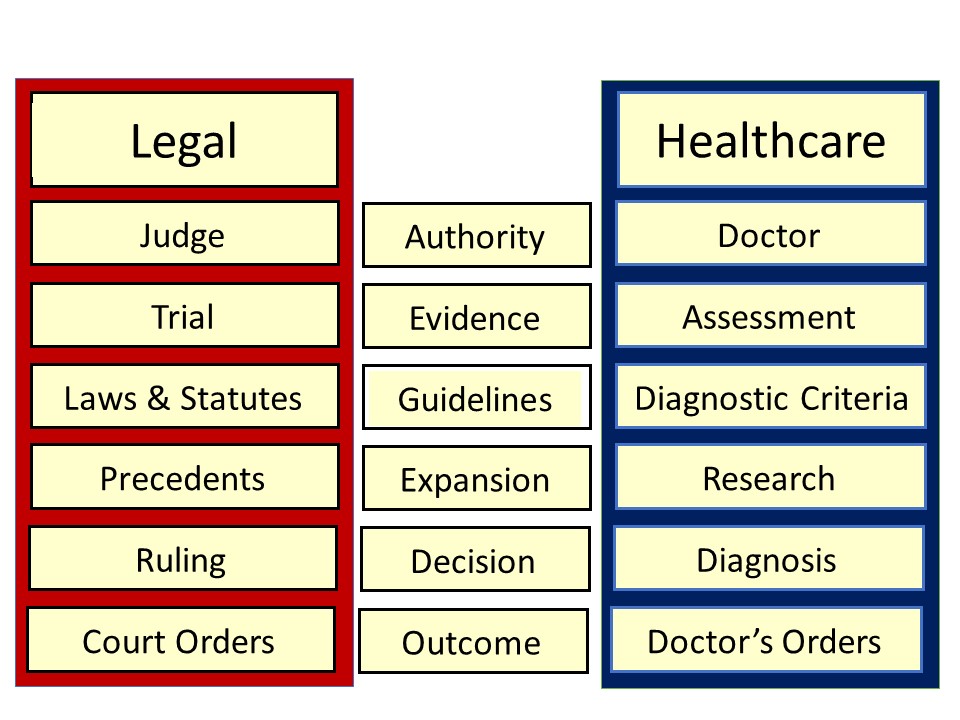
Healthcare & Legal: Two Parallel Systems

There are two parallel and co-equal systems – healthcare and legal. They are built around identical structures to serve different roles and functions.

Authority:

Legal: judges
Healthcare: doctors

Fact Finding:

Legal: trials
Healthcare: clinical interviews

Facts:

Legal: evidence
Healthcare: symptoms

Applied Knowledge:

Legal: laws & statutes
Healthcare: diagnostic criteria

Modified Knowledge

Legal: precedents
Healthcare: research

Decision

Legal: ruling by judge
Healthcare: diagnosis by doctor

Outcome:

Legal: court orders
Healthcare: doctor’s orders

There are two separate and co-equal systems that serve different roles and functions.

Pathology in the family is a treatment issue and is within the scope of the Healthcare system to resolve. When the courts are also involved, the two systems must exchange the child and family back-and-forth to resolve the pathology in the family.

Professionally, we must first diagnose what the pathology is before we know how to treat it, i.e., we must first identify what the problem is before we know how to fix it.

Diagnose = identify
Pathology = problem
Treatment = fix it

When mental health pathology (a family problem) enters the courts, it needs to be turned back into the mental healthcare system to receive a proper assessment, that leads to an accurate diagnosis, that will guide the development of an effective treatment plan.

Once this diagnosis and written treatment plan is returned from the doctors in the healthcare system, then this becomes evidence within the legal system. The legal system then applies its rules and procedures to its evidence to make its decisions based on the law and circumstance.

The two systems must work back-and-forth together, each performing its role within the limits and scope of its role. Clinical psychology offers no recommendations on child custody, that is the court’s role and decision.  It is not the role of doctors to determine who “deserves” to be a parent. Doctors can identify (diagnose) the problem (pathology) and tell you how to fix it (treatment).

Treatment vs Custody Approaches

The position of clinical psychology regarding child custody is that, in the absence of child abuse, each parent should have as much time and involvement with the child as possible.

In the absence of child abuse, parents have the right to parent according to their cultural values, their personal values, and their religious values. In the absence of child abuse, professional psychology should not intrude onto these fundamental parental rights to be parents. If there are problems, we fix them through a written treatment plan with specified Goals, Interventions, Timeframes, and Outcome Measures.

Google “mental health treatment plans” and read the top two returns for a description of a written treatment plan with Goals, Interventions, Timeframes, and Outcome Measures, so standard of practice that the description returns on a simple Google search.

Is there child abuse? DSM-5 V995.51 Child Psychological Abuse. That is the question of concern.  That is the question clinical psychology can answer.

It is the obligation of clinical psychology to accurately diagnose child abuse when it is present, and it is the obligation of clinical psychology to protect the child 100% of the time.

When possible child abuse is a considered diagnosis, the diagnosis from healthcare must be accurate 100% of the time. The consequences for the child of misdiagnosing child abuse are too severe and destructive.

In healthcare, the appellate system for a disputed diagnosis is second opinion, or even third. Throughout all of healthcare, diagnosis guides treatment, if we treat cancer with insulin the patient dies from the misdiagnosed and mistreated cancer. In healthcare, our diagnosis must be accurate 100% of the time because when we misdiagnose and mistreatment pathology people get hurt – badly hurt.

Misdiagnosis is unacceptable.  Diagnosis guides treatment.  Always.  An accurate diagnosis is needed to guide effective treatment for the pathology (for the problem).

When possible child abuse is a considered diagnosis, as it often is in the family courts, the diagnosis from the mental healthcare system must be accurate 100% of the time, and since it is anticipated to be a disputed diagnosis, a second opinion consultation should be common and frequent in court-involved clinical psychology.

The Application of Knowledge

All psychologists should be applying the same knowledge and information (the best) to reach exactly the same diagnostic conclusions (accurate), with the same recommendations (effective).  Second opinion consultation improves decision-making and the quality of healthcare received by the patient.

Standard 2.04 Bases for Scientific and Professional Judgments
Psychologists’ work is based upon established scientific and professional knowledge of the discipline. (APA Ethics Code)

The established scientific and professional knowledge of the discipline is:

Attachment – Bowlby and others
Family systems therapy – Minuchin and others
Personality disorders – Beck and others
Complex trauma – van der Kolk and others
Child development – Tronick and others
Self Psychology – Kohut and others
ICD-10 & DSM-5 diagnostic systems

In the legal system, the appellate process is applied in sequence, first the ruling by the judge and then the appeal. In the healthcare system, on the other hand, the appellate process begins early and is used often, doctors consult with each other before reaching a diagnostic decision, and will often reach a consensus diagnostic opinion through consultation.

The healthcare and legal systems are different systems built on the same underlying structures. In healthcare, the doctors are the “judges” and there are no attorney-level roles, the doctors conduct the clinical interviews personally (“try the case”), and doctors then consult in second, or even third, opinions frequently and easily (the appellate system for diagnosis).

For example, when a patient goes to their primary care physician with a pain, if the pathology is unusual the primary care physician may refer to a specialist doctor for a specialized assessment. This specialist may then also seek consultation from a third doctor specialist if the case has complex features. Referrals for second opinion is common practice in healthcare.

Consultation among doctors (the “judges” in the healthcare system) happens early, often, and easily. This improves the accuracy of diagnosis and the quality of decision making and patient care.

In court-involved family conflict, the diagnosis is anticipated to be disputed, so the diagnosis and treatment plans for court-involved family conflict should almost always be supported by second opinion for clarity and certainty in the court’s subsequent decisions.

The consulting second opinion should concur with the diagnosis given by the primary involved doctor.  If a significant dissent occurs regarding the diagnosis, then a consulting third opinion should be sought from another doctor specialized in the field, forming a three-doctor appellate panel for the diagnosis and recommended treatment plan.  That’s how the healthcare system works to reach its decisions.  The appellate system for a disputed diagnosis is second opinion, and it is activated early and often.

Custody & Child Abuse

In the absence of child abuse, each parent should have as much time and involvement with the child as possible.

The question is, is there child abuse?

When child abuse is a considered diagnosis, our diagnosis must be accurate 100% of the time. The consequences of misdiagnosing child abuse for the child are too severe.

Tele-medicine and tele-psychology allows doctors to consult easily through secure Internet videoconferencing platforms. Remote testimony is also easily handled now by the courts following their adjustments for Covid. We live in an emerging age of the Internet. This provides substantial advantages for both the healthcare and legal systems in successfully resolving court-involved family conflict.

To achieve solutions for the child’s healthy development, the two systems must work in cooperation toward achieving an effective treatment plan to successfully resolve the family conflict, with each system performing their role in parallel structures, that will allow us to return to the child a healthy and normal-range childhood.

Craig Childress, Psy.D.
Clinical Psychologist, CA PSY 18857

Domains of Specialized Professional Background

I am appending my vitae in support of three domains of specialized expertise in professional psychology:

1.) Thought disorders and delusional pathology

2.) Child abuse assessment, diagnosis, and treatment

3.) The attachment system and attachment pathology

Thought Disorders & Delusions

In support of my specialized expertise in the assessment and diagnosis of thought disorders and delusions are 12 years of experience at a major UCLA clinical research project on schizophrenia where I received annual training in the assessment and diagnosis of delusions and thought disorders using the Brief Psychiatric Rating Scale (BPRS) to diagnostic reliability of r=.90 to the co-directors of the Diagnostic Unit at the UCLA-Brentwood VA, Dr. Lukoff and Dr. Ventura.  The entry on my vitae for this work experience while I was at Dr. Nuechterlein’s project at UCLA is:

9/85 – 9/98  Research Associate
UCLA Neuropsychiatric Institute
Principle Investigator: Keith Nuechterlein, Ph.D.

Area: Longitudinal study of initial-onset schizophrenia. Received annual training to research and clinical reliability in the rating of psychotic symptoms using the Brief Psychiatric Rating Scale (BPRS).  Managed all aspects of data collection and data processing.

Note that I was trained annually in the rating of delusional and psychotic symptoms using the Brief Psychiatric Rating Scale (BPRS).  Wikipedia describes the BPRS:

From Wikipedia: “The Brief Psychiatric Rating Scale (BPRS) is a rating scale which a clinician or researcher may use to measure psychiatric symptoms such as depression, anxiety, hallucinations and unusual behaviour. The scale is one of the oldest, most widely used scales to measure psychotic symptoms and was first published in 1962.

From Wikipedia: “An expanded version of the test was created in 1993 by D. Lukoff, Keith H. Nuechterlein, and Joseph Ventura.”[6]

The Expanded version cited by Wikipedia links to a professional reference available online from Drs. Nuechterlein, Ventura, and Lukoff, note the date of the revision – 1993.  Note where I was from 1985-to-1998, i.e., at Dr. Neuchterlein’s UCLA research project being annually trained in the assessment and diagnosis of delusional and thought disorder pathology to an r=.90 diagnostic reliability with the co-directors of the Diagnostic Unit at the UCLA-Brentwood VA and authors of the Expanded BPRS, Dr. Ventura and Dr. Lukoff.  I have considerable professional training, background, and experience in assessing and diagnosing thought disorders and delusional pathology,

Child Abuse Pathology

Regarding my background in child abuse pathology, I served as the Clinical Director for a three-university assessment and treatment center for children ages zero-to-five in the foster care system.  Our primary referral source was Child Protective Services (CPS).  I have personally worked with all four DSM-5 child abuse diagnoses and have led and supervised the multi-disciplinary assessment and treatment of child abuse as the Clinical Director for a three-university treatment center.  The entry for this experience on my vitae is:

10/06 – 6/08:  Clinical Director

START Pediatric Neurodevelopmental Assessment and Treatment Center
California State University, San Bernardino
Institute of Child Development and Family Relations

Clinical director for an early childhood assessment and treatment center providing comprehensive developmental assessment and psychotherapy services to children ages 0-5 years old.  Directed the clinical operations, clinical staff, and the provision of comprehensive psychological assessment and treatment services across clinic-based, home-based, and school-based services. A three-university collaboration with speech and language services through the University of Redlands, occupational therapy through Loma Linda University, and psychology through Calif. State University, San Bernardino.

Attachment System & Attachment Pathology

I have specialty background in Early Childhood Mental Health, ages zero-to-five.  This is a specialty domain of practice because it requires extensive knowledge of brain development in infancy through the first five years of life.  Early Childhood Mental Health specialization requires understanding the neuro-development of each brain system individually (cognitive, language, sensory-motor, emotional, memory, relationship) as well as how they integrate with each other at each developmental period of maturation in the first year of infancy and beyond into all the subsequent maturational changes.

The period of early childhood is directly the developmental period of the child’s early attachment formation to the parent.  With this specialty background, I know two additional diagnostic systems for early childhood besides the DSM-5 and ICD-10, the DC:0-3 which is more attachment sensitive and the DMIC which is stronger with autistic spectrum disorders.  I also know two early childhood attachment therapies, Watch, Wait, and Wonder for infants and Circle of Security for preschool-age children, and I am Certified in Infant Mental Health.

The attachment system is the brain system that governs all aspects of love and bonding throughout the lifespan, including grief and loss.  The attachment system develops its patterns for love-and-bonding during childhood and then we use these internalized patterns for love-and-bonding (attachment) to guide our expectations and our approach to all future love and bonding experiences in adulthood.  The clinical domain of attachment and attachment pathology is Early Childhood Mental Health specialization, and my clinical experience is with children ages zero-to-five in foster care, which is directly attachment pathology.  A child rejecting a parent is a problem in attachment, a problem in the love-and-bonding system of the brain,

I have specialized professional background, training, and expertise in multiple relevant domains of knowledge, 1) thought disorders and delusions, 2) child abuse pathology, and 3) the attachment system and attachment pathology.  I also am trained in family systems therapy (Bowlby, Minuchin, Haley, Madanes, Satir), and I have worked with court-involved family conflict for the past decade, with professional presentations to the American Psychological Association, the Association of Family and Conciliation Courts, an invited presentation at the Erasmus Medical Center in the Netherlands, and an invited presentation to the Law Society of Saskatchewan. 

I have a broad array of directly relevant domains of professional background and experience.

Dr. Childress Vitae:

Click to access 1-childress-vitae-8-1-21-BI.pdf


Attachment Pathology in the Family Courts

C.A. Childress, Psy.D. (2021)

The pathology of concern in the family courts is an attachment pathology that potentially rises to the level of child abuse.  When a potential child abuse diagnosis is a consideration, the diagnosis returned from the mental health care system for the Court’s consideration in its decisions must be accurate 100% of the time. 

The consequences of an incorrect decision by the Court when a child abuse diagnosis is involved can be severe for the child.  Leaving a child with an abusive parent can lead to the destruction of the child’s life.  When a child abuse diagnosis is among the possible differential diagnoses for the child’s symptom display, the diagnosis returned from the mental health care system for the Court’s consideration must be accurate 100% of the time.

If there is any question, if there is any dispute about the diagnosis (and the diagnosis is anticipated to be disputed in court-involved family conflict), then get a second opinion, or even a third.  When a possible child abuse diagnosis is involved, do whatever it takes to make sure the diagnosis that is returned from the assessment is accurate. 

The appellate system in healthcare for a disputed diagnosis is second opinion, or even a third.  The damage done to the child from a misdiagnosis of child abuse is too severe.  When child abuse by a parent is a diagnostic consideration, which it is with severe attachment pathology displayed by a child, then the diagnosis returned from the mental health care system must be accurate 100% of the time. 

The Pathology

The pathology of clinical concern for the family is a possible shared persecutory delusion created by the pathogenic parenting of the allied parent, a thought disorder in the allied parent from unresolved trauma that is being imposed on the child, which then destroys the child’s attachment bond to the other parent. 

In this pathology, the allied parent forms a cross-generational coalition (Haley)[1] with the child against the targeted parent, resulting in an emotional cutoff in the child’s attachment bond to the targeted parent.  The allied parent is triangulating the child into the spousal conflict to use the child as a weapon of spousal revenge and emotional abuse directed at the ex-spouse, i.e., Intimate Partner Violence (IPV), the emotional abuse of the ex-spouse using the child as the weapon.  In weaponizing the child into the spousal conflict, the allied parent creates such significant pathology in the child that it rises to the level of a DSM-5 diagnosis of psychological child abuse. 

The needed risk assessments for the family pathology surrounding court-involved family conflict are for:

  • Child Abuse: potential child abuse by the targeted parent (to be specified), or potential psychological child abuse by the allied parent (DSM-5 V995.51 Child Psychological Abuse)
  • Spousal Abuse: potential IPV emotional abuse of the ex-spouse and parent using the child as the weapon (DSM-5 V995.82 Spouse or Partner Abuse, Psychological)

Whenever child abuse is a diagnostic consideration, the diagnosis returned from the mental health care system must be accurate 100% of the time.  The Court needs an accurate diagnosis for its decisions, and the child needs an accurate diagnosis when the potential diagnosis is child abuse by a parent. 

There are four DSM-5 diagnoses of child abuse, each DSM-5 diagnosis of child abuse warrants a proper risk assessment; Child Physical Abuse (V995.54), Child Sexual Abuse (V995.53), Child Neglect (V995.52), Child Psychological Abuse (V995.51).  All of these child abuse diagnoses are equivalent in the severity of the damage they do to the child, they differ only in the type of damage done, not in the severity of damage done to the child.  Psychological child abuse destroys the child from the inside out.

When a child rejects a parent, the clinical concern is child abuse, the diagnostic questions is, which parent?  When the possible diagnosis is child abuse by a parent, both the child and the Court require that a proper risk assessment be conducted that will reach an accurate diagnosis 100% of the time. 

If the diagnosis is disputed, the appellate system in healthcare is not litigation in the courts, it’s second opinion, or even a third opinion from other doctors.   All doctors, all psychologists, should be applying exactly the same sets of knowledge (the best) to reach exactly the same conclusions (accurate) and recommendations (successful).   Standard 2.04 of the Ethical Principles of Psychologists and Code of Conduct of the American Psychological Association requires that the established scientific and professional knowledge of the discipline serve as the bases for professional judgments.

  • 2.04 Bases for Scientific and Professional Judgments
    Psychologists’ work is based upon established scientific and professional knowledge of the discipline.

The established scientific and professional knowledge of the discipline surrounding court-involved family conflict is:

  • Attachment – Bowlby and others
  • Family systems therapy – Minuchin and others
  • Personality disorders – Beck and others
  • Complex trauma – van der Kolk and others
  • Child development – Tronic and others
  • Self psychology – Kohut and others
  • ICD-10 & DSM-5 diagnostic systems

Diagnosis is a pattern-match of the symptoms to the diagnostic criteria.  If there is a disputed application of the diagnostic criteria to a set of symptoms, get a second opinion, or even a third if necessary.  When the potential diagnosis is child abuse, we must not get it wrong.  We must be accurate in our diagnosis 100% of the time.  Misdiagnosis hurts people – badly.  A misdiagnosis of child abuse is extremely bad.

Misdiagnosis of a shared persecutory delusion has particularly troubling implications.  If you believe a shared delusion then you become part of the shared delusion, you become part of the pathology.  When the pathology is child abuse, you become part of the child abuse. 

If the involved mental health professional misdiagnoses the pathology and believes the delusional disorder as if it were real, and if the Court then makes its decisions based on the false beliefs of a pathological parent that are misdiagnosed, then they all become part of the shared delusion, they all become part of the pathology, they all become part of the child abuse. 

The potential damage from the misdiagnosis of a shared delusional disorder and child abuse can be severe, and the potential implications for the involved professionals can be profound.  The diagnosis returned from the mental health system must be accurate 100% of the time.  

Attachment Pathology

A child rejecting a parent is an attachment pathology, a problem in the love-and-bonding system of the brain.  There are two potential causes, 1) child abuse by the targeted-rejected parent (to be specified by the assessment), or 2) child psychological abuse by the allied parent who is using the child as a weapon of IPV spousal abuse (Intimate Partner Violence; i.e., emotional abuse of the ex-spouse using the child as the weapon).

A child rejecting a parent is a problem in love-and-bonding.  A child rejecting a parent is an attachment pathology, a problem in the love-and-bonding system of the brain.  The attachment system is the brain system governing all aspects of love and bonding throughout the lifespan, including grief and loss.  It is a primary motivational system of the brain, like other primary motivational systems for eating and sex.  A breach in the attachment bonding between children and their parents is a pathology in a primary motivational system of the brain, the love-and-bonding system; the attachment system. 

There is no more severe form of attachment pathology than the termination of the child’s attachment bond to the parent.  There is nothing worse in terms of attachment pathology, for pathology in a primary motivational system of the brain, than a severing of the parent-child attachment bond.  That is as bad as attachment pathology in childhood gets, pathology in a primary motivational system of the brain that is developing its patterns to guide love-and-bonding throughout the lifespan during childhood through the relationship bonds with both parents.  A child rejecting a parent is the worst possible attachment pathology in childhood.

To understand the severity we can use an analogy to another primary motivational system, the eating system.  The worst possible eating pathology is anorexia, the person refuses to eat, their bond to food is completely severed, they starve, and they die.  By analogy, a complete severing of a child’s attachment bond to a parent represents “anorexia” of the attachment system, the worst possible form of attachment-related pathology. 

There is nothing worse in terms of attachment pathology, that’s as bad as it gets.  It is exceedingly important for the healthy development of children that their attachment pathology toward their mothers and fathers be effectively treated and resolved as quickly as is possible. 

The differential diagnosis for the attachment pathology (i.e., for a child’s rejection of a parent) is that either 1) the parent who is the target of rejection is causing the attachment breach through possibly severe maltreatment of the child, or 2) the allied parent is creating the attachment breach through their extremely problematic parenting, called a “cross-generational coalition” with the child against the other parent.  The coalition of the child with one parent against the other parent leads to the “emotional cutoff” in the child’s attachment bond to the targeted parent out “loyalty” to the coalition with the allied parent.

            The diagnosis of clinical concern is potential Child Psychological Abuse (pathogenic parenting) by the allied parent (DSM-5 V995.51), a thought disorder in the allied parent (a persecutory delusion) that is being imposed on the child, destroying the child’s attachment bond to the other parent in spousal revenge and retaliation for the failed marriage and divorce (DSM-5 V995.82 Spouse or Partner Abuse, Psychological).  This needs a proper assessment to reach an accurate diagnosis to guide both the Court’s decisions and the development of an effective treatment plan.

Family Systems Therapy

There are four primary schools of psychotherapy; psychoanalytic (Freud and the couch), humanistic-existential (self-actualization and growth), cognitive-behavioral (B.F. Skinner, rewards and punishment), and family systems therapy (describing how families work and how to fix problems in families).  Of the four primary schools of psychotherapy, the appropriate school for developing a treatment plan for resolving family conflict is family systems therapy (Minuchin, Bowen, Haley, Madanes, Satir).   Parents and the Court will want an assessment of the family conflict and attachment pathology that applies the constructs of family systems therapy toward resolving the family conflict. 

The family systems diagnostic description of concern for assessment would be that the child is being triangulated into the spousal conflict through the formation of a cross-generational coalition with one parent against the other parent, that is then resulting in an emotional cutoff in the child’s attachment bond to the targeted parent.  This specific pathology is depicted by a Structural family diagram from the preeminent family systems therapist, Salvador Minuchin. 

This Structural family diagram depicts the relationship pattern of concern, a cross-generational coalition of a father with his son against the mother.  The triangle pattern to the family relationships is clearly evident in the diagram, i.e., the child becomes “triangulated” into the spousal conflict by the alliance with the father against the mother.

Also evident is a symptom feature called the inverted hierarchy in which the child becomes over-empowered by the coalition with the allied parent into an elevated position in the family hierarchy above that of the mother, from which the child becomes empowered (by the allied parent’s support) to judge the adequacy of the other parent as if the other parent were the child and the child were the parent.  In the Structural family diagram from Minuchin, this symptom feature of the inverted hierarchy is reflected in the child’s elevated position above the hierarchy line to be with the father in a “co-parenting” role over the mother, who is in the child’s relative position, and who’s adequacy as a parent is being judged by the child.

  • From Krugman: “The child is elevated into the parental hierarchy and the system is stabilized through role reversal.  The child may thus be either covertly allied with one parent against the other, or parentified and obliged to care for a parent.” (p. 139)[3]

The emotional cutoff  caused by the cross-generation coalition is reflected in the broken lines from the child to the mother, and from the father to the mother.  An emotional cutoff is created by unresolved trauma in the parent being transferred to the child through aberrant and distorted parenting practices, called multi-generational trauma by Bowen (Bowen; Titelman).[4]

The three lines joining the father and son in the diagram represent a psychologically fused and over-involved relationship called enmeshment (i.e., the psychological control of the child), which leads to the emotional cutoff in the child’s attachment bond to the other parent.   In the Journal of Emotional Abuse, Kerig notes the intertwined relationship between enmeshment and disengagement within families,

  • From Kerig: “Enmeshment in one parent-child relationship is often counterbalanced by disengagement between the child and the other parent (Cowan & Cowan, 1990; Jacobvitz, Riggs, & Johnson, 1999).” (p. 10)[5]

An enmeshed and psychologically over-intrusive parent-child bond is a very destructive psychological relationship for a child to have with a parent, and it is why Jay Haley, the co-founder of Strategic family systems therapy, calls the cross-generational coalition a “perverse triangle,” i.e., because it violates the child’s psychological self-integrity and boundaries.  The psychological boundaries and self-autonomy of the child should always be respected by the parent, but are violated by a cross-generational coalition. 

  • From Kerig: “The breakdown of appropriate generational boundaries between parents and children significantly increases the risk for emotional abuse.” (p. 6)
  • From Kerig: “Rather than telling the child directly what to do or think, as does the behaviorally controlling parent, the psychologically controlling parent uses indirect hints and responds with guilt induction or withdrawal of love if the child refuses to comply. In short, an intrusive parent strives to manipulate the child’s thoughts and feelings in such a way that the child’s psyche will conform to the parent’s wishes.” (p. 12)

This is the pathology of clinical concern relative to the family conflict and attachment pathology in the family courts, and this is the family pathology that requires a focused diagnostic assessment.   

Psychological Control of the Child

Psychological control of the child by a parent is a scientifically established family relationship pattern in dysfunctional family systems.  In his book regarding parental psychological control of children, Intrusive Parenting: How Psychological Control Affects Children and Adolescents,[6] published by the American Psychological Association, Brian Barber and his colleague, Elizabeth Harmon, identify over 30 empirically validated scientific studies that have established the construct of parental psychological control of children. 

In Chapter 2 of Intrusive Parenting: How Psychological Control Affects Children and Adolescents, Barber and Harmon define the construct of parental psychological control of the child:

  • From Barber & Harmon: “Psychological control refers to parental behaviors that are intrusive and manipulative of children’s thoughts, feelings, and attachment to parents.  These behaviors appear to be associated with disturbances in the psychoemotional boundaries between the child and parent, and hence with the development of an independent sense of self and identity.” (Barber & Harmon, 2002, p. 15)[7]

According to Stone, Bueler, and Barber:

  • From Stone, Bueler, & Barber: “The central elements of psychological control are intrusion into the child’s psychological world and self-definition and parental attempts to manipulate the child’s thoughts and feelings through invoking guilt, shame, and anxiety.  Psychological control is distinguished from behavioral control in that the parent attempts to control, through the use of criticism, dominance, and anxiety or guilt induction, the youth’s thoughts and feelings rather than the youth’s behavior.” (Stone, Buehler, & Barber, 2002, p. 57)[8]

Soenens and Vansteenkiste (2010) describe the various parental methods used to achieve psychological control over the child:

  • From Soenens & Vansteenkiste: “Psychological control can be expressed through a variety of parental tactics, including (a) guilt-induction, which refers to the use of guilt inducing strategies to pressure children to comply with a parental request; (b) contingent love or love withdrawal, where parents make their attention, interest, care, and love contingent upon the children’s attainment of parental standards; (c) instilling anxiety, which refers to the induction of anxiety to make children comply with parental requests; and (d) invalidation of the child’s perspective, which pertains to parental constraining of the child’s spontaneous expression of thoughts and feelings.” (Soenens & Vansteenkiste, 2010, p. 75)[9]

Stone, Buehler, and Barber (2002) describe the link between psychological control of the child and the cross-generational coalition formed with one parent against the other parent:

  • Stone, Buehler, & Barber: “The concept of triangles “describes the way any three people relate to each other and involve others in emotional issues between them” (Bowen, 1989, p. 306).  In the anxiety-filled environment of conflict, a third person is triangulated, either temporarily or permanently, to ease the anxious feelings of the conflicting partners.  By default, that third person is exposed to an anxiety-provoking and disturbing atmosphere.  For example, a child might become the scapegoat or focus of attention, thereby transferring the tension from the marital dyad to the parent-child dyad.  Unresolved tension in the marital relationship might spill over to the parent-child relationship through parents’ use of psychological control as a way of securing and maintaining a strong emotional alliance and level of support from the child.  As a consequence, the triangulated youth might feel pressured or obliged to listen to or agree with one parents’ complaints against the other.  The resulting enmeshment and cross-generational coalition would exemplify parents’ use of psychological control to coerce and maintain a parent-youth emotional alliance against the other parent (Haley, 1976; Minuchin, 1974).” (Stone, Buehler, & Barber, 2002, p. 86-87)

Diagnosis Guides Treatment

Parents and the Court will need a written treatment plan.  Google “mental health treatment plans” and read the first two returns.  Those are descriptions of the structure for a written treatment plan.  To formulate a written treatment plan will require a diagnosis.  The treatment for cancer is different than the treatment for diabetes – diagnosis guides treatment.  In order to obtain an accurate diagnosis, parents the the Court will need an appropriate assessment of the child’s attachment pathology.

Appropriate Assessment

An appropriate assessment for the type of attachment-bonding pathology in the family courts involves three components representing a trauma-informed clinical psychology assessment of the child’s attachment pathology

  • Trauma-informed: A “trauma informed” assessment ensures the proper application of information sets from complex trauma and the multi-generational transmission of trauma from a parent to a child.
  • Clinical psychology: A clinical psychology assessment is focused toward developing a written treatment plan (as contrasted with a “forensic psychology” assessment focused on child custody schedules).  Clinical psychology is focused on treatment.
  • Attachment pathology: The goal of the assessment is on developing a written treatment plan to resolve the children’s attachment pathology relative to their parents.  This involves the application of information sets surrounding the attachment system in childhood.

Assessment is always directed toward answering a referral question. The recommended referral question for a trauma-informed clinical psychology assessment of a child’s attachment pathology displayed toward a parent surrounding divorce would be,

  • Referral Question for Assessment:  Which parent is the source of pathogenic parenting[11] creating the child’s attachment pathology, and what are the treatment implications?

Obtaining an Accurate Diagnosis

The differential diagnosis for attachment pathology is between severely problematic parenting by the targeted parent (i.e., child abuse) or severely pathogenic parenting by the allied parent (i.e., a cross-generational coalition of the child and parent).  A trauma-informed clinical psychology assessment of the child’s attachment pathology should address this differential diagnosis. 

There are three diagnoses that parents and the Court will want returned from the trauma-informed diagnostic assessment of the family surrounding children’s attachment pathology:

 1) ICD-10 Diagnosis 

The ICD-10 diagnostic system is from the World Health Organization.  It is the formal diagnostic classification coding system for all medical and psychiatric diagnoses, from high blood pressure, to cancer, to diabetes, to depression, to ADHD.  The ICD-10 diagnostic system is the formal diagnostic system internationally, and in the U.S. it is used as the diagnostic coding system for all medical and psychiatric pathology for insurance billing purposes.

The ICD-10 diagnosis of concern for attachment pathology in the family courts is a possible thought disorder emanating from the allied parent’s influence and affecting the child, an ICD-10 diagnosis of F24, a shared persecutory delusion of the child with the allied parent, with the parent as the “primary case” (also called the “inducer”).  This is the description of a shared delusional disorder from the American Psychiatric Association:

  • From the APA:  “Usually the primary case in Shared Psychotic Disorder is dominant in the relationship and gradually imposes the delusional system on the more passive and initially healthy second person…  Although most commonly seen in relationships of only two people, Shared Psychotic Disorder can occur in larger number of individuals, especially in family situations in which the parent is the primary case and the children, sometimes to varying degrees, adopt the parent’s delusional beliefs.” (American Psychiatric Association, 2000, p. 333)

2) DSM-5 Diagnosis

The DSM-5 diagnostic system is from the American Psychiatric Association.  It is a specialty diagnostic system focused solely on psychiatric disorders (as contrasted with the ICD-10 that is both medical and psychiatric diagnostic codes).  In its more specialty focus, the DSM-5 offers greater descriptive elaboration on each psychiatric disorder.  The ICD-10 is the diagnostic coding system, the DSM-5 is the description.  Parents and the Court will want the assessment to generate both. 

For the pathology of concern, the ICD-10 diagnosis is F24 Shared Psychotic Disorder (a shared persecutory delusion), and the DSM-5 diagnosis for creating a thought disorder in the child that then destroys the child’s attachment bond to the other parent would be V995.51 Child Psychological Abuse.  These specific diagnoses should be part of the differential diagnoses considered by the assessment.

3) Case Conceptualization Diagnosis – Family Systems Therapy

The “case conceptualization” diagnosis is the organizing framework for the treatment.  The treatment approaches available for resolving family pathology are guided by the constructs and principles of family systems therapy, one of the four primary schools of psychotherapy.  To develop a written treatment plan we also need a case-conceptualization diagnosis from family systems therapy (as contrasted with the “categorical” diagnoses of the ICD-10 and DSM-5).

The family systems pathology of concern is that the child is being triangulated into the spousal conflict through the formation of a cross-generational coalition with the allied parent against the targeted parent, resulting in an emotional cutoff in the child’s relationship to the targeted parent.

  • Triangulated: Child put in the middle.
  • Cross-generational coalition: the problematic parenting of the allied parent.
  • Emotional cutoff: a family member rejecting a family member; a child rejecting a parent (caused by “multi-generational” unresolved trauma originating in the parent).

Treatment Considerations

Diagnosis guides treatment.  If a thought disorder (shared persecutory delusion) is present, then the DSM-5 diagnosis would be Child Psychological Abuse (V995.51).  In all cases of child abuse, the standard of practice and professional duty to protect requires the child’s protective separation from the abusive parent.  The child’s normal-range and healthy development is then recovered and restored.  Once the child’s healthy development has been recovered, contact with the abusive parent is reestablished with enough safeguards in place to ensure that the child abuse does not resume when contact with the abusive parent is restored.

With regard to treatment for a shared delusional disorder, the American Psychiatric Association twice indicates that a protective separation of the child from the primary case (the “inducer”) will resolve the child’s delusional beliefs.

  • From the APA: “If the relationship with the primary case is interrupted, the delusional beliefs of the other individual usually diminish or disappear.” (American Psychiatric Association, 2000, p. 333)
  • From the APA: “Course – Without intervention, the course is usually chronic, because this disorder most commonly occurs in relationships that are long-standing and resistant to change.  With separation from the primary case, the individual’s delusional beliefs disappear, sometimes quickly and sometimes quite slowly.” (American Psychiatric Association, 2000, p. 333)

The assessment for a thought disorder pathology is a Mental Status Exam of thought and perception.  For more information on the Mental Status Exam of thought and perception, Google the search term “mental status exam” and read the NCBI return, Chapter 207 of Clinical Methods, scroll to the section on Thought and Perception.  That is the clinical assessment for a possible thought disorder pathology, i.e., a Mental Status Exam of thought and perception.

Treatment Plan

A treatment plan is structured around four major components – Goals – Interventions – Timeframes – Outcome Measures.  For a description of mental health treatment plans, I recommend a Google search for the term “mental health treatment plans” and read the top two returns.  The structure for a mental health treatment plan is so standard-of-practice it returns on a simple Google search.  The family therapy should be guided by a written treatment plan that follows this standard of professional practice and should include:

  • Short- and long-term goals, identified in measurable ways,
  • Specified interventions to achieve those goals,
  • Timeframes for achieving the treatment goals, with measurable benchmarks,
  • Treatment outcome data collection on symptoms and recovery

The type of therapy should be trauma-informed family therapy.  The pathology creating the children’s attachment pathology involves the trans-generational transmission of trauma (van der Kolk), also called multi-generational family trauma (Bowen).  The additional information sets from complex trauma and personality disorders provide valuable additions to the established constructs of family systems therapy. 

An additional focus on the work of Marsha Linehan surrounding the “invalidating environment” that is created by a pathogenic parent would also be particularly helpful for treatment,

  • From Linehan: “A defining characteristic of the invalidating environment is the tendency of the family to respond erratically or inappropriately to private experience and, in particular, to be insensitive (i.e., nonresponsive) to private experience… Invalidating environments contribute to emotional dysregulation by: (1) failing to teach the child to label and modulate arousal, (2) failing to teach the child to tolerate stress, (3) failing to teach the child to trust his or her own emotional responses as valid interpretations of events, and (4) actively teaching the child to invalidate his or her own experiences by making it necessary for the child to scan the environment for cues about how to act and feel.” (p. 111-112)[12]
  • From Linehan: “They tend to see reality in polarized categories of “either-or,” rather than “all,” and within a very fixed frame of reference. For example, it is not uncommon for such individuals to believe that the smallest fault makes it impossible for the person to be “good” inside. Their rigid cognitive style further limits their abilities to entertain ideas of future change and transition, resulting in feelings of being in an interminable painful situation. Things once defined do not change.  Once a person is “flawed,” for instance, that person will remain flawed forever.” (p. 35)[13]
  • From Fruzzetti et al: “In extremely invalidating environments, parents or caregivers do not teach children to discriminate effectively between what they feel and what the caregivers feel, what the child wants and what the caregiver wants (or wants the child to want), what the child thinks and what the caregiver thinks.” (p. 1021)[14]

Family systems therapy is a primary school of psychotherapy and it is the appropriate school of psychotherapy to apply to resolving family conflict (Minuchin, Bowen, Haley, Madanes, Satir).  The case conceptualization for treatment should derive from the application of family systems therapy constructs (i.e., triangulation, cross-generational coalition, emotional cutoff). 

Adjunctive Solution-Focused Therapy:

The addition of Solution-Focused Therapy[15] (Berg) will provide an additional important trauma recovery component that will substantially improve prognosis for treatment efficacy.  Trauma pathology pulls toward an unsolvable past.  The present and future orientation of solution-focused family therapy will counteract the pull of trauma toward an unsolvable fixation on the past.

Treatment Goals

Restoring the healthy attachment bonds of children with their mothers and fathers is of high and immediate priority.  Healthy and affectionate attachment bonds between children and their parents need to be restored as quickly as possible. 

The parent-child attachment bond is too important to a child’s healthy psychological development to remain unrepaired when damaged, and lost time during childhood can never be recovered.  Childhood is once.  The goal of psychotherapy is not merely to eliminate pathology, the goal is to achieve healthy child development.  The goal of psychotherapy is to achieve a healthy attachment system in the child, with a healthy attachment bond to their mother and to their father – neither parent is expendable, and both are vital to the child’s healthy development. 

In American Psychologist,[16] the primary journal of the American Psychological Association, Mary Ainsworth, a leading figure in attachment research provides the following description of a healthy attachment bond:

  • From Ainsworth:  “I define an “affectional bond” as a relatively long-enduring tie in which the partner is important as a unique individual and is interchangeable with none other.  In an affectional bond, there is a desire to maintain closeness to the partner.  In older children and adults, that closeness may to some extent be sustained over time and distance and during absences, but nevertheless there is at least an intermittent desire to reestablish proximity and interaction, and pleasure – often joy – upon reunion.  Inexplicable separation tends to cause distress, and permanent loss would cause grief.” (p. 711)
  • From Ainsworth:  “An ”attachment” is an affectional bond, and hence an attachment figure is never wholly interchangeable with or replaceable by another, even though there may be others to whom one is also attached.  In attachments, as in other affectional bonds, there is a need to maintain proximity, distress upon inexplicable separation, pleasure and joy upon reunion, and grief at loss.” (p. 711)

A child rejecting a parent is the worst attachment pathology possible in childhood, pathology in a primary motivational system of the brain developing its patterns to guide love-and-bonding throughout the lifespan during childhood, through relationships with both parents.  Leaving the worst possible attachment pathology untreated and unrepaired is the worst possible thing we can do. 

It is always in the child’s best interests to have a healthy and normal-range attachment bond to both parents.  It is always in the child’s best interests for the family to make a successful transition to a healthy and normal-range post-divorce separated family structure.  Successful treatment that restores a healthy and normal-range attachment bond between children and their parents is always in the child’s best interests.

The child unites two families into the very fabric of their being, two family lineages, two family heritages, two family cultures are brought together and united in who they are.  For a child to reject either parent is for the child to reject half of themselves. 

Children are not weapons.  Children should never be used as weapons in the spousal conflict surrounding divorce.  When one parent weaponizes the child into the spousal conflict, we must protect the child.  The clinical concern is for a DSM-5 diagnosis of Child Psychological Abuse by the allied parent (V995.51), a thought disorder in the parent imposed on the child.  This needs a proper assessment to reach an accurate diagnosis. 

When potential child abuse is a considered diagnosis, the diagnosis returned from the mental health system for the Court’s consideration must be accurate 100% of the time.  Do whatever it takes to answer any question that needs to be answered, seek any consultation for information that is needed, conduct any response-to-intervention trial required to achieve an accurate diagnosis, do whatever it takes.  Because when child abuse by a parent is a considered diagnosis for the Court’s decision, the diagnosis from the mental health care system must be accurate 100% of the time.

Craig Childress, Psy.D.
Clinical Psychologist, CA PSY 18857

Footnotes


[1] Haley, J. (1977). Toward a theory of pathological systems. In P. Watzlawick & J. Weakland (Eds.),

From Haley: “The people responding to each other in the triangle are not peers, but one of them is of a different generation from the other two… In the process of their interaction together, the person of one generation forms a coalition with the person of the other generation against his peer. By ‘coalition’ is meant a process of joint action which is against the third person… The coalition between the two persons is denied. That is, there is certain behavior which indicates a coalition which, when it is queried, will be denied as a coalition… In essence, the perverse triangle is one in which the separation of generations is breached in a covert way. When this occurs as a repetitive pattern, the system will be pathological.” (Haley, 1977, p. 37)

[2] The DSM-5 diagnostic system is from the American Psychiatric Association.  It is a specialty diagnostic system focused solely on psychiatric disorders (as contrasted with the ICD-10 that is both medical and psychiatric diagnostic codes).  In its more specialty focus, the DSM-5 offers greater descriptive elaboration on each psychiatric disorder, as well as diagnostic criteria for each disorder.  The ICD-10 is the diagnostic coding system, the DSM-5 is the description. 

[3] Krugman, S. (1987). Trauma in the family: Perspectives on the Intergenerational Transmission of Violence. In B.A. van der Kolk (Ed.) Psychological Trauma (127-151). Washington, D.C.:

[4] Bowen, M. (1978). Family Therapy in Clinical Practice. New York: Jason Aronson.

Titelman, P. (2003).  Emotional Cutoff: Bowen Family Systems Theory Perspectives. New York: Haworth Press.

[5] Kerig, P.K. (2005). Revisiting the construct of boundary dissolution: A multidimensional perspective. Journal of Emotional Abuse, 5, 5-42.

[6] Barber, B. K. (Ed.) (2002). Intrusive parenting: How psychological control affects children and adolescents. Washington, DC: American Psychological Association.

[7]  Barber, B. K. and Harmon, E. L. (2002). Violating the self: Parenting psychological control of children and adolescents. In B. K. Barber (Ed.), Intrusive parenting (pp. 15-52). Washington, DC: American Psychological Association.

[8] Stone, G., Buehler, C., & Barber, B. K.. (2002) Interparental conflict, parental psychological control, and youth problem behaviors. In B. K. Barber (Ed.), Intrusive parenting: How psychological control affects children and adolescents. Washington, DC: American Psychological Association.

[9]  Soenens, B., & Vansteenkiste, M. (2010). A theoretical upgrade of the concept of parental psychological control: Proposing new insights on the basis of self-determination theory. Developmental Review, 30, 74–99.

[10] The Bowen Center for the Study of the Family: https://www.thebowencenter.org/triangles

[11] Pathogenic parenting: patho=pathology; genic=genesis, creation.  Pathogenic parenting is the creation of significant pathology in the child through aberrant and distorted parenting practices.

[12] Linehan, M. M. & Koerner, K. (1993). Behavioral theory of borderline personality disorder. In J. Paris (Ed.), Borderline Personality Disorder: Etiology and Treatment. Washington, D.C.: American Psychiatric Press, 103-21.

[13] Linehan, M. M. (1993). Cognitive-behavioral treatment of borderline personality disorder.  New York, NY: Guilford

[14] Fruzzetti, A.E., Shenk, C. and Hoffman, P. (2005). Family interaction and the development of borderline personality disorder: A transactional model.  Development and Psychopathology, 17, 1007-1030.

[15] Solution-Focused Therapy Wikipedia: https://en.wikipedia.org/wiki/Solution-focused_brief_therapy:

“SFBT has been examined in two meta-analyses and is supported as evidenced-based by numerous federal and state agencies and institutions, such as SAMHSA’s National Registry of Evidence-Based Programs & Practices (NREPP). To briefly summarize:

  • There have been 77 empirical studies on the effectiveness of SFBT,
  • There have been 2 meta-analyses (Kim, 2008; Stams, et al, 2006), 2 systematic reviews.
  • There is a combined effectiveness data from over 2800 cases.
  • Research was all done in “real world” settings (“effectiveness” vs. “efficacy” studies), so the results are more generalizable.
  • SFBT is equally effective for all social classes.
  • Effect-sizes are in the low to moderate range, the same that are found in meta-analyses for other evidence-based practices, such as CBT and IPT. Overall success rate average 60% in 3–5 sessions
  • The conclusion of the two meta-analyses and the systematic reviews, and the over-all conclusion of the most recent scholarly work on SFBT, is that solution-focused brief therapy is an effective approach to the treatment of psychological problems, with effect sizes similar to other evidenced-based approaches, such as CBT and IPT, but that these effects are found in fewer average sessions, and using an approach style that is more benign (Gingerich et al, 2012; Trepper & Franklin, 2012). That is, the more collegial and collaborative approach of SFBT does not involve confrontation or interpretation, nor does it even require the acceptance of the underlying tenets, as do most other models of psychotherapy. Given its equivalent effectiveness, shorter duration, and more benign approach, SFBT is considered to be an excellent first-choice evidenced-based psychotherapy approach for most psychological, behavioral, and relational problems.”

[16] Ainsworth, M.D.S. (1989). Attachments beyond infancy. American Psychologist, 44, 709-716.

Oregon Licensing Board Sanctions

I have been sanctioned by the Oregon licensing board for practice without a license in Oregon because I provided consultation to the Conscious Co-Parenting Institute, Dorcy Pruter, CEO. These sanctions were delivered despite Oregon law with exempts consultation with “organizations or institutions” from licensing requirements.

From my attorney: “Under ORS 675.090(1)(a), the above statutes do not apply to a “person who teaches psychology, conducts psychological research or provides consulting services to an organization or institution, provided that the person does not supervise direct psychological services and does not treat any behavioral, emotional or mental disorder of an individual.” (Emphasis added).”

I am appealing the Oregon licensing board ruling into the courts. I believe the decision was wrong. I believe the Oregon licensing board did not apply the Oregon statutes to my matter. I will have more to say in the days ahead. At this point, I need to be precise in my public statements.

To parents – this is why no clinical psychologist will work with you and your families, and this is why the quality of care you receive is so poor. The forensic psychologists control the licensing boards. Clinical psychologists know that, they won’t work with your families. This is why you have ONLY forensic psychologists who will work with you. The forensic psychologists control the licensing boards and will retaliate against any clinical psychologist who tries to help you.

They believe they own you. I am challenging that belief because it is incorrect. They’re wrong. You are not their personal “fiefdom” for their financial exploitation. We need to fix things. That’s treatment. That’s clinical psychology.

I will be appealing this decision by the Oregon licensing board. I will have more to say on the matter going forward. I must be precise in my public discussion and will want to consider my statements carefully, with appropriate consultation before more fulling discussing the situation.

Legal cases are tried in the court. I will, however, need to address this issue publicly because it affects court cases, my ability to provide professional consultation to the Conscious Co-Parenting Institute, Dorcy Pruter, CEO, and the Custody Resolution Method which is offered into evidence in courts across the nation, and it interferes with my ability to speak with any Oregon resident, even once, and my ability to provide consultation and expert testimony to Oregon attorneys.

I am no longer providing any professional consultation to the Conscious Co-Parenting Institute, Dorcy Pruter, CEO, regarding the data profiles generated by the Custody Resolution Method as directed by the Oregon licensing board.

I am no longer providing any professional contact – no contact – with any resident of Oregon. I have been sanctioned for having zero contact with an Oregon resident. I am now unclear whether I am allowed to have even one contact with an Oregon resident.

I am no longer providing any professional consultation or expert testimony for any attorney or for any litigation in Oregon pending greater clarity on who I can and cannot consult with and the scope.

Until I have greater clarity on who I can and cannot consult with, I am no longer having any contact with Oregon residents, not even once, I am declining contact. I have already declined consultation appointments with Oregon residents pending greater clarity on who I can and cannot consult with in Oregon.

Furthermore, I am now unclear on who I am allowed and not allowed to provide consultation to, and whether an analysis of the compiled data profile generated by the Custody Resolution Method of CCPI is allowed by the Oregon licensing board, and if so, by what means of presentation to me am I allowed to provide my analysis of the CRM data profile? Or am I simply not allowed under any circumstances to provide an analysis of the CRM data profile?

Until I have greater clarity on who I am allowed to consult with and about what, I am no longer providing consultation and expert testimony for any attorneys in Oregon.

Until I obtain greater clarity on who I can and cannot provide professional consultation to – Oregon is black to Dr. Childress. Oregon residents and attorneys will have zero capacity to access the consulting services of Dr. Childress per instructions to me from the Oregon licensing board.

This will affect child custody cases nationally, since one of the litigants in these cases, the targeted-rejected parent, will no longer be able to obtain an interpretive report regarding the CRM data profile that provides documented evidence for the nature of the pathology in the family.

I believe this Oregon licensing board complaint was generated by an organized conspiracy to tamper with the evidence provided to the courts in-between the court cases.

I have no idea what the litigants in these other cases will do. Per the instructions from the Oregon licensing board, I am not allowed to provide interpretive reports regarding the compiled CRM data profile of the Conscious Co-Parenting Institute.

I AM able to provide an interpretive report of the CRM data profile. The parent-litigants, CCPI, and the involved attorney want me to provide an interpretive report on the CRM data profile. However, I cannot provide an interpretive report on the compiled data profiles generated by the Custody Resolution Method of the Conscious Co-Parenting Institute per the instructions and sanctions of the Oregon licensing board.

So I’m not. Nor am I providing any professional consultation to anyone in Oregon, not residents, not attorneys, until I have greater instructional clarity on who I am and am not allowed to provide professional consultation to and the scope.

In the view of the Oregon licensing board, the Conscious Co-Parenting Institute, CEO Dorcy Pruter, apparently does not represent an “organization or institution,” and I am not allowed to provide consultation to the Conscious Co-Parenting Institute on the compiled CRM data profiles. I believe this judgment to be in error. I believe the Oregon licensing board is twisting their interpretation of the Oregon law to specifically target Dr. Childress for sanctions – when I did nothing wrong.

My professional consultation to Dorcy Pruter and the Conscious Co-Parenting Institute on the complied data profiles generated by the Custody Resolution Method is entirely allowed under Oregon statutes that exempt consultation with “organizations or institutions” from licensing requirements

I believe the sanctions represent a selective and targeted retaliation against me by the forensic psychologists in Oregon because my consultation report for the Custody Resolution Method of CCPI resulted in a licensing board complaint by the client-parent of CCPI against the involved forensic psychologists.

No investigation was opened by the Oregon licensing board regarding the professional actions of the involved forensic psychologists. Instead, the Oregon licensing board sanctioned me for practicing in Oregon without a license because I provided consultation to CPPI and the Custody Resolution Method regarding the data profile generated by the Custody Resolution Method.

It is of note that the client of CCPI did not file the complaint. Who would file a licensing board complaint against Dr. Childress if not the person who received the CRM report, i.e., the contact-point for the services? A: The opposing party in the litigation who was negatively affected by the report of Dr. Childress in their custody conflict and the forensic psychologists who were exposed to potential legal liability by the CRM report of Dr. Childress.

In my view, the Oregon licensing board complaint originates in an attempt at evidence tampering to systematically bias court decisions in custody litigation in favor of one of the litigants, and the sanctions from the Oregon licensing board are in furtherance of that goal.

I will have more to say on this matter going forward once I have greater clarity on the parameters of what I can and cannot discuss. This is a matter of public record, it affects cases in Oregon and nationally, I will need to address these sanctions in all future cross-examinations. I will need to address the Oregon licensing board sanctions publicly.

I will begin with sharing my instructions to my attorney to file the appeal. I have already spent $25,000 to defend myself against $7,500 sanctions, and I am just staring the appeals process. This is targeted harassment from forensic psychologists to drive clinical psychologists – the treating psychologists – away – and to specifically prevent introduction of the Custody Resolution Method data profile into evidence in the courts.

Instructions to my attorney:

Please appeal the decision.  It is the right thing to do.  I was not practicing in Oregon, I was consulting with an organization, the Conscious Co-Parenting Institute, on their work product of compiled frequency counts from the raw data in child custody litigation.

I believe this is a targeted effort at retaliation specifically directed at me because my report embarrasses the forensic psychologists involved in the case, resulting in a licensing board complaint against the involved forensic psychologist.  I believe I have been singled out for retaliation by the forensic psychologists on the Board, requiring them to disregard the law in order to achieve their retaliation goal.

I also believe this is a targeted effort directed at Ms. Pruter and the Conscious Co-Parenting Institute to deny her the ability to obtain the professional interpretation for her data profiles that she and her client-litigants need, thus denying one of the litigants in child custody cases access to the information needed for their court case.  I believe the Oregon licensing board allegations essentially originate in an effort at evidence tampering in the courts by outside parties between court cases.  The motivation of these outside parties is to damage and ‘rough up’ the credibility of the expert witness testimony from Dr. Childress through various harassment efforts including seeking to generate sanctions from a licensing board against me, and to also specifically prevent litigants in court cases from accessing the information compiled through the Custody Resolution Method (CRM) of the Conscious Co-Parenting Institute.

I believe one of the involved participants in this conspiracy to damage the credibility of my testimony as an expert witness in the courts and prevent the introduction of the CRM evidence to the court is Dr. Jean Mercer, who I believe contacts litigants between cases and prompts them in ways to retaliate against me professionally and against Ms. Pruter’s ability to provide her services to her clients.  I believe this blog by Dr. Mercer describes her approach to targeting professionals for harassment, of selectively targeting myself and Ms. Pruter for her campaign of harassment, and for recruiting others into her campaign of harassment specifically targeting myself and Ms. Pruter, the CEO of the Conscious Co-Parenting Institute.

Dr. Mercer Blog Describing Organized Targeted Harassment

I note that the original Oregon board complaint contained two allegations, but only one was pursued by the licensing board and the other was dropped without mention.  The original complaint was a ‘shot-gun’ of complaints surrounding possible practice in Oregon without a license, the goal is not a specific infraction, the goal is to generate sanctions by any allegation.  I did not enter an online presence until a year after the case of the other allegation and the two are entirely unrelated.  The licensing board complaint was generated to seek sanctions, not by infractions.  Only one allegation was pursued by the Oregon board, they made no decision and no reference to the other allegation.  Given the arbitrary nature of the Board’s rulings, I am still vulnerable to that other allegation about my online availability through the Internet that received no decision and no mention.  Am I allowed to speak with Oregon residents directly even once?

The answer is yes, according to all statutes and standards of practice, I am allowed to speak with people at least once to find out what they want to speak with me about.  However, given the arbitrary nature of the Board’s current ruling that I cannot have even indirect contact with a resident of Oregon through a business organization and no direct contact with the Oregon resident, the Oregon Board’s opinion on whether I am allowed even a single direct contact with an Oregon resident becomes unclear.
When the application of the law becomes unclear then everything becomes an arbitrary case-by-case basis, and I will now need further clarity on this second allegation as well – am I allowed to speak directly with Oregon residents?  How many times?  I’m limiting myself to two contacts based on consultation with the Trust malpractice insurance carrier.  Is that acceptable to the Oregon licensing board, that I can speak with an Oregon resident once or twice to find out what they want to speak to me about?

If I am allowed to speak to Oregon residents once or twice… but I’m not allowed to speak with the Conscious Co-Parenting Institute regarding their client who is an Oregon resident and with whom I have no contact, the Oregon board is essentially saying that I can speak with the person, the Oregon resident, without needing to be licensed, but I just can’t speak with Ms. Pruter and the Conscious Co-Parenting Institute about an Oregon resident, because in that case I need to be licensed in Oregon. 

My question then becomes, in my one ‘allowed contact’ with an Oregon resident to find out what they want to talk with me about, can the Oregon resident provide me with the CRM data profile and can I then provide an interpretive report on the CRM data profile directly to the Oregon resident, but just not through Ms. Pruter?  Or do I have to say no, I cannot provide an interpretive report to an Oregon resident for the CRM data profile without being licensed in Oregon?   How then, should the Oregon resident get an interpretive report on the CRM data profile from me?  By what method of introduction to me of the CRM data profile am I allowed to provide an interpretive report on the CRM data profile to a resident of Oregon?  Or am I just not allowed to provide an interpretive report on the CRM data profile for any Oregon resident no matter the means it’s provided to me?  What if an attorney provides it to me?  By what means, but what route, or by no route maybe?  I am immensely unclear.

I am willing and able to provide an interpretive report from clinical psychology on the mental health issues raised by the compiled CRM data profile.  The Oregon resident, a litigant in a court case, wants my interpretive report on the CRM data profile.  Am I allowed to provide the Oregon resident with an interpretive report on the CRM data profile?  How, by what means of introduction to me of the CRM data profile will I be allowed to provide an interpretive report on the profile?  Or do I need to be licensed in Oregon for any interpretive report I provide for a CRM data profile for an Oregon resident no matter the means of introduction to me?

I need instructional clarity from the Oregon licensing board now.  They have said I’m not allowed to provide this interpretive report directly to the organization or institution that generated the data profile because I have to be licensed in Oregon for that.  Can I provide it directly to the litigant resident of Oregon if they ask me, or do I need to be licensed in Oregon for that?  What if an attorney asks me?  Only attorneys then?  What about pro se litigants representing themselves?  Or are they the Oregon residents I’m not allowed to provide an interpretive report of the CRM data profile to?  How much of an opinion am I allowed to provide to the attorney about the psychology of the matter in Oregon before I must be licensed in Oregon?  I provide more involved and extensive data-review, analysis, and opinions for attorneys than I did for the Custody Resolution Method. 

My CRM report is nothing more than what I write in my book, “if these symptoms are present, this is the pathology.”  The CRM data profile presents me with three symptoms being present, I say, “If these three symptoms are confirmed by direct assessment, this would be the diagnosis and treatment, it should be assessed by the local area mental health providers to confirm or disconfirm the presence of these three symptoms.”  That’s simply my book, if these symptoms are present, this is the pathology, and this specific type of pathology warrants a direct assessment.  If I must be licensed in Oregon to make that statement, I’m unclear about the more extensive and individualized opinions and statements I make with attorneys in my consultation reports to them.  With attorneys, I’m actually providing analysis on the raw-data directly that’s much more extensive and individual to the situation.  Do I need to be licensed in Oregon for those more extensive opinions based on more individualized data for the Oregon resident?

I thought I knew the rules of professional consultation to third-parties.  I am now immensely unclear as to how to respond to the request from Oregon residents for an interpretive report on the CRM data profile.  Am I allowed to provide one, and if so, how, by what means of introduction to me of the CRM data profile?

I am not reaching out seeking contact with Oregon residents, they are seeking contact with me wanting an interpretive report from me regarding the CRM data profile generated from the raw data surrounding their case.  Am I allowed to provide an interpretive report on the CRM data for Oregon residents?  How?  By what method?  If I am not allowed to provide the consultation report to the business organization that generated the data profile, am I allowed to provide the interpretive report directly to the litigant if they provide it to me, what about an attorney, what about a litigant representing pro se?  When the Oregon board does not follow the law, everything now becomes immensely unclear.

I am stopping all consultation with all residents of Oregon, I will not speak with any resident of Oregon per the Board’s instructions, not even once because that would be even more direct contact than I had with CRM, which was zero, and yet I was sanctioned for needing a license for zero contact – I’ve already been sanctioned for zero contact with an Oregon resident, I am not going to risk direct-contact, not even once, until I have clarity on what I can and cannot do with Oregon residents.  I have already declined contact appointments with Oregon residents not even knowing what they wanted to talk with me about, because I am unclear on the scope of the Oregon board’s ruling about who I can and cannot consult with, and my need to be licensed in Oregon relative to that consultation.

Nor will I provide consultation with any Oregon attorney or pro se representation until I am provided with greater clarity on who I can and cannot provide consultation to and the scope.  The CRM report is nothing more than what I say in my book.  I provide much more extensive and individualized opinions for attorneys based on the raw data directly.  If I need to be licensed in Oregon for my CRM report, then what is the scope of my allowable opinions and involvement?  I am now unclear.  I thought I knew the rules, but the rules apparently don’t apply to me.  Before I have any contact or involvement with any Oregon attorney or resident or become involved in any legal case in Oregon as a consultant or expert witness, I will need greater clarity on who I am allowed to consult with and who I am not, how, by what method?  I will need clear direction now because laws are apparently arbitrarily applied and I am uncertain as to what I am allowed and not allowed to do.

I believe this Oregon licensing board ruling is part of a larger conspiracy of harassing actions that are directed toward myself and Ms. Pruter, and organized by an individual, Dr. Jean Mercer, that includes,

1) AFCC Harassment:  An orchestrated campaign of complaints made to the AFCC and APA in 2017 seeking to have Continuing Education units provided for our 2017 presentation to the national convention of the AFCC revoked on technical grounds (as described in her blog: ) to use the withdrawal of CE units to then allow attorneys in court litigation to imply that the AFCC and APA had rejected the content of our presentation, seeking to damage the credibility of my expert testimony to the court by implication.

2) APA Harassment:  An orchestrated campaign of complaints made to the APA prior to the presentation of Dr. Childress and Dorcy Pruter to the national convention of the American Psychological Association in 2019, seeking to have the APA rescind its acceptance of our presentation.  This targeted campaign of harassment resulted in the APA imposing on us specific peer-review requirements for our paper, and we were singled out alone from all the other papers and required to submit our paper for review and direct approval from the head of Division 24 prior to our presentation, which no other presenter had to do relative to their presentation.  Our paper was accepted for presentation and the review had entirely positive comments.

3) California Board Complaint:  A licensing board complaint filed in California by Dr. Mercer alleging I referred to her rudely in a blog by saying she’s not a “real psychologist” because her degree is in Experimental psychology and she has never been licensed as a Clinical psychologist who actually treats pathology, and so has never assessed, diagnosed, or treated any pathology.  The goal of Dr. Mercer’s California licensing board complaint, as is her general goal of targeted and persistent professional harassment of me, was to generate sanctions from the California licensing board in order to ‘rough up’ the expert testimony of Dr. Childress in-between custody cases. This particular matter involved a case in California in which I was personally directly involved as the court-ordered assessing and diagnosing psychologist in California, where I am licensed as a psychologist, and Dr. Mercer who was an out-of-state “expert” witness brought in by the opposing party specifically to rebut the diagnostic report of Dr. Childress.  Dr. Mercer had no knowledge of the matter and no experience or professional background in assessment, diagnosis, or treatment of pathology, yet she opined on these issues anyway from her ignorance.  The California board complaint was dismissed without sanctions.

I believe the Oregon licensing board complaint is within this organized conspiracy of professional harassment seeking to damage the credibility of my expert testimony to the court in-between court cases.  I believe the disregard of the law by the Oregon licensing board is in furtherance of this goal of interference in child custody litigation cases by preventing or seeking to damage the evidence presented to the courts.

I believe there is a pattern of harassment and efforts targeting me specifically in retaliation for my work in the courts with litigants in child custody cases.  I believe the Oregon licensing board complaint is part of that pattern and conspiracy to damage the credibility of my testimony to the court and to prevent the admission of evidence to the court by one of the litigants in order to systematically bias court decisions in favor of one of the litigants in the case.

I had no client in Oregon.  My client was the Conscious Co-Parenting Institute, Dorcy Pruter, CEO.  The Oregon Board’s decision was in error and appears to have mis-applied the law in an effort to target me specifically for retaliation and prevent the Conscious Co-Parenting Institute and the client-litigants served from obtaining the necessary professional consultation and interpretations from clinical psychology regarding their compiled data profiles, thereby preventing the evidence from the compiled data profiles being presented to the court because Ms. Pruter cannot obtain an interpretive report from clinical psychology for the data profiles generated by the Custody Resolution Method.

Please file an appeal of the Board’s decision.

Craig Childress, Psy.D.
Clinical Psychologist, PSY 18857

Flying Monkey Testimony

I am increasingly serving as an expert witness in the courts. As a clinical psychologist, I am a healthcare professional. The domain of mental health care is my world, not the legal system. When I provide testimony in the legal system, I’m in their world.

As expert testimony in the legal system, I’m evidence. I know my role. I am not an advocate. The legal system has advocates, they’re called attorneys. In the legal system, I’m evidence.

In court testimony, I listen to the question, I answer the question, and then I stop and wait for the next question.

Sometimes they argue over what questions they can ask, and then I wait. When they finally resolve their discussion and ask me a question, I listen to the question, I answer the question, and then I stop and wait for the next question.

I allow the attorneys to present the evidence and impeach the evidence presented. That is their role. I listen to the question, I answer the question, and then I stop and wait for the next question.

In recent expert testimony, I was asked an interesting set of questions. I had no idea this line of questioning would develop, and I was surprised at some of the turns it took. I listened to the question, I answered the question they asked.

I have posted to my website a selection of testimony I gave that is not case-specific regarding the social distribution feature of the pathology and its allies, called “flying monkeys” by the Urban Dictionary.

Dr. Childress Flying Monkey Testimony
https://drcachildress.org/wp-content/uploads/2021/03/Dr.-Childress-Flying-Monkey-Testimony.pdf

AFCC CE Units Domain

One line of questions is a relatively common issue raised in some cross-examinations, that CE units from a seminar I gave with Dorcy Pruter in 2017 to the national convention of the AFCC were reportedly withdrawn, the rumor is because Ms. Pruter does not have a doctoral degree.

I was never contacted by the AFCC and I have no direct information from them about any CE unit dispute or decision, I was never contacted by the AFCC or anyone. I’ve heard rumors that a semi-organized group of people began harassing the AFCC following our presentation and got the AFCC to remove the CE credits from the attendees because Ms. Pruter does not have a doctorate degree.

That would seem odd to me, that they would not provide CE units because Ms. Pruter does not have a doctorate. I do. I have a doctorate, and I presented throughout, including co-presenting with with Ms. Pruter regarding the structure and change agents used in the High Road workshop.

Anyway, that’s what I’ve heard through the general grapevine – and – attorneys keep asking me about it in cross-examination so they’re being given this information from somewhere, so it’s probably true. There are people who want to discredit my testimony and the work of Ms. Pruter.

Someone probably got the AFCC to remove CE credits for the attendees because Ms. Pruter is not licensed as a psychologist or attorney. It’s not relevant to the content of our presentation. If you want to see the Powerpoint slides from the AFCC presentation of Dr. Childress & Dorcy Pruter in 2017, they are posted on my website in the Attorney: High Road section.

AFCC Presentation: Dr. Childress & Dorcy Pruter (2017)
https://drcachildress.org/wp-content/uploads/2019/11/AFCC-Powerpoint-Chldress-Pruter-2017.pdf

Childress & Pruter: AFCC Presentation (2017)

Personally, I think the AFCC is professionally negligent that they have not – invited – Ms. Pruter to speak at their conventions. She regularly and consistently recovers the healthy attachment bonding of these children to their formerly targeted-rejected parent with the High Road workshop, and she does so with documented success every time.

Why the AFCC would NOT want to know how she accomplishes this with the High Road workshop is unclear. But they don’t. They have no interest in solving the pathology in the family courts. When they do, they will invite Ms. Pruter to explain how she recovers a healthy and normal-range parent-child bond in a 4-day workshop.

But CE units are not my concern, they are irrelevant to anything. Whatever happened, it was simply an effort after-the-fact to damage my future testimony by innuendo, which is now the attempt in my cross-examination in some of the cases, such as this one. The opposing counsel will raise the issue of the AFCC withdrawing CE units saying that, “Isn’t it true that the AFCC has rejected “your theory” of “parental alienation, correct?” No, that is not correct. “Oh, so what is correct?”

I explain each time, that no, the AFCC has not rejected anything, and that no, I have no “new theory” – everything I say is the established scientific and professional knowledge of the discipline, Bowlby-Minuchin-Beck. I also explain that I have no direct information about what, if anything happened after-the-fact, about CE units for a talk I gave with Ms. Pruter in 2017, or why any decisions were made if they were. No one has ever notified me about anything related to our presentation.

I think next time I’m asked about this in cross-examination, I’ll once again relate that no one has has directly told me anything, perhaps I’ll politely ask opposing counsel to please inform me about what they’ve heard, because I keep getting asked about it, so apparently someone is telling these attorneys something. Can they please tell me what they’re being told so I can answer more knowledgeably the next time I’m asked?

Somebody is apparently telling them something. I wonder who’s providing these attorneys with this misleading information. It does not serve the attorney well to begin presenting misleading evidence. Because I correct it. I’m sworn to tell the truth.

I listen to the question and I answer the question.

Petition to the APA

The opposing counsel also opened another line of questions trying to impeach my testimony under the same general format, this time asking, “Isn’t it true that the APA has rejected your new theory.” I again explain that I have no “new theory,” and that no, the APA has not rejected anything.

Well isn’t it true you submitted a Petition to the APA seeking to have them change their position on Parental Alienation Syndrome? Yes, that was one of the remedies we sought. And didn’t they reject your Petition? No, they have not responded in any way to the 20,000 parents who signed and submitted this Petition to the APA.

https://www.change.org/p/the-american-psychological-association-ending-parental-alienation-pathology-for-all-children-everywhere

I’ve faced the AFCC line of questions before, this is the first time I’ve had the Petition to the APA raised in cross-examination. What’s raised by opposing counsel in cross-examination has implications. Things that cannot be presented on direct examination for various question-asking legal reasons, can be address on redirect when raised in cross-examination.

Like what occurred surrounding the AFCC talk I gave with Ms. Pruter, as well as the reasons for the Petition to the APA and the remedies sought. My-oh-my, these questions began taking an interesting turn on redirect. Then re-cross, then redirect once more.

I had not anticipated these lines of questions. I follow the lead of the attorney, the courtroom is their world. I listened to the question and I answered their questions. I explained about the social distribution feature of the pathology and the problematic practices in forensic psychology. “Isn’t it true that you have accused the APA of being complicit in child abuse?” Yes, that is correct.

I’m sworn to tell the truth. I listen to the question and I answer the question

The Flying Monkey Testimony of Dr. Childress covers some very interesting areas surrounding the social distribution feature and the pathogen’s allies.

Craig Childress, Psy.D.
Clinical Psychologist, CA 18857

Comment 2021: Proposed APA Guidelines for Custody Evaluations

A Working Group for the American Psychological Association has proposed Guidelines for Child Custody Evaluations.

They have invited public comment

https://apps.apa.org/commentcentral2/Default.aspx?site=67

I submitted my public comment today. They allowed one general comment and five additional specific comments.

I began by conducting a review and Analysis of the proposed APA Guidelines for Child Custody Evaluations. I have posted this review and Analysis to my website, as both a full and complete analysis, as well dividing the larger Analysis into each sub-section Analysis.

Childress Analysis: Full Set
Childress Analysis: Introduction
Childress Analysis: Scope (Guidelines 1-3)
Childress Analysis: Competence (Guidelines 4-6)
Childress Analysis: Preparing (Guidelines 7-10)
Childress Analysis: Conduct (Guidelines 11-23)
Childress Analysis: References
Childress Analysis: Checklist of Applied Knowledge

Here are my Comments made to the APA website inviting public comments:

General Comment:

The proposed Guidelines for Child Custody Evaluations in Family Court Proceeding are substantially flawed, far more flawed than can be elaborated in the limited space provided here for Comment.  I have provided a more comprehensive Comment on the proposed Guidelines which is available publicly on my website (https://drcachildress.org/wp-content/uploads/2021/02/Proposed-Guidelines-Custody-Evaluation-Analysis-full-set-2-1-21.pdf).

In 2018 a Petition to the APA signed by 20,000 parents was hand-submitted to the APA offices in Washington, DC asking for a redress of grievances regarding rampant and unchecked ethical violations in the practice of child custody evaluations and forensic psychology.  The APA has made no response to parents regarding their grievances.  The APA has shown complete and full contempt for the plight of parents in the family court system and the rampant unethical practices in forensic psychology surrounding child custody evaluations.  These concerns continue. 

I provide a more complete Comment on the proposed Guidelines for Child Custody Evaluations in Child Custody Proceedings in my comprehensive commentary available publicly on my website.  In the remaining Comments here I will describe the most concerning issues.

In sum, I am concerned about possible legal liability for the APA in any potential class action lawsuit brought by parents for ongoing, rampant, and multiple violations of the APA ethics code in the practice of child custody evaluations (Standards 2.04, 2.01, 9.01, 3.04), and for negligent failure in their professional duty to protect on two separate counts, failure to protect the child from child psychological abuse, and failure to protect the targeted parent from IPV spousal abuse using the child as the weapon.  The negligent professional practice of child custody evaluators is based on their violations of Standards 2.04, 2.01, 9.01, and 3.04 of the APA ethics code and the routine failure in their duty to protect.

Analysis – References – https://drcachildress.org/wp-content/uploads/2021/01/apa-working-group-references-4.pdf

Comment 1:

Ethical Code Violations: Principle D Justice. The excessive cost of child custody evaluations ($20,000 – $40,000) prevents access to qualified psychological input in court cases to only the most affluent of clients, denying equal access to professional services as guaranteed by Principle D Justice of the APA ethics code. 

The lack of inter-rater reliability for child custody evaluations means that two different evaluators can reach  different conclusions and differing recommendations based on exactly the same information.  This denies equal quality of professional services as guaranteed by Principle D Justice. 

Furthermore, restricting access to child custody evaluations to only the most affluent of clients who can afford them denies equal quality in professional services as guaranteed by Principle D Justice.  The lengthy delay required to conduct child custody evaluations (typically six to nine months) and their exceedingly high cost ($20,000 – $40,000) prevents parents from obtaining a second opinion on the conclusions and recommendations.  The absence of inter-rater reliability and the failure to apply the “established scientific and professional knowledge of the discipline (i.e., attachment, family systems therapy, personality disorders, complex trauma, child development, the ICD-10 and DSM-5 diagnostic systems) means that the opinions and conclusions reached may be in error, yet a second opinion confirmation is prohibited by the excessive financial cost and time required to conduct and child custody evaluation. 

The practice of child custody evaluations violates Principle D Justice on two separate and independent counts, failure to provide equal access to psychological services, failure to provide equal quality.

Comment 2:

Ethical Code Violations Standard 2.04 & Standard 9.01. Child custody evaluations do not apply the “established scientific and professional knowledge of the discipline” as the bases for their professional judgements in violation of Standard 2.04 of the APA ethics code.  The “established scientific and professional knowledge of the discipline” is attachment, family systems therapy, personality disorders, complex trauma, child development, and the ICD-10 and DSM-5 diagnostic systems. 

Failure to apply the “established scientific and professional knowledge of the discipline” – i.e., attachment, family systems therapy, personality disorders, complex trauma, child development, ICD-10 & DSM-5 diagnostic systems) is a violation of Standard 2.04 of the APA ethics code.  Because child custody evaluators do not apply the “established scientific and professional knowledge of the discipline” (in violation of Standard 2.04), their “recommendations, reports, and diagnostic or evaluative statements, including forensic testimony,” are NOT based on information “sufficient to substantiate their finding,” in violation of Standard 9.01 of the APA ethics code.

Note specifically the reference in Standard 9.01 to Standard 2.04, Bases of Scientific and Professional Judgments. The reason child custody evaluators do not apply the “established scientific and professional knowledge of the discipline” (i.e., attachment, family systems therapy, personality disorders, complex trauma, child development, ICD-10 & DSM-5 diagnostic systems) is because they do not know this knowledge, in violation of Standard 2.01, Boundaries of Competence.

Comment 3:

No Inter-Rater Reliability.  If an assessment procedure is not reliable it cannot possibly be valid.  This is axiomatic in assessment.  There are four types of reliability in assessment, test-retest, alternate forms, internal consistency, inter-rater.  The appropriate reliability measure for an interview format assessment is inter-rater reliability, i.e., that two different “custody evaluators” will reach the same conclusions and recommendations based on the same information.  There is zero inter-rater reliability for child custody evaluations.  Two different evaluators can reach entirely different conclusions and recommendations based on the same information. 

If an assessment procedure is not reliable, it cannot possibly be valid.  Child custody evaluations are not a valid assessment of anything, they are simply the opinion of one person whose interpretations were influenced by both their ignorance and their cultural and personal biases.  Child custody evaluations have no inter-rater reliability, they are not a valid assessment of anything – that is an axiomatic foundational principle of assessment, if an assessment procedure is not reliable it cannot possibly be valid.

Comment 4:

Ethical Violations Standard 3.04.  In the absence of child abuse, parents have the right to parent according to their cultural values, their personal values, and their religious values.  Professional psychology should NOT intrude into that fundamental right of parenting.  Furthermore, there is no information existent in professional psychology that would allow prediction of the child’s “best interests” based on any scientific and professionally established definition and criteria – it is entirely a matter of post-hoc personal opinion made by the custody evaluator based on no scientifically defined and established criteria. 

In the absence of child abuse, parents have the right to parent according to their cultural values, their personal values, and their religious values.  If there are conflicts within the family, these are treatment-related concerns that should be addressed in a written treatment plan with specified Goals, Interventions, Outcome Measures, and Time-frames. 

In the absence of child abuse, each parent should have as much time and involvement with their child as possible.  Any recommendation other than that would harm the parent who received the restricted time by inflicting grief at the loss, and it would harm the parent by creating a damaged relationship with their child, it will also harm the child by damaging parent-child attachment bonds in restricting the child’s time and involvement with that parent.  In the absence of child abuse, harming the child’s attachment bond to their mother or father by restricting time and involvement with that parent will harm the child, will harm the parent-child attachment bond, and will harm the parent, in violation of Standard 3.04, Avoiding Harm. 

In the absence of child abuse, the ONLY ethically allowable recommendation from professional psychology is that each parent should have as much time and involvement with the child as possible.  If there is family conflict, we fix it with a written treatment plan with specified Goals, Interventions, Outcome Measures, and Time-frames.

Comment 5:

Dr. Childress Analysis of Proposed APA Guidelines for Child Custody Evaluations

Analysis of: Introduction – Scope (Guidelines 1-3) – Competence (Guidelines 4-6) – Preparing (Guidelines 7-10) – Conduct (Guidelines 11-23) – References

Craig Childress, Psy.D.
Clinical Psychologist, PSY 18857

Orienting to Parallel Process

It’s called parallel process, when the same thing occurs at two different levels.  It’s most notable in treating borderline personality pathology when the treatment team develops and expresses the splitting pathology of the borderline patient.

The treatment team splits into the “good therapist” who is “understanding” of the patient’s fragility and seeks to make allowances and offers support, and the “bad therapist” who wants to set firm boundaries and is accused of being too “hard” and harsh on the patient.

Splitting.  The “good therapist” and the “bad therapist.”  This is axiomatic in treating borderline personality pathology on a treatment team – parallel process, splitting.  Marsha Linehan, the developer of Dialectic Behavior Therapy calls it “staff splitting.”

I remember encountering it vividly when I was a clinical supervisor in Choc’s APA internship program.  Choc had about five licensed pediatric psychologists on staff covering different rotations in the hospital, and about five interns and post-docs in the training program.

We met weekly, all of the clinical supervisors, to discuss the trainees because we shared supervision responsibilities across rotations.  Each trainee had a primary supervisor, but then additional supervisors for each specific rotation.

We had this one trainee, a post-doc. I wasn’t her primary but I was a secondary supervisor.  She was having difficulty on some of the other rotations.  One week there was an escalating disagreement in the supervision group as to how to respond to the trainee’s evident deficiencies.

One supervisor was supporting the post-doc and minimizing the difficulties, the other was being harsh and critical and asking for immediate remediation of the alleged problems. The intensity of disagreement began to become elevated into sides.

Then one of the supervisors in the group said, “splitting” and everyone immediately stopped all discussion of the post-doc.  We turned to the splitting pathology in the supervision group, the “good supervisor” in the “supportive” role and the “bad supervisor” in the “harsh and critical” role.

We found middle, we then recognized that there was borderline spectrum pathology with the post-doc, that means unresolved trauma, which will affect her counter-transference issues with clients, we need to get that cleared up.  So a remediation plan was developed that was trauma-informed relative to the professional needs of the post-doc.

With the recognition of parallel process, the professional discussion shifted from the prior superficial conflict of division, to the remediation of unresolved trauma with the post-doc regarding their professional development as a psychologist.

That’s what you do in a treatment team when the parallel process of splitting emerges, first person to see it says, “splitting” and everyone stops.  The entire conversation about whatever, stops.  The discussion becomes about staff-splitting, the “good therapist” (typically the individual therapist) and the “bad therapist” (typically the family therapist).

Find middle.  Then reevaluate the situation from a borderline (unresolved trauma) perspective. There will be distorted perceptions of “victimization,” emotional regulation problems under stress, and use of external regulatory objects (i.e., manipulation and exploitation of others).  Borderline (unresolved trauma) pathology will also allege “abuse,” using that specific word, that will elevate intensity immediately and claim a position of “victimization” in response to any structure or limitations imposed on them.

Document everything carefully and fully with borderline and narcissistic pathology, they will attack. Make sure your documentation is clean.

Borderline personality pathology (unresolved trauma, unresolved sexual abuse trauma, emotional regulation problems and problems in self-identity stability) is challenging to deal with as a professional.  Typically, the advice within the profession, passed mentor to trainee, is to only have one borderline (max) on your caseload at any one time.

Many (most) psychologists will not carry any borderline pathology on their caseload.  They are the most challenging of diagnostic populations to deal with.

Except with DBT, Dialectic Behavior Therapy, developed by Marsha Linehan at the University of Washington.  She combined the structure of Cognitive-Behavior Therapy (CBT) with Eastern principles of Mindfulness, a grounding in our now, a release from the chattering of monkey-mind, and radical self-acceptance.

The construct of radical self-acceptance is an amazing trauma recovery orientation.  In the application of this construct, Dr. Linehan developed a key to unlocking pathological shame.  That is centrally important in treating sexual abuse pathology, what is typically called “borderline” personality pathology is actually unresolved sexual abuse trauma – we are pathologizing that little girl twice, first with the abuse, and then we call her “borderline” when she’s an adult because of the damage to love-and-bonding done to her as a child.  That is wrong, we need to stop doing that.

DBT is a treatment team, that’s another thing Dr. Linehan understood about treating “borderline” personality pathology, it’s exhausting as a professional, and there are a lot of facets of both education and therapy.  DBT is a treatment team model, as is all trauma recovery therapy.

Trauma is always a treatment team, it’s too tough on a single therapist.  When there is a treatment team and borderline pathology involved, there will be parallel process, the primary one will be splitting.

From Linehan:  “Staff splitting,” as mentioned earlier, is a much-discussed phenomenon in which professionals treating borderline patients begin arguing and fighting about a patient, the treatment plan, or the behavior of the other professionals with the patient.” (Linehan, 1993, p. 432)

From Linehan:  “Arguments among staff members and differences in points of view, traditionally associated with staff splitting, are seen as failures in synthesis and interpersonal process among the staff rather than as a patient’s problem… Therapist disagreements over a patient are treated as potentially equally valid poles of a dialectic.  Thus, the starting point for dialogue is the recognition that a polarity has arisen, together with an implicit (if not explicit) assumption that resolution will require working toward synthesis.” (Linehan, 1993, p. 432)

I discussed the construct of parallel process and staff splitting in a recent blog:

Parallel Process

I will be expanding on that discussion of parallel process to the current societal surround.  Our society is reflecting a parallel process, or we are reflecting that process here in this court-involved pathology, the reflection is actually an illusion, the parallel process of each has the same origins in both.

Rippling Trauma

Complex trauma (relationship-based trauma) is like a rock thrown into a lake; there is the rock of the abuse, the splash of the trauma, and the ripple across generations through the distorted parenting that unresolved childhood trauma creates.

We all ripple our parent’s and grandparent’s child abuse and complex trauma, and our children ripple ours, and we don’t even see it, because it surrounds us, to us, it’s natural and ordinary, it’s unconscious.

We ripple trauma in the distorted parenting practices that complex trauma, relationship-based childhood trauma, creates. Yet with each passing generation, we process a little more out, we become slightly healthier from generation to generation.

Our children are healthier than we are, and we are healthier than our parents.

To orient to reality of who we are I offer four names, Caligula, Genghis Kahn, Robespierre, and Adolf Hitler.  A substantial span of time, yet the level of savagery remains consistent, our insanity, our trauma, our pathological violence, our personality pathology born of trauma is who we are.

The Burning Times the Holocaust, centuries apart, the same savagery of inhumanity, of pathology, a narcissistic pathology born of trauma, creating trauma, endlessly.

Yet with each generation, we parent slightly better, our complex trauma gets worked through a bit in a process of projective identification with the child. The child becomes us psychologically and we re-parent ourselves through our parenting of the child.

With each generation, humanity improves, our children are healthier than we are because our parenting improves somewhat from what we received.  Look to 1940 Imperial Japan and their Bushido culture and to how far away that is from now to understand the progress in mere generations.

Once shared trauma united our shared psychology, trauma pathology was the norm, trauma was the constant of experience.  In that world the narcissistic absence of empathy and capacity for savage cruelty is not pathological, that’s survival in reality of the context.

We’re getting better, but we’re still rippling trauma of child abuse and complex trauma – in our society.  Our society is constructed by us, it is a reflection of us, it is a reflection of our traumas, and of our efforts at synthesis and resolution of the splitting, the sides, the divisions, and the restoration of normal-range human empathy.

Our society is a reflection of our psychology, and our psychology is a creation of our societal surround – a mirror of each, a reflection of both.  That is the source of parallel process.  It’s because both our society and our psychology reflect us, our structures, our inherent beliefs that we don’t even question.

We repeat patterns without thinking, without awareness, the patterns born in our complex trauma.

Narcissistic Pathology

Childhood complex trauma creates a constellation of symptoms from damaged information structures in the attachment networks of the brain, the love-and-bonding system.  Complex trauma, relationship-based trauma, primarily damages two sets of information structures in the attachment networks, empathy and the stability of self-identify.

The consequences of these damaged love-and-bonding networks is a constellation of symptoms termed “narcissistic personality” pathology; grandiosity, absence of empathy, haughty and arrogant attitude, need to be seen as special and the center of attention, a sense of entitlement, manipulation and exploitation of others, and splitting into polarized sides.

In the age of Caligula these traits were adaptive, same with the Crusades, Henry VIII, Napoleon as well.  Less so with each generation.

Now these traits of trauma, i.e., a narcissistic capacity for human cruelty and a fear-organized brain, are no longer adaptive, in fact, quite the opposite.  We now need our frontal lobe executive function systems fully operational in this up-and-coming tech-world of information.

We are releasing our trauma through our children, we are gradually freeing them from us, from our rippling of trauma.  We succeeded, not with ourselves, but through our children.  They are healthier than us, because of us.  We rippled just a little less of our trauma, as our parents rippled a little less of their’s to us.

Understand the trenches of World War I, the horrors of World War II, Stalin’s genocide, the Belgian Congo, the slave trade, and the devastating brutality of colonialism.  Our parents rippled their parents who rippled their’s, all of it unseen at the time, because it was “normal.”

We don’t see ours, except in the mirror, if we have the courage and clarity for self-reflection.  Portland, 2020 is no accident, it is a ripple, Black Lives Matter & Say Her Name are ripples, Make American Great Again, division, discord, and conflict are a ripple of trauma, complex trauma, relationship-based trauma in the love and bonding system.

The pathology here in high-conflict court-involved family conflict is narcissistic and borderline personality pathology activated by the rejection and abandonment inherent to the failed marriage and divorce.

Narcissistic personality pathology is the abuse pathology, child abuse and spousal abuse, those are the narcissistic personality pathologies, they are trauma pathologies just like the narcissistic personality disorder; relationship-based trauma.

Adolph Hitler and the Nazis offer a full display of the narcissistic pathology in all its myriad features.  I know it’s common to hyperbolically describe someone as being like Hitler, but with narcissistic pathology of abuse the parallels are valid.

The example of Hitler and that cadre of coldly malevolent cruelty in the surrounding humans, and with Imperial Japan, and in colonialism, are all applicable to gain increased understanding for the pathology.

The psychology of the narcissistic pathology achieves reflection in the societal surround. We don’t see the ripple because we are the ripple, we are unconscious of our patterns because they surround us, they are “normal,” they disappear from view because we are everywhere we look.

It used to be common, entirely common, spousal abuse and child abuse.  Child abuse laws were only enacted this past century, women have only received the vote this past century, our founding father’s were slave owners, and we’re just now ending the Civil War, the racist traitors lost, the union won and prevailed, all people are created equal and are endowed with certain inalienable rights.

I am introducing a line of discussion, using symptoms of trauma expressed in the societal surround for education and illumination of the symptom features of narcissistic pathology.

In narcissism, there is a continuum of self-esteem, from damaged self-worth to high levels of self-confidence, then it stops, the continuum stops at high self-confidence and strong self-esteem.  Then there is a gap, and then it resumes with pathological narcissism, the narcissistic personality disorder, it is not on the continuum of normal-range self-esteem.  It is a pathology, a deviant development from childhood complex trauma.

Narcissist pathology is low self-worth masquerading as high.

From Beck: “The core belief of narcissistic personality disorder is one of inferiority or unimportance.  This belief is only activated under certain circumstances and thus may be observed mainly in response to conditions of self-esteem threat.  Otherwise, the manifest belief is a compensatory attitude of superiority.” (Beck, et. al, 2004, p. 249)

Narcissistic pathology is born in childhood complex trauma (relationship-based trauma) and it creates trauma, it is abusive, it is cruel; the absence of empathy is the capacity for human cruelty.

The narcissistic personality collapses into delusions, persecutory delusions. Stalin is the most florid example.

There is a social distribution feature in narcissistic pathology, that’s Himmler, Goring, Heydrich, and all the loyal party members at the Nazi rallies, Mussolini’s Black Shirts, Hitler’s SA Brown Shirts, the thugs, the ruffians.  A group-mind develops, a shared delusional disorder, a persecutory delusion, they need to defend their race (self-identity), their beliefs (self-identity) against the threat from the “other,” the outsider, the not-me.

It represents a hyper-activation of their need to impose boundaries against psychological intrusion, against the violation by the other, that was born in a history of relationship-based trauma of psychological boundary violations.

From Beck: “Narcissistic individuals also use power and entitlement as evidence of superiority… As a means of demonstrating their power, narcissists may alter boundaries, make unilateral decisions, control others, and determine exceptions to rules that apply to other, ordinary people. (251)

From Beck: “Out of their vehement certainty of judgment, boundary violations of all sorts may occur, as narcissists are quite comfortable taking control and dictating orders (“I know what’s right for them”) but quite uncomfortable accepting influence from others” (p. 251)

In his book, Prisoners of Hate, Aaron Beck noted an important point, evil never sees itself as evil, it sees itself as the victim.  The Nazi’s saw themselves as victims of the Jews, the racists see themselves as victims, as being threatened, they see the other person as the danger, as the threat.  Evil never sees itself as evil, it projects itself onto the “other,” the split.

From Cohen: “The narcissist exaggerates his own importance, achievements, abilities, talents, and efforts, while splitting off, disassociating, or repressing negative elements of his self and projecting them onto others.” (Cohen, 1998, p. 198)

From Cohen: “The propensity to blame is an outstanding feature of narcissistic behavior in general.  It is a way for the narcissist to see himself in a good light and a manifestation of the splitting off of the negative aspects of the self and projecting them onto others that is a major narcissistic defense.” (Cohen, 1998, p. 206)Slide2

We are the all-wonderful, the pinnacle of ideal virtue.  They are the evil, malevolent, and all-bad.  Spitting, polarities, narcissistic and borderline personality disorder pathology.

Kill the infidels, kill the non-believers, the Protestants, the Catholics, the darker ones, them, the ones with the wrong beliefs, kill them, they’re evil, they deserve to die.

Our projected shadow.

From Kernberg: “The normal tension between actual self on the one hand, and ideal self and ideal object on the other, is eliminated by the building up of an inflated self concept within which the actual self and the ideal self and ideal object are confused.  At the same time, the remnants of the unacceptable self images are repressed and projected onto external objects which are devalued.” (Kernberg, 1975, p. 217)

From Svrakic: “Narcissist persons eliminate bad aspects of themselves using massive projections.  Naturally, such projections contaminate external objects that are then experienced as “dangerous, threatening, and worthless.” (Svrakic, 1990,  p. 193)

Humans are not “enemies,” we are family, we have merely forgotten, we are remembering, our children are learning again that we are family.  Family has no enemies, family is family, if family struggles, we support the more fragile and vulnerable family member and figure it out through empathy, care, and dialogue.

We’re family, brothers and sisters, mothers and fathers, sons and daughters, granted, a thousand times removed, we wandered all over the place, and in wandering, we forgot.

Then things happened, “civilization” came, and brutality, savagery, trauma, and suffering increased exponentially for centuries.  I offer Caligula and Rome as my citation, the Crusades or Mongol hordes work equally as well.  Shall we talk about Vlad the Impaler?  How about the Spanish Inquisition?  The Burning Times?

Pathological violence created by the absence of normal-range human empathy.  Henry VIII wasn’t a king, he was a psychopath, so was Julius Caesar, so were all of them, it was adaptive, the sensitive and compassionate ones didn’t last long.

We are changing, our psychology is changing.  Our pathology is being exposed in order to be worked through, processed, and resolved.  It is a narcissistic pathology of cruelty, hatred, fear, and brutality, of shared persecutory delusions, of violence, conflict, oppression, power, control, and intimidation.

Portland 2020.  BLM.  MAGA.  The Covid response of delusional denial.  There is a parallel process in our societal surround.  Shared persecutory delusions in conspiracy theories captivate many, Bill Gates is going to implant tracking microchips into the vaccines for Covid-19 to follow us, to control us, to violate our freedoms, Hillary was operating a pedophile sex ring out of a pizza place in New York, someone went with a gun to stop the delusional ring of non-existent pedophiles.

Conspiracy theories, shared persecutory delusions, parallel process from the same pathology, the same narcissistic personality pathology, a trauma pathology, complex trauma, relationship-based trauma that damages empathy and self-identity networks.

I will be expanding the discussion of parallel process into the societal surround for education and illumination regarding pathological narcissism, a trauma pathology with social distribution features, not to create political division into sides, not even to engage in political discussion, George Will, Bill Crystal, Steve Schmidt, ideology aside – to expose a pathology – a shared persecutory delusion from pathological narcissism, a trauma pathology.

We must find middle and avoid the parallel process of splitting – we must seek synthesis, not division and conflict.

In political debate, reasonable minds can disagree.  That’s not what I will be discussing, I will be discussing the symptoms of pathological narcissism for public education, consideration, and illumination.

The courts, the judges, need to see clearly and understand the nature of the pathology.  It is a pathology of lies, is a pathology of fear, it is a pathology of endless interminable conflict, of brutality, cruelty, and revenge.

It is not on the continuum of normal, it is pathological.

Our psychology is our society, we create one from the other, and each to both, we are a product of our childhood, a product of our surround.

Self-reflective insight is an executive function system of the frontal lobe, so is linear and logical reasoning, foresight and planning ahead.  So is the prefrontal cortex regulation of the limbic emotional system of fear-based responding from activated arousal (vagal nervous system) and a fear-organized brain (amygdala dominant).

I will be discussing the parallel process in our societal surround.  We are working through our trauma, led by our children, our healthier selves.

Craig  Childress, Psy.D.
Clinical Psychologist, PSY 18857