Richard Dawkins, Divorce, and the Zero Sum Game

The attachment system is the brain system that governs all aspects of love and bonding throughout the lifespan, including grief and loss.  A child rejecting a parent is a problem in the love-and-bonding system of the brain; the attachment system. 

A child’s rejection of a parent surrounding divorce is an attachment-related pathology.

That is a meme structure.


We are changing systems.

We are changing how the mental health system responds to attachment-related family pathology surrounding divorce.

We are changing how the legal system responds to attachment-related family pathology surrounding divorce.

To understand more deeply how this foundational change in systems is being accomplished, it benefits to know about Richard Dawkins and his construct of memes.  Currently the Internet has adopted the term “meme” to describe an idea, typically captured in a picture combined with a few words.  It was Richard Dawkins, however, in his book The Selfish Gene, who first introduced the construct of meme structures as representing units of culturally relevant information that are transmitted from brain to brain (i.e., memes are self-replicating units of information).

Dawkins: The Selfish Gene
Chapter 11. Memes: the new replicators

According to Dawkins, meme structures are units of information that are passed from brain to brain; they self-replicate.  As self-replicating entities, memes are subject to the same forces, laws, and principles of evolution as genes are for physical development. 

I find this to be an intriguing idea and one that has been quite productive in my professional work as a clinical psychologist, particularly with regard to conceptualizing the inter-generational transmission of the attachment-related family pathology of “parental alienation.”

I first read Dawkins’ The Selfish Gene decades ago.  I found the ideas expressed in The Selfish Gene so intellectually provocative that I remember returning to the book to re-read it several times within the span of a couple of years.  These ideas have been actively percolating in my brain ever since, altering, developing, and transforming my ideas and perception.  The meme-structures provided in The Selfish Gene have proven to be highly productive.

As we move more fully into this time of systems change, I’ve been refreshing myself on the principles and ideas of The Selfish Gene.  In wandering through Chapter 12 on the development of cooperation, I came across a description by Dawkins of divorce in the legal system.  When I first read this book, the topical content for this example wasn’t particularly important to me because I wasn’t working with high-conflict divorcing families in the legal system.  At the time I first read the book I was in the fields of ADHD and early childhood mental health, not high-conflict divorce.  I took the broader point Dawkins was making about the evolution of zero sum and nonzero sum activities in human social interaction, but the specific content of the example he used, about divorce in the legal system, flowed in and flowed out of memory.

In re-reading his example now, however, in the context of my current work with high-conflict divorce in the legal system, the observations of Dawkins regarding the application of game theory to high-conflict divorce in the legal system are striking and intriguing, and I want to highlight them for consideration as we create systems change.

In Chapter 12 Dawkins is making a point about the development of Evolutionarily Stable Strategies (ESS) in a social context, and the role of game theory in illuminating the development of cooperation and selfishness, in particular a game called the ‘prisoner’s dilemma’ which highlights the development and subsequent stability of cooperation and selfish strategies for how we socially relate to each other. 

The prisoner’s dilemma game introduces the constructs of a zero sum game in which one person winning causes the other person to lose (win-lose strategies; selfishness), and nonzero sum games where both players can win (win-win strategies; cooperation).  Dawkins uses the example of divorce in the legal system to highlight the evolutionary development of zero sum and nonzero sum activities. 

Re-reading his example now, twenty or so years later, I find the description of divorce in the legal system offered by Dawkins to be intriguing.

From Dawkins:

“In what are called ‘civil disputes’ there is often in fact great scope for cooperation. What looks like a zero sum confrontation can, with a little goodwill, be transformed into a mutually beneficial nonzero sum game.  Consider divorce. A good marriage is obviously a nonzero sum game, brimming with mutual cooperation.  But even when it breaks down there are all sorts of reasons why a couple could benefit by continuing to cooperate, and treating their divorce, too, as nonzero sum.  As if child welfare we’re not a sufficient reason, the fees of two lawyers will make a nasty dent in the family finances. So obviously a sensible and civilized couple begin by going together to see one lawyer, don’t they?”

“Well, actually no. At least in England and, until recently, in all 50 states of the USA, the law, or more strictly – and significantly – the lawyers’ own professional code, doesn’t allow them to. Lawyers must accept only one member of a couple as a client. The other person is turned from the door, and either has no legal advice at all or is forced to go to another lawyer. And that is when the fun begins. In separate chambers but with one voice, the two lawyers immediately start referring to ‘us’ and ‘them.’  ‘Us’, you understand, doesn’t mean me and my wife; it means me and my lawyer against her and her lawyer. When the case comes to court, it is actually listed as ‘Smith’ versus ‘Smith’!  it is assumed to be adversarial, whether the couple feel adversarial or not, whether or not they have specifically agreed that they want to be sensibly amicable. And who benefits from treating it as an ‘I win, you lose’ tussle? The chances are, only the lawyers.”

“The hapless couple have been dragged into a zero sum game. For the lawyers, however, the case of Smith v. Smith is a nice fat nonzero sum game, with the Smiths providing the payoffs and the two professionals milking their clients’ joint account in elaborately coded cooperation.  One way in which they cooperate is to make proposals that they both know the other side will not accept. This prompts a counter proposal that, again, both know is unacceptable. And so it goes on. Every letter, every telephone call exchanged between the cooperating ‘adversaries’ adds another wad to the bill.  With luck, this procedure can be dragged out for months or even years, with costs mounting in parallel.  The lawyers don’t get together to work all this out. On the contrary, it is ironically their scrupulous separateness that is the chief instrument of their cooperation at the expense of the clients. The lawyers may not even be aware of what they’re doing. Like the vampire bats that we shall meet in a moment, they’re playing to well-ritualized rules.  The system works without any conscious overseeing or organizing. It is all geared to forcing us into zero sum games. Zero sum for the clients, very much nonzero sum for the lawyers.”

(Dawkins, 1989, p. 221-222)

The solution using an attachment-based model of “parental alienation” (AB-PA) addresses this by teaming the treating family therapist with an amicus attorney representing the court.  This brings the solution to the family conflict under the purview of a single mental health professional (the AB-PA Certified therapist) cooperating with a single legal professional (the AB-PA Knowledgeable amicus attorney), altering the current adversarial context of the legal system’s response to divorce.

In re-reading The Selfish Gene, I thought the comments of Dawkins about divorce in the legal system warranted note.

Craig Childress, Psy.D.
Clinical Psychologist, PSY 18857
 

Should I Bring an Apple?

This coming Tuesday I begin the nine week course in Higher Purpose Parenting taught by Dorcy Pruter. 

I’m taking the nine week Webinar course because I believe it is consistent with my professional obligation as a clinical psychologist to maintain my professional knowledge and professional competence (Standard 2.03). 

Every two years, clinical psychologists in California renew their license.  As part of this two-year renewal, the psychologist must complete 36 hours of continuing education.

It is the professional obligation of psychologists to continually seek knowledge and education, it is our professional obligation to stay abreast of current and emerging developments.

This obligation to seek knowledge is even codified into the ethics code of the APA:

Standard 2.03 Maintaining Competence
Psychologists undertake ongoing efforts to develop and maintain their competence.

Dorcy’s approach to extracting a trauma pathogen from the trans-generational flow is impressive.  I understand what she’s doing.  It will be successful.  I want to learn more.  Not because I’m going to incorporate Higher Purpose Parenting into my work.   I’m not particularly.  I know enough to know the limits of what I should and should not be doing.  I know what I don’t know, if that makes any sense.  I’m smart enough to know what I should leave to others.

I’m going to leave implementing Higher Purpose Parenting to Dorcy and her coaches.  I’m going to absorb information, and I’m going to let it percolate with the other information structures of the pathology.  I want to know more about what she’s doing from my professional appreciation for the nature and quality of the intervention, for coordination of services implications, and for the insights her approach has for understanding the nature of trauma and solution.

This coming Tuesday is my first day of class.  I’m excited.  Should I bring an apple?

Craig Childress, Psy.D.
Clinical Psychologist, PSY 18857

The Petition to the APA: Washington DC

The first week of June, Wendy Perry, Rod McCall, and I are traveling to Washington, D.C. to present the Petition to the APA to the APA.  I will be contacting the APA in the upcoming weeks and months to discuss planning for a formal presentation event.

Ginger Gentile of the documentary Erasing Family will be joining us with her film crew to cover the presentation event.  This is huge, because it will help motivate the APA to be pleasant and cooperative in planning an appropriate presentation event.

If they want the event to simply be handing the Petition to the APA to the security guard… we can do that… but such insensitivity by the APA to the suffering of parents is going to be captured on film.  I am confident that with our oh-so-pleasant invitation for cooperation, the APA will offer an appropriate representative to accept the Petition to the APA.  We’ll also be seeking a separate meeting with representatives of the APA at which the voice of targeted-chosen parents can be heard.

Thank you Ginger.  Your support is immensely important to bringing the voice of targeted-chosen parents to the APA.

The annual convention of the Association of Family and Conciliation Courts (AFCC) is also being held in Washington, D.C. that week, offering us an additional opportunity for the voice of targeted-chosen parents to be heard by the primary legal-psychological professional organization involved in child custody and high-conflict divorce.

Our Agenda

Here is our proposed agenda for the Washington, D.C. trip.            

Wednesday 6/6

Day 1 Morning:  Press conference
Day 1 Afternoon:  Visit congressional offices

Thursday 6/7

Day 2 Morning: APA presentation event
Day 2 Afternoon:  Meeting with APA representative

Friday 6/8

Day 3 Morning: Visit congressional offices
Day 3 Afternoon: Visit congressional offices
Day 3 Evening: Erasing Family fundraiser

Saturday 6/9

4-hour Seminar: Dr. Childress & Dorcy Pruter
Solutions to Parental Alienation in High-Conflict Divorce

The Delegation

The Petition to the APA is your voice.  This isn’t about me, it’s about you and your children.  Which is why I asked Wendy Perry and Rod McCall to join me in making the formal presentation of the Petition to the APA. 

Wendy and Rod both agreed to travel to Washington D.C. at their own expense for the presentation of the Petition to the APA.  Which leads to my first request for support from targeted-chosen parents. 

The Childress Institute for Child Development is now up and operational as a 501c3 non-profit with a Board of Directors governing its operation.  The Childress Institute will support my speaking and training of mental health and legal professionals in AB-PA.  Once we solve “parental alienation,” the focus of The Childress Institute for Child Development will shift to unraveling and solving the terrorist mind and pathological violence, seminars in healthy parenting for all parents, revising our foundational approach to educating children, and healing the trauma mindset of prisoners to reduce the rate of prison recidivism.  I’m planning to start each of these projects once we solve “parental alienation,” leaving a legacy for healthy child development that will outlive my tenure on the planet.

As the first formal act of the Childress Institute, I am asking for contributions to reimburse Wendy Perry and Rod McCall for their travel expenses to Washington, D.C.  I did not discuss reimbursing them prior to my invitation, and they have both spent their own money for hotel reservations and airfare.  They are your voice with me.  Please help to reimburse their travel expenses by making a tax deductible contribution to The Childress Institute. 

Donations to The Childress Institute for Child Development

I know that fighting the pathology of “parental alienation” is exceedingly expensive.  But whatever you can afford to help Wendy and Rod with their travel expenses would be greatly appreciated.

What about my travel expenses?  I’ll cover my own expenses.  Wendy and Rod are my priority.  No one is rich here.  They could use your help.  If we receive enough donations to zero-out their travel expenses, any addition money collected by The Childress Institute will be used to purchase an event table at the AFCC convention.  I’ll talk about that shortly.

There was discussion of possibly including the voice of now-adult children of alienation in our presentation event to the APA.  Wendy, Rod, and I decided against including a representative of now-adult children of alienation for a couple of reasons.  First, and most importantly, parents speak for children.  We do not use the child to make our point.  Parents protect children, parents speak for children.  We have this.  We will carry the voice of children.

And trust me, Eryk will be with us in Rod. (For the Love of Eryk)

So we will not be including a representative of now-adult children of alienation in the formal presentation event to the APA.

At the same time, children have a voice, and we want to respect the authenticity of children’s voice.  Adults have the right to discuss their lives and childhood experiences.  Now-adult children of alienation have a right to their voice.  We would like to honor and respect that voice in the following ways:

1.)  We would like representation from the voice of now-adult children of alienation at the opening press conference (I’ll discuss this shortly). 

2.)  We would like representation from the voice of now-adult children of alienation at the meeting with the APA following the presentation event. 

3.)  We would like representation from the voice of now-adult children of alienation at the visits to the congressional offices.

4.)  I would invite representation from the voice of now-adult children at The Childress Institute event table at the AFCC convention.

It’s just at the formal presentation event that we want parents to speak for children.  That’s the right thing to do.

Dorcy Pruter

When Dorcy learned that Wendy, Rod, and I were traveling to Washington, D.C., she wanted so much to be part of the trip and the delegation.  I said no.  She is too bright a luminary.  I want this to be the quiet voice of all the parents everywhere.  Wendy and Rod can fully carry this voice.

In my participation at the various activities, I plan to only make a brief introductory statement at each event before turning the floor over to Wendy and Rod, and the other participants at the events.  I am merely a conduit for the voice of parents and children.  I plan to get out of the way.  There will be time enough for my voice.  This is about the suffering of targeted-chosen parents and their children, and their call for solution.

Dorcy is also an immensely powerful voice in the solution, and her participation would be extremely valuable.  Dorcy will be coming to Washington, D.C. and she will be participating in all of the surrounding events, the press conference, the separate meeting with the APA (anticipating that this can be arranged), and perhaps some of the visits to the congressional offices.  But the congressional office visits are not as important a venue for Dorcy’s voice than is the AFCC convention in Washinton, D.C. that week.

The Childress Institute is going to purchase an event table at the AFCC convention, and Dorcy has agreed to staff that table as much as she is able to bring the voice of parents and children, and the call for solution, to the AFCC.

Erasing Family

Ginger Gentile from the documentary Erasing Family will be holding a fund-raising event on Friday evening.  Dorcy and I will both be at this fundraising event, meeting and exchanging ideas with the people who attend.

I am inviting Ginger to also participate in all aspects of the week’s events.  I would like her on the dias at the press conference to discuss her documentary and the voices of children and families.  Similarly, I would like her in the separate meeting with the APA to again offer the voice of children and families.  If she wants to film some of the congressional office visits, that’s fine with me and we will make prior arrangements with the congressional offices for permission and cooperation with the filming.  If Ginger wants to simply attend these congressional office visits and speak to the voice of children and families, that’s fine too.

At each event, we will highlight the Friday evening soiree of the Erasing Family fundraiser, inviting congressional staffers, APA representatives, and AFCC convention participants (attorneys and mental health professionals) to come to the Friday evening Erasing Family event.

The Erasing Family fundraiser will be the crescendo focal point for the week’s activities.

Saturday Seminar

The formal week’s events end on Friday with the Erasing Family soiree event.  Wendy and Rod are free to return home or sight see in Washington, D.C.

Dorcy and I, on the other hand, have one more event. 

Dorcy and I are going to conduct a 4-hour seminar on Saturday 6/9 on the Solution to Parental Alienation in High-Conflict Divorce.  Hopefully we can generate interest from the legal and mental health professionals attending the AFCC convention, from APA representatives, and from congressional staffers.

The Dorcy & Dr. Childress Seminar on Saturday is like an epilogue to the week’s event.

The Press Conference

We want to begin the week’s activities with a press conference.  At the dias I would like Wendy, Rod, Ginger, Dorcy, and a representative of now-adult children.

Needless to say, I don’t know anything about putting on a press conference.  I’m going to need some help in this if it is to happen.  Everything is in the hands of the universe, so we’ll see what happens.  But for my part, I’m going to try to learn as much as I can in the next few months to be able to put together this opening press conference event.

Congressional Office Visits

Wendy, Rod, and I will be arranging visits with the offices of our congressional representatives.  We may not be able to meet directly with our representatives, but I’m fairly confident we can at least arrange meetings with their congressional staffers.  Ginger, Dorcy, and a representative for now-adult children are invited to join us for these meetings.

At these meetings, we will be inviting the congressional staffers to the Friday evening Erasing Family soiree and the Saturday Dorcy and Dr. Childress Seminar on solutions.

AFCC Convention

The Childress Institute is going to purchase an event table at the AFCC convention.  I will pay for this out of my own pocket, but if The Childress Institute is able to collect donations that zero-out Wendy and Rod’s travel expenses, then any additional money will be put toward purchasing this event table.

I’m probably going to be pretty busy during the week’s events, so I’m not likely to be at the AFCC event table very much.  I’ll have materials there, along with flyers to the Erasing Family fundraising event on Friday evening and flyers for the Saturday seminar with Dr. Childress and Dorcy on solutions to “parental alienation.” 

I’m hoping to drop by the event table for at least two-hours each day, with the schedule for my personal availability at the event table posted at the table, so that anyone who wants to speak with me personally can drop by the event table at these times and I’ll be there.

In the meantime, Dorcy will also provide coverage at The Childress Institute event table for times that I’m unavailable.  We’ll have my materials at the table.  Dorcy will also have her materials at the table.  And we’ll have flyers at the AFCC event table for the Friday Erasing Family fundraiser and the Saturday Dorcy and Dr. Childress seminar.

For times that neither Dorcy nor I are available to staff the table, it may go unattended, or we may be able to arrange for a volunteer who lives in the D.C. area to staff the table.  We’ll see what happens.

Your Voice

Everything is in the hands of the universe.  Each of us has our roles to play.  My role in this is to serve as the catalyst for making this event happen, and then to serve as the conduit to facilitate the voice of parents and their children.

Your voice is the Petition to the APA (16,718 signatures).  Your voice becomes more powerful with more signatures.  Is 16,718 signatures enough?  It is for me.  You have given me a strong enough voice to take to the APA.  But if I were a targeted parent, I’d want to make my voice as strong as possible.  Are there only 16,000 people in the world affected by “parental alienation”?  There are supposedly hundreds of thousands of parents, grandparents, extended family, and friends who have been affected by the pathology of “parental alienation.”  So…

This is your voice.  Wendy, Rod, and I are bringing your voice to the APA.  How strong that voice will ultimately be by June of this year is up to you.

Washington, D.C.

That’s the initial plan.  Things seldom work out as planned, and I understand that all of this is in the hands of the universe. 

Thank you to Wendy and Rod.  Thank you to Ginger.  Thank you to Dorcy.  And thank you to all of you who support us in bringing the voice of targeted parents and their children to the APA.

I also want to acknowledge Howie Dennision for his prior and ongoing advocacy with the APA and Jason Hofer for the prior petition he wrote calling for change.  Their work has been formative to the Petition to the APA and to the week in Washingon, D.C.  This is an extension of their prior efforts.

The world is changing.  We are bringing your voice to the APA.  The solution is coming.  We will not stop until all of your children, including your now-adult children are back in your arms.

Donations to The Childress Institute for Child Development

Craig Childress, Psy.D.
Clinical Psychologist, PSY 1885


Dangerous

I have now had a threat relayed to me back-channel that if the criticism of Karen Woodall by people does not stop,

“…there is consideration of complaints to Police and regulatory authorities about your Posts.”

Here is the full threat that was delivered to me by a supposed “friend” and ally:

“The debate has now provoked such abuse and harassment from the public that there is consideration of complaints to Police and regulatory authorities about your Posts.”

I am being threatened in order to silence you… a message delivered to me back-channel by a supposed “friend” and ally that if I don’t act to silence your criticism of Karen Woodall then I will face “complaints to Police and regulatory authorities” about my Posts.

Apparently, we are not allowed to criticize Karen Woodall.  We must all accept what she says without question, criticism, or debate.

Nonsense.

Do I care about the threat?  Not one bit.  There is nothing in my posts that is problematic on either legal or regulatory grounds.

But I want to be clear, criticizing Karen Woodall is now dangerous.  I have been put on notice that I face legal retaliation against me if targeted parents continue to criticize Karen Woodall.  The threat is designed to induce me to silence you.

I don’t care about the threat to me… bring it.  But if I am now at risk, then that means that you are now at risk too.  It has become dangerous to criticize Karen Woodall.  If you criticize Karen Woodall you may face legal retaliation.  Be careful.  Criticizing Karen Woodall is dangerous.

This threat has now been made directly to me back-channel by a supposed “friend.”  I am passing it along.  Do not criticize Karen Woodall.  She will not abide criticism.  She will retaliate against critics to silence them.  Be careful.

Do not criticize Karen Woodall.

And my offer still stands for a professional level discussion of the pathology:

Conversation Between Karen Woodall & Dr. Childress

Not Relevant

At this point, Karen Woodall is not relevant to a professional-level discussion of the issues.  The only thing that matters is a solution to the pathology.  I don’t care how may angels can dance on the head of a pin.  Until Karen Woodall describes a path to a solution using the Gardnerian eight diagnostic symptoms, she is not relevant to a professional-level discussion.

I describe in comprehensive detail the path to the solution using the Bowlby-Minuchin-Beck model of AB-PA:

The Solution: The Return to Professional Practice

The Solution: The Dominoes

We are going to enact this solution.  We begin with a return to standard and established constructs and principles of professional psychology.  From this professional foundation, we are going to establish professional standards of practice for the assessment, diagnosis, and treatment of attachment-related pathology surrounding divorce (AB-PA).  Once we establish this ground baseline for professional competence, we will then move into establishing professional expertise.

The Gardnerian PAS “experts” are simply obstructionists (describe the path to a solution using the Gardnerian PAS diagnostic model), and they are quickly moving into irrelevancy, and actually they have already arrived at irrelevancy.

Karen Woodall is dangerous.  She will not abide criticism.  Do not criticize Karen Woodall.  Allow her to recede into irrelevancy.  We are moving on into the solution without her.

And Karen… describe your path to a solution using the Gardnerian PAS diagnostic model.  The only thing that is relevant is the path to the solution.  Describe your proposed path to the solution – or recede into irrelevancy.

Do not criticize Karen Woodall.  Not because it places me at risk.  I’m fine.  But because it places you at risk.

The Garnderian PAS “experts” are not relevant.  Until they describe a path to a solution using the Gardnerian PAS diagnostic model, they are not relevant to a professional-level discussion.

Craig Childress, Psy.D.
Clinical Psychologist, PSY 18857
Going to DC

The Petition to the APA asserts the right of targeted parents for professional competence in the assessment, diagnosis, and treatment of their children and families.

Article 3 of the Petition to the APA describes four domains of great concern regarding potential violations of the APA ethics code:

Standard 2.01 Boundaries of Competence
Standard 9.01 Bases for Assessment
Standard 3.04 Avoiding Harm
Standard 2.03 Maintaining Competence

I am a clinical psychologist.  If I become aware of ethical violations by colleagues, there are professional guidelines for me as a psychologist.

Standard 1.05 of the APA Ethics Code
Reporting Ethical Violations

If an apparent ethical violation has substantially harmed or is likely to substantially harm a person or organization and is not appropriate for informal resolution under Standard 1.04, Informal Resolution of Ethical Violations, or is not resolved properly in that fashion, psychologists take further action appropriate to the situation.

“…psychologists take further action appropriate to the situation.”

On June 6-8th, I will be traveling to Washington D.C. to personally deliver a petition of 15,926 voices to the APA.  I will be doing this because I am a clinical psychologist.  I will be doing this as a clinical psychologist in deference to Standard 1.05 of the APA ethics code.

Professional standards of practice have meaning. 

My traveling to Washington, D.C. to deliver the Petition to the APA is consistent with my professional obligation under Standard 1.05 to take “further action appropriate to the situation.”  I am going to Washington, D.C. because I am a clinical psychologist… and that’s what we do if we need to do it.

I’m not from the field of forensic psychology and high-conflict divorce.  I’m from ADHD and early childhood mental health.  I only came into this field of high-conflict divorce once I entered private practice back in 2008.  There are serious professional concerns regarding the professional practices surrounding high-conflict divorce and child custody decision-making that greatly warrants the focused attention of the APA.

There are a whole class of clients, families with a narcissistic/(borderline) personality parent, who are receiving deeply deficient professional services substantially below acceptable standards of practice for knowledge and professional competence.  As a result, thousands of families are being destroyed by the ignorance and incompetence of mental health professionals.

I am not this voice, 15,925 signatures to the Petition to the APA are the voice of this truth.  I am merely the conduit for the voice. 

There are four domains of professional knowledge needed for professional competence in the assessment, diagnosis, and treatment of attachment-related family surrounding divorce:

The attachment system,
Personality disorder pathology,
Family systems therapy,
Complex trauma.

The assessment, diagnosis, and treatment of attachment-related pathology surrounding divorce without the necessary professional knowledge required for professional competence would represent practice beyond the boundaries of professional competence in violation of Standard 2.01a of the APA ethics code.

Professional standards of practice have meaning.  Mental health professionals are not allowed to be ignorant and incompetent.

This pathology ends, for all children everywhere.  We will no longer sacrifice children to the pathology of their parents because of professional ignorance and incompetence.

It is up to professional psychology to solve this, and professional psychology can 100% solve this once we return to the standard and established constructs and principles of professional psychology.

Bowlby, Ainsworth, Millon, Beck, Linehan, Kernberg, Bowen, Minuchin, Haley, van der Kolk

The attachment system,
Personality disorder pathology,
Family systems therapy,
Complex trauma.

There is absolutely zero reason for the APA not to support a call for professional competence.  It is your right granted to you by the APA’s own ethics code.  The APA is your rightful ally in creating the solution.

The APA has been asleep.  We are waking them up.  You will not be erased from the lives of your children, and you’re children shall not be erased from your lives.  We will fight with every measure of our voice for your children.  We will no longer abandon children to the pathology of their parents.

In the first week of June, 2018, I will be going to Washington, D.C. because I’m a clinical psychologist.  I am acting as the professional conduit between your voice and my profession.  That’s my job as a clinical psychologist.

Professional standards of practice have meaning.

Craig Childress, Psy.D.
Clinical Psychologist, PSY 18857

AB-PA Certified Professionals

We are going to establish a standard of practice in the assessment of attachment-related pathology surrounding divorce. 

We are then going to move toward professional expertise.  Mental health professionals who know what they’re doing – within standard and established constructs and principles.

Assessment leads to diagnosis, and diagnosis guides treatment.

It begins with assessment. 

Attachment-related pathology is always created by pathogenic parenting.  A child’s rejection of a parent (attachment-related pathology) is either being caused by the pathogenic parenting of the targeted-rejected parent (through hostile-aggressive child abuse), or it is being caused by the pathogenic parenting of the allied and supposedly “favored” parent (through the formation of a cross-generational coalition with the child against the other spouse-and-parent).

A semi-structured six-session treatment-focused assessment protocol can identify the source of pathogenic parenting creating the attachment-related pathology.

The Assessment of Attachment-Related Pathology Surrounding Divorce

AB-PA Certification

There are four mental health professionals that I know of who are qualified to conduct a treatment-focused assessment of attachment related pathology surrounding divorce.  Each of these mental health professionals has trained with me personally, and each has direct access to me for consultation as needed.  These four mental health professionals are Certified in AB-PA, including administration and documentation of the six-session treatment-focused assessment protocol.

We are establishing a ground foundation of professional knowledge in the standard and established constructs and principles of professional psychology required for professional competence, and ultimately for professional expertise.

The Attachment System
Family Systems Therapy
Personality Disorder Pathology
Complex Trauma

Does a mental health professional need to be “certified” to conduct a treatment-focused assessment protocol?  No.  Absolutely not.  All mental health professionals should be conducting a treatment-focused assessment of attachment-related pathology surrounding divorce right now.  It’s all standard and established professional psychology.

Can they?  I have no idea. I am appalled by the degree of professional ignorance and incompetence that’s out there.

I do know this.  There are four mental health professionals who can.  They are the certified mental health professionals I worked with across three days of seminars in November.  There are four mental health professionals who absolutely know how to conduct a treatment-focused assessment of attachment-related pathology surrounding divorce.

They have the knowledge, and they have my ear if they want consultation on a particularly troubling case.  What’s more they have each other.  They don’t realize this yet, but as things develop I’m planning to encourage a network of inter-professional consultation across AB-PA Certified mental health professionals; to use each other as resources of professional consultation.

What the Bowlby-Minuchin-Beck model of AB-PA provides is a shared common knowledge and language of professional psychology – cross-generational coalitions, emotional cutoffs, personality pathology, splitting, attachment trauma – all understood even before the consultation begins.  The constructs of established professional psychology (Bowlby, Bowen, Beck, Minuchin, Millon) can unravel the diagnostic complexities and treatment issues.

There are four mental health professionals who are certified in AB-PA, who understand the pathology, who know what to do, and who are part of a growing network of professional collaboration. 

They are not advocates or friends on Facebook; they don’t offer “advice” on what parents should do.  They work with clients.  They bring solution to family pathology for their clients.  They are a verified source of high-level professional knowledge regarding attachment-related pathology surrounding divorce for families and the Courts.  These four mental health professionals are:

Jayna Haney, MS, LPC Intern:  Houston, Texas.
Advanced Certified in AB-PA

Ms. Haney is in a leadership role in bringing professional knowledge and expertise to the solution for “parental alienation.” She has studied with Karen Woodall in Great Britain as well as becoming Advanced Certified in AB-PA with me in November.  Of additional note, Jayna is also trained in EMDR treatment for trauma and brings this additional trauma expertise to her work with the complex trauma of “parental alienation.”  Jayna Haney has my full support, and she has my ear.

Jayna Haney: jayna@thebridgeacross.com

Michelle Jones, LCSW: Provo, Utah.
Advanced Certified in AB-PA

Michelle Jones, LCSW is a licensed clinical social worker who works with Concordia Families agency in Provo, Utah.  Ms. Jones brings her AB-PA Advanced Certification into a professional clinic already experienced with the family pathology of “parental alienation” and court-involved families.  Michelle Jones and the therapeutic team at Concordia Families has my full support, and they have my ear.

Michelle Jones: mjones@concordiafamilies.com
Concordia Families Website

Nadine Colgan, MS, NCC, LPCMH: Kennett Square, PA
Advanced Certified in AB-PA

Ms. Colgan brings a wealth of experience to her work.  She holds a Master’s Degree in Counseling and Human Relations, she is a Licensed Professional Mental Health Counselor, she is a National Board Certified Counselor and a Certified Mediator.  Ms. Colgan has extensive experience working with high-conflict divorce and is a strong resource in the Philadelphia, Wilmington, and Baltimore area.

Nadine Colgan: nadinecr1@nadinecolgan.com
Nadine Colgan Website

Larken J. Sutherland MS, LPC: Corpus Christi, Texas

Larken Sutherland is a Licensed Professional Counselor and Parenting Coordinator/Facilitator in private practice in Corpus Christi, Texas.  Ms. Sutherland is experienced in working with high conflict families and she is Certified in AB-PA, she is a strong resource for families in the Corpus Christi area.  Ms. Sutherland has my full support, and she has my ear.

Additional Certification

Three others also received Certification in AB-PA, one is a legal professional, and two are parent-advocates.

JulieAnne Leonard
Advanced Certified in AB-PA

JulieAnne Leonard is an attorney who is completing her psychology degree in developmental psychology.  Of note is that developmental psychology is a particularly useful domain of knowledge for understanding the influence of parenting on child development.  Ms. Leonard has an extensive background serving as a Guardian ad Litem with high-conflict families.  Through her legal background as an attorney, her extensive experience as a GAL, and her AB-PA Certification, Ms. Leonard represents an exceptionally strong resource for the Court in assisting the Court to identify “parental alienation” pathology and in coordinating effective treatment services for the family.

Peter Knudsen
Advanced Certified in AB-PA

Peter Knudsen is a parent-advocate located in the Netherlands.  He is active in bringing the knowledge and protocols of AB-PA to the European mental health system and family courts.  Peter and I are currently collaborating on several avenues for expanding AB-PA into the European mental health and family law systems.  Peter has my full support and he has my ear.

Bryan Hale
Advanced Certified in AB-PA

Bryan Hale is a theology student and parent-advocate completing his degree in theology with the goal of becoming an ordained minister.  I suspect the universe has designs for the life of Mr. Hale.  He brings a unique array of talents to the solution, including a strong background in business and in creating organization support structures for projects and endeavors.  Bryan Hale has my full support, and he has my ear.

Professional Expertise

Jayna Haney
Michelle Jones (Concordia)
Nadine Colgan
Larken Sutherland

I know that these four mental health professionals can conduct a treatment-focused assessment of attachment-related pathology surrounding divorce.  These four mental health professionals are a verified resource for knowledge and professional skill sets for families, family law attorneys, and the Court. 

As an attorney and Guardian ad Litem, JulieAnne Leonard also represents a strong resource for the Court in helping the Court to identify “parental alienation” and in coordinating the treatment.

Peter Knudsen, Bryan Hale, and I will be working behind the scenes on creating the support structures for change across the entire mental health and family court systems, for all children, everywhere.

As importantly… they are the core for a network of consultation support for each other, each bringing a different facet of knowledge, yet all with a common foundation of knowledge.

Change is Coming

This is not about me.  This is about you.  You are the change.  I am merely a catalyst.  I am simply the clarion call returning professional psychology to the ground foundations of professional psychology; Bowlby, Minuchin, Beck, Millon, Bowen.  You are the agents of change.

We are establishing a ground foundation of knowledge and standards of practice for the assessment, diagnosis, and treatment of attachment-related family pathology surrounding divorce.  From this foundation, we then build professional expertise.

The ground foundation is not me.  It’s Bowlby-Minuchin-Beck and the established constructs and principles of professional psychology.

This is about you and your children.  This is about solving the family pathology of “parental alienation” for all children everywhere.

Craig Childress, Psy.D.
Clinical Psychologist, PSY 18857

Children Are Not Weapons

Family conflict is not solved by litigation.  Family conflict is solved through professional psychology.
 
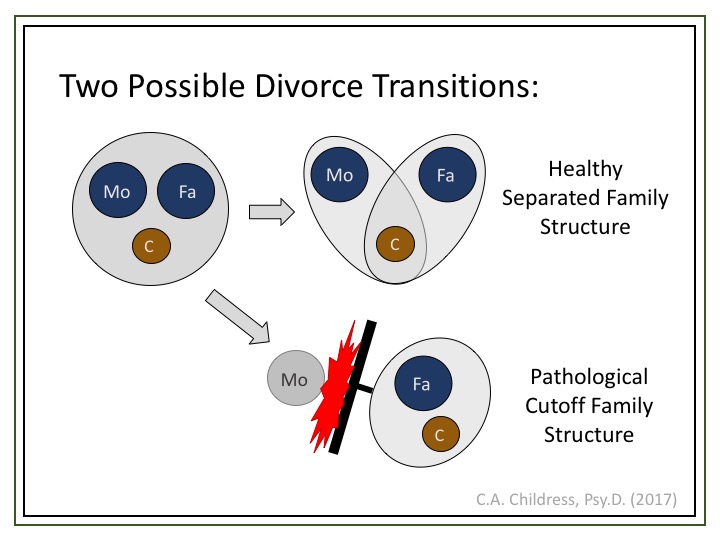
Divorce ends the marriage; it does not end the family.  Where there are children, there will always be a family.
 
In divorce, the child’s best interests are that the family successfully transitions to a healthy and functional separated family structure, united by bonds of shared affection with both parents.  It is the responsibility of professional psychology to ensure that this occurs.
 
Why?
 
Because it is in the best interests of the child.  Our client.  The person we work for.
 
It is up to professional psychology to solve this.  For the child.  For the family.  For the client.  For the Court.  That’s our job.  Professional psychology.
 
Professional psychology can absolutely 100% solve this, through the application of the standard and established constructs and principles of professional psychology.
 
There are four domains of knowledge – four data-sets from the constructs and principles of professional psychology – that need to be applied to the problem of family conflict in order to solve it:
 
The attachment system;
Personality disorder pathology;
Family systems therapy;
Complex trauma.
 
With attachment-related family conflict surrounding divorce, we start by applying the data-set from family systems therapy.
 
Triangulation,
Cross-generational coalition,
Inverted hierarchy,
Emotional cutoff.
 
Professional psychology can absolutely 100% solve the family issues surrounding divorce and the separated family structure through the application of the proper data sets from professional psychology.  It is the responsibility of professional psychology to solve this; that all families transition to a healthy separated family structure following divorce.

Family Therapy Surrounding Divorce

Principle 1:  Parents are not allowed to use the child as a weapon.  The child is not a weapon.
 
That is non-negotiable.  The child is not a weapon.
 
For all mental health professionals working with family conflict, if that is NOT currently your orientation to family therapy, it needs to immediately become your orientation to family therapy.  The child is not a weapon.
 
If the child is being “triangulated” into the spousal conflict through the formation of a “cross-generational coalition” with one parent against the other parent that is resulting in an “emotional cutoff” in the child’s relationship with the targeted parent (Bowen; Minuchin; Haley)… then the child is being used as a weapon.
 
The allied parent is using the child as a weapon.  That’s not okay in divorce.  You’re not allowed to weaponize the child.  That’s not healthy for the child.
 
And you know what,… Depending on the degree of child-weaponization, the parenting practices of turning the child into a weapon could rise to the level of psychological child abuse; creating severe psychopathology in order to weaponize the child in the spousal conflict is psychological child abuse.  Children are not weapons.  Ever.
 
Children have the right to love both parents, and children have the right to receive the love of both parents.
 
Children have the right to be loved by their grandparents and siblings, by their aunts and uncles and cousins.  Children have the right to be loved by friends, and teammates, and teachers, and coaches, and mentors.
 
Children have the right to be loved.  And it is up to professional psychology through family therapy to ensure that.  Because that’s in the best interest of the child, and the child is our client.
 
Professional psychology can solve this.  Professional psychology needs to solve this.  Because that’s in the best interests of the child, our client.
 
Professional psychology will need the support of the family court system based on the principle that children are not weapons.  The issue that AB-PA knowledgeable professionals, both legal and psychological, will be taking to the Court is that children are not weapons to be used in divorce.  Children are neutral; they’re off limits to the spousal conflict.
 
Children are not weapons.
 
For professional psychology, here are the professional constructs to apply:
 
Triangulation – cross-generational coalition – inverted hierarchy – emotional cutoff.
 
Source – cause – action – result.
 
The child is being used as a weapon in the post-divorce “spousal” conflict.
 
This is standard family systems therapy.
 
Bowen, Minuchin, Haley:  triangulation – cross-generational coalition – inverted hierarchy – emotional cutoff.
 
What is required is professional competence in the constructs and principles of family systems therapy when conducting family therapy.
 
Professional psychology can absolutely solve this.  We will need the support of the Court.  Children are not weapons.  With that support, professional psychology can absolutely solve this.
 
Craig Childress, Psy.D.
Clinical Psychologist, PSY 18857

Standard of Practice in Assessment, Diagnosis, and Treatment

I just wrote the following email to an attorney who was seeking consultation.  I thought the information I provide might be more broadly of interest

To an attorney:


Attachment-Related Pathology

A child rejecting a parent is an attachment-related pathology.  The attachment system is the brain system governing all aspects of love and bonding throughout the lifespan. A child rejecting a parent is a problem in the love and bonding system of the brain; in the attachment system.

The attachment system NEVER spontaneously dysfunctions.  It ONLY becomes dysfunctional in response to pathogenic parenting (patho=pathology; genic=genesis, creation).  Pathogenic parenting is the creation of significant pathology in the child through aberrant and distorted parenting practices.

Attachment-related pathology is always caused by pathogenic parenting, either from the mother or from the father.  The diagnostic question is which parent is the source of the pathogenic parenting creating the child’s attachment-related pathology (the rejection of a parent).  In this case, is it the mother’s parenting (child abuse), or is it the father’s parenting (a “cross-generational coalition” with the child against the targeted parent)?

Pathogenic parenting is an established construct in both clinical psychology and developmental psychology and it is used most commonly in reference to attachment-related pathology because the attachment system never spontaneously dysfunctions, but ONLY becomes dysfunctional in response to pathogenic parenting.

A “cross-generational coalition” is also a defined, standard, and established construct in family systems therapy.

The process of diagnosis regarding the source of pathogenic parenting is to evaluate the parenting practices of both parents.

1.  Targeted-Rejected Parent

We start with the parenting practices of the targeted-rejected parent. We assess the parenting practices of the targeted-rejected parent using:

The Parenting Practices Rating Scale

The Parenting Practices Rating Scale documents the findings from the assessment of the targeted parent’s parenting practices.

First, identify the category of parenting,

Abusive (level 1)
Severely Problematic (level 2)
Problematic (level 3)
Healthy (level 4)

Levels 1 and 2 parenting by the targeted-rejected parent would represent pathogenic parenting by this parent.  Treatment for Levels 1 and 2 parenting should focus on changing the parenting behavior of the targeted-rejected parent.

Levels 3 and 4 parenting represent broadly normal-range parenting and could not account for a suppression in the child’s attachment bonding motivations toward a parent.

Next, rate the parenting of the targeted-rejected parent on a continuum from 0 to 100, from neglectful-uninvolved parenting (0) to hostile over-controlling parenting (100).

Normal range parenting is anything in the 25-75 range.  Our preference in professional psychology is in the range of 40-60, but respect should be given to parents to define family values within their families and with their children, consistent with their personal, cultural, and religious values.  Some parents will tend to be more permissive and lax, but still within normal-range expectations (ratings in the 30s), some parents will tend to be more firm, structured, and rule-oriented, but still normal-range (ratings in the 60s).

If a clinical assessment by the involved mental health professional identifies that the parenting practices of the targeted-rejected parent are in the normal range (documented as Category 3 or 4; and between 25-75 on the Permissive-to-Structured continuum), then the parenting practices of this parent are broadly normal-range and cannot account for the attachment-related pathology being evidenced by the child (a rejection of a normal-range attachment bond to the parent).

2.  The Allied Parent

The next step is to assess the possibility of pathogenic parenting by the allied and supposedly “favored” parent. This becomes a little more challenging because the allied parent is hiding their negative-controlling influence on the child behind the child:

Allied Parent: “It’s not me, it’s the child who is refusing.  I tell the child to go, but what can I do?  I can’t force the child to go.”

The way to assess the pathogenic parenting of the allied parent is to lift the evidence of parental psychological control of the child from off of the child’s symptom features (the “psychological fingerprints” of parental control of the child).

We cannot psychologically control a child without leaving “psychological fingerprint” evidence of the control in the child’s symptom display.

Three symptoms in the child’s symptom display represent definitive diagnostic indicators of psychological control of the child by an allied narcissistic/(borderline) personality parent:

1.  Attachment System Suppression:  The suppression of the child’s attachment bonding motivations toward a normal-range parent.

2.  Personality Disorder Traits:  Five specific narcissistic personality traits in the child’s symptom display (grandiose judging of the targeted parent; absence of empathy toward the targeted parent; entitled expectations relative to the targeted parent; haughty and arrogant attitude toward the targeted parent; splitting/polarization of perception).

3.  Persecutory Delusion:  The child displays a fixed and false belief (a delusion) in the child’s supposed “victimization” by the normal-range parenting of the targeted parent (an encapsulated persecutory delusion).

When all three of these symptom indicators are present in the child’s symptom presentation – no other pathology in all of mental health will create this specific set of symptoms other than a cross-generational coalition of the child with a narcissistic/(borderline) parent against the targeted parent.

The presence of these three symptoms are documented using:

The Diagnostic Checklist for Pathogenic Parenting

Current Providers:

If the involved mental health professional completes these two assessment documentation instruments, then I can absolutely tell you what the origins are for the attachment-related pathology in the family based on the symptom features displayed.

Normal-range parenting by the targeted parent and the three diagnostic indicators of pathogenic parenting by the allied parent are evident in the child’s symptom display… the pathogenic parenting creating the child’s attachment-related pathology is emanating from the allied and supposedly “favored” parent (a cross-generational coalition with the child against the other parent).

Treatment-Focused Assessment

These two domains (potential pathogenic parenting by the targeted-rejected parent, and potential pathogenic parenting by the allied parent) can be assessed in six to eight treatment-focused assessment sessions.

I describe this six-session assessment protocol in the booklet:

The Assessment of Attachment-Related Pathology Surrounding Divorce

DSM-5 V995.51 Child Psychological Abuse

Pathogenic parenting that is creating significant developmental pathology in the child (diagnostic indicator 1), personality disorder pathology in the child (diagnostic indicator 2), and delusional-psychiatric pathology in the child (diagnostic indicator 3) represents a DSM-5 diagnosis of V995.51 Child Psychological Abuse, Confirmed.

Assessment leads to diagnosis, and diagnosis guides treatment:

In all cases of child abuse, physical child abuse, sexual child abuse, and psychological child abuse, the standard of practice and “duty to protect” requires the child’s protective separation from the abusive parent.

The child is then treated for the consequences of the child abuse, and the child’s healthy and normal-range development is recovered and restored.

Once the child’s healthy development is restored, the child’s relationship with the formerly abusive parent is then reestablished with sufficient safeguards to ensure that the child abuse does not resume once contact with the formerly abusive parent is reestablished.  Typically, the abusive parent is required to obtain collateral individual therapy to gain and demonstrate insight into the prior abusive behavior (in this case, the psychological abuse of the child), and the level of safeguards for the child are typically based on the degree of cooperation and insight shown by the formerly abusive parent.

It is the confirmed DSM-5 diagnosis of V995.51 Child Psychological Abuse (based on the treatment-focused assessment using the Parenting Practices Rating Scale and the Diagnostic Checklist for Pathogenic Parenting) that serves as the professional and legal rationale for the protective separation period.

My typical recommendation is for a 9-month protective separation period.

Remedy: Contingent Visitation Schedule

An alternative to a protective separation period is available from a Strategic family systems intervention of a Contingent Visitation Schedule

Strategic family systems therapy (principle theorist: Jay Haley) is one of the two primary models for family therapy, the other being Structural family therapy (principle theorist: Salvador Minuchin).  Strategic family systems therapy alters how the symptom confers power within the family.

A Contingent Visitation Schedule makes time with the allied pathogenic parent contingent upon the child remaining symptom free.

Custody is ordered as 50-50%.  If the child develops symptoms (as determined by daily rating scales, monitored by the family therapist), then time with the allied pathogenic parent is reduced (to reduce the negative pathogenic influence of this parent who is creating the child’s symptoms), and time with the targeted parent is increased (to increase the time needed to repair the relationship being damaged by the pathogenic parenting of the other parent).

This increase-decrease time in visitation is defined within the structure of the Contingent Visitation Schedule.  Once the child returns to non-symptomatic, custody visitation is returned to the shared 50-50% order.

The Contingent Visitation Schedule can be used prior to a protective separation, to give the allied parent one last chance to release the child from the coalition and allow the child to love both parents, or it can be used following the protective separation to ensure that the child psychological abuse does not resume once the distorted parenting of the allied pathogenic parent is reintroduced.

Summary

Parenting Practices Rating Scale

Diagnostic Checklist for Pathogenic Parenting

Assessment of Attachment-Related Pathology Surrounding Divorce

Contingent Visitation Schedule

Craig Childress, Psy.D.
Clinical Psychologist, PSY 18857

Definition of Cross-Generational Coalition

Jay Haley (1977)

“The people responding to each other in the triangle are not peers, but one of them is of a different generation from the other two… In the process of their interaction together, the person of one generation forms a coalition with the person of the other generation against his peer. By ‘coalition’ is meant a process of joint action which is against the third person… The coalition between the two persons is denied. That is, there is certain behavior which indicates a coalition which, when it is queried, will be denied as a coalition… In essence, the perverse triangle is one in which the separation of generations is breached in a covert way. When this occurs as a repetitive pattern, the system will be pathological.” (p. 37)

Haley, J. (1977). Toward a theory of pathological systems. In P. Watzlawick & J. Weakland (Eds.), The interactional view (pp. 31-48). New York: Norton.

Failing the Courts

Professional psychology is failing the family courts.

A child’s rejection of a parent surrounding divorce is a family therapy issue, not a child custody issue.

Child’s Best Interests

The family’s successful transition to a healthy and functional separated family structure following divorce is always in the child’s best interests.

Divorce ends the marriage, not the family.  A cutoff family structure is always pathological.  A cutoff family structure is NEVER a healthy post-divorce family.

It is always in the child’s best interests for the family to transition to a healthy and functional separated family structure following divorce.

The courtroom is not the proper venue to solve family pathology.  Family pathology cannot be litigated.  The resolution of family pathology is the domain of professional psychology.

The legal system therefore turns to  professional psychology for consultation on family pathology.

This request for consultation takes one of two forms, an order for something called “reunification therapy” or an order for a child custody evaluation by professional psychology.

In each of these, professional psychology is failing the court.

First, there is no such thing as reunification therapy.  This is important to understand.  There is no such thing as reunification therapy.  It’s an entirely made up thing.  There is no book, no article, no theorist who has ever described anything called “reunification therapy.”  It’s a sham construct designed to allow the “reunification therapist” to just make stuff up and do whatever they want, and just call it “reunification therapy.”

I’m a clinical psychology.  Psychotherapy is what I do, and I don’t think I’m being clear enough about this yet:

“Reunification therapy” is a snake-oil remedy of unknown contents that is more likely as not to kill you as to cure ya.  If any mental health person says they do “reunification therapy” – run.  There is no such thing as “reunification therapy.”

There, is that clear enough?

If any mental health professional disagrees, there is a Comment section to this blog.  Cite for me a single book or article that describes what “reunification therapy” is.

Crickets.  Nothing.

What the court and all parents want is family systems therapy; either Structural family systems (Minuchin) or Strategic family systems (Haley; Madanes).  Bowen has a foundational family systems model (Bowenian family systems therapy; The Bowen Center).  Satir has a model strong on family communication dynamics.

A competent family systems therapist is knowledgeable about all of these variations.  They all center around the same basic core constructs of Bowen; elaborated by Munichin and Haley.

Family systems therapy is one of the four primary schools of psychotherapy, the others are psychoanalytic psychotherapy (think Freud and his couch), cognitive-behavioral therapy (think lab rats pressing a lever), and humanistic-existential psychotherapy (think hot tub in Esalen). 

Family systems therapy is the only school of psychotherapy that is designed to address and solve current family relationship conflict. Family systems therapy is the appropriate form of psychotherapy for addressing and resolving family-related conflict surrounding divorce.

The pathology of a child-rejecting a parent surrounding divorce is called an “emotional cutoff” (Bowen).  This is not Dr. Childress saying this. This is Murray Bowen saying this.  Standard family systems construct.

The pathology of an “emotional cutoff” is caused by disturbances in the process of “differentiation” within and among the family members.  Read:

Bowen Center: Eight Concepts
2. Differentiation of Self

This is not Dr. Childress.  This is Bowen.  Standard family systems therapy.  Disturbances in differentiation within family members can lead to the child’s “triangulation” into the spousal conflict to stabilize a parent’s vulnerability. 

The child’s “triangulation” into the spousal conflict can take the form of a “cross-generational coalition” with one parent against the other parent, resulting in an “emotional cutoff” in the child’s relationship with the targeted parent.

Triangulation

Cross-generational coalition

Emotional cutoff

Differentiation of self

All standard family systems therapy stuff.  Bowen, Minuchin, Haley.

There is no such thing as “reunification therapy.”  No book.  No article.  No theorist.  The court and parents want family systems therapy.

Structural family systems therapy (Minuchin)

Strategic family systems therapy (Haley, Madanes)

Bowenian family systems therapy (Bowen)

Problem 1: Professional psychology is failing to provide the court with the proper professional knowledge and expertise needed to solve attachment-related family pathology surrounding divorce.  Instead, mental health persons surrounding the legal system are simply making stuff up willy nilly.

Problem 2: Child custody evaluations.

This is important to understand:  There is no scientifically established support for the validity of child custody evaluations. 

Child custody evaluations violate every standard of professional practice regarding the development of an assessment procedure.  I discuss all of this more fully in:

The Child Custody Industry in Mental Health

There are multiple-multiple devastating problems with the practice of child custody evaluations, but I’ll focus here on just one, the most devastating one: No inter-rater reliability.

The conclusions and recommendations reached by child custody evaluations have no inter-rater reliability.  What this sentence means is that two different evaluators can reach two entirely different sets of conclusions and recommendations based on exactly the same data.

Well, that’s a problem.  According to the axioms of assessment, if an assessment procedure is not reliable (does not produce stable results), then the assessment procedure CANNOT – by definition – be valid.  The conclusions and recommendations from child custody evaluations are not valid.

If there is no inter-rater reliability, the conclusions and recommendations of child custody evaluations are simply the opinions of one person, that specific evaluator, perhaps based loosely on some psychological principles, perhaps based on no psychological principles whatsoever, just a matter of the individual opinion of the evaluator.

Don’t believe me?  There is a Comment section to this blog.  I challenge any mental health professional to cite for me a single study indicating the inter-rater reliability of the conclusions and recommendations reached by child custody evaluations.

Crickets.  Nothing.

The conclusions and recommendations of child custody evaluations are no more valid than a monkey throwing darts at a dart board, and a lot less entertaining – and, I might add, far more expensive.  Child custody evaluations are a very lucrative industry for professional psychology surrounding the family courts.

Child custody evaluations are a financial racket, pure and simple.  That is a strong professional statement to make, and I am absolutely prepared to back it up anytime, anywhere.  If any mental health professional wants to take exception to my statement, cite for me a single study identifying the inter-rater reliability of child custody evaluations.  If an assessment procedure is not reliable, it cannot, by axiomatic definition within professional assessment, be valid.  Child custody evaluations are a financial racket, pure and simple:

RICO

Do child custody evaluations actually do anything to solve the family pathology?  No.  Of course not.  They’re “evaluations” – not “therapy.”  For therapy, you’ll need “reunification therapy.” 

See, right here in Recommendation 3 of the child custody evaluation, right after Recommendation 2 that custody time-share should remain exactly where it is right now (with the child rejecting one parent), see, a recommendation for “reunification therapy.”

Child custody evaluations don’t actually fix things, they just tell the court to keep things where they are right now (with the child rejecting one parent) and do “reunification therapy.”

And do you know what the “reunification therapist” is going to say?

“We need to go slowly and not rush the child.  We’ll start with 2 hours of supervised visitation and then increase it from there as the child decides they want to spend time with the parent.  We don’t actually want to solve the family pathology of a cutoff family relationship.”

“We need to go “slowly” – a consistent hour of “therapy” on my schedule every week.  Court-ordered, month after month, year after year.  But nothing actually changes, because “reunification therapy” isn’t really a form of therapy.  It’s just designed to give pablum to the court as if something was taking place.”

But the child never “decides” to spend more time with the targeted parent.  Surprise, surprise.  In fact, things get worse, and worse, and worse, throughout all of the “reunification therapy.”

Professional Responsibility

It is the responsibility of professional psychology to treat and resolve family pathology.  That’s our job.

Professional psychology is failing the family court system.  Professional psychology is not providing the court with the proper professional expertise required to solve the family conflict.

The court and parents don’t want or need a pointless child custody evaluation.  If you’re tempted to conduct a child custody evaluation I suggest you hire a monkey with darts instead; it’ll be more entertaining and equally as valid.

The court and parents don’t want a mythical “reunification therapy,” a snake-oil therapy that solves nothing, ever.

The court and parents want family systems therapy – real psychotherapy that will solve the family conflict and facilitate the family’s successful transition to a healthy and functional separated family structure following divorce, which is always in the child’s best interests.

It is time for professional competence based in the standard and established constructs and principles of professional psychology.

Family systems therapy: Bowen, Minuchin, Haley.

The finger that points at the moon is not the moon.

Craig Childress, Psy.D.
Clinical Psychologist, PSY 18857