Exposing the Pathogen

It’s time for Gardnerian PAS to die.

The solution to “parental alienation” is through a return to standard and established constructs and principles of professional psychology: AB-PA.

Gardnerian PAS offers no solution whatsoever.

For three years – three years – I have repeatedly asked the self-proclaimed Gardnerian PAS “experts” to provide their path to a solution using the Gardnerian PAS model, most recently in August-September of this year.  Their response?… crickets.  Nothing.

The Gardnerian PAS diagnostic model offers no solution whatsoever.  They know it, and I know it.  Now everyone knows it.

So then why do the Gardernian PAS “experts” hold onto a failed diagnostic model of the pathology that offers NO solution whatsoever?

Because they don’t want a solution.

They are enabling allies of the pathogen whose role is to sow discord and division, thereby disabling the mental health response to the pathology.

Past History:  In sowing discord and division with establishment psychology for the past 30 years, the Gardnerian PAS “experts” have allowed the pathology of “parental alienation” to continue unsolved and unabated – for 30 years – and they have created a culture of ignorance and incompetence in professional psychology surrounding high-conflict divorce that invites the profound professional ignorance and incompetence we currently witness.

Current Behavior:  Now that AB-PA is leading us into a solution, the Gardnerian PAS “experts” are trying to hide AB-PA in confusion and obscurity so that professional psychology does not learn that AB-PA even exists to solve the pathology.  They seek to sow confusion by actively co-opting constructs from AB-PA without acknowledgement that these constructs emerge from AB-PA.  This is not about who gets “credit” for what (with AB-PA credit belongs to Bowlby, Minuchin, Beck,…) – it’s about sowing confusion by fusing the constructs of AB-PA onto PAS in order to hide the existence of AB-PA – as if AB-PA is nothing more than Gardnerian PAS.  It is a conscious and premeditated strategy to disable the solution available from AB-PA.

By not joining us in solving “parental alienation” through a return to standard and established constructs and principles of professional psychology (AB-PA), they are now sowing discord and division within the mental health allies of targeted parents, creating two “camps” – the Gardnerian PAS “expert” camp and the Childress AB-PA “camp.”

The Gardernian PAS “experts” sow discord and division – that’s what they do.  First with establishment psychology, and now with AB-PA that seeks to reunite us with establishment psychology.  We can absolutely solve this attachment-related family pathology surrounding divorce ONCE we return to standard and established constructs and principles of professional psychology.  The Gardnerian PAS “experts” are fighting against a return to standard and established constructs and principles – they are fighting against the solution.

One approach to creating this discord and division is by falsely characterizing me as being some sort of “guru” – they use this term – rather than accurately characterizing my efforts as a call to return to the path of established professional constructs and principles – Bowlby, Millon, Minuchin, Beck…

The pathogen deals in falsehood.

In falsely characterizing my work with AB-PA by a personal attack on me as an alleged “guru,” they seek to discredit me and, by association, the truth of AB-PA (the established truth of standard and established constructs and principles of professional psychology) by alleging that I have narcissistic designs.  They don’t attack the substance of AB-PA – because they can’t.  The substance of AB-PA is true.  So they attack me personally in an effort to discredit the truth of what I describe in AB-PA.

This is a classic attack strategy of the pathogen.

The pathogen launched a personal attack on Gardner by claiming he was a “pedophile.”  If Gardner was labeled a “pedophile” then the content of what he said would be discredited.  The personal attack on me by the Gardnerian PAS “experts” that I am some sort of “guru” (Karen Woodall’s “false prophet” characterization) is exactly the same approach, to attack AB-PA by leveling their attack against me personally using the false label of “guru.”  Same exact process.  I know this pathogen.  I see the pathogen clearly.

The truth is that Gardnerian PAS provides NO solution whatsoever.  They know it.  I know it.  Everyone knows it.  All they are doing is sowing discord and division in not joining with us in solving “parental alienation” through a return to the established constructs and principles of professional psychology.

There is absolutely NO rational argument against a return to standard and established constructs and principles of professional psychology, but the Gardnerian PAS “experts” are tying themselves in knots of illogic and irrationality trying – desperately trying – to find a reason NOT to accept AB-PA.

Why?  Because they don’t want to solve this pathology.

The pathogen deals in falsehoods.  For the narcissistic personality, “Truth and reality are whatever I assert them to be.”

If they want to confabulate Gardnerian PAS with AB-PA, they simply assert that they are the same thing just using “different words,” ignoring the fact that words have meaning, so using “different words” results in different meanings.  Saying, “I like pie” is not the same as saying, “the sky is blue” just using “different words.”  Different words = different meaning.  Now Karen Woodall appears to be claiming that AB-PA is nothing new because she thought of it all years ago.  Whatever, Karen.

The Gardnerian PAS “experts” have alleged that it’s Dr. Childress who is being divergent in not “cooperating” with them by not accepting Gardnerian PAS.

The truth:  If I accept Gardnerian PAS then I accept no solution for targeted parents and their children, because Gardnerian PAS provides no solution.  They know it provides no solution.  I know it provides no solution.  They want me to accept no solution because then everything stays exactly as it is.

Look, if they simply tell us the path to a solution using the Gardnerian PAS diagnostic model, I’d be happy to join with them.  Woo hoo.  Yay.  But they don’t offer a solution because they can’t offer a solution.  Gardnerian PAS provides NO solution whatsoever.  They know it.  I know it.  We all know it.

They are even free to add whatever they want to the standard and established constructs and principles of professional psychology described in AB-PA.  They can add all the unicorns, and mermaids, and beautiful dancing pixies they want.  Fine by me.  But we MUST establish a baseline of professional competence – a ground foundation of professional knowledge and professional competence in the established constructs and principles of professional psychology (AB-PA).

I don’t care one whit for how many angels can dance on the head of a pin.  The only thing I care about is solving the pathology of “parental alienation” as quickly as is humanly possible.  If the Gardnerian PAS diagnostic model with its 8 symptom features could solve this, I’d be joining them in a heartbeat.  It can’t.  And it never will.  30 years.  No solution.  Scoreboard.

I’m not the one who isn’t cooperating.  THEY aren’t cooperating.

I’m not the one insisting that AB-PA is the only solution, they are the ones who are rigidly INSISTING that only Gardnerian PAS is allowed to solve the pathology – knowing full well that Gardnerian PAS does not provide a solution.

The pathogen lies.  It deals in falsehoods.  It sows discord and division with its lies, mistruths, and false statements.

AB-PA provides a solution.  That is the truth.  Gardnerian PAS doesn’t.  That is the truth.  If the Gardnerian PAS “experts” disagree, then tell us the solution using Gardnerian PAS… nothing but crickets.  That is the truth.

The pathogen sows discord and division with lies.  In the discord, confusion, and division it sows, the pathogen just makes stuff up.  It can make a series of false statements in 10 seconds that then require three hours to respond to.  Chaos, discord, division.  Hallmarks of the pathogen.

Britian’s Children

Now, let me expose the pathogen in the Gardnerian PAS “experts” more fully.

Recently in England, an organization called Cafcass, who supposedly represents the “voice” of the children in divorce and child custody proceedings, has made a momentous admission, that they have been missing the identification of “parental alienation” in large numbers of the 125,000 cases they assess each year.

The Guardian Article on Cafcass

From the Guardian:  “Cafcass said it had recently realised parental alienation occured in significant numbers of the 125,000 cases it dealt with each year.”

From my relatively superficial understanding of Cafcass, I would agree with their self-assessment.  They have been horrible, and their previous assessments have been directly responsible for the destruction of countless numbers of families and childhoods – lost love and lost childhoods that were irrevocably damaged by the prior ignorant and incompetent assessments and reports produced by Cafcass.

But they have apparently become enlightened by knowledge.  This is outstandingly positive news.

They acknowledge that they have missed identifying prior cases of “parental alienation” and they are adopting a “groundbreaking” protocol of potentially removing children from the “alienating” parent if this parent does not stop alienating the child from the other parent.  Sounds like an extremely positive development to me.

A protective separation of the child in order to release the child from the psychological control and psychological manipulation of the allied narcissistic/(borderline) parent is an exceedingly positive step.  Cafcass will begin taking active steps to protect the child and protect the child’s loving bond to the normal-range parent.

This is outstandingly good news.  The solution is coming.  Change is coming.

Yet Karen Woodall – a staunch Gardnerian PAS “expert” in England – is AGAINST this change.  Let that sink in for a moment.  Karen Woodall opposes separating the child from the psychological manipulation and control of the “alienating” parent.

Karen Woodall argues AGAINST separating the child from the “alienating” parent because she is concerned that separating the child from the psychological manipulation and control of the “alienating” parent might damage the child’s relationship with that parent.

Here’s what Karen Woodall says about protectively separating the child from the pathological psychological control of the narcissistic/(borderline) parent:

From Karen Woodall:  “Treating parental alienation by forcing a child (who has already been forced into losing one parent to keep the other), to lose that parent in order to regain the other, is not the way that any responsible practitioner wishes to treat parental alienation.”

The Battle for Britain’s Alienated Children, 11/22/17 (emphasis added)

Seriously, Karen?  You are more concerned with protecting the child’s pathological relationship with the “alienating” parent than you are with protecting the child’s healthy relationship with the normal-range and loving parent.  Wow.

Notice the manipulative communication she uses in characterizing efforts to protect the child as somehow “forcing” the child to lose a relationship with the manipulative and psychologically controlling “alienating parent.”

No one is “forcing the child” into losing a relationship with a parent.  That is simply not true.  The pathogen lies.

Associated Clinical Sign 1 of the Diagnostic Checklist for Pathogenic Parenting is the use of the  word “forced.”  I have described the origins of this symptom feature:

ACS 1: Use of the Word Forced

The use of the word “forced” is a manipulative communication strategy designed to dis-empower efforts to protect the child.  We are not “forcing” the child to lose a relationship with the narcissistic “alienating” parent – we are PROTECTING the child from the abusive psychological control and manipulation of the child by the “alienating” parent who seeks to destroy the child’s loving bond of shared affection with the other parent.

Every time we encounter this manipulative effort to dis-empower our efforts to protect the child by claiming we are “forcing the child,” we need to immediately correct this characterization with a more accurate and balanced description:

The child is not being “forced,” the child is being given the opportunity to have a loving bond of affection with both parents.

That is the truth.  Karen’s characterization is false.  It is manipulative.  It seeks to undermine and dis-empower efforts to protect the child from the psychological control and manipulation of the “alienating” parent.

When we begin treatment of the induced psychopathology created in the child by the pathogenic parenting of the allied and supposedly “favored” narcissistic “alienating” parent, we DON’T want to turn the child into a “psychological battleground” between the efforts of therapy to restore a normal-range and loving relationship with the targeted parent and the continuing efforts of the narcissistic/(borderline) parent to create and maintain the child’s psychopathology.

We must first protect the child from the psychopathology of the narcissistic/(borderline) parent.

Notice too, the second manipulative communication of Karen Woodall in characterizing professional efforts to protect the child as being “irresponsible” professional practice:

“…is not the way that any responsible practitioner wishes to treat parental alienation.”

I’ve got news for you Karen, I am a responsible practitioner and a protective separation of the child from the psychopathology of the narcissistic/(borderline) “alienating” parent is EXACTLY the treatment for “parental alienation.”  We must first protect the child from the manipulative psychological control of the narcissistic/(borderline) parent.  ONLY when we have first protected the child can we then ask the child to reveal their authentic love for the targeted parent.

We must first protect the child.  In doing so, we must protect the child’s healthy relationship with the normal-range targeted parent.

Once we have restored the child’s healthy and normal-range development, we can then stabilize the family’s transition into a successful separated family structure of shared bonds of affection between the child and both parents.
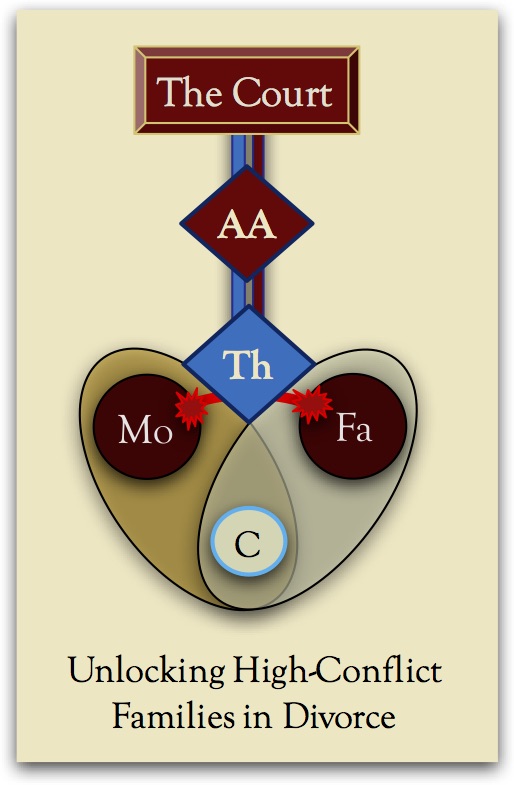
And Karen… anticipating your response – ANY parent who seeks to destroy the child’s relationship with the other parent following divorce is, by definition, narcissistic.  NO parent who has authentic empathy for the child would ever – ever – seek to destroy that child’s relationship with the other parent.

So, Karen, all your supposed “hybrid cases” of “parental alienation,” ALL of them involve a narcissistic allied parent to some degree.  ANY parent who seeks to destroy the child’s loving bonds of affection with the other parent following divorce is narcissistic – by definition; the absence of authentic empathy for the child involves placing the parent’s own emotional and psychological needs ahead of the child’s healthy development.

Argue with me if you want, Karen, but then look what you’re doing.  You are attempting to minimize the narcissistic pathology of the “alienating” parent in order to argue in FAVOR of keeping the child with the psychologically manipulative and controlling “alienating” parent at the expense of the child’s healthy relationship with the normal-range parent.  Do you really want to be on that side of the argument?

Karen, seriously… we protect the child from the psychological manipulation and psychological control of the narcissistic parent, we restore the child’s normal-range relationship with the targeted parent that has been damaged by the pathogenic parenting of the narcissistic “alienating” parent, and then we restore the child’s relationship with the pathological “alienating” parent with sufficient safeguards to ensure that the psychological abuse of the child does not resume once the pathology of this parent is reintroduced.

And you’re arguing AGAINST that.  Really, Karen?   You actually want to leave the child with the pathological “alienating” parent even though this parent is trying to destroy the child’s healthy bonds of affection with the targeted parent.  Wow.

I want everyone to just sort of let Karen Woodall’s position sink in.  She is arguing that “responsible” treatment is to leave the child with the alienating parent because we wouldn’t want to damage that relationship by removing the child from the manipulative psychological control of that parent.

Wow.

False Allies

Garderian PAS offers no solution whatsoever.

AB-PA provides an immediate solution through a return to standard and established constructs and principles of professional psychology.

There is no rational reason to continue to hold onto a made-up diagnostic model of the pathology that sows discord and division between the mental health allies of targeted parents and establishment psychology.  We must reunite with establishment psychology to solve this pathology.

There is no rational reason to continue to hold onto a made-up diagnostic model that provides no solution and not join with and support a return to standard and established constructs and principles of professional psychology that provides an immediate solution.

By continuing their non-cooperation with the solution available from a return to the standard and established constructs and principles of professional psychology, the Gardnerian PAS “experts” simply sow discord and confusion with no purpose, since the Gardnerian PAS diagnostic model offers NO SOLUTION whatsoever.

So then why do the Gardnerian PAS “experts” continue to hold onto a failed diagnostic model – and why do they seek to protect the child’s pathological relationship with the psychologically manipulative and controlling “alienating parent” at the expense of sacrificing the child’s healthy relationship with the loving and beloved targeted parent?

Because they don’t want a solution, they want to be “experts.”

Extrapolate Karen Woodall’s proposed solution:

Karen Woodall is the bestest expert anywhere, and everyone should come to Karen Woodall’s clinic to be assessed… everyone.  She will then conduct this super-special assessment that only she can do, and then she’ll tell us about what this unique form of pathology is in this family, determined by her for each individual case based on her magnificent expertise in this “new form of pathology.”

Can the rest of clinical psychology solve this?  Absolutely not.  We all need the magnificence of her expertise for each individual case, since the standard and established constructs of professional psychology are insufficient to solve this unique “new form of pathology” without benefit of her magnificent “expertise.”

And she calls me a “guru.”  Uh, can I call projection on that?

The standard and established constructs and principles of professional psychology can absolutely solve this pathology.  Bowlby, and Minuchin, and Haley, and Beck, and Millon,… The standard and established constructs and principles of clinical psychology are fully sufficient to solve this pathology.

The diagnostic model of AB-PA exposes both the pathogen and its allies from beneath their veil of concealment.  AB-PA represents a threat to the pathogen, and the pathogen has called its allies to attack and disable the solution offered by AB-PA by creating discord and division.  Lo and behold, it’s the Gardernian PAS “experts” who have answered the pathogen’s call.  They cannot attack the substance of AB-PA because AB-PA is a true and accurate description of the pathology.  So they instead try a variety of other strategies in an effort to nullify the solution available from AB-PA:

From Karen Woodall:  “Treating parental alienation by forcing a child (who has already been forced into losing one parent to keep the other), to lose that parent in order to regain the other, is not the way that any responsible practitioner wishes to treat parental alienation.”

Karen Woodall is arguing against a protective separation and in favor of keeping the child with the psychologically manipulative and controlling “alienating parent” because she wants to protect the (pathological) relationship with the “alienating parent” even at the expense of the child’s healthy relationship with the targeted parent.

Let that sink in.

There are those who are made uncomfortable by the conflict between Dr. Childress and Karen Woodall, believing that allies of targeted parents should work together toward solving the pathology.  I couldn’t agree more, allies should work together.  The self-proclaimed “experts” in Gardnerian PAS, however, are not our allies, and they are beginning to expose themselves.

Karen Woodall is openly advocating that we sacrifice the child’s healthy relationship with the targeted parent in order to protect the child’s pathological relationship with the “alienating” parent, and to support this assertion she makes false and manipulative characterizations of efforts to protect the child as “forcing” the child to lose a relationship with the “alienating” parent in a convoluted effort to justify her alliance with the pathology of the narcissistic/(borderline) parent.

We never abandon a child to a psychologically abusive parent.

Is “parental alienation” psychological child abuse, Karen?  If so, then why are you abandoning the child to the psychologically abusive “alienating” parent?

You are either advocating that we leave the child with a psychologically abusive parent – or you are saying that “parental alienation” is not child abuse.  Which is it Karen?

I’m sorry if this inter-professional conflict makes people uncomfortable.

I know the pathogen.  I see the pathogen.  And I know the allies of the pathogen.  I will fight for the children, always.  We must first protect the child.

I am a strong advocate that protectively separating the child from the manipulative psychological control and pathogenic parenting of the narcissistic/(borderline) parent is the proper course of action in response to “parental alienation.”

Karen Woodall advocates that we leave the child with the “alienating” parent because she would rather protect the child’s relationship with the psychologically controlling narcissistic parent than protect the child’s healthy relationship with the targeted parent.

I will fight for the children, always.  Even if it makes people uncomfortable.  We must first protect the child.

Craig Childress, Psy.D.
Clinical Psychologist, PSY 18857

Renewing the Focus on the APA

Prior to my presentation to the Pennsylvania House Children and Youth Committee, I was speaking with some parents who were in attendance regarding the important role of the American Psychological Association in achieving the professional competence necessary to solve the attachment-related family pathology of “parental alienation (AB-PA).
 
I’ve been so tied up in producing the resources of the treatment-focused assessment protocol and the Contingent Visitation Schedule, and then preparing for my presentation in Pennsylvania and now my Certification seminars, that I haven’t been able to spare the time to focus on the APA front.
 
That’s going to change once the Certification seminars are completed this weekend. The APA is the next focus.
 
The American Psychological Association is an excellent professional organization.  They will become our allies in solving this attachment-related family pathology.
 
They have become inert and inactive in their role of ensuring professional competence because of the failure and abject inadequacy of the Gardnerian PAS diagnostic model to adequately define the pathology.  The Gardnerian PAS diagnostic model is an exceptionally bad model for a pathology for a variety of reasons.  It has divided professional psychology and has allowed professional ignorance and incompetence to overtake the assessment, diagnosis, and treatment of the pathology.
 
The reason we don’t have a solution to this attachment-related family pathology is NOT because of the APA or establishment professional psychology, including the DSM diagnostic system.  The reason we don’t have a solution to the attachment-related family pathology is because of the inadequacy of the Gardnerian PAS model in defining the pathology.
 
We must return to the standard and established constructs and principles of professional psychology in order to reunite with establishment professional psychology, including the American Psychological Association, and set about solving this, not only in solving the attachment-related pathology of “parental alienation” (AB-PA), but also solving the broken interface of professional psychology with the legal system surrounding child custody decision-making.
 
The APA and establishment psychology are NOT our adversaries, they are our allies… they just don’t know it yet.
 
All we are seeking is professional competence.  This is a right granted to all clients of mental health services by Standard 2.01a of the APA ethics code.
 
The attachment-related family pathology of “parental alienation” is a blend of four domains of professional psychology, 1) attachment-related pathology, 2) personality disorder pathology, 3) family systems pathology, and 4) complex trauma pathology.  Professional competence REQUIRES a professional-level of knowledge in all four of these domains.
 
After this weekend, we will have the first mental health professionals with this required professional expertise – AB-PA Certified mental health professionals.  These mental health professionals will provide the standard for professional excellence in the assessment, diagnosis, and treatment of attachment-related family pathology surrounding divorce.
 
All mental health professionals treating the attachment-related family pathology MUST be professionally competent in the attachment system, personality disorder pathology, family systems therapy, and complex trauma.  Otherwise, they are in violation of Standard 2.01a of the APA ethics code.
 
There are three components – three things – we want from the APA in achieving professional competence in the assessment, diagnosis, and treatment of the attachment-related family pathology of “parental alienation” (AB-PA).
 
1. Press Release Statement:
At the very least – the very least – a statement from the APA indicating that:
 
Requested Statement: “The assessment, diagnosis, and treatment of attachment-related pathology in high-conflict divorce requires specialized professional knowledge in a variety of professional domains. It is the expectation of the American Psychological Association that all psychologists who are assessing, diagnosing, and treating attachment-related pathology surrounding divorce possess the require professional knowledge needed for professional competence, consistent with Standards 2.01a and 2.03 of the APA ethics code.”
 
This is a middle-of-the-road statement in support of Standard 2.01a of the APA ethics code and professional competence.  This statement avoids the controversy surrounding “parental alienation” that is created by the inadequacy of Gardnerian PAS, and it avoids any need to endorse AB-PA and a return to standard and established constructs and principles.  It simply reminds all psychologists that they are required to possess the necessary knowledge for professional competence (Standard 2.01a) and that they are required to “undertake ongoing efforts to develop and maintain their competence” (Standard 2.03).  This proposed statement requested from the APA simply asks them to affirm the Standards of their own ethics code.
 
2. Change in Position Statement:
We want the APA to change their position Statement on Parental Alienation Syndrome to either,
 
1)  Take into consideration and address the fact that there are now TWO models defining the pathology (AB-PA being the second definition of the pathology), or
 
2)  Withdraw their statement and make no statement whatsoever, consistent with having “no position.”
 
If the APA chooses to make a statement about the attachment-related pathology described as “parental alienation” in the popular culture, then we want two things:
 
First, formal acknowledgement that the pathology exists – using whatever term they want for the pathology, “parental alienation,” cross-generational coalition, attachment-related pathology, cutoff family structure, obstructed bonding – they can call it Bob for all it matters – simply acknowledge that the pathology exists.
 
Second, that this group of children and families represents a “special population” requiring specialized professional knowledge and expertise to competently assess, diagnose, and treat.
 
3.  Conference of Experts:
We would like to APA to hold a formal high-level conference of experts to examine the interface of professional psychology with the legal system surrounding divorce and child custody.
 
This conference of experts would include expertise in the attachment system, personality disorder pathology, family systems therapy, complex trauma (including child abuse and domestic violence), along with representatives from forensic psychology with expertise in child custody decision-making.
 
This conference of experts would produce a white paper for the APA regarding the interface of professional psychology and the legal system surrounding child custody decision-making, discussing professional standards of practice in the assessment, diagnosis, and treatment of family pathology impacting child custody recommendations and child custody decision-making.
 
In early 2017, the APA said they wanted to form a committee to “study” the issues surrounding professional ignorance and incompetence in the assessment, diagnosis, and treatment of the attachment-related pathology of “parental alienation.”  It is now a year later.  The trauma and tragedy of destroyed childhoods and destroyed families continues unabated. 
2018 is the year we focus on enlisting the help of the American Psychological Association in guaranteeing professional knowledge and professional competence in the assessment, diagnosis, and treatment of attachment-related pathology surrounding divorce.
Silence and inaction in response to professional incompetence is complicity.
 
Craig Childress, Psy.D.
Clinical Psychologist, PSY 18857

Salvador Minuchin has Passed

The renowned family therapist, Salvador Minuchin, has passed today.

Salvador Minuchin, a Pioneer of Family Therapy, Dies at 96

A brilliant man.  My clinical work as a family therapist is strongly influenced by Minuchin.  I had the benefit of hearing him lecture at a conference, and the statement of his that resonated with me most is when he said, “A child cannot be as powerful as an adult unless he’s standing on someone’s shoulders” – speaking about the cross-generational coalition.

The second important influence on my work from Salvador Minuchin is his recognition that a dysfunctional system is stable WITH the symptom present.  In order to create change, we must first disrupt the stability of the dysfunctional system.  Then, as the system begins to re-stabilize from the disruption we intentionally create as the family therapist, we can remove the symptom and help the system reorganize into a healthier set of relationships.

This is at the core of my work in bringing change to the dysfunctional mental health and legal systems surrounding the pathology of “parental alienation.”

The broken mental health and legal systems are stable and resistant to change.  Everything I am doing is with the goal of first disrupting the stability of the dysfunctional systems – AB-PA, at its core, has this as its purpose, the disruption of the dysfunctional system.  AB-PA is challenging the APA from its slumber, AB-PA is challenging the ignorance of therapists out of their incompetence, AB-PA is  challenging the status quo of child custody evaluations, AB-PA is challenging the complacency of Gardnerian PAS “experts.”

Through AB-PA, I am disrupting the stability of the dysfunctional systems.  This is by design and is directly the result of Salvador Minunchin’s influence on my work. He is a guiding force in my work to solve “parental alienation,” from start to finish.

In 1993, in his book Family Healing with Michael Nichols, Salvador Minuchin provided a structural family diagram for the pathology of “parental alienation” – called a “cross-generational coalition” in family systems therapy.

AB-PA is not Childress. It’s Minuchin.

He lives in me, and his life ripples through my healing with families.  Bless you dear man.  You live in every family therapist, and your influence to heal children and families continues.

Craig Childress, Psy.D.
Clinical Psychologist – and family therapist – PSY 18857

AB-PA Certification Content Agenda

I just sent out welcome letters to the currently registered participants in the November AB-PA Certification seminars in Pasadena in which I describe the content agenda for these seminars.
I thought I would share this agenda letter more broadly so that people would understand what Basic and Advanced AB-PA Certification means and entails.
I will also be working on the handout for my upcoming presentation to the Pennsylvania legislature Children and Youth Committee on November 15.  I will make this handout available on my website after my November 15 presentation.
Over the next two weeks I’ll be preparing for both the Pennsylvania presentation and the AB-PA Certification seminar, so my online presence may diminish as I focus on preparing materials for these events.
Craig Childress, Psy.D.
Clinical Psychologist, PSY 18857

The Solution’s Emergence

I recently responded with three posts to a Comment in my Facebook group, the Alliance to Solve Parental Alienation.  I think what I discuss in the posts to the Alliance are important enough that I want to provide this commentary to by blog as well.


Facebook Comment Post 1

Professional psychology became split by Gardner’s proposal of a “new form of pathology” and by several subsequent poorly conceived positions by Gardner that polarized professional psychology.

Gardner’s proposal that children’s allegations of abuse could be discounted if there was “parental alienation” present provoked the domestic violence and child abuse protection advocates into becoming adversaries of the construct of “parental alienation,” and then he made distasteful comments about children’s sexuality that further activated opposition to his proposal for a “new form of pathology.”

The Shadow Side of PAS

You can still see the echos of turning the domestic violence protection advocates into our adversaries in the official position of the APA on Parental Alienation Syndrome

APA: Statement on Parental Alienation Syndrome

Furthermore, not only did Gardner create a schism in establishment professional psychology, his proposal for a supposedly “new form of pathology” gave away all of the power because it placed targeted parents and their mental health allies in a position of having to prove the existence of a “new form of pathology.”

Immediately, the opponents of PAS stated – accurately – that there was no scientific basis to PAS, and that it was a “discredited” unacceptable proposal. This also created a mindset in targeted parents and their mental health allies that they had to prove “parental alienation” exists as a construct and have it “accepted” by professional psychology.

Gradually, the construct of “parental alienation” was grudging accepted by most individual mental health professionals, but the overall construct of Parental Alienation Syndrome proposed by Gardner continued to be rejected. This creates the fertile breeding ground for professional ignorance and incompetence in which mental health professionals just start making up their own subjective and idiosyncratic definitions of what constitutes “parental alienation.”

In addition, by proposing that “parental alienation” represents a “new form of pathology” unique in all of mental health, requiring a unique new set of symptoms unlike any other symptoms for any other pathology in all of mental health, the Gardnerian PAS diagnostic model does not provide a professionally anchored description for what the pathology is. It’s this unique new thing – with no anchoring professional-level explanation for what it is or how it works.

Gardner skipped the step of professional diagnosis. Diagnosis is the application of standard and established constructs and principles to a set of symptoms. Instead of applying the rigor of professional standards of practice for diagnosis, Gardner too quickly abandoned professional practice by proposing a “new form of pathology unique in all of mental health.”

By leaving the path of established professional psychology, Gardner led everyone into the wilderness, and targeted parents and their mental health allies have been struggling ever since.

In developing the solution to “parental alienation” I spent about a year back in 2008-2009 simply analyzing the nature of the problem and laying out the course needed for the solution. I then set about correcting the step skipped by Gardner – diagnosis – in order to return us to the path of established professional psychology.

By returning to the path of established professional psychology we define the pathology from entirely within standard and established constructs and principles, which then defines domains of knowledge needed for professional competence. We leave the wilderness of “new forms of pathology unique in all of mental health” and return to the solid foundation of established constructs and principles.

Gardnerian PAS as a supposedly new form of pathology unique in all of mental health is a theory that needs to be proven.

AB-PA is the application of standard and fully established constructs and principles – constructs and principles already amply proven in the scientific research and professional literature – to a set of symptoms. This is called diagnosis. AB-PA is NOT a theory, it is diagnosis.

AB-PA goes back and corrects the step skipped by Gardner – diagnosis. By correcting this step, AB-PA leads us out of the wilderness of “new and unique forms of pathology” and returns us to the path of established professional psychology.

By NOT proposing a “new form of pathology,” but instead defining the pathology entirely from within standard and established constructs and principles, AB-PA provides a compromise solution to end the schism in professional psychology; establishment psychology does not need to accept a “new form of pathology unique in all of mental health,” and we have the pathology of “parental alienation” formally defined and acknowledged by all of mental health, with formal standards of practice for its assessment, diagnosis, and treatment.

Craig Childress, Psy.D.
Clinical Psychologist, PSY 18857

Facebook Comment Post 2

Let me introduce a secret that I know but haven’t disclosed yet, I’m operating at about five to ten years ahead of what is currently taking place in this solution to “parental alienation.” That’s why I’m beginning to shift my focus over to unlocking the terrorist mind:

The Terrorist Mind

AB-PA is already solved. It is simply a matter of how long it takes for the solution to be enacted.

I’ll be describing this to the Advanced AB-PA Certification mental health professionals attending Day 3 the Pasadena seminars, so that they too will begin operating about 5 years ahead of the current situation.

The Basic AB-PA Certification seminar on November 18-19 will train to expertise in activating the current “information-structures” of the solution, the professional knowledge base, the assessment and diagnosis protocol, and the beginning treatment protocol.

The Advanced AB-PA Certification seminar on November 20 will train to expertise in the next phase – the opening of intersubjectivity (Stern, Fonagy, Shore, Tronick, Trevarthan) which will fully open the treatment component of the solution, and in the actual “meme-structures” – the information structures; the underlying “code structures” – for both the pathogen and the solution.

The solution offered by AB-PA operates on many-many levels. On Day 3 of the AB-PA Certification seminar, I’ll be explaining the “meme-structure” of the pathogen, the origins and maintenance of the professional schism, and the fullness of the solution. I’m really looking forward to this portion of the seminar. It would take me a book to explain what I did with AB-PA and how AB-PA is working to create the solution – AB-PA will, with 100% certainty, create the solution. It’s simply a matter of how long it takes the meme-structures of AB-PA to propagate through the mental health system.

If the meme-structures of AB-PA propagate fast enough, then I’ll still be around to help support the solution’s development into its full completeness. If not, then it will be to the next generation of mental health professionals to fully activate the complete solution that will be emerging into the attachment system field, the personality disorder field, and the complex trauma field.

The AB-PA Advanced Certified mental health professionals will be trained to a high level of expertise, and will also be operating at about 5 years ahead of the current situation. They will be the ones who will be leading professional psychology into the emerging solutions provided by AB-PA. These emerging solutions will not only be about “parental alienation” in high-conflict divorce, but will extend significantly into both attachment research and attachment trauma pathology (complex trauma).

Currently, the field of “parental alienation” in high-conflict divorce is a little known and little attended to backwater in professional psychology. In about 5 years it will explode front-and-center into the professional fields of attachment research, personality disorder pathology, and complex trauma. In about 10 years, implications growing out of AB-PA will be central in both research and in solving a variety of attachment-related issues affecting the mental health of our society.

My shelf life is limited. By the time these expansions of the implications take place I’ll be gone or preparing to leave the planet. It will be for the next generation to activate these information structures. Leadership in the next generation will be from the AB-PA Advanced Certified mental health professionals. If I don’t leave the planet abruptly (I’ve already had one stroke), then I figure I have about 10 years to teach and train the next generation of expertise. If it takes about 5 years to ramp-up this training, that means I have about 5 years of fully active training and teaching before I pass the baton to the next generation of expertise.

The current phase of the solution we are enacting is to eliminate the profound professional ignorance and incompetence in professional psychology that has been allowed to fester under the Gardnerian PAS paradigm. That’s why I had to excoriate the remaining Gardnerian PAS “experts” back in August and September. Think of it as cauterizing the remaining open wound in professional psychology that continued to act as a source for professional ignorance and incompetence.

The phases that will be emerging next will be to leverage AB-PA into the necessary systems changes within the family law courts, and also to open up more fully the treatment-related domains of the solution.

The phases that follow the family court and treatment solutions will be to extend AB-PA into the fields of attachment theory, personality disorder pathology, and complex trauma.

My personal focus will be shifting to the viral code-structure of the Terrorist Mind (same core structure as AB-PA, different surrounding meme-structures), and to other domains that I wanted to get to before I became involved in “parental alienation.”

My shelf-life is limited. There are things I want to get to before I leave.

Craig Childress, Psy.D.
Clinical Psychologist, PSY 18857

Facebook Comment Post 3

The best way for me to explain how AB-PA works is simply to create the solution with it. As the solution manifests, people will gradually see how it’s working in creating the solution and they’ll start to go, “Ooooooh, I see. I get it.”

The phase we’re in right now is clearing out the professional ignorance and incompetence in professional psychology that 30 years of Gardnerian PAS has allowed to fester and grow unchecked. This is through AB-PA’s meme-structures that define domains of professional knowledge needed for professional competence, which then activates Standard 2.01a of the APA ethics code, which then empowers targeted parents to file licensing board complaints based on these domains of competence. Using the Standards of the APA ethics code, we will expel professional ignorance and incompetence.

This current phase of building professional expertise is supported by my Certification seminars, by establishing standards of practice for “assessment of attachment related pathology surrounding divorce,” and by the three diagnostic indicators of AB-PA that define the pathology (present-absent) in all cases.

Assessment of Attachment-Related Pathology

We are currently in the process of establishing a ground foundation for professional competence, and then ultimately expertise, in required knowledge, in assessment, and in diagnosis (and later, in treatment, although I’m already opening the treatment door with the Contingent Visitation Schedule).

Contingent Visitation Schedule

The next phase will be to leverage the professional expertise we establish in professional psychology to create the systems change needed in the family court system. I’ve recently opened the meme-structures (information structures) for this solution with the AB-PA Key Solution Pilot Program for the Family Courts.

AB-PA Key Solution

These resources all represent complex “meme-structures” (information structures) that will solve the problems in the mental health system and legal systems. Through the AB-PA Certification seminars I will be creating the professional expertise needed to actualize this solution.

The solution is already here. It’s just a matter of how long it takes for the meme-structures of the solution to propagate through the mental health and legal systems.

Richard Dawkins: Meme Structures

In the Basic AB-PA Certification seminars on November 18-19 I will be training to expertise in activating the basic meme-structures of the solution; the knowledge base, the assessment and diagnosis protocol, and the treatment protocol (the Contingent Visitation Schedule and the ability to work in collaboration with High-Road augmented recovery).

In the Advanced AB-PA Certification seminar on November 20 I will be training to expertise in the next set of meme structures that open magnificent doors of understanding; intersubjectivity (Stern, Fonagy, Shore, Trevarthan; Tronick) and the meme-structures themselves (the code structures of the pathology and of the solution).

Seeing the “meme-structures” is like seeing the code in the movie The Matrix. Once the underlying meme-structure code is recognized, everything become clear, both the pathology and it solution.

The solution is already in place. Sufficient “meme-structures” (information structures) to create the solution are already in the “meme-scape.” It is just a matter of how long it takes for these meme-structures to propagate through the mental health and legal systems.

If you think of the pathology as a “computer virus” in the love-and-bonding “software programs” of the brain (the attachment system) that is crashing the child’s attachment system, then AB-PA represents the “anti-viral” program that:

1.)  Identifies the “computer virus” by its code structure (the three diagnostic indicators of AB-PA);

2.)  Quarantines the child’s love-and-bonding “software programs” from the active source of the “computer virus” (the protective separation);

3.)  Restores the normal-range “code structure” and functioning of the child’s love-and-bonding “software programs” (the child’s healthy attachment bonding to the targeted parent);

4.)  Installs “anti-viral software” in the child’s love-and-bonding programs to prevent reinfection by the “computer virus” contained in the love-and-bonding system of the previously allied parent (stabilization of the child’s recovery);

The child is then reintroduced to the source of the “computer virus,” (the personality disordered parent) with monitoring to ensure that the child’s love-and-bonding “software programs” do not become “reinfected” by the “computer virus” in the love-and-bonding “software” (the attachment/personality disorder pathology) of the formerly allied parent.

Craig Childress, Psy.D.
Clinical Psychologist, PSY 18857

Last Call Karen

To Karen Woodall:

Hi Karen.  The AB-PA Certification seminar is less than a month away at the Westin in Pasadena (November 18-20: Registration).  I’m once again extending a personal invitation for you and your clinical psychologist to attend and become Advanced Certified in AB-PA so you can take the solution offered by AB-PA back to Great Britain and back to the targeted parents there.

The solution offered by AB-PA (The Solution: The Return to Professional Practice; The Solution: The Dominoes) requires that we define the pathology from entirely within standard and established constructs and principles of professional psychology – no “new forms of pathology” proposals.  This means that your continuing to hold on to the inadequate Gardnerian PAS diagnostic model is a barrier to my ability to cooperate with you.  You, however, can cooperate with me, you can join with me in bringing the solution offered by AB-PA to England.

You can add whatever you want to AB-PA.  We just need to establish a ground foundation using standard and established constructs and principles of professional psychology for the professional knowledge required for professional competence.

AB-PA & Gardnerian PAS

The AB-PA diagnostic model leads directly to a confirmed DSM-5 diagnosis of V995.51 Child Psychological Abuse.  Gardnerian PAS does not.

The confirmed DSM-5 diagnosis of V995.51 Child Psychological Abuse provides the professional rationale for the child’s protective separation from the pathogenic parenting of the allied narcissistic/(borderline) during the child’s treatment and recovery.

The Gardnerian PAS diagnostic model does not lead to a DSM-5 diagnosis of Psychological Child Abuse and so does not provide any rationale for the child’s protective separation.

The diagnostic model of AB-PA (three diagnostic indicators) provides targeted parents with a confirmed DSM-5 diagnosis of V995.51 Child Psychological Abuse for the pathology being evidenced in their families.  That is a good thing.

The diagnostic model of Gardnerian PAS (eight symptom identifiers) does not provide targeted parents with a DSM-5 diagnosis of Child Psychological Abuse.  That is a bad thing.

In addition, the categorical diagnostic structure of AB-PA (present-absent) provides the structure necessary to establish a semi-structured and flexibly standardized six-session treatment-focused assessment protocol that can serve as a standard of practice for the assessment of attachment-related pathology surrounding divorce.

The dimensional diagnostic structure of Gardnerian PAS (mild-moderate-severe) does not provide a structured or standardized assessment protocol, and so offers no pathway to a standard of practice for the assessment of the pathology.

By defining the pathology entirely from within standard and established constructs and principles of professional psychology, AB-PA identifies four domains of knowledge needed for professional competence – the attachment system, personality disorder pathology, family systems therapy, and complex trauma – to which ALL mental health professionals can be held accountable

AB-PA activates professional ethical code standards for professional competence (APA: Standards 2.01a & 9.01a; Professional Competence). 

Gardnerian PAS, on the other hand, proposes a “new form of pathology” that is unique in all of mental health, so Gardnerian PAS does not activate professional ethical code standards for professional competence.  The Gardnerian PAS diagnostic model invites professional incompetence in which mental health professionals simply make up whatever they want.  There are no established standards of practice and no ground on which to stand.

The very existence of AB-PA as a second model defining the pathology requires a systems-wide review within professional psychology regarding how “attachment-related pathology surrounding divorce” is assessed, diagnosed, and treated.  Because AB-PA is based entirely within standard and established constructs and principles of professional psychology, it requires that professional psychology integrate these constructs and principles identified by the AB-PA diagnostic model into the assessment, diagnosis, and treatment of this attachment-related family pathology.

The constructs and principles of Gardnerian PAS, on the other hand, have long ago been integrated into the approach of professional psychology for assessment, diagnosis, and treatment.  Gardnerian PAS simply maintains the status quo.

The world is changing.  The coming professional dialogue will not be about Gardnerian PAS, it will be about AB-PA, it will be about a structured and standardized Treatment-Focused Assessment protocol, it will be about the Contingent Visitation Schedule, it will be about the Key Solution Pilot Program for the family courts.

If you want to remain relevant to the discussion, join us in enacting the solution.  Because if you insist that the ONLY solution is through Gardnerian PAS, then you and your expertise in Gardnerian PAS will fade into irrelevancy.

At some point, I will be invited to come to Europe and provide training and Certification in AB-PA.  I’ve already been contacted about potential European seminars.  I’m agreeable, it’s just a matter of funding my time away from my private practice.  AB-PA Certified mental health professionals will eventually be established in Europe as a defined standard for professional knowledge and professional competence, and the solution offered by AB-PA will eventually be enacted in Europe.  Join me in leading this effort to bring AB-PA to Great Britain.

AB-PA Certification

On November 18-19 I will be providing Basic Certification in AB-PA.  Basic Certification in AB-PA verifies that these participating mental health professionals possess the core knowledge base in the attachment system, in personality disorder pathology, in family systems therapy, and in complex trauma needed for professional competence.  This will be Day-1 of the Certification seminar.

On Day-2 of the AB-PA Basic Certification seminar, I will be covering the structured and flexibly standardized assessment protocol of a six-session Treatment-Focused Assessment that provides the Court with an alternative to an unnecessary and costly child custody evaluation, and I’ll be covering the treatment issues along with the structure and implementation of the Strategic family systems intervention of a Contingent Visitation Schedule which provides the Court with a potential treatment-related compromise solution to the child’s protective separation from the allied narcissistic/(borderline) parent.

In the Advanced AB-PA Certification seminar on November 20th, I will be covering treatment in more depth, focusing on the intersubjective systems of the brain (Stern; Tronic; Shore; Trevarthan; Fonagy) and the misattribution of inner experience (Bowlby; Beck).  I will be describing the deep-trauma meme-structures of the pathogen – the viral code of the pathogen – and the trauma origins of its defensive structures, its inhibition of executive function systems for logical reasoning, its capacity to alter narrative memory structures, its distortions to identity structures, and the implications of its access to motivational networks of the brain.  I will also be extending the pathogen into gaslighting, malignant narcissism, and the terrorist mind.

My goal isn’t to be an “expert” in “parental alienation.”  My goal is to establish a ground foundation for professional knowledge and professional competence that both targeted parents and the Courts can rely on in the assessment, diagnosis, and treatment of attachment-related pathology surrounding divorce.  My goal is not to to BE an “expert,” my goal is to use the standard and established constructs and principles of AB-PA to extend professional expertise to others.

Conflict Coding System

Also… on Saturday evening November 19th I will be offering an additional brief seminar-ette on the Parent-Child Conflict Coding System.  I’ve decided to work this up into a brief descriptive booklet for my AB-PA Certification seminars (Parent-Child Conflict Coding System). 

I’m going to recommend that all AB-PA Certified mental health professionals provide a Conflict Code as part of the standardized Treatment-Focused Assessment protocol – and I will be strongly recommending that the Conflict Coding System be used by all mental health professionals assessing parent-child conflict for the Courts (all child custody evaluators and court-involved therapists) in order to establish a ground foundation for professional assessment, professional case conceptualization, and professional treatment planning.

I’m a pretty smart guy, Karen.  You’ve seen my 40-page reference list for AB-PA.  That AB-PA reference list is just my reference list for this pathology – and “parental alienation” is not my primary field.  Imagine my reference lists for my primary expertise in ADHD, autism-spectrum pathology, and early childhood mental health (which includes the socially-mediated neuro-development of the brain during childhood).

The Parent-Child Conflict Coding System is a small but power-packed gem.  Good things come in small packages.  I want to get it out there because it will be incredibly useful in obtaining professional competence in the assessment of pathology, all forms of pathology.  It’ll make mental health professionals think – thinking, learning, and growing are always good things. 

Ultimately, though, this Conflict Coding System represents just the bare-bones structure for where I want to take it.  Ultimately, once we solve the pathology of “parental alienation” (AB-PA) – and we will absolutely solve it – then I’m going to be turning to other areas, such as:

The Terrorist Mind:  I will be unlocking the clinical psychopathology of the terrorist mind.  It’s the same core pathogen structure as AB-PA, with different surrounding meme-structures.  I’m already opening that process.  I’m currently in a series on my new blog, The Terrorist Mind, in which I’m unlocking the motivations of the Las Vegas shooter.  I’m thinking that my next series will be on the Manchester Bomber, and then the Paris Shooters.  I’ll probably need a couple of informational blogs in between these series though.

ADHD Solution:  I want to develop a parenting skills training website as part of describing a relationship-based treatment-solution to ADHD.  The regulatory pathology of ADHD has been my primary focus for expertise since I entered clinical psychology.  ADHD is what took me to work for Children’s Hospital of Orange County, because I wanted to work with Jim Swanson at UCI (who was running a collaborative project with CHOC on identifying ADHD in preschoolers).  Jim Swanson is one of the biggest kahunas in ADHD research.  I then moved into early childhood in order to understand brain development with the hopes that if we caught ADHD early enough we could actually cure it, and the early childhood brain development information actually does unlock ADHD.  We actually can cure it using relationship-based approaches if we know what to do.

Developmentally Supportive Psychotherapy:  Also out of the early childhood brain development research and literature comes a new approach to child psychotherapy.  Professional psychology is currently using play therapy (based on Anna Freud and Virginia Axline from the 1950s) and behaviorism (from B.F. Skinner and training lab rats in the 1940s and 50s).  Our child therapy models are absolutely archaic. They incorporate none of the child development and brain neuro-development research that’s occurred in the last 50 years.  We can absolutely solve issues like oppositional-defiant behavior, school behavior problems, family conflict, all that stuff… if we know how the brain works.  This is where I was headed when I became diverted into solving “parental alienation,” which then consumed my focus for the past decade.

And there’s more still.  I’ve got lots and lots of things I want to get to.  I don’t want to be an “expert” in “parental alienation,” I want to create the expertise in others so I can get to these other things before I leave the planet.

Once we solve “parental alienation” (AB-PA), I’m planning on taking the bare-bones structure of the Parent-Child Conflict Coding System and expanding the descriptions for the causal origins identified in the Parent-Child Conflict Coding System into a full Compendium, an magnum opus of my knowledge across ADHD, ODD, and the neuro-development of the brain during childhood (a companion opus to a developmentally supportive model of parent-child psychotherapy).

I just need the time.  If there is any doubt about what my knowledge can do, just look what I’ve accomplished with “parental alienation” – and “parental alienation” isn’t even my primary field of expertise.  And there’s even more about “parental alienation” that I haven’t even talked about yet because I’m waiting for professionals to catch up with the basic stuff.

The Parent-Child Conflict Coding System is just the bare-bones skeletal structure, but even this bare-bones structure has immense value in bringing organizational coherence to identifying the causal structures for parent-child conflict.  In the AB-PA Basic Certification seminars I will be offering an additional seminarette on the Conflict Coding System. 

I don’t care about being an “expert,” nor do I care about how many angels can dance on the head of a pin.  The ONLY thing I care about is bringing the pathology of “parental alienation” to an end as quickly as is humanly possible.  Targeted parents and their children need a solution today – now.  AB-PA provides them with that solution, now, today, immediately.

If you join me in bringing AB-PA to Great Britain, the solution arrives sooner and the nightmare for these families ends more quickly.  If you sit on the sidelines of the paradigm shift to AB-PA, then the solution for these parents and their children will take longer.

I cannot join with you because your insistence on holding onto the Gardnerian PAS diagnostic model acts as a barrier to my ability to join you.  The solution provided by AB-PA requires that we return to using ONLY standard and established constructs and principles of professional psychology.  You, however, can join with me.  You simply need to accept AB-PA as the floor-ground of knowledge, and then you can add whatever you want.  Just make the case to professional psychology for your additions, and if professional psychology accepts your “new forms of pathology” proposals – woohoo, yay.  If not, then at least we have the floor ground of AB-PA that defines domains of professional knowledge needed for professional competence and solves the pathology for targeted parents and their children.

November 18-20th at the Westin in Pasadena:

Registration: AB-PA Certification

Less than a month away.  Last call, Karen.  The world is changing.  AB-PA is coming as the primary paradigm for defining attachment-related pathology surrounding divorce. 

AB-PA is a return to the established path of professional psychology.  Join me in creating the solution.

Craig Childress, Psy.D.
Clinical Psychologist, PSY 18857

Assessment of Attachment-Related Pathology Surrounding Divorce

My role is to be a resource for targeted parents in achieving professional competence in the assessment, diagnosis, and treatment of your families.
 
In order to achieve professional competence, we must establish standards of professional practice in the assessment, diagnosis, and treatment of attachment-related pathology surrounding divorce (“parental alienation”; AB-PA).
 
We start with assessment. Assessment leads to diagnosis, and diagnosis guides treatment.
 
I am announcing another resource for parents to use in acquiring professional competence, a new booklet describing the assessment protocol that targeted parents and their attorneys should seek from the Court:
 
 
In order to solve “parental alienation” (AB-PA), targeted parents must obtain a professionally competent assessment of the attachment-related pathology in their families. This booklet is designed for targeted parents to provide to their attorneys, and for their attorneys to provide to the Court.
 
The assessment protocol described by this booklet is what you want the Court to order in terms of assessment: The Assessment of Attachment-Related Pathology Surrounding Divorce.
 
“Your honor, we want this; a treatment-focused assessment of attachment-related pathology surrounding divorce as described by Dr. Childress in this booklet.”
 
This booklet is designed with the goal of helping targeted parents obtain a professionally competent assessment. It briefly describes the nature of the pathology and the assessment protocol that’s needed. I intentionally kept the booklet short. It is only 40 pages long, 20 pages of description and 20 pages of supporting appendices of the practical tools used in the assessment.
 
This booklet is designed for targeted parents to provide to their attorneys, and for family law attorneys to provide to the Court. This booklet describes the assessment protocol that the Court should specifically order in all cases of attachment-related pathology surrounding divorce.
 
“Your honor, this is the assessment we want you to order.”
 
There remains the challenge that currently there are no mental health professionals with the knowledge-based needed to conduct the assessment protocol. But this booklet can also be provided to mental health professionals;
 
“This booklet describes the assessment protocol the Court has ordered and we would like conducted. Dr. Childress is available for consultation if needed.”
 
On November 18-20 I will be conducting the first AB-PA Certification seminars at the Westin in Pasadena (registration through The Childress Institute Website) in which I will be training mental health professionals in the 6-session treatment-focused assessment protocol and in the development and management of the Contingent Visitation Schedule.
 
This coming Friday, October 20, in Houston I will be presenting a seminar on the AB-PA Key Solution Pilot Program for the Family Courts that can quickly bring the required professional knowledge base and competence to entire geographic regions.
 
We will be working to solve the professional knowledge issue. In the meantime. the Assessment of Attachment-Related Pathology Surrounding Divorce is what targeted parents and family law attorneys need to be seeking from the Court, and the Contingent Visitation Schedule is the treatment-focused remedy when the pathology is identified.
 
The Assessment of Attachment-Related Pathology Surrounding Divorce is a companion resource booklet to the Contingent Visitation Schedule. These two booklets work in tandem.  The Assessment of Attachment-Related Pathology describes the assessment protocol. If the pathology of AB-PA is identified by the assessment, then the Contingent Visitation Schedule describes the remedy.
 
These two booklets are designed to help targeted parents fix the broken mental health system and the broken legal system responses to the pathology in their families.
 
Assessment leads to diagnosis, and diagnosis guides treatment. Assessment is the key. We start with assessment.
 
Each of the three legal system solution booklets address a different facet of fixing the broken mental health/legal system response to the pathology,
 
Assessment of Attachment-Related Pathology: This booklet is designed to acquire a professional competent assessment of the pathology.
 
Contingent Visitation Schedule: This booklet is designed to address the remedy to the pathology.
 
Key Solution Pilot Program for the Family Courts: This booklet is designed to achieve the systems-wide professional competence in conducting the treatment-focused assessments and managing the Contingent Visitation Schedules.
 
Together as a set, these three booklets provide the solution to fixing the broken mental health and legal system responses to the attachment-related pathology of “parental alienation” (AB-PA) surrounding divorce.
 
In addition, I use the opportunity provided by each booklet to highlight a different facet of the overall pathology.
 
Assessment of Attachment-Related Pathology: In this booklet I address the importance of each type of parent-child relationship: mother-son, mother-daughter, father-son, father-daughter. I describe that each of these relationship types should be fully supported by child custody visitation decisions and that a 50-50% shared custody visitation schedule is the only scientifically supported visitation schedule that supports the unique and special value of each relationship type.
 
In the Assessment of Attachment Related Pathology, I also describe the critical importance of NOT making the child a “custody prize” to be “won” by the supposedly “better parent” in their spousal dispute surrounding divorce. A shared 50-50% custody is the recommended custody visitation schedule to avoid making the child a “custody prize” to be awarded in the spousal conflict.
 
While the treatment-focused assessment protocol is separate from the custody visitation schedule that is ordered – the assessment protocol is not dependent on the custody visitation schedule – I nevertheless took the opportunity provided by the booklet to address these issues with the Court.
 
Contingent Visitation Schedule: This booklet provides the treatment remedy when the pathology of AB-PA is identified by the structured and standardized (semi-structured; flexibly standardized) treatment-focused assessment protocol for attachment-related pathology surrounding divorce.
 
In the Contingent Visitation Schedule booklet, I more strongly emphasize a family systems description of the pathology, and I more fully describe the difference between a family’s post-divorce transition to a healthy “separated family structure” rather than to a pathological “cutoff family structure.” I also provide a stronger section of quotes from the research literature on the construct of the parent’s “psychological control” of the child.
 
In the Contingent Visitation Schedule booklet, I also make explicit the direct linkage of the pathology to a DSM-5 diagnosis of V995.51 Child Psychological Abuse, which then provides the professional rationale for the protective separation of the child from the psychologically abusive allied parent. The pathology of AB-PA is not a child custody issue, it is a child protection issue. Through the Contingent Visitation Schedule booklet the issue of child protection concerns are explicitly raised for the Court’s consideration.
 
I also take the opportunity provided by the Contingent Visitation Schedule booklet to list the Associated Clinical Signs. I do this to begin sensitizing the Court to these characteristic features of the pathology, such as the use of the word “forced” in characterizing the child’s visitations with the targeted parent (ACS-1), the empowerment of the child through statements like “the child should be allowed to decide on visitation” and the allied parent seeking the child’s testimony in court to reject the targeted parent (ACS-2), the exclusion demand of the child restricting the parent’s access to the child’s events (ACS-3), the unforgivable past event used as the justification for all current and future rejection of a parent (ACS-5), excessive texting and phone calls with the allied parent while the child is in the care of the targeted parent (ACS-9), and the continual disregard of Court orders for child custody and visitation (ACS-12). Once the Court is alerted to these symptom features, these characteristic signs of the pathology will begin to jump out in the declarations of the allied narcissistic/(borderline) parent.
 
Through each booklet, I take the opportunity offered to describe to the Court a slightly different aspect of the pathology. My goal is to both educate the legal system with each booklet regarding the nature of the pathology, with a slightly different emphasis in each booklet to describing the pathology, and to also provide the legal system with a structured data-driven solution.
 
My goal with these two court-related booklets, the Assessment of Attachment-Related Pathology Surrounding Divorce and the Contingent Visitation Schedule, is to provide targeted parents and family law attorneys with the tools needed to solve the pathology.
 
“Your honor, this is the assessment protocol we want you to order. We have located a mental health professional who is willing to conduct the structured data-driven assessment protocol described by Dr. Childress in the Assessment of Attachment-Related Pathology Surrounding Divorce, and Dr. Childress has indicated his willingness to consult with this assessing mental health professional as needed in conducting the structured assessment protocol.”
 
“Your honor, the treatment-focused assessment protocol that was conducted by the mental health professional assigned to this case indicates a severe attachment-related pathology being created by a cross-generational coalition of the child with the allied parent, and we are therefore requesting that a structured Contingent Visitation Schedule be ordered as the treatment remedy. We have located a mental health professional who is willing to organize and manage the Contingent Visitation Schedule treatment intervention, and Dr. Childress has indicated his willingness to consult as needed with this assessing mental health professional in the management of the Contingent Visitation Schedule.”
 
Assessment leads to diagnosis, and diagnosis guides treatment. We need to establish a standard of professional practice for the assessment of attachment-related pathology surrounding divorce.
 
Both the treatment-focused Assessment of Attachment-Related Pathology Surrounding Divorce and the treatment-focused Contingent Visitation Schedule rely on data-driven decision making which serves as the ground foundation for establishing a professional standard of practice for the assessment, diagnosis, and treatment of attachment-related pathology surrounding divorce.
 
Assessment leads to diagnosis, and diagnosis guides treatment. We start with assesment.
 
Craig Childress, Psy.D.
Clinical Psychologist, PSY 18857

My Role is Changing

I am beginning to shift my professional focus. 

To remain focused on solving “parental alienation” (AB-PA) and keep my work conceptually distinct, I just created a new blog to begin the process of addressing the terrorist mind and pathological violence:

The Terrorist Mind: Pathological Anger and Pathological Violence

As I unraveled the narcissistic pathology of “parental alienation,” I was led into researching pathological anger and hatred, and ultimately into researching the nature of evil.  The narcissistic pathology of “parental alienation” is evil (the Dark Triad Personality).  This research into evil and the terrorist mind is not on my personal reference list for AB-PA because I don’t want to distract from the core solution to AB-PA. 

Three of the primary references are:

Baron-Cohen, Simon (2011). The science of evil: On empathy and the origins of cruelty. New York: Basic Books.

Beck, A.T. (2000). Prisoners of hate: The cognitive basis of anger, hostility, and violence. New York: Harper Collins.

Baumeister, R. F. (1997). Evil: Inside human violence and cruelty. New York: Freeman.

Other research references are on my personal reference list for terrorism. 

Through my research into the psychologically violent and abusive narcissistic pathology of “parental alienation,” I have been on the path of unlocking the pathological violence of the terrorist mind for several years now.  I am currently forming a 501c3 non-profit to serve as the umbrella organization for providing training and Certification in AB-PA (The Childress Institute).  If you scroll down the homepage for The Childress Institute you will see that one of the primary “Future Directions” is unlocking the terrorist mind and the extremism of pathological hatred. 

The Terrorist Mind & the Extremism of Pathological Anger:

“Developing an attachment-based understanding of the terrorist mind, pathological hatred, and fanatical extremism, with the goal of developing primary and secondary treatment interventions to resolve the social and psychological attachment-related trauma pathology that creates the terrorist mind and the extremism of pathological anger.” (The Childress Institute website)

I will be addressing the linkage of the pathogen that is creating “parental alienation” to the pathology of the terrorist mind on the third day of my November AB-PA Certification seminars for Advanced Certification.  Same pathogen, same set of damaged information structures in the attachment networks, with differing appending structures yielding different variants of narcissistic-psychopathic pathology.

The core set of damaged information structures that are creating “parental alienation” (AB-PA) are the same damaged information structures creating the pathological violence of the terrorist mind.  You can recognize the symptom features of “parental alienation” (AB-PA) in the core symptoms of pathological violence:

A profound absence of empathy.

An absence of shared social morality.

A sadistic gratification in causing immense suffering.

Same pathogen, with slightly different appending structures surrounding a set of core damaged information structures in the attachment networks of the brain. 

In my diagram for the underbelly of the pathogen (The Structure of the Pathology), you’ll notice that the pathogen (the damaged information structures in the attachment networks) attacks three other structures in the brain; logical reasoning, identity, and memory structures.  The influence of the damaged information structures on identity becomes particularly relevant in understanding pathological violence and the terrorist mind (as does the pathogen’s construction of the Group Mind).

As I unpack the damaged information structures of the terrorist mind and pathological violence I will be expanding on the significance of the absence of empathy as a feature of attachment-related pathology.  Ultimately, I will lead this into the assertion that the absence of empathy is the central core pathological feature of narcissistic pathology.  Grandiosity, the need for attention, a haughty and arrogant attitude, entitlement, all the other symptom traits of narcissistic pathology are secondary personality features surrounding the core trauma-feature of an absence of empathy.

One of the key research articles I’ll be unpacking in this regard is Moor and Silvern (2006) whose research revealed that childhood trauma and the absence of parental empathy are the same thing – flip sides of exactly the same coin.  Child abuse occurs because of the absence of parental empathy, and the absence of parental empathy is itself traumatic.

“The act of child abuse by parents is viewed in itself as an outgrowth of parental failure of empathy and a narcissistic stance towards one’s own children.  Deficiency of empathic responsiveness prevents such self-centered parents from comprehending the impact of their acts, and in combination with their fragility and need for self-stabilization, predisposes them to exploit children in this way.” (Moor & Silvern, 2006, p. 95)

“Only insofar as parents fail in their capacity for empathic attunement and responsiveness can they objectify their children, consider them narcissistic extensions of themselves, and abuse them.  It is the parents’ view of their children as vehicles for satisfaction of their own needs, accompanied by the simultaneous disregard for those of the child, that make the victimization possible.” (Moor & Silvern, 2006, p. 104)

My role in solving “parental alienation” is changing.  Everything is now available for the solution.  It’s now simply a matter of enacting the solution.  The only barrier to the solution is professional ignorance and incompetence.

My role in solving “parental alienation” is to be a resource, to be the catalyst for creating change.  My role is not to enact the change.  That falls to targeted parents and their allies in mental health.  It is up to you and your allies to address the profound professional ignorance and incompetence that currently destroys your families.  In this coming change, I am your resource – I am your weapon, not your warrior.  You, and your allies in professional psychology, are the warriors for your children.

That’s why I chastised your allies, the Gardernian PAS “experts,” for abandoning you in your fight for professional competence.  Enacting the solution is not my role, it’s theirs.  I have places to go and things to do.  I’m just a lone psychologist in Southern California.  It is up to your allies in professional psychology to help you enact the solution, to advocate for you in seeking substantially enhanced professional knowledge and standards of practice for professional competence.

It’s up to your allies in professional psychology to become the next generation of experts in AB-PA to help you achieve professional expertise and competence in the assessment, diagnosis, and treatment of your children and families.

To the Gardnerian PAS experts:  Stop fighting me and the transition to AB-PA.  The world is changing.  AB-PA is coming.  AB-PA will, with absolute certainty, replace Gardnerian PAS as the dominant paradigm for defining attachment-related pathology surrounding divorce.  The meme-constructs  (idea-structures) of AB-PA are vastly superior to the meme-constructs (idea-structures) of Gardnerian PAS.  The meme-constructs of AB-PA are derived from the structures of Bowlby, Millon, Beck, Minuchin, Stern and Fonagy, and the full research base in attachment theory, personality pathology, family systems therapy, intersubjectivity, and complex trauma.  The meme-constructs of Gardnerian PAS rely entirely on only one person, Richard Gardner.  The meme-constructs (the idea-structures) of AB-PA expand and link into so many other constructs within professional psychology, AB-PA is a vastly superior model of the pathology.  AB-PA will replace Gardnerian PAS as the dominant paradigm defining attachment-related pathology surrounding divorce.  That is a fact.

The existence of AB-PA will then require a systems-wide review by professional psychology of its approach to the assessment, diagnosis, and treatment of the attachment-related family pathology of “parental alienation.”  That’s the catalytic change-agent role of AB-PA.  That is spot-on the purpose and function of AB-PA.

Gardnerian PAS has been around for 30 years.  The meme-constructs (the ideas) of Gardnerian PAS have already been fully integrated into professional psychology. 

The meme-constructs of AB-PA, on the other hand, are entirely different from the idea-structures of Gardnerian PAS.  AB-PA will require professional psychology to integrate its new meme-constructs (idea-structures).  Through defining the construct of “parental alienation” from entirely within the standard and established constructs and principles of professional psychology, the existence of AB-PA requires a systems-wide review throughout all of professional psychology and the legal system regarding how attachment-related pathology surrounding divorce is assessed, diagnosed, and treated. 

That is a good thing.

AB-PA is not an accident.  When this systems-wide review occurs, look at the meme-construct I’ve embedded prominently right up front: the DSM-5 diagnosis of V995.51 Child Psychological Abuse.  Like a falling series of dominoes, the DSM-5 diagnosis of Child Psychological Abuse leads into a series of required child protection steps.  This is not an accident.

AB-PA is a catalytic change agent designed to obtain professional competence.  In the systems-wide review of professional practice required by the need to integrate the meme-contructs (idea-structures) of AB-PA, we will build into professional practice standardized and structured assessment and diagnostic protocols as a ground for professional competence.  This is not an accident.  This is the function and purpose of AB-PA.

To the Gardernian PAS experts:   My role is to create the catalytic change agent, your role is to help targeted parents enact the solution offered by AB-PA. 

Stop fighting against AB-PA.  Work with AB-PA.  Work with AB-PA to help create the systems-wide review of professional practices that AB-PA now requires.  Work with me in establishing the professional standards of practice for professional competence required by AB-PA as a catalytic agent of systems-wide change.

To Bill Bernet:  Use your connections and influence to promote the systems-wide review of professional practices regarding assessment, diagnosis, and treatment of attachment-related pathology surrounding divorce.  Stop fighting against the coming of AB-PA.  It’s coming.  Work with AB-PA to help targeted parents create the solution offered by AB-PA. Guide the PASG into advocating for changes to the APA position statement on “parental alienation” that are now required by the existence of AB-PA. 

Work with AB-PA, Dr. Bernet.  Stand on the pulpit that the universe has provided to you and use your voice to help create the professional transition into structured and standardized standards of professional competence and standards of professional practice (semi-structured and flexibly standardized).  That is the role in this change process that the universe is seeking from you.  Enacting the solution offered by AB-PA is not my role, that’s your role.

To Karen Woodall:  My goodness, Karen, stop fighting against AB-PA.  The prior issue I took you to task for was not “plagiarism” – heavens, AB-PA is not Dr. Childress, it’s Beck and Bowlby, and Million, and Minuchin…  How can you plagiarize something that is already fully within the foundations of professional psychology?  The issue is that you so prominently avoid citation of the meme-constructs of AB-PA when such citation would be warranted, thereby ignoring the existence of AB-PA.  Your avoidance of citation and avoidance of support for AB-PA then delays the systems-wide review within professional psychology that AB-PA brings.  Enacting the solution offered by AB-PA is not my role, that’s your role.

Work with the solution AB-PA brings, Karen.  From what I hear, professional psychology in England is kind of archaic in their approach to assessing, diagnosing, and treating attachment related pathology surrounding divorce (“parental alienation”).  AB-PA is not a gradual incremental change within professional psychology, AB-PA brings transformative change to professional psychology.  Professional psychology in Great Britain (the home of John Bowlby and attachment theory) could immediately become a world leader in the assessment of attachment-related pathology surrounding divorce, and you could be leading this systems-wide change.  Become the expert in AB-PA for Great Britain.  Bring AB-PA to England.  Assist in the systems-wide review of professional practice within the entire mental health system of England that will be required by AB-PA.

The mental health system has already integrated the meme-constructs of Gardnerian PAS.  The mental health system has NOT yet integrated the meme-structures of AB-PA, and AB-PA both provokes and requires this integration.  That’s what the ethics code Standards 2.01/9.01 meme-construct is designed to accomplish.  I’m taking a provoking hard-line stance that requires professional psychology to consider and integrate the meme-constructs (idea-structures) of AB-PA (an integration of Bowlby; Beck; Millon; Minuchin to the assessment, diagnosis, and treatment of attachment-related family pathology surrounding diovorce).

Seriously Karen, November 18-20 at the Westin in Pasadena.  Become Advanced Certified in AB-PA and take AB-PA back to England.  Lead the systems-wide review in professional psychology across Great Britain that is provoked and required by AB-PA to help parents and families acquire standards of professional competence and standards of professional practice in the assessment, diagnosis, and treatment of the attachment-related pathology in their families.  It’s not my role to enact the solution, that’s your role.  My role was to develop the catalytic change agent.  I’ve accomplished my role.

I have things I need to get to – Manchester and Las Vegas.  I need to shift over to the related narcissistic pathology of pathological violence and the terrorist mind, along with revisions to child therapy, and enacting solutions to the pathologies of ODD an ADHD, and developing 22nd Century solutions to education, and reducing recidivism in our criminally involved youth.  I’ve got things calling for my attention.  Principally right now, Manchester and Las Vegas.  Pathological violence is a variant of the same narcissistic (attachment-trauma) pathology: absence of empathy, absence of shared social morality, and a desire to inflict immense suffering.

My role was to develop the catalytic change agent to create the solution.  AB-PA accomplishes that.  I am providing all of the resources needed to create the solution. 

Foundations prompts the systems-wide review of professional practices surrounding the assessment, diagnosis, and treatment of attachment-related pathology following divorce.  On pages 312-313 of Foundations I directly discuss the DSM-5 diagnosis of V995.51 Child Psychological Abuse.

The Narcissistic Parent  is a resource that can be provided to legal professionals to help educate them on this form of family pathology created by a narcissistic parent.  On pages 34-37 of The Narcissistic Parent I discuss children’s testimony in court.  This chapter alone is valuable for informing the legal system regarding the substantial drawbacks to seeking and allowing child testimony.

The Diagnostic Checklist for Pathogenic Parenting and the Parenting Practices Rating Scale provide documentation of the child’s symptoms and the parenting practices of the targeted parent.  These assessment documentation instruments establish foundational standards of practice for the assessment of attachment-related pathology surrounding divorce (Conversations with Dr. Childress: 4.01 & 4.02).

The Contingent Visitation Schedule provides a potential compromise solution to a protective separation of the child from the pathogenic parenting of the allied narcissistic/(borderline) parent.  It can also provide a structured approach for stabilizing the family following a protective separation when the pathogenic parenting of the allied narcissistic/(borderline) parent is reintroduced.

AB-PA Certification seminars provide the resource for establishing standards for professional competence.

The AB-PA Key Solution pilot program proposal for the family courts provides the resource for broad-scale development of professional knowledge and competence across wide geographic regions.

I’ve fulfilled my role of developing the resources for creating systems-wide catalytic change in the mental health and legal systems surrounding the assessment, diagnosis, and treatment of attachment-related pathology.  My role is not to enact the solution.  That’s your role.

I have things I need to get to (Manchester and Las Vegas).  Can we please enact the solution to “parental alienation” as quickly as as we possible can?  It’s important.

The Terrorist Mind: Pathological Anger and Pathological Violence

Craig Childress, Psy.D.
Clinical Psychologist, PSY 18857

V995.51 Child Psychological Abuse

Pathogenic parenting that is creating

significant developmental pathology in the child (attachment system suppression; diagnostic indicator 1 of AB-PA),

personality disorder pathology in the child (narcissistic personality traits evidenced in the child’s symptom display; diagnostic indicator 2 of AB-PA),

delusional-psychiatric pathology in the child (an encapsulated persecutory delusion; diagnostic indicator 3 of AB-PA),

is a DSM-5 diagnosis of V995.51 Child Psychological Abuse, Confirmed.  Creating that level of severe psychopathology in the child is psychological child abuse.

The Diagnostic Checklist for Pathogenic Parenting documents these three symptom features.  There is absolutely zero reason why a mental health professional should not, at the very least, assess for the presence or absence of these three symptom features in the child’s symptom display.

If these symptoms are not present, then they are not present.  No worries.

If, however, these three symptoms ARE present in the child’s symptom display, then the DSM-5 diagnosis is V995-51 Child Psychological Abuse, Confirmed.

This is an issue of child protection.

This is simple.  This is direct.  This is straightforward. 

There is absolutely zero reason for any mental health professional to not at least assess for the presence or absence of these three specific symptoms in the child’s symptom display.  Simply assess for the presence or absence of these three symptoms in the child’s symptom display and then document the results of the assessment using the Diagnostic Checklist for Pathogenic Parenting.

This would represent a reasonable standard of practice and child protection obligation in the professional assessment of attachment-related pathology surrounding divorce.

Craig Childress, Psy.D.
Clinical Psychologist, PSY 18857

Unpacking “Conversations”

The primary challenge faced by targeted parents and their children is the professional incompetence of the mental health assessment and diagnosis of the attachment-related pathology in their family.

We must acquire professional competence in the assessment and diagnosis of attachment-related pathology surrounding divorce.  To achieve professional competence, we must establish standards for the domains of knowledge needed for professional competence to which all mental health professional can be held accountable.

Gardnerian PAS cannot accomplish this.

AB-PA activates Standards 2.01a and 9.01a of the APA ethics code.  In the Conversation series, I lay out this line directly.

Previous seminars (such as the Master’s Lecture Series) and descriptions of the pathology (such as in Foundations) provide an overall structural analysis of the pathology.  In the seven core Conversations with Dr. Childress, I apply the constructs of professional psychology to the symptom sets displayed by the child during the assessment.

Two branches emerge from the core line of seven Conversations, one describes the specific assessment protocol (4.01; 4.02), and the other branch (8-Series) activates standards of professional practice from the APA ethics code.

The Assessment Protocol (4.01; 4.02)

The foundation to building professional competence is establishing a ground standard of practice for documentation of the initial assessment.

Assessment leads to diagnosis, and diagnosis guides treatment.

Building professional standards of practice begins with establishing a structured and standardized assessment protocol (semi-structured; flexibly standardized) that is documented in the patient record.

When we are medically ill we go to the physician, and the doctor’s office collects a structured and standardized assessment of our “vital signs” (blood pressure, weight, and temperature) as simply a matter of course – a standard of practice – for the intake assessment surrounding a medical concern.

With attachment-related pathology surrounding divorce, the Parenting Practices Rating Scale and the Diagnostic Checklist for Pathogenic Parenting represent a structured and standardized intake assessment protocol for attachment-related pathology surrounding divorce (the “vital signs” for attachment-related pathology surrounding divorce).

The Parenting Practices Rating Scale and the Diagnostic Checklist for Pathogenic Parenting are documentation instruments.  They document information collected during the initial assessment. 

A structured and standardized assessment protocol (semi-structured; flexibly standardized) is the foundation to establishing a professional standard of practice, which is critical to building professional competence in the assessment and diagnosis of pathology.

Conversations on Competence (8-Series)

The 8-Series Conversations on Competence represents the ability of AB-PA to leverage change.  The 8-Series on professional competence can be leveraged to require a systems-wide review of how attachment-related pathology surrounding divorce is assessed and diagnosed. 

What represents professional competence?  That is the issue addressed in the 8-Series. 

I provide the answer from AB-PA in 8.01 Domains of Knowledge

In 8.02 Violations of Competence, these domains of knowledge are linked to the Standards of the APA ethics code.  Conversation 8.02 empowers targeted parents to expect and require professional competence. 

In Conversation 8.03 and Conversation 8.04, the power of targeted parents is flexed to motivate systemic movement toward professional competence.

8.01 Domains of Knowledge

Once the pathology is described within standard and established constructs and principles of professional psychology (Foundations; Conversations 1-7), this then defines the domains of knowledge needed for professional competence. 

That’s Conversation 8.01, in which I describe the domains of knowledge required for professional competence.  Step-by-step we are building professional competence and professional standards of practice. 

8.02 Violations of Competence

Once domains of knowledge are defined for professional competence, this then activates the Standards of the APA ethics code.  That’s Conversation 8.02, in which the domains of knowledge required for professional competence are directly linked to Standards of the APA ethics code; Standards 2.01a and 9.01a.

This represents the power available from remaining within standard and established constructs and principles in defining pathology.  We can absolutely solve this pathology, as long as we remain within the standard and established constructs and principles of professional psychology. 

The first step is to acquire professional competence and professional standards of practice for the assessment of attachment-related pathology surrounding divorce.

8.03 Licensing Board Complaints

In Conversation 8.03, I am demonstrating what it means to fight for targeted parents and their children.  I am directly challenging my mental health colleagues through the line created by Conversations 8.01 and 8.02. 

This is a trauma pathology.  There is a trauma-slumber associated with it, a learned helplessness acceptance-of-abuse enters the mindset.  I am waking up the field from its slumber.

Targeted parents and their children have the right to expect professional competence in the assessment, diagnosis, and treatment of their families.  All of the various ethics codes governing all mental health professionals have Standards that require professional competence.  For psychologists, it’s Standard 2.01a of the APA ethics code.

Once the pathology is defined entirely by standard and established constructs and principles, this defines domains of knowledge needed for professional competence, which then activates Standard 2.01a of the APA ethics code.

The activation of the APA ethics code empowers targeted parents to expect and require competence.  The trauma-slumber of helplessness ends. 

In Conversation 8.03, I am directly challenging my professional colleagues to dispute what I am saying.  Dispute Conversation 8.01 that defines the domains of knowledge needed for professional competence.  Dispute Conversation 8.02 that links these domains to the APA ethics code.  Dispute them or they stand. 

And if they stand, then targeted parents become empowered to expect and require professional competence in the four domains of professional-level knowledge described in Conversation 8.01:

1)  The Attachment System
2)  Personality Disorder Pathology
3)  Family Systems Therapy
4)  Complex Trauma.

Standards for professional competence. 

8.04 Risk Management

In Conversation 8.04, I am demonstrating what it means to fight for targeted parents and their children.

I would expect that all mental health allies of targeted parents and their children to take a stance of advocating for professional competence with our professional colleagues.  The fight to acquire professional psychology as an ally for targeted parents and their children is now.  Mental health allies of targeted parents and their children should not abandon targeted parents to fight this fight for professional competence on their own.

By defining the pathology entirely from established constructs and principles, AB-PA provokes a system-wide review of the mental health response to attachment-related family pathology surrounding divorce. 

AB-PA leads to domains of knowledge required for professional competence.

Establishing domains of knowledge required for professional competence activates Standard 2.01a of the APA ethics code that requires professional competence (and all standards requiring professional competence in all professional ethics codes everywhere, across the U.S. and internationally). 

Activating APA ethics code Standards empowers targeted parents to expect and require professional competence .

The empowerment of targeted parents makes them dangerous to ignorance and incompetence. 

The dangerousness of targeted parents provokes a risk-management response across professional psychology to become professionally knowledgeable and competent.

Our Goal:  Defined standards for professional competence and defined standards of practice in the assessment and diagnosis of attachment-related family pathology surrounding divorce.

The Conversation with Dr. Childress series is designed as a professional-to-professional resource that targeted parents can direct the mental health professionals to who are assessing and diagnosing the pathology in their families.

Craig Childress, Psy.D.
Clinical Psychologist, PSY 18857