Legislative Approach: Amending Child Abuse Reporting Laws

A targeted parent in Florida recently contacted her State Senator – not national Senator; her State Senator in Tallahassee, Florida – regarding the State Senator’s willingness to possibly sponsor legislation at the state level to address the pathology of “parental alienation.”  After receiving a positive response from her State Senator, this parent contacted me for my input on a legislative approach to solving “parental alienation.” 

In my view, a legislative approach is appropriate and it should target obtaining a minor one-sentence addition to the child abuse reporting laws in each state that specifically identifies pathogenic parenting as a form of psychological child abuse that would be reportable under child abuse reporting laws.  

A single sentence added to the child abuse reporting laws regarding pathogenic parenting as a form of psychological child abuse reportable under the child abuse reporting laws would be immensely helpful in moving the pathology of “parental alienation” out of the non-responsive court system over to the child protective services system (where it belongs), and would go a long way to solving the family tragedy of “parental alienation.”

In support of this parent’s efforts in Florida, I wrote a letter to the parent and legislative aide for the State Senator describing my recommendation for a legislative approach to addressing the pathology of “parental alienation” as a child protection rather than a child custody issue.  I have posted a copy of this letter to my website as an example for other targeted parents who may also want to explore a legislative option with their own state legislators.  This letter is on my website at the very-very bottom (so it’s easy to find); the last resource on the page, just below the domestic violence support letter.  A direct link to the letter for a Legislative Proposal for Amending Child Abuse Reporting Laws is:

Legislative Support Letter for Amending Child Abuse Reporting Laws

Targeted parents nationwide may wish to consider contacting your individual state legislators to see if they are willing to entertain the idea of sponsoring legislation to add a single sentence to the child abuse reporting laws regarding pathogenic parenting as a form of psychological child abuse which would be reportable under state law.  If you receive a positive response and believe that the letter on my website might be helpful in your lobbying efforts, I’d be more than happy to address a similar letter to you and the legislative aide who will be handling your request made to the legislator. Just email me as to how I should address the letter, and if you could look up the specific wordings of your particular state’s child abuse reporting laws that would be helpful.

I’m a psychologist.  I am not a lawyer, nor am I a political animal.  I’m a psychologist.  So a legislative approach is up to you to make happen.  But I’m willing to do what I can to support any legislative effort to amend child abuse reporting laws to indicate that pathogenic parenting is a reportable form of psychological child abuse under state child abuse reporting laws.

Craig Childress, Psy.D.
Clinical Psychologist, PSY 18857

APA Position Statement On Parental Alienation

In April of this year, the American Psychological Association’s Committee on Children, Youth and Families will consider the issue of changing APA’s official position statement regarding the pathology of “parental alienation.” 

Current APA Position Statement on Parental Alienation Syndrome

This consideration by the Committee on Children, Youth and Families is in response to a petition developed and launched by leadership within the targeted parent community.

Petition for New APA Position Statement

The goal of this effort by targeted parents is twofold:

1.  To have the APA formally acknowledge that the pathology of “parental alienation” exists – by whatever name the APA wishes to label it.

 2.  To have the APA recognize the children and families who are affected by this pathology as representing a “special population” requiring specialized professional knowledge and expertise to competently assess, diagnose, and treat.

I want to take this opportunity to express my recommendations to the APA Committee on Children, Youth and Families regarding changes to the APA position statement on “parental alienation.”

Conference & White Paper

Both the professional and family issues surrounding the pathology of “parental alienation” are complex and should be thoughtfully considered relative to the official position of the American Psychological Association.  All sides of this complex issue should be provided the opportunity to have their voices and concerns heard and recognized.  Since the wording of the APA’s official position statement will have a profound and long-lasting impact on the lives of children and families, precipitous decisions should be avoided and thoughtful consideration is recommended.

I would therefore urge the Committee on Children, Youth and Families to recommend convening a 4-day conference of stakeholders and professional experts to examine this complex family issue with the goal of producing a White Paper describing the issues and offering recommendations from a variety of perspectives for the Committee’s consideration. 

I would recommend the following stakeholders and professional content experts be included in this panel:

  • Attachment Theory Expertise: Two recognized experts in attachment theory who could speak to the suppression of attachment bonding motivations and the potential trans-generational transmission of attachment trauma surrounding the pathology of “parental alienation.”
  • Family Systems Expertise: Two recognized experts in family systems theory who could speak to the application of established constructs of family systems theory to the pathology of “parental alienation.”
  • Personality Disorder Expertise: Two recognized experts in personality disorders who could speak to the potential role of parental narcissistic and borderline personality pathology surrounding divorce and its role in the pathology of “parental alienation.”
  • Trauma Expertise: Two recognized experts in childhood abuse and developmental trauma who could speak to both the child’s response to trauma and the trans-generational transmission of trauma schemas in future relationships.
  • Targeted Parent Representation: Two members from the community of targeted parents affected by the pathology of “parental alienation” to represent their perspective on the pathology.
  • Child Survivor Representation: Two members from the community of now-adult survivors of childhood “parental alienation” to represent their perspective on the pathology.
  • International Representation: The pathology of “parental alienation” spans international boundaries and the decisions made by the APA Committee on Children, Youth and Families will have international repercussions.  Stakeholder representatives should therefore be invited from the international community affected by decisions regarding the pathology of “parental alienation” to present their perspective.
  • Traditional Advocates from the Professional Community: Two representatives from the professional community of traditional advocates for the construct of “parental alienation” pathology.
  • Traditional Opponents from the Professional Community: Two representatives from the professional community of traditional opponents to the construct of “parental alienation” pathology.

I would recommend that the first three days of the conference involve invited paper presentations by the participants and discussion of the issues raised, with the fourth day allocated to discussion of recommendations for the official APA position statement regarding “parental alienation” pathology.  This conference would result in a White Paper summarizing the conference discussion and incorporating the paper submissions from the participants.  The APA Committee on Children, Youth and Families could then incorporate the discussion and recommendations of this conference in their decisions regarding the official position statement of the APA regarding “parental alienation” pathology.

The implications of the APA position statement on the pathology of “parental alienation” has profound and potentially long-lasting consequences on children and families, both in the U.S. and internationally, and should receive the highest level of measured and thoughtful consideration commensurate with this profound importance.

Proposed Position Statement

If a position statement is to be produced without the benefit of professional expert and stakeholder discussion and recommendations, I would offer the following proposal as my recommendation for an official position statement of the APA regarding the pathology of “parental alienation”:

Title:  Place the term “parental alienation” in quotes to indicate that it is a popular-culture term that is used to capture a complex family pathology.

Opening Sentence 1:  Definition of the construct.  Operationally define the popular-culture construct of “parental alienation” which is to be addressed by the position statement.

Sentence 2:  A statement regarding the range of issues that need to be considered in the assessment, diagnosis, and treatment of this complex form of family pathology.

Sentence 3:  The designation of children and families affected by this form of pathology as representing a special population in mental health who require specialized professional knowledge and expertise to competently assess, diagnose, and treat.

Sentence 4:  A statement that professional expertise and professional competence in the relevant domains of psychology is an expectation of working with this population of children and families.

Closing Sentence 5:  A concluding statement that the APA does not take an official position regarding any proposal or model for the pathology.

This format might result in the following example for a position statement:

Statement on “Parental Alienation” Pathology Surrounding Divorce


When a child’s attachment bonding motivations toward a normal-range and affectionally available parent (the targeted parent) are artificially suppressed by the pathogenic parenting practices of the other parent (the allied parent), this represents a serious distortion to the normal-range functioning of the child’s attachment system which has received the label of “parental alienation” in the popular culture.  In assessing, diagnosing, and treating this form of family pathology, a variety of factors need to be considered in addition to the potential triangulation of the child into the spousal conflict by the formation of a cross-generational coalition with the allied parent against the targeted parent, including the specific nature and features of the child’s symptoms, a potential trauma history within the family and potentially experienced by the child, and the parenting practices and possibility of parental pathology creating the child’s attachment-related symptoms.  The complexity of the family processes surrounding divorce, particularly high-conflict divorce in which a child is evidencing a severe distortion to normal-range attachment bonding motivations toward a parent, warrants the designation of these children and families as a special population within mental health who require specialized professional knowledge and expertise to competently assess, diagnose, and treat.  The potential complexity of family dynamics surrounding attachment-related pathology and divorce, and the potential for professional counter-transference issues, requires that psychologists who are involved in the assessment, diagnosis, and treatment of attachment-related pathology within the family should possess superior professional expertise in the relevant domains of psychological constructs, principles, and pathologies to be able to competently assess, diagnose, and treat the complexity of the family relationship dynamics.  The APA, however, does not have an official position on any specific model for defining the pathology which has received the common-culture label of “parental alienation.”

I offer this as an example for a proposed position statement that is balanced and based in established psychological constructs and principles of attachment theory and family systems constructs.  I would, however, first propose that a conference be held to more fully examine the issues surrounding the pathology of “parental alienation” from a variety of expert domains and stakeholder perspectives.  The impact of an official position statement by the American Psychological Association on the pathology of “parental alienation” will have profound and long-lasting consequences for countless children and families far into the future.  This decision should therefore receive the highest level of thoughtful consideration prior to issuing a formal position statement representing the American Psychological Association.

Craig Childress, Psy.D.
Clinical Psychologist, PSY 18857

important and simple

Something big is happening in April. 

Through the efforts of leadership within the community of targeted parents, the American Psychological Association is beginning the process of reconsidering their official position statement regarding the pathology traditionally called “parental alienation.”  This reconsideration is being prompted by the work of leadership among targeted parents who, among other efforts, are actively petitioning the APA’s Committee on Children, Youth and  Families to revise the APA’s formal Position Statement on “parental alienation.” 

This petition is at:

New APA Position Statement: Some children are manipulated into rejecting a parent.

I urge you to sign the petition.  Ask your extended family and your friends to sign the petition.  Also, note the statement that is linked at the end of the petition:

Results! The APA has initiated the process to update their position statement!

The National Alliance for Targeted Parents

Mar 7, 2016 — Dr. Lauren Caldwell of the APA Committee on Children, Youth and Families, has informed us that “we have initiated [the] process regarding the request to update the 2008 statement. Our next governance meetings will be held in April. I will be back in touch after the meetings to provide an additional update regarding your request.”

Nothing has been accomplished yet.  Organizational inertia is strong.  Systems are traditionally resistant to change. 

But the battle to reclaim professional mental health as your ally has been joined.  We’ll see what happens in April.  But it is time for targeted parents, all targeted parents, your friends and family, to stand up and begin demanding professional competence from the mental health professionals who are assessing, diagnosing, and treating your children and families. 

Leadership is emerging from within the community of targeted parents.  Listen to and follow this leadership.  This is a fight for your children; all of your children.  This is the battle to reclaim the mental health profession as your ally.  We cannot solve this nightmare in any one family until we solve it for all families.  In one voice you are alone and powerless.  In 100, you reclaim your voice.  In 1,000 you reclaim your power.  In 10,000 you become an unstoppable force.  Come together into an unstoppable force.

The goal in changing the official position statement of the APA is twofold

  1. The Pathology Exists: We seek formal acknowledgement by the APA through their position statement regarding “parental alienation” that the pathology of pathogenic parenting by a narcissistic/borderline personality parent surrounding divorce exists.  They can call it whatever they want, “parental alienation,” pathogenic parenting, trauma reenactment pathology, personality disorder pathology surrounding divorce, whatever.  But they must formally acknowledge that the pathology exists. 
  1. Special Population Status: We seek formal recognition from the APA that the children and families experiencing this type of family pathology (your children and your families) represent a “special population” requiring specialized professional knowledge and expertise to competently assess, diagnose, and treat.  We must eliminate the vast number of ignorant and incompetent mental health persons who are currently assessing, diagnosing, and treating your children and families.  Professional competence is not a hope; it is an expectation.

Once we obtain a formal change to the position statement of the APA regarding “parental alienation,” where will this lead?  To professional competence in the assessment, diagnosis, and treatment of your children and families by ALL mental health professionals.

Diagnosis and Protective Separation

I was recently sent a blog written by Karen Woodall that referenced my work and in which she disagreed with my position on the need for a protective separation of the child from the psychologically abusive parent.

Reunification Therapy: A Comparison of Outcomes in the UK Family Court System

I respect the work Ms. Woodall does.  Unfortunately, she disagrees with my framework.  I, in turn, likely disagree with the framework she is using. Such is the nature of systems change.

This professional disagreement is healthy, and it raises an important point in moving forward with the APA and professional competence generally.  In order to require professional competence we must achieve professional clarity on the terminology we are using to describe the pathology we are seeking to assess, diagnose, and treat.

In her blog post, Ms. Woodall appears to expand the definition of the pathology beyond the pathology of what I am discussing, and she uses a variety of non-defined terms that undermine clarity in the discussion of this pathology.  So I would like to take this opportunity to clarify what I am discussing, even if I remain unsure regarding the pathology that Ms. Woodall is discussing.

Digression: Reunification Therapy

Before getting to my main point regarding the diagnosis of pathology, I have to take an excursion into the realm of mythical therapies.  Ms. Woodall references something called “reunification therapy.”  I’m a clinical psychologist, yet I don’t know what “reunification therapy” is.  That’s because there is no such thing as “reunification therapy” which has ever been defined and described in any of the literature within professional psychology.  It is a mythical form of therapy.  I would request a citation to any description of what “reunification therapy” is. 

I know what psychoanalytic psychotherapy is.  There are numerous descriptions of psychodynamic psychotherapy.  I know what humanistic-existential therapy is.  There are descriptions of various forms of humanistic-existential therapy, such as Rogers’ client-centered therapy and Perls’ Gestalt therapy.  Yalom wrote a wonderful book on humanistic-existential therapy.  I know what family systems therapy entails because there are published descriptions of family systems models of psychotherapy (e.g., Bowen, Satir, Minuchin, Haley, Madanes, and many others).  I know what cognitive-behavioral therapy is.  There are ample descriptions of the theoretical underpinnings and techniques of cognitive-behavioral therapy.  I’m even familiar with post-modern therapies such as narrative therapy, solution focused therapy, and feminist therapy.  But nowhere in all of the vast literature on various forms of psychotherapy can I find a description of what “reunification therapy” is.  It is, I’m afraid, a mythical form of psychotherapy.  There is no such thing. 

Again, I would ask for a reference citation that describes the theoretical foundations for “reunification therapy” (is it a form of psychodynamic object relations therapy?  Or cognitive-behavioral therapy?  Or what?  What school of psychotherapy does reunification therapy belong to?) and what are the techniques used in reunification therapy.  How is a determination made to use what type of technique in what type of situation?

Because if there are no descriptions of what “reunification therapy” entails, then the term has no meaning, and I am of the opinion that when we discuss things it helps a lot to use words and terms that have meaning.  I’m a clinical psychologist, and yet I have no idea what “reunification therapy” is.  Citation please.

Main Point: Diagnosis

This issue of clarity in the terms we use leads into the second point, which I believe is even more centrally important to the issue of demanding professional competence in the assessment, diagnosis, and treatment of family pathology; in clinical psychology there is no such thing as “parental alienation.”  I know this is sacrilegious to even suggest such a thing, and I know that people use the term a lot, as if it had meaning… but it doesn’t.  People also use the term “reunification therapy” as if it had meaning when it doesn’t. 

The construct of “parental alienation” is not a defined construct in clinical psychology.  Sorry.  Not my fault.  The only definition of what the term “parental alienation” means is Gardner’s model of Parental Alienation Syndrome, and the PAS model is not an accepted model of pathology in clinical psychology.  And you know what, I agree with the critics of the PAS model.  It’s a really poor model of the supposed pathology.

But let me add one minor correction to my claims that there exists no description of what “reunification therapy” entails and that the construct of “parental alienation” is not a defined construct in clinical psychology.  There actually is one description of a model for what “reunification therapy” entails.  It’s mine. It’s up on my website and in my book Essays. Also, there is one definition for the construct of “parental alienation” which is based in fully established psychological principles and constructs.   Again, it’s mine.  Foundations offers a defined model for what the construct of “parental alienation” is.  (I know a lot of people have described multiple aspects of the elephant, it’s ears are like fans, its legs are like tree trunks.  But I have not located any other description of the entire elephant that resembles the elephant.)

In my view, discussion improves considerably when terminology has defined meaning, and in my view defined meaning in clinical psychology is based on established psychological principles and constructs.  Proposals for “new syndromes” that represent unique forms of pathology in all of mental health aren’t really solid foundations on which to base clinical assessment, diagnosis, and psychotherapy.  Call me conservative, but in my professional view mental health professionals must assess, diagnose, and treat pathology using standard and established psychological principles and constructs without resorting to a proposed “new syndrome” that is supposedly a unique new form of pathology unrelated to any other form of pathology in all of mental health.

Treatment:  Protective Separation

In her blog post, Ms. Woodall seemingly takes exception to my call for a protective separation of the child from the pathogenic parenting of the allied narcissistic/borderline parent, and also apparently broadens the pathology under discussion to types of pathologies not involving a narcissistic/borderline parent.  I am only talking about what I am talking about.  I am not trying to solve everything under the sun… at least not yet.  We need to take diagnosis of pathology step-by-step.

Diagnosis guides treatment.  This is a really important principle of clinical psychology to understand.  Diagnosis guides treatment. 

We start with diagnosis.

Premise 1:  Pathogenic parenting that is creating significant developmental pathology in the child (diagnostic indicator 1), personality disorder pathology in the child (diagnostic indicator 2), and psychiatric-delusional pathology in the child (diagnostic indicator 3) as a means to stabilize the psychopathology of the parent represents a DSM-5 diagnosis of V995.51 Child Psychological Abuse, Confirmed.

Question 1:  Is there any disagreement with this premise? 

If so, what is the disagreement?  Is it considered acceptable parenting to create significant developmental pathology, personality disorder pathology, and psychiatric-delusional pathology in a child in order to meet the emotional and psychological needs of the parent?

If there is no disagreement, then we can move on.

Premise 2:  When a DSM-5 diagnosis of child abuse is made, this confirmed DSM-5 diagnosis of child abuse triggers the mental health professional’s “duty to protect,” and the treatment-related issues change from those involving child custody considerations to those of child protection concerns.

Question 2:  Is there any disagreement with this premise? 

If so, what is the disagreement?  Why wouldn’t a confirmed DSM-5 diagnosis of child abuse trigger the mental health professional’s duty to protect?

If there is no disagreement with this premise, then we can move on.

Premise 3:  In all cases of child abuse, physical child abuse, sexual child abuse, and psychological child abuse, the duty to protect requires that we protectively separate the child from the actively abusive parent.

Question 3:  Is there any disagreement with this premise? 

If so, what is the disagreement?  Why is it acceptable to leave a child with a diagnostically confirmed abusive parent who is creating significant developmental pathology in the child, significant personality disorder pathology in the child, and significant psychiatric-delusional pathology in the child?

Diagnosis guides treatment.  Is Ms. Woodall suggesting that we leave a child with an actively abusive parent?

My position is that it is never acceptable to abandon a child to a physically abusive parent; it is never acceptable to abandon a child to a sexually abusive parent; and it is never acceptable to abandon a child to a psychologically abusive parent.  When a DSM-5 diagnosis of child abuse is made, child protection considerations take precedence over all other considerations.

My position is that a DSM-5 diagnosis of V995.51 Child Psychological Abuse, Confirmed warrants an immediate protective separation of the child from the psychologically abusive parent.

So is Ms. Woodall’s position that a child who has been given a confirmed DSM-5 diagnosis of V995.51 Child Psychological Abuse be left with the psychologically abusive parent?  If that’s not her position… then which one of the three premises listed above does Ms. Woodall disagree with?  Because if she agrees with the three premises listed above and agrees that we never abandon a child to an actively abusive parent, then she is in agreement with me regarding the need for a protective separation of the child in all cases where the three diagnostic indicators of pathogenic parenting are present in the child’s symptom display.

Easy-peasy.  Just administer the Diagnostic Checklist of Pathogenic Parenting available on my website and poof, everything’s good.  If the three diagnostic indicators of pathogenic parenting are present in the child’s symptom display then make the DSM-5 diagnosis of V995.51 Child Psychological Abuse, Confirmed and – because diagnosis guides treatment – a protective separation of the child from the actively abusive parent is warranted (based on the mental health professional’s “duty to protect”). 

Diagnosis guides treatment.

Seems pretty straightforward to me.

Bear in mind, I’m only talking about the pathology I’m talking about.  I’m not trying to solve all forms of parent-child conflict… yet.

Diagnosis guides treatment.  See how that works.  Simple.

All that other stuff in Foundations about parental narcissistic and borderline pathology, disorganized attachment, trauma reenactment narratives, and role-reversal relationships just provides the Foundations for making the diagnosis based in fully established and fully accepted psychological principles and constructs.

An attachment-based model for the construct of “parental alienation” isn’t some form of “new theory” – it’s just diagnosis.  Identify the pathology using fully established and fully accepted psychological constructs and pathologies, and make the diagnosis.  Foundations simply provides the Foundations for the diagnosis in established psychological principles and constructs for why each of the three diagnostic indicators are present in the child’s symptom display.  But once it comes to diagnosis, it’s really-really simple.  Three diagnostic indicators of pathogenic parenting by a narcissistic/(borderline) personality parent and voila – the diagnosis of V995.51 Child Psychological Abuse, Confirmed.

Diagnosis guides treatment, so a confirmed DSM-5 diagnosis of child abuse warrants the child’s protective separation from the actively abusive parent.  Seems pretty clear to me.

This is not some new theory – it’s called diagnosis.

Now could Ms. Woodall be treating forms of pathology other than pathogenic parenting by a narcissistic/(borderline) parent?  Of course.  There are all sorts of family pathologies out there.  There is authentic parent-child conflict.  There is authentic child abuse.  There are parental coalitions in which the parents join together against the child.  There is ADHD and autism spectrum disorders.  There are all sorts of stuff out there.  I’m not trying to solve everything under the sun… not just yet at least.  I’m only talking about one specific form of pathology:

Three diagnostic indicators of pathogenic parenting = V995.51 Child Psychological Abuse, Confirmed.  That’s all I’m talking about.

A DSM-5 diagnosis of child abuse warrants a child protection response of protectively separating the child from the actively abusive parent.

Diagnosis guides treatment.

Clinical Psychology & Parental Alienation

In clinical psychology, there is no such thing as “parental alienation.” That’s why I always put the term in quotes.

Gardner’s model of PAS is both inadequate and it is wrong.  The pathology traditionally called “parental alienation” is NOT a “new syndrome” that is unique within all of mental health (which then requires an equally unique new set of diagnostic symptom identifiers that have no relationship with any other pathology in all of mental health).

In proposing a “new syndrome” for the pathology Gardner was simply a poor diagnostician.  In proposing that the pathology identified by Gardner as representing “parental alienation” was a “new syndrome” that was a unique new pathology in all of mental health, Gardner too quickly abandoned the professional rigor required for diagnosing the pathology within established psychological principles and constructs.

Diagnosis guides treatment.  Gardner skipped the first step of making a diagnosis.  He too quickly adopted an intellectually lazy approach of proposing a unique “new syndrome.”

In actuality, the pathology traditionally called “parental alienation” is amply described within standard, fully accepted, and fully established psychological constructs and principles.  The parent-child conflict traditionally called “parental alienation” simply represents the child’s triangulation into the spousal conflict through the formation of a cross-generational coalition with one parent against the other parent.  No big deal.  This form of pathology is amply described in the family systems literature.  The preeminent family systems theorist Jay Haley provided the following definition of a cross-generational coalition:

“The people responding to each other in the triangle are not peers, but one of them is of a different generation from the other two… In the process of their interaction together, the person of one generation forms a coalition with the person of the other generation against his peer.  By ‘coalition’ is meant a process of joint action which is against the third person… The coalition between the two persons is denied.  That is, there is certain behavior which indicates a coalition which, when it is queried, will be denied as a coalition… In essence, the perverse triangle is one in which the separation of generations is breached in a covert way.  When this occurs as a repetitive pattern, the system will be pathological.” (Haley, 1977, p. 37; emphasis added)

Haley, J. (1977). Toward a theory of pathological systems. In P. Watzlawick & J. Weakland (Eds.), The interactional view (pp. 31-48). New York: Norton.

I honestly don’t see what all the controversy is about for the past 30 years.  Cross-generational coalition.  Standard stuff.

The renowned family systems theorist, Salvador Minuchin, also identified and described the pathology of the cross-generational coalition:

“An inappropriately rigid cross-generational subsystem of mother and son versus father appears, and the boundary around this coalition of mother and son excludes the father.  A cross-generational dysfunctional transactional pattern has developed.” (Minuchin, 1974, p. 61-62)

“The boundary between the parental subsystem and the child becomes diffuse, and the boundary around the parents-child triad, which should be diffuse, becomes inappropriately rigid.  This type of structure is called a rigid triangle… The rigid triangle can also take the form of a stable coalition.  One of the parents joins the child in a rigidly bounded cross-generational coalition against the other parent.” (Minuchin, 1974, p. 102; emphasis added)

Salvador Minuchin even provided a clinical description of the effects of a cross-generational coalition:

“The parents were divorced six months earlier and the father is now living alone… Two of the children who were very attached to their father, now refuse any contact with him.  The younger children visit their father but express great unhappiness with the situation.” (Minuchin, 1974, p. 101; emphasis added)

Minuchin, S. (1974). Families and Family Therapy. Harvard University Press.

Doesn’t Minuchin’s clinical description of a cross-generational coalition match identically the pathology traditionally called “parental alienation” within the popular culture? – “Two of the children who were very attached to their father, now refuse any contact with him.”  People in the general public call this “parental alienation” – in clinical psychology it’s called the child’s triangulation into the spousal conflict through the formation of a cross-generational coalition.  Standard stuff.  No big deal.

In clinical psychology, there is no such thing as “parental alienation.”  The term “parental alienation” is an undefined construct.  That’s why everything is such a mess right now, because we’re routinely using a term that lacks defined meaning in clinical psychology.   In clinical psychology the pathology is described as “pathogenic parenting” (i.e., producing psychopathology in the child through aberrant and distorted parenting practices) and as a “cross-generational coalition” of the child with one parent against the other parent.  Standard stuff.  This is not some “new theory” – it’s simply diagnosis.   Gardner was a very poor diagnostician, and because he was diagnostically lazy and proposed a “new syndrome” he led everyone down the wrong path for thirty years of controversy.

Gardner’s definition of the pathology as representing a “new syndrome” which is unique in all of mental health is 100% wrong.  The pathology is not a “new syndrome.”  It is a manifestation of fully established and well-defined forms of existing pathology.  To solve things we simply need to stop applying some vague and poorly defined popular-culture construct of “parental alienation” to diagnosing pathology, and instead apply the professional rigor necessary to diagnose the pathology from entirely within standard and established psychological principles and constructs.  No big deal.

Mental health professionals need to STOP using the term “parental alienation” to describe the pathology.  The correct clinical psychology constructs for the pathology traditionally called “parental alienation” are:

1)  The child’s triangulation into the spousal conflict through the formation of a cross-generational coalition with one parent against the other parent, and

2)  Pathogenic parenting in which the distorted parenting practices of the allied parent in the cross-generational coalition are creating significant developmental pathology in the child (diagnostic indicator 1), personality disorder pathology in the child (diagnostic indicator 2), and delusional psychiatric pathology in the child (diagnostic indicator 3).

If, as Ms. Woodall suggests regarding her cases, the effects of pathogenic parenting are not evidenced in the child’s symptom display, then she needs to define what type of pathology that represents.  But whatever pathology she is treating, it is not what I am discussing.  I am discussing pathogenic parenting that is creating significant developmental pathology in the child (diagnostic indicator 1), personality disorder pathology in the child (diagnostic indicator 2), and delusional-psychiatric pathology in the child (diagnostic indicator 3).

Pathogenic parenting that is creating significant developmental pathology in the child (diagnostic indicator 1), personality disorder pathology in the child (diagnostic indicator 2), and delusional-psychiatric pathology in the child (diagnostic indicator 3) represents a DSM-5 diagnosis of V995.51 Child Psychological Abuse, Confirmed

A confirmed DSM-5 diagnosis of child abuse activates the mental health professional’s “duty to protect” which must be discharged by the mental health professional taking affirmative action to protect the child.  In all forms of child abuse, physical child abuse, sexual child abuse, and psychological child abuse, we protectively separate the child from the abusive parent. 

Is Ms. Woodall suggesting that we leave the child with a diagnostically confirmed actively abusive parent?

Diagnosis guides treatment.

See how remaining within standard and established psychological principles brings clarity?  An attachment-based model of the pathology traditionally called “parental alienation” isn’t some “new theory” – it’s called diagnosis.  Diagnosis.

Some cross-generational coalitions involve personality disordered allied parents.  Some don’t.  I’m not talking about those that don’t.  I’m only talking about those that do.  See how using established and defined clinical terminology brings clarity to the discussion?

How do we treat cross-generational coalitions that don’t involve personality disordered parents?  Read Minuchin.  Read Haley.  Read Bowen.  Read Satir.  Read Madanes.  Read Framo.  Read Boszormenyi-Nagy.  That’s not my current concern.  That’s not what I am currently talking about.

How do we treat cross-generational coalitions that DO involve narcissistic/borderline parents?  We first diagnose the degree of pathogenic parenting involved.  How do we do that?  By looking at the child’s symptoms. If the child’s symptoms are evidencing severe developmental pathology (diagnostic indicator 1), personality disorder pathology (diagnostic indicator 2), and delusional-psychiatric pathology (diagnostic indicator 3), then we make the DSM-5 diagnosis of the pathology as V995.51 Child Psychological Abuse, Confirmed.

And if we’ve made the DSM-5 diagnosis of V995.51 Child Psychological Abuse, Confirmed then this activates our “duty to protect” and the treatment related considerations shift from child custody and visitation issues to child protection considerations.   In all cases of child abuse we protectively separate the child from the actively abusive parent. 

Is anyone actually suggesting we leave the child with the actively abusive parent when a confirmed DSM-5 diagnosis of V995.51 Child Psychological Abuse is made?

It’s actually really simple.  Diagnosis guides treatment. 

Standard 9.01a of the Ethical Principles of Psychologist and Code of Conduct of the American Psychological Association requires that:

9.01 Bases for Assessments
(a) Psychologists base the opinions contained in their recommendations, reports and diagnostic or evaluative statements, including forensic testimony, on information and techniques sufficient to substantiate their findings.

ALL mental health professionals assessing, diagnosing, and treating the suppression of a child’s attachment bonding motivations toward a normal-range and affectionally available parent following divorce should assess for the pathology of pathogenic parenting associated with the trans-generational transmission of attachment trauma from the childhood of the allied parent to the current family relationships through the formation of a cross-generational coalition with the child, mediated by the narcissistic/(borderline) personality disorder pathology of the allied parent.  The clinical assessment of pathogenic parenting is based entirely on the features of the child’s symptom display as evidenced in the three definitive diagnostic indicators of pathogenic parenting created by an attachment-trauma reenactment pathology. 

Notice I never once used the term “parental alienation” in the preceding paragraph.  The construct of “parental alienation” is vague and unnecessary.  It is a term used in the common-culture but it lacks a defined meaning in clinical psychology. 

New syndrome proposals are intellectually and professionally lazy.  All mental health professionals must do the work necessary for the formal diagnosis of pathology.  All mental health professionals need to make the diagnosis of pathology from within standard and established psychological principles and constructs and stop relying on imprecise terminology and constructs.

An attachment-based model for the construct called “parental alienation” is not some “new theory” – it’s called diagnosis.

Diagnosis guides treatment.  Mental health professionals need to stop using the term “parental alienation” – “parental alienation” doesn’t exist in clinical psychology.  Don’t be lazy.

By the way, I am not an expert in “parental alienation.”  I have testified as an expert witness in a variety of cases, and never once have I been qualified by the court as an expert in “parental alienation.”  Not once.  When targeted parents request information about my possible role as an expert consultant and witness I send them a handout in which I explicitly state:

“My professional expertise is in clinical psychology, child and family therapy, diagnosis and psychopathology, parent-child conflict, and child development, not in “parental alienation,” since I approach what has traditionally been referred to as “parental alienation” from within standard mental health constructs and principles, particularly centering around the normal-range development and expression of the “attachment system” during childhood.  In my professional view, the term “parental alienation” is a general common-culture label rather than a professional term, which is used in common parlance to quickly refer to a complex set of family process involving the induced suppression of the normal-range functioning of the child’s attachment bonding motivations toward one parent (i.e., the “targeted parent”) as a result of the pathogenic influence on the child of the other parent’s personality disordered psychopathology (i.e., the “alienating parent”)… I typically do not use the term “parental alienation” in my expert work and testimony, and my expertise for Court purposes is in:

  • Clinical psychology
  • Child and family therapy
  • Diagnosis and treatment of parent-child conflict
  • Diagnosis of psychopathology within a family context
  • Child development”

Handout:  Dr. Childress Expert Consultation and Testimony

So just for future reference, I’m not an expert in “parental alienation.”  I’m a clinical psychologist.  Diagnosing and treating psychopathology is what clinical psychologists do.  I specialize in child and family pathology, particularly ADHD, angry-oppositional children, and parent-child conflict.  All types.  I’m familiar with autism-spectrum disorders, early childhood pathologies, school failure, childhood developmental trauma and child abuse, attachment related pathologies, juvenile delinquency, and child behavior problems surrounding divorce.  My professional expertise is across  the spectrum of parent-child and family conflict because I’m a clinical psychologist specializing in child and family therapy.  Cross-generational coalitions and pathogenic parenting?  Standard forms of pathology.

I’m not talking about everything under the sun.  I’m only talking about the pathology that I am talking about.  If someone wants to talk about some other form of parent-child or family pathology, then it is incumbent upon them to define what that pathology entails using standard and established psychological principles and constructs that have defined meaning in clinical psychology.  I’m only talking about pathogenic parenting that is creating 1) a suppression of the child’s attachment bonding motivations toward a normal-range and affectionally available parent, 2) a set of five a-priori predicted narcissistic and borderline personality traits in the child’s symptom display, and 3) an intransigently held fixed and false belief (i.e., a delusion) regarding the supposedly “abusive” parental inadequacy of a normal-range and affectionally available parent.

When this symptom set is evidenced in the child’s symptom display the appropriate DSM-5 diagnosis is V995.51 Child Psychological Abuse, Confirmed and a protective separation of the child from the actively abusive parent is indicated. 

Diagnosis guides treatment.  A DSM-5 diagnosis of V995.51 Child Psychological Abuse, Confirmed warrants a child protection response under the mental health professional’s duty to protect. 

In my view, a failure by the mental health professional to assess for pathogenic parenting using the Diagnostic Checklist for Pathogenic Parenting available on my website would likely represent a breach of Standard 9.01a of the APA ethics code which requires that psychologists base diagnostic statements on information “sufficient to substantiate their findings.”  How can the mental health professional have information “sufficient to substantiate their findings” if the mental health professional did not even assess for the pathology?

If anyone wants to know if the pathology I am talking about applies to your family or your clients, simply complete the Diagnostic Checklist for Pathogenic Parenting which is available on my website:

If the child’s symptoms meet the three diagnostic indicators of pathogenic parenting by the allied parent, then I’m talking about your family situation. 

If the child’s symptoms do not meet the three diagnostic indicators, then I’m not talking about your family situation.

Simple.

If your child’s symptoms meet the three diagnostic indicators of pathogenic parenting by the allied parent, then the appropriate and warranted DSM-5 diagnosis is V995.51 Child Psychological Abuse, Confirmed – because no other pathology in all of mental health will result in these three diagnostic indicators except pathogenic parenting by an allied narcissistic/borderline parent. 

Diagnosis guides treatment.   A DSM-5 diagnosis of V995.51 Child Psychological Abuse, Confirmed engages the mental health professional’s “duty to protect” and shifts treatment-related concerns from those of child custody and visitation to prominent child protection considerations that require the mental health professional take affirmative action to ensure the child’s protection and discharge the mental health professional’s “duty to protect.”

Seems pretty straightforward to me.

In future case examples of alleged “parental alienation” that are offered by mental health professionals, it would be extremely helpful to include data regarding the Diagnostic Checklist for Pathogenic Parenting – such as whether the three diagnostic indicators of pathogenic parenting were met, and if the diagnostic indicators were not evident in the child’s symptom display, which indicator(s) of pathogenic parenting were not evident and why.  Information regarding whether any of the Associated Clinical Signs were evident would also be helpful in understanding the case dynamics.

Craig Childress, Psy.D.
Clinical Psychologist, PSY 18857

The Flying Monkey Newsletter

I know my blog has been dark, and I do not intend to reactivate my writing to it at this time, but I want to make a general announcement regarding the availability of a new resource I am making available to targeted parents in our battle to protect and recover your children: The Flying Monkey Newsletter.


Announcement:  The first edition of The Flying Monkey Newsletter is available on my website, just below the Checklist of diagnostic indicators:

The Flying Monkey Newsletter – March 2016

According to the Urban Dictionary, a “flying monkey” is an ally of the narcissist who seeks to inflict additional suffering on the victim of the narcissist.

In attachment-based “parental alienation” these allies of the narcissistic/(borderline) parent provide support for maintaining the pathology involving the psychological abuse of the child by the narcissistic/(borderline) parent. They likely do so because of their own ignorance or because of trauma histories in their own background that resonate with the false trauma reenactment narrative being presented in attachment-based “parental alienation” (a process called “counter-transference” in professional psychology).

The Flying Monkey Newsletter will address the false justifications made by the allies of the pathology for maintaining the pathology of “parental alienation,” with each edition of the newsletter addressing a specific false justification offered by the allies of the pathology. When targeted parents encounter one of these false justifications, they can provide the ally of the pathology with the relevant Flying Monkey Newsletter in response.

The March 2016 Flying Monkey Newsletter addresses the false justification that separating the child from the psychologically abusive narcissistic/(borderline) parent will somehow be harmful for the child.

The April 2016 edition of the Flying Monkey Newsletter will address the false justification made by flying monkeys that an attachment-based model of the “parental alienation” pathology lacks empirical support (it has substantial empirical support in the established literature of professional psychology).

Each edition of the Flying Monkey Newsletter will address a specific false justification offered by the allies of the pathology that they use in their effort to continue the psychological abuse of children by the narcissistic/(borderline) parent.

The pathology of pathogenic parenting that is producing severe developmental pathology (diagnostic indicator 1), personality pathology (diagnostic indicator 2), and delusional-psychiatric pathology (diagnostic indicator 3) in the child as a means to meet the emotional and psychological needs of the parent represents a DSM-5 diagnosis of V995.51 Child Psychological Abuse, Confirmed.

Pathogenic parenting is not a child custody issue, it is a child protection issue.

In our fight to protect and recover your children, I ask all targeted parents, your friends and families, to sign the petition demanding that the American Psychological Association acknowledge that pathogenic parenting exists and that the APA requires professional competence from ALL mental health professionals working with the “special population” of your children and families:

New APA Position Statement: Some children are manipulated into rejecting a parent.

Work with the leadership within your community of targeted parents to write letters, advocate, publicize, and demand professional competence from ALL mental health professionals working with your children and families.

The pathology of “parental alienation” is in the DSM-5. The DSM-5 diagnosis of attachment-based “parental alienation” – as described in Foundations – is V995.51 Child Psychological Abuse, Confirmed.

We must require that ALL mental health professionals be required to assess for the pathology of pathogenic parenting under Standard 9.01a of the ethics code of the American Psychological Association, and if the three diagnostic indicators of pathogenic parenting are present in the child’s symptom display, then ALL mental health professionals must make an appropriate and ACCURATE DSM-5 diagnosis of the pathology evident in the child’s symptom display as representing V995.51 Child Psychological Abuse, Confirmed.

Pathogenic parenting is not a child custody issue, it is a child protection issue.

We will no longer abandon your children to the psychological child abuse inflicted on them by your narcissistic/(borderline) ex-. The battle to protect and recover your children has been joined.

Craig Childress, Psy.D.
Clinical Psychologist, PSY 18857
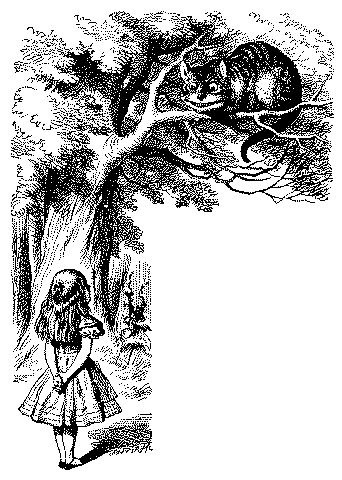
A Cheshire Cat in Wonderland

I’ve done what I came here to do.

I have provided you with three gifts.

I have provided you with the confirmed DSM-5 diagnosis of V995.51 Child Psychological Abuse for the pathology of “parental alienation.”

I have provided you with a means to require the American Psychological Association to revise their position statement on “parental alienation” to formally recognize that the pathology exists and formally designate children and families evidencing this pathology as representing a “special population” requiring specialized professional knowledge and expertise to competently assess, diagnose, and treat.

I have provided you with a road to reunite with your natural allies in mental health and restore the unity within mental health regarding the pathology of “parental alienation.”

There’s nothing more I can do for you at this point in time. It’s now up to you.

To Targeted Parents:

These are your children. This is your fight.

I’ve activated Standards 2.01 and 9.01 of the APA ethics code to give you the weapon of licensing board complaints that you need to require professional competence (Standard 2.01) in the assessment (Standard 9.01) of your children and families to prevent harm to you and your children (Standard 3.04).

I have given you the strategy for changing the APA’s position statement to formally recognize your children and families as a special population requiring specialized professional knowledge and expertise to competently assess, diagnose, and treat.

It’s now up to you.

The APA must eventually change its position statement to incorporate an attachment-based model of the pathology because their current position statement is now too narrow and too specific to only Gardnerian Parental Alienation Syndrome. So at some point they must change their position statement. Whether this takes one year or ten, is up to you.

To Gardnerian PAS Experts:

I’ve corrected the initial mistake by Gardner that took us down the wrong path of a “new syndrome” unique in all of mental health when he did not apply the professional rigor necessary to define the pathology within standard and established psychological principles and constructs.

By correcting this initial error of Gardner in too quickly abandoning established and accepted psychological principles and constructs in his proposal of a “new syndrome,” I have given you the DSM-5 diagnosis of V995.51 Child Psychological Abuse, Confirmed. This changes the conceptual framework from one of child custody and visitation to one of child protection which requires a period of protective separation for the child from the pathogenic parenting of the allied narcissistic/borderline parent during the active phase of the child’s treatment and recovery. 

Correcting Gardner’s initial error in proposing a “new syndrome” which is unique in all of professional psychology and by instead defining the pathology entirely within standard and established psychological principles and constructs, I’ve provided defined domains of professional knowledge (personality disorder pathology, attachment trauma pathology, family systems pathology) that are necessary for professional competence and expertise, and to which all mental health professionals can be held accountable.

I’ve given you a set of three definitive diagnostic indicators in the child’s symptom display that are defined by standard and established forms of symptom pathology and that can reliably identify the pathology of “parental alienation” and reliably differentiate the pathology of “parental alienation” from all other forms of parent-child conflict.

By reformulating the description of the pathology from entirely within standard and established professional constructs and principles within mental health, I’ve also given you a road back to reuniting with establishment mental health, and bringing the unity to mental health that is so desperately needed by targeted parents and their children.

It’s Up to You

Activating these gifts will require a paradigm shift from the Garderian PAS model to an attachment-based model. Whether this paradigm shift takes one year or ten, is up to you.

I’ve done what I set out to do. I’ve given you these gifts.

My continued overt presence on the stage of “parental alienation” serves no useful function at this point in time other than to distract from what needs to happen to activate these gifts. So, like the Cheshire Cat in Wonderland, my conversation with Alice is done and I will vanish now,

alice23a“Would you tell me, please, which way I ought to go from here?’

‘That depends a good deal on where you want to get to,’ said the Cat.

Alice’s Adventures in Wonderland; Chapter VI

So which way you decide to go is up to you now. And like the Cheshire Cat who has reached the end of his conversation with Alice, I will fade from view and allow you to choose whatever path you wish.

Going Dark

This will be my last blog post. My blog is going dark. And I don’t plan on making any more posts to the parental alienation area of my website. If a time comes that needs my Diagnosis book, I’ll produce that.

I’ll still be around. I’ll be available for expert testimony in court cases if your attorney thinks my testimony could be helpful, or for professional-to-professional consultations or writing collaborations. But this is your fight now. As I’ve said all along, I’m not your warrior, I’m your weapon.

I’ll still be working with Dorcy in getting you the intervention you need to restore your children’s normal-range functioning once you’re able to acquire the necessary protective separation (we must first be able to protect the child before we can ask the child to show his or her authenticity).  And I’ll be standing shoulder to shoulder with her in the upcoming battle with the pathogen.  But the assault on the individual allies of the pathogen, the binding sites of ignorance, and on the citadel of establishment mental health, these are your battles.  I cannot fight these battles for you.

My primary professional focus now will be to reveal a model of developmentally supportive child psychotherapy that’s based in the scientific research on the neuro-development of the brain during childhood, as a replacement for our current obsolete behaviorist child therapy approach that’s based in outdated research from the 1940s on changing the behavior of lab rats. You think solving “parental alienation” is difficult, I’m going to set about solving all of child psychotherapy.  I already have the model for that.  Wish me luck.

I’ve given you what you need, now it’s up to you. If it takes one year or ten, that’s up to you now.

This will be my last blog post. There is nothing more for me to to say that will advance our ability to change the mental health and legal response to the pathology.  You have Foundations.  You have Professional Consultation.  You have the ABAB Assessment and Remedy protocol. You have the online California Southern University Master Lecture Series seminars (google California Southern University Dr. Childress).  Foundations actives Standards 2.01 and 9.01 and gives you the DSM-5 diagnosis of Child Psychological Abuse, and an attachment-based alternative to Gardnerian PAS provides you with the reason needed to seek a change in the APA position statement.  You have everything you need.

So my blog is going dark.

“No, please stay with us.  We’ll miss you.”

If you need me, I’ll be here. And I’ll still be working with Dorcy on having the solution available when we reach that point. But there is nothing more for me to say for the time being. Things need to change. These are your children, this is ultimately your fight. If you’re waiting for someone to rescue you, you will be waiting a very long time.  I am a lone psychologist in private practice. I cannot rescue you. My going dark is empowering you.

I can only give you the tools you need and show you the strategy.  But you must come together.  You are all in this together.  You cannot solve the pathology of “parental alienation” in any one case, for just your child, until we solve “parental alienation” for all children.  “Me and mine” are narcissistic attitudes.  We cannot fight narcissism by being narcissistic.  You will only solve this pathology by coming together in support of each other, and not in mutual commiseration, but in action.

I’m leaving the stage so as not to distract you from your task, whatever you may decide that to be, wait for someone to rescue you, or set about the hard road of rescuing your children.

Like the Cheshire Cat with Alice,

“Would you tell me, please, which way I ought to go from here?’

‘That depends a good deal on where you want to get to,’ said the Cat,

Craig Childress, Psy.D
Clinical Psychologist, PSY 18857

The Domestic Violence Variant

The first case of “parental alienation” I treated involved a narcissistic husband/father and a targeted parent mother. The father was clearly using the child’s induced rejection of the mother as a weapon to inflict suffering on his ex-wife for having rejected his self-perceived “magnificence,” and the child was in fear of the father’s narcissistic retaliation if the child failed to show sufficient rejection of his mother.

Soon after, I treated another case with a narcissistic/antisocial father and targeted parent mother. In this case the hostility of the adolescent son toward his mother was excessive and required her to call the police for self-protection on several occasions. The domestic violence themes of power, control, and domination which were being enacted by the narcissistic/antisocial father through the child’s open contempt, hostility, and disrespect for his mother were clearly evident.

I have since been involved in several other cases of “parental alienation” involving a narcissistic father who displayed obsessive-compulsive personality overtones (i.e., highly moralistic judgement of the ex-wife from fundamentalist religious beliefs), in which the domestic violence themes of power, control, and domination were again evident.

I am not a domestic violence expert, but as a clinical psychologist I know enough to recognize the pathology of domestic violence.

There are several related variants of “parental alienation” involving a narcissistic/(antisocial), narcissistic/(obsessive-compulsive), and narcissistic/(paranoid) personality husband-father and a targeted parent mother that essentially represent domestic violence by proxy. The verbal, emotional, and psychological abuse by the narcissistic father of the mother during and following the marriage in this variant of the “parental alienation” pathology clearly evidence the themes of power, control, and domination characteristic of domestic violence. 

In some cases the loss of the mother’s beloved children is used as the weapon to inflict suffering,

“Aren’t you sorry now that you left me. I’ve killed your children. You don’t have your children anymore. They’re mine.”

In other cases, the children’s open contempt and hostility toward the targeted parent mother are used as violence-by-proxy weapons by the narcissistic (or narcissistic/antisocial or narcissistic/obsessive-compulsive or narcissistic/paranoid) ex-husband to continue the emotional and psychological abuse of his ex-wife following divorce.

So as I was researching why the mental health system response to this pathology was so broken, imagine my surprise in learning that the National Organization of Women (NOW) was one of the staunchest opponents of the “parental alienation” construct. Are you kidding me? They should be one of our staunchest allies. But instead, they are active opponents to recognizing the pathology of “parental alienation.” Why?

Gardnerian PAS.

They are afraid that the poorly structured symptom descriptions of Gardnerian PAS will discount the reports by children of authentic domestic violence based on false allegations of “parental alienation” made by the abusive narcissistic spouse. They are afraid that children exposed to authentic domestic violence, who are authentically afraid of their violent and abusive narcissistic father, and who are authentically being protected by their normal-range mother, will have their fears discounted based on false allegations of “parental alienation.”

So I looked at that concern. I imagined scenarios of authentic domestic violence and applied the Gardnerian eight symptom identifiers to these hypothetical cases. Is it possible that a poor application of the Gardnerian eight symptom identifiers could result in an authentically abused child potentially being returned to and re-exposed to an abusive narcissistic father based on a false allegation of “parental alienation”?

And you know what? Using the Gardnerian eight symptom identifiers… it’s possible.

That’s why you see the opening statement of the APA’s Position Statement on Parental Alienation Syndrome address the issue of discounting allegations of domestic violence. They have a legitimate concern and this legitimate concern is officially recognized by the American Psychological Association.

So one of my main goals in working out an alternative model and alternative set of diagnostic indicators has been to address this concern of NOW and other domestic violence mental health professionals to ensure the protection of children from authentic child abuse by a narcissistic ex-husband/father.

A child who has been authentically abused will not meet the three diagnostic criteria of an attachment-based model of “parental alienation.”

The primary diagnostic indicator that will not be met by authentically abused children who are afraid of their abusive parent is Diagnostic Indicator 2: five specific personality disorder traits evidenced in the child’s symptom display. Authentically abused children will not evidence a haughty and arrogant attitude toward the abusive parent, and authentically abused children will not evidence an attitude of entitlement toward the abusive parent.

Nor will authentically abused children meet Diagnostic Indicator 3 of an attachment-based model of “parental alienation” regarding a delusional belief in the supposedly “abusive” parenting of the normal-range and affectionally available targeted parent, because in authentic abuse the child’s beliefs regarding the abusive parenting of the feared parent have a reality basis. They are not delusional. They are real and authentic concerns that can be supported by the evidence.

The child will actually not meet Diagnostic Indicator 1 of attachment system suppression either, but recognizing that symptom feature is more subtle and requires expertise in the attachment system display of children and the attachment system display in response to trauma.

In my former role as the Clinical Director for an early childhood assessment and treatment center, one of our primary client groups were children in the foster care system (we had a contract with the Department of Children and Family Services – our child protective services agency). I have seen all of the various forms of severe child neglect, physical abuse, and sexual abuse. Meth addicted parents whose children had no food in the house for days as the meth parent slept off a multiple-day drug binge. Children of meth addicted parents who were sexually abused by other meth addict friends of the parent while high. Children who were beaten with electrical cords leaving raised welts across their backs, or who had burns from where the parent put cigarettes out on the child’s arm as a form of discipline. I’ve seen authentic child abuse up close and personal.

And the attachment system response of these authentically abused children does not display the same pattern of distortion as it does in the pathology of “parental alienation.” If you know the attachment system and if you know how it responds to authentic trauma, it’s actually quite easy to differentiate the authentic trauma of child abuse from the induced pathology of “parental alienation.”

Our goal is to protect 100% of children 100% of the time from all forms of child abuse, physical, sexual, and psychological.

Interestingly, just the other day I took on two new cases involving “parental alienation.” One is a treatment-related case involving a clearly borderline personality mother who has a narcissistic personality veneer, who is seeking to make the ex-husband an ex-father in order to establish her “dream family” with the new spouse (with mountains of substantiated false and delusional allegations by the mother of supposed “abuse” by the clearly normal-range and affectionally available father), and the other case I accepted is a legal case working as a consultant and possible expert witness for an attorney involving a false allegation of “parental alienation” in which a clearly narcissistic, emotionally and psychologically abusive ex-husband and father is seeking to discount the child’s authentic fear by making false allegations that the child’s authentic fears are the product of “parental alienation” by the mother. In the legal case, I’ll be applying an attachment-based model to the child’s symptom display, along with the prior evidence of substantiated abuse, and I will be using this model to highlight how the child’s symptom display is actually consistent with authentic anxiety associated with chld abuse rather than induced pathology.

False allegations of “parental alienation” are a legitimate concern.  Not everything is a dog.  But neither is everything a cat.

Domestic Violence “Parental Alienation”

We need to recognize the legitimate concerns of mental health professionals and women’s rights groups regarding authentic domestic violence and child abuse relative to problematic aspects of the Gardnerian eight symptom identifiers. We should be allies with domestic violence mental health professionals and women’s rights groups, not adversaries. An attachment-based model of “parental alienation” with its three diagnostic indicators can achieve this reunification with our domestic violence allies in mental health.

There are a group of variants within the “parental alienation” pathology that essentially represent domestic violence by proxy.

The domestic violence variants of “parental alienation” typically involve a narcissistic husband-father (although not always) who may have additional antisocial, obsessive-compulsive (i.e., rigid moralistic beliefs), or paranoid overtones to the personality disorder pathology. In these cases, the targeted parent mother was typically attracted initially to the narcissistic/(antisocial) charm of the husband, and she believed that their emotional intimacy would develop over time during their marriage.

However, once married, the narcissistic emotional and psychological abuse by the husband became increasingly more evident. Eventually, the wife could no longer tolerate the emotional coldness and distance of the narcissistic husband and his continual openly displayed contempt and hostility toward her. In some cases, the children may have been so exposed to the father’s openly contemptuous and demeaning treatment of the mother that they are primed to evidence the same attitude toward the mother, in other cases the narcissistic father’s incapacity for emotional intimacy has allowed the children to form an emotionally close bond with the mother during the period of the marriage and intact family.

Having suffered years of emotional and psychological abuse from her narcissistic husband, the wife eventually decides to divorce her abusive narcissistic husband. It is at this point that the “parental alienation” pathology takes off into over-drive. This rejection of the abusive narcissistic husband creates a narcissistic injury of exposing his core self-inadequacy to public display. The narcissistic ex-husband is being publicly exposed by the divorce and by the wife’s rejection of him as being an inadequate husband and person.

This narcissistic injury provokes a narcissistic rage and an intense desire for retaliatory revenge against the ex-wife. However, because she is no longer physically present in the home to be emotionally and psychologically degraded and abused by the narcissistic ex-husband, he turns to his only remaining weapon, the children who are beloved by the mother, as the means to exact his retaliatory revenge and continue his emotional and psychological abuse of her.

By divorcing the narcissistic (antisocial, moralistic obsessive-compulsive, paranoid) ex-husband, the mother has escaped his direct emotional and psychological abuse and degradation. But because they still share children, she has not escaped him entirely, and he can continue his abuse of her indirectly through his use of the children as his proxy weapons of continuing emotional and psychological domestic violence.

With the mother’s decision to divorce, the narcissistic husband begins to poison the children against their mother by blaming her for the divorce and for her supposedly breaking up “our family” because “she doesn’t love us anymore.” The interpersonal power of narcissistic confidence and his open contempt for the children’s mother models for them what their attitude toward her should be. The father elicits criticisms from the children of their mother through his directive and motivated questioning and their role-reversal relationships with him as external “regulatory objects” to stabilize his emotional and psychological state. The narcissistic ex-husband and father then inflames and exploits these elicited child criticisms to create a culture of denigrating the mother for her supposed inadequacies and failures as a parent (as a person), all the while hiding his continuing psychological and emotional abuse of the mother behind the children’s induced hostility and rejection:

“I’m just listening to the children. Just ask them. I’m telling them that they need to love their mother no matter how bad she is. But what can I do, she’s just a bad parent. Just ask the children.”

This is not some “new form of pathology.” This is a all a manifestation of standard personality disorder pathology triggered by the rejection inherent to divorce. Once we stop thinking “parental alienation” and start thinking narcissistic personality disorder pathology (in the domestic violence variants with possible antisocial, moralistic obsessive-compulsive, and paranoid overtones, in other variants with possible borderline and histrionic overtones), the pathology becomes evident and easily diagnosable by professionals who are competent in assessing and diagnosing personality disorder pathology.

There is no “new syndrome.”  Richard Gardner was simply a poor diagnostician. 

It’s all standard and well-established forms of pathology fully accepted within the established domain of clinical psychology. We need to stop thinking “new form of pathology” and simply do an adequate job of diagnosing pathology.

The personality disorder pathology of the psychologically controlling parent will be evident in the child’s symptom display. Since the child’s symptoms are being induced by the personality disordered parent, the child’s symptoms act as a lens into exposing the exact personality disorder pathology of the narcissistic parent – with borderline overtones, with antisocial overtones, with histrionic overtones, with paranoid overtones, with moralistic obsessive-compulsive overtones.

Dr. Childress’ “new theory.” Nonsense. Personality disorder pathology. The only reason it seems “new” to some people is because personality disorder pathology is new to them. This is nothing new. Standard mental health constructs and pathology.

Letter of Support

I was recently asked for consultation regarding the domestic violence variant of “parental alienation” by a mental health professional who is seeking to get this component domestic violence by proxy pathology incorporated into the domestic violence response of the mental health system in her state. In response to her request for consultation, I wrote a letter of support for recognizing variants of “parental alienation” pathology as a form of domestic violence. I have posted this letter of support to my website in case this letter might be helpful to targeted parents who are going through this type of domestic violence by proxy form of the “parental alienation” pathology.

Domestic Violence in “Parental Alienation” Support Letter

Mental health professionals concerned about domestic violence and women’s rights groups, such as the National Organization of Women, should NOT be our adversaries, they are actually are natural allies. They have legitimate concerns. We need to address their legitimate concerns. An attachment-based model of the pathology of “parental alienation” that defines the pathology from the perspective of standard and established personality disorder pathology provides a road to reuniting with our allies in domestic violence prevention and treatment.

Let’s take that road.

Craig Childress, Psy.D.
Clinical Psychologist, PSY 18857

The APA End Game

Let me start by saying that I know persons of other nationalities are following the discussion, but I’m not trying to solve things in your countries, at least not yet (you’ll see my thoughts on this aspect by the end of this post). I’m just trying to solve things in the United States right now.

In the United States, the key player in the solution is the American Psychological Association, the APA. The APA has established standards of practice governing psychologists, the Ethical Principles of Psychologists and Code of Conduct. There are different professional organizations for Marriage and Family Therapy and Social Work, but if the APA changes then these other professional organizations will follow suit. The key is the APA.

It doesn’t matter what we think as a collective group within “parental alienation experts.” What matters is what the APA thinks. The end game is not whether Dr. Baker and Dr. Childress make up and play nice. That’s not going to change a thing. What matters is that we create change in the APA that will ripple through all of the professional practice response to the pathology of “parental alienation.”

What’s important to understand, is that I have a strategy here. I’m not just running off crazy and half-cocked. There is definitely a strategy to this. There are about 20 components to this strategy, with about three main lines. I laid out one of the main lines in my post I’ll Explain It Just Once. In this current post I’m going to explain another main line to the strategy, the APA end game strategy. But it’s important to understand that there is a strategy to this.

My Motivation

I’m not a “parental alienation” expert. I’m from the outside. I’m from ADHD and early childhood mental health. I only came over here to fix the broken mental health response to the pathology of “parental alienation.” Once we’ve completed the APA end game, I’m going back to ADHD and parenting generally.

The reason I left ADHD and came over here is because this is the most horrific pathology I have ever seen, and I’ve worked with kids in the foster care system. To kill someone’s children because you’re mad at them and want revenge is an abomination. And what this pathology does to the self-structure development of children is a form of child psychological abuse. When I ran into this pathology and recognized the extent of the failures in both the legal system and the mental health system, I just had to stop what I was doing and come over here to fix this.

The first thing I did was a thorough analysis of the broken mental health system and legal system response. Once I figured out what needed to happen to fix these systems’ response to the pathology, and the order of the fix, I then set about analyzing the structure of the pathology. I realized that people wouldn’t be able to recognize the solution by just explaining it to them, there were too many integrated moving parts to the solution. I would simply have to enact the solution, and then at some point they would see its integration and go, “Ohhhhh, I get it.” Hopefully we’re reaching the “I get it” moment (actually we’re past where I thought it would start to dawn on people). 

So now I’m going to explain the APA end game.

The APA Strategy

The primary problem in the professional mental health response to the pathology of “parental alienation” is the degree of extensive incompetence of mental health professionals who are involved in the assessment, diagnosis, and treatment of this pathology. If we could limit the assessment, diagnosis, and treatment to only persons expert in Gardnerian PAS we’d have the solution. Problem is, we can’t.

So we need to establish domains of competence to which all mental health professionals can be held accountable in order to clear out the extensive incompetence surrounding the recognition and diagnosis of this pathology. This will allow us to gain control of the assessment, diagnosis, and treatment of this pathology. Establishing domains of professional competence that would be subject to APA Standard 2.01 (and 9.01) requires that the APA give its tacit approval to the pathology. There’s no formal governing body of the APA tasked with “approving” official pathologies, but if we can obtain a signal from the APA, then this would go a huge way to solving things.

The group tasked with formally designating pathologies is the American Psychiatric Association through their diagnostic codex, the DSM (currently in its fifth revision; the DSM-5). I know, Psychological – Psychiatric; APA and APA. Confusing. But we in mental health have all of this squared away. I’m focused on changes in the American Psychological Association not changes in the DSM.

The key is the APA (American Psychological Association) Position Statement on Parental Alienation Syndrome. Notice an interesting aspect of this official position statement, it is directed specifically at Gardnerian PAS. It’s so incredibly specific. If we offer up an entirely different model for defining the pathology, then the APA must then CHANGE their position statement to accommodate this new model. Are gears beginning to click into place, are you beginning to get it?

This change in the position statement MUST occur, because the current position statement ONLY covers Gardnerian PAS.

Whether this formal change to the wording of the position statement occurs in 10 years, or 5 years, or next week, it must at some point change. That’s the revolutionary importance of Foundations. It presents the American Psychological Association with an entirely different and separate model for defining the pathology, so that they MUST now change their official position statement in order to accommodate this new model as well. Ten years, five years, next week, it must happen, it’s just a matter of time.  Get it?

I’ll give you a little preview of where this post is going to end. I want to achieve a four-day conference hosted by the APA with invited participants to work out the new wording changes to the official APA position statement. The participants at this official sit-down will include representation from our team and representation from opponents and other relevant stakeholders. From this 4-day official conference, the APA will announce the new wording, and the group will probably produce an official position statement paper, with individual commentary by each of the participants who want to provide a commentary.

From our team, I’d like to see William Bernet, Amy Baker, Linda Gottlieb, and myself. I’d like Dr. Bernet to lead our team. I’m not familiar enough with the other side to comment on who would receive an APA invitation for that team, but it’s likely to include all the standard arch-nemeses of Gardnerian PAS.

But this is important to understand:

This formal APA 4-day conference is ONLY to address wording changes to the APA position statement made necessary by a NEW model – an attachment-based model – NOT to deal with anything Gardnerian PAS, because the current position statement of the APA fully addresses what they want to say about “Parental Alienation Syndrome.” Been there, done that.

So the ONLY people who will receive invitations from the APA (I’m not going to be in charge of invitations to this little soiree; the APA is going to decide to whom it wants to extend invitations) will be people relevant to the discussion of wording changes needed to address the NEW attachment-based model. They are not going to re-open Gardnerian PAS. So if William Bernet and Amy Baker and Linda Gottlieb – or whoever – want an invitation to this event, and I really-really want them at the table, then they are going to have to speak from an attachment-based perspective, because that’s the only people who will be on our side. The APA is not going to invite Gardnerian PAS people. They’ve already decided on that model. That’s closed.

Do I hear more gears clicking?

So let me finish off with the guest list. I’d like to see our team headed by Dr. Bernet because he has the most extensive knowledge of the pathology and of the history of trying to get formal recognition for the pathology. I’d like Amy Baker there because of her solid research into the pathology and she is the media face of “parental alienation.” I’d like Linda Gottlieb there because she worked with Salvador Minuchin and she has the family systems component nailed. I’ll be there as the central representative of the NEW model.

But Drs. Bernet and Baker and Linda Gottlieb are ONLY going to receive an invitation from the APA (not from me, from the APA) if they are relevant to an attachment-based model, because their expertise in Gardnerian PAS isn’t relevant to the purpose of the conference, which is ONLY made necessary by the need for a wording change to accommodate a NEW alternative model to Gardnerian PAS for describing the pathology.

So when Dr. Bernet and the other Gardnerians want me to play nice and work together, they don’t get it. If an attachment-based model is subsumed under a Gardnerian PAS model, then there is NO REASON for the APA to revise its position statement. It is vital – and indeed central – to this strategy that an attachment-based model be an entirely different and ALTERNATIVE model to the Gardnerian PAS model. This will force the APA to change the wording to their position statement. Get it?

To flesh out my wish list for the participants from our team, I would hope that Karen Woodall could receive an invitation representing our global colleagues, since this is a global phenomenon, and I would propose that Amanda Sillars attend representing both Australia and the stake-holders of targeted parents. I think that’s a pretty good dance card for our team.  But I’m open to who is on our team.

I know this, though.  If none of the Gardnerians change to an attachment-based model, I may have to carry representation all on my own.  I don’t want to, but if I have to I will.

Then there will be the other side, probably composed of all the arch-nemeses of Gardnerian PAS.

But again, this APA conference is only caused by an attachment-based model being a new and alternative model to Gardnerian PAS, so that there are now two different models which must be addressed by the APA’s position statement, and the only people getting invitations will be attachment-based people since the Gardnerian PAS model will be nowhere on the agenda.

Back in my younger days of being an expert in Internet Psychology, I received an invitation from the American Academy for the Advancement of Science in collaboration with the Office for Protection from Research Risks (OPRR) to a conference to develop a white paper on Internet research in mental health. I envision a very similar sort of targeted “white paper” type of officially sponsored 4-day conference, focused specifically on coming up with wording changes to the APA position statement made necessary by the NEW attachment-based alternative to the Gardnerian PAS model

Is the strategy starting to make sense to you?

Positions

Our position is that we want two things, 1) acknowledgement that the pathology exists, and 2) designation of these children and families as representing a special population who require specialized professional knowledge and expertise to assess, diagnose, and treat.

I think those are totally middle-of-the-road and reasonable positions.

Here’s how I envision the negotiation process:

Their Side: No Gardnerian PAS.

Our Side: Agreed

Our Side: Acknowledge the pathology exists (personality disorder pathology affecting families surrounding divorce) and “special population” status for these families.

Their Side: Agreed.

Yay. Breakthrough. The gridlock is ended.

(We may have the framework of a deal worked out even before the start of the conference).

Now to the specifics of the wording.

Wording of Pathology Exists

Our Side: “Family relationships surrounding divorce can be affected by a variety of factors, including the negative influence of one parent regarding the child’s relationship with the other parent.”

Their Side: We want acknowledgement of child abuse trauma and domestic violence.

Our Side: Then we also want acknowledgement of “pathogenic parenting” and personality disorder pathology

Proposal: “Family relationships surrounding divorce can be affected by a variety of factors including the child’s response to child abuse, prior domestic violence in the home, and pathogenic parenting by a personality disordered parent.

And so we’d go, back-and-forth. Perhaps the best option would be to remain general and not be too specific, and to just produce a general sentence that:

Proposal: “Family relationships surrounding divorce can be affected by a variety of complex factors.”

I could probably live with that. The conference itself and the invited guest list of conference participants is acknowledging that the pathology exists. We’d work something out in terms of acceptable wording. My goal is to get us the conference, the sit-down with APA. From that point on, I’m flexible.

Wording of Special Population

Our Side: “Because of the varied complexities of family relationships, those families that are involved in high-conflict divorce situations represent a special population requiring specialized professional knowledge and expertise to competently assess, diagnose, and treat.”

Their Side: “We want this specialized knowledge to include children’s response to abuse trauma and domestic violence.”

Our Side:  “Agreed. We want this specialized knowledge to include personality disorder pathology, attachment trauma pathology, and family systems expertise.”

And so we’ll work out the exact wording, back-and-forth in productive dialogue and mutual cooperation to reach a common goal. The APA itself can close its position statement with the same general neutral position it currently has, of having “no official position” on the pathology of “parental alienation.” No problem.

Kumbaya, and the lion lays down with the lamb.

Okay, I’m not entirely that naïve. But we’re smart people. We’ll be able to work something out. If the other side becomes intransigent, then they will just marginalize themselves because then they expose that nothing is acceptable to them. Narcissistic and borderline pathology exists. The particular vulnerabilities of these personality disturbances will be specifically triggered by divorce. To be intransigent on recognizing this is simply to maintain a false position of inflexibility. Authentic child abuse and domestic violence exist. We have no problem acknowledging that, as long as the pathology (personality disorders and “parental alienation” – with a fall-back position to “pathogenic parenting”) is also acknowledged as existing. Dogs exist and cats exist. No problem. We’ll be able to work this out.

Then I go back to ADHD, leaving Dr. Bernet, Dr. Baker, Linda Gottlieb and the rest of the “parental alienation” experts to work out the details within the actual field of practice.

The conference itself will be a high-profile acknowledgement that the pathology exists, as is the need for a wording change to the APA position statement. As importantly, if not more so, is that targeted parents and their children are formally designated as a special population requiring specialized professional knowledge and expertise, which will dramatically improve the quality of the mental health response to the pathology.

Paradigm Shift

From where I sit, this is a win all the way around, most of all for the targeted parents and their families. But it is ONLY made possible by a second NEW model alternative to Gardnerian PAS. As long as Gardnerian PAS remains the dominant paradigm for defining the pathology, there is no need for the APA to change its position statement.

Are you still not seeing that?

So, Dr. Bernet, when you write an article saying that an attachment-based model is just the same old thing (Old Wine in Old Wine Skins) you are actually preventing this sit-down with the APA.

You’re all saying I’m not working with you. From my position, you’re not working with me.

My goal is to get this sit-down sometime in 2016 simply by the pressure on the APA applied by targeted parents. But Dr. Bernet, imagine if you went to your contacts in the APA and started talking up the attachment-based model,

“Oh my God, there’s a new model out here for parental alienation that defines it from entirely within standard and established constructs using the attachment system. This could potentially revolutionize our approach to diagnosis and treatment. You really need to take this new model into consideration. We need a sit-down conference to work out wording changes to your official APA position statement to take this new model into consideration.”

And I’m handing you the good-cop/bad-cop on a silver platter.

APA: Well Bill, you know this Dr. Childress calling for licensing board complaints, that’s kind of over the top

Bill:  Yeah, I know.  He gets like that. But if we had this sit-down conference to change the wording of the APA’s position statement, I’m confident I could get him to back off on that.

Work with me people.  I’m taking the outside position so you don’t have to.  You can be all moderation and reasonableness.  Work with me.  You don’t think I know what I’m doing?

Dr. Baker, you are the media face of “parental alienation.” Imagine if you made a high-profile switch to using the three diagnostic indicators of an attachment-based model. That would create a tectonic shift in mental health. The APA would have to have this sit-down with us on a wording change to their official position statement.  You and Dr Bernet working in tandem, it’s sure to get done.

Work with me people. I’m not your enemy. If you stop me, then we don’t get this 4-day conference to change the wording of the APA position statement to acknowledge that the pathology exists and obtain special population status for targeted parents and their children.

But this is ONLY possible from an attachment-based model. It is not possible from a Gardnerian PAS model because the APA already has a position statement on Gardnerian PAS.  

And look at this, if their position statement were about “parental alienation” more generally, a wording change might be a harder sell. But look there, right in the title, and in the body of the statement, they are ONLY referring to Gardnerian PAS. A new alternative model has ‘em. They have to change their position statement to accommodate the new alternative model as well. We’ve got ‘em.

But only if we approach this from an attachment-based model perspective.

And then look at the first key breakthrough. Our opponents don’t want a Gardnerian PAS model. We agree. That’s the key to achieving this breakthrough. But then does the position statement say there’s no Gardnerian PAS?  No it doesn’t.  If you want to go back to a Gardnerian model after the conference, go ahead.  After the conference if you want to define 30 variants of “parental alienation,” be my guest.  There will be more than enough time for that, once we stop the bleeding out of this pathology.

Think of this, once we get a statement that the assessment, diagnosis, and treatment requires specialized knowledge and expertise, this doesn’t specify what knowledge and expertise.  You can all discuss and debate what type of expertise is necessary to your heart’s content.  Fine by me.  But first things first.

Dr. Bernet, Amy Baker, Linda Gottlieb and the rest, if you insist on holding onto the Gardnerian PAS model, then I along with those targeted parents who “get it” are ultimately going to provoke the APA into this 4-day conference (that’s why I’m calling for licensing board complaints – I’m trying to motivate the APA to address our issues, the wording changes to the official APA position statement. – I’m trying to be as annoying as hell to them. Get it?).

And this conference won’t be about Gardnerian PAS.  They already have a position statement about Gardnerian PAS.  If you hold onto Gardnerian PAS you won’t get an invitation to participate in this conference, because the conference is NOT going to re-open Gardnerian PAS. It’s ONLY going to address wording changes to the APA position statement prompted by the existence of a second, alternative model to Gardnerian PAS.

I want you at this conference. Dr. Bernet, I’d like you to lead our side. Amy Baker, Linda Gottlieb, I’d like you there. But I’m not in charge of the guest list invitations. If you remain on the outside, you will remain on the outside. Ultimately targeted parents and I are going to prod and provoke the APA into eventually holding this 4-day conference on wording changes to their official position statement on “parental alienation.”  It’s going to happen because the current position statement of their’s is too narrow now that there are two alternative models.  Get it?  If you simply subsume the attachment-based model into the current Gardnerian model then we lose this entire advantage. Get it?

This is really far more of the strategy than I was hoping to have to spell out in print.  After all, we will eventually be going into negotiations and I’d rather not spell out too much in advance.  I was hoping that just the general sophistication advantage of the attachment-based model and it’s ability to give us a DSM-5 diagnosis of Child Psychological Abuse and the call to change the APA position statement would be enough to get you to come on board.  But apparently not.  So I guess I need to be really specific on the strategy.

Good-cop/bad-cop.  Get a conference with the APA for them to change their wording on their official position statement to acknowledge the pathology and require specialized domains of knowledge and expertise. Get it?

If left on our own, I’m hoping that targeted parents and I can achieve this sit-down with APA sometime in 2016.  But maybe targeted parents will be slow to mobilize and activate. And maybe it will take two or three years to achieve this conference. But Dr. Bernet and Dr. Baker, with your fully active support, could we achieve this 4-day conference by March of 2016?  April?  July?  Every day that passes is one day too long for these families.

Please. Don’t sit on the sidelines in this fight. You’re saying I’m not cooperating with you. From where I sit, you’re not cooperating with me. We’re all on the same team. Join me. But if you choose to sit on the sidelines and force targeted parents and I to achieve this sit-down with the APA entirely on our own, oh well, I guess that’s what we have to do.

This is far more of the strategy than I was hoping to have to disclose. So if at some point this blog post mysteriously disappears, don’t be surprised.

So we have the APA end game and we have the DSM-5 diagnosis of Child Psychological Abuse. Those are two of the lines. There’s more. There’s another line for how we join with allies in domestic violence and attachment trauma, both for the conference but also for the DSM-5.1 revision.  There’s more. But are you starting to see it yet?

If you leave targeted parents and I to do this on our own, well, not much we can do about that.  We’ll do what we have to do.

Craig Childress, Psy.D.
Clinical Psychologist, PSY 18857

Personal Boycott

I am not speaking to targeted parents, I am speaking only to my professional colleagues in mental health.

Let me extend this request to all of my professional colleagues on this side of the “parental alienation” debate within mental health, whether you like me or not, whether you support me or not.  Let’s stop using the term “professional” to refer to our mental health colleagues on the other side who are evidencing such profound professional ignorance and incompetence in their response to this pathology. Let’s start calling them “mental health persons.”

I’m asking for a professional boycott on our use of the word “professional” in referring to our professional colleagues who are colluding with the expression of this savage and brutal psychopathology.  If you choose to join me in this boycott, you can do so openly as I’m doing through the strikeout, or you can simply subtly replace the word “professional” with “person.”

I know for myself, I’m not going to use the term again in reference to them until they begin to act like “professionals.” I’m done calling them professionals. To me, they are mental health persons until they start behaving at a level commensurate with a professional.

We can’t get to this boycott through Gardnerian PAS. If we try to use Gardnerian PAS to start boycotting the use of the term “professional” then we just look petulant.

But I’m using personality disorder pathology. I’m done with Gardnerian PAS. I am acting from entirely within standard and established psychological principles and constructs. I want either professional competence or I want the professional licenses of incompetent mental health professions revoked.

I know licensing boards won’t revoke their license… yet.  But I want these ignorant and incompetent mental health professionals persons to know that I’m trying with all my knowledge, skill, and determination to revoke their license to practice. And they underestimate me at their peril.

Core Issue

The core issue is the savage and brutal covert anger dyscontrol of a narcissistic or borderline personality spouse and parent being expressed into the surrounding family context, and the collusion with and abetting of this covert anger dyscontrol pathology by the professional ignorance and incompetence of the mental health professional person.

Core Principle

The core principle guiding my actions is Standard 1.04 of the APA ethics code that states,

1.04 Informal Resolution of Ethical Violations
When psychologists believe that there may have been an ethical violation by another psychologist, they attempt to resolve the issue by bringing it to the attention of that individual, if an informal resolution appears appropriate and the intervention does not violate any confidentiality rights that may be involved.

The ethical violation by these mental health professionals persons is of Standard 2.01 of the APA ethics code regarding practice beyond the boundaries of their professional competence, and the area of professional competence is in the manifestation of narcissistic and borderline personality pathology into a family context surrounding divorce (rejection by the attachment figure of the former spouse).

The core feature of this pathology’s expression is of the savage and brutal covert anger dyscontrol expressed by the narcissistic or borderline personality spouse and parent, and the manipulative and exploitative use of the child by the narcissistic and borderline spouse and parent as a means for the covert expression of psychologically violent anger dyscontrol.

Notice I’m not using the term “parental alienation” anywhere. All standard and well-established psychological principles and constructs.

These mental health persons are not recognizing and not responding appropriately to personality disorder pathology. Personality disorder pathology exists. I’m not a Gardnerian PAS advocate. I’ve distanced myself from Gardnerian PAS. I’m a standard and established mental health guy. And from entirely within standard and established psychological principles and constructs, I am personally boycotting the term “professional” when referring to mental health professionals persons who are practicing beyond the boundaries of their competence, and so who are, as a result, colluding with and abetting the savage and brutal covert expression of anger dyscontrol by a narcissistic or borderline personality spouse and parent toward the targeted parent.

I am asking my professional colleagues to consider joining me in this boycott, as a matter of personal conscience and in a personal expression of solidarity with the victims of this savage and brutal covert expression of anger dyscontrol by a narcissistic or borderline personality spouse and parent.

This pathology must stop.

Through their ignorance and incompetence regarding the expression of narcissistic and borderline personality pathology into and within a family context, these mental health professionals persons are colluding with and abetting in the psychological brutalization of the ex-spouse.

The narcissistic or borderline spouse and parent is manipulating and exploiting the children (fully consistent with the interpersonal processes characteristic of narcissistic and borderline psychopathology) to be used as weapons for inflicting suffering onto the ex-spouse. The desire to produce suffering in the ex-spouse is a manifestation of the anger dyscontrol associated with the narcissistic and borderline personality psychopathology.

The manipulation and exploitation of the children in this pathology represents a manifestation of the characteristic interpersonal style and approach of narcissistic and borderline personalities. The anger dyscontrol of the narcissistic or borderline spouse and parent is being covertly manifested through the manipulation and exploitation of the children as vehicles for the expression of this anger dyscontrol.

If mental health professionals are going to assess, diagnose, and treat – in any way – the impact created in the family from narcissistic and borderline personality pathology surrounding a divorce, then they MUST possess a high level of professional expertise in the overt and the covert manifestations of the pathology of narcissistic and borderline personalities.

The propensity for both overt and covert expressions of anger dyscontrol by a narcissistic or borderline personality, particularly arising from the interpersonal rejection inherent to divorce (rejection by the attachment figure), places the ex-spouse at a high risk of being targeted for the anger dyscontrol of the narcissistic or borderline personality spouse and parent. Intense anger is associated with both the narcissistic and borderline forms of personality pathology, and intense anger is also associated with interpersonal violence and brutalization. Mental health professionals treating this form of psychopathology in the family must therefore be highly alert and sensitized to recognizing both overt and covert expressions of interpersonal psychological violence and the brutalization of the ex-spouse by the pathology of the narcissistic or borderline personality spouse and parent.

Failure to possess the required professional competence regarding the overt and covert manifestations of narcissistic and borderline psychopathology with a family context represents practice beyond the boundaries of professional competence in violation of Standard 2.01 of the Ethical Principles of Psychologists and Code of Conduct of the American Psychological Association.

When there is an ethical violation by our colleagues, we are required by Standard 1.04 of the APA ethics code to “resolve the issue by bringing it to the attention of that individual,” In my decision to personally boycott referring to these ignorant, stupid, and incompetent mental health professionals persons as professionals, I am exercising my professional obligation to “resolve the issue by bringing it to the attention of that individual” consistent with my ethical responsibilities under Standard 1.04 of the ethics code.

I don’t care if they recognize that they are assessing, diagnosing, or treating narcissistic or borderline personality pathology within the family – because you know what? That’s their job to recognize that they’re treating personality disorder pathology.

To the stupid and incompetent mental health person:

You are not a plumber. You are not an engineer. You are a mental health professional, and unless you act like a mental health professional you don’t deserve to be called a mental health professional.

So from here are out, to me, you are not a professional. You are a plumber who is doing mental health work. You are an engineer. You are simply a person. You are not a mental health professional. You are simply an incompetent and stupid person who is doing mental health related work. I don’t care what letters you have after your name or what job you may hold. You are an incompetent and stupid person until you start acting with the knowledge and competence of a professional.

The core of this pathology is narcissistic and borderline personality pathology. That’s what needs to be recognized and understood within the mental health system. This isn’t “parental alienation.” This is a manifestation of narcissistic and borderline personality pathology surrounding divorce. This is the core of the issue that I want to drive into and throughout the mental health system. Narcissistic and borderline personality pathology exists. It is activated by divorce. It is prone to anger dyscontrol that can be both savage and brutal. You know it. I know it. And they know it.

Both the narcissistic and borderline personality pathologies are referenced and operationally defined in the DSM-5. Narcissistic and borderline personalities have also been extensively described in the works the preeminent theorists Otto Kernberg, Theodore Millon, and Arron Beck. This is established and existing, fully recognized and fully accepted psychopathology. I want to drive this pathology into the mental health system’s understanding regarding the pathology that we typically describe as “parental alienation.”

We can talk about all the variations and nuances of the “parental alienation” pathology later, once we bring this pathology to an end. But first, I want to stop the evil of a narcissistic or borderline personality ex-spouse seeking revenge on the abandoning attachment figure of the targeted parent by killing the targeted parent’s children (“Now aren’t you sorry you rejected me. You don’t have your children anymore. I’ve killed your beautiful, wonderful children.” – evil, pure evil).

Mental health professionals persons who collude with the pathology and abet in the enactment of this evil do not deserve the appellation of “professional,” and from here on out, I’m not going to give it to them.

I’m going to try as hard as I can, as a mental health professional, to overtly and publicly shame my professional colleagues for their professional ignorance and incompetence.

To all my professional colleagues on this side of understanding, who know the reality of “parental alienation,” I’m not going to nit-pick and get diverted by all the different shades and variations of this pathology. I know they exist. There will be time enough for that once we bring this pathology to an end. But I want to drive home to the core of our professional colleagues on the other side that this isn’t some esoteric fictional pathology, this is an all too real and existing, severe and savage pathology that they are colluding with and that they are abetting because of their professional ignorance and stupidity.

Professional Decorum

To the incompetent and stupid mental health professionals persons:

If you don’t like me calling you ignorant and stupid. Then stop being ignorant and stupid.

“Dr. Childress, you need to act with greater professional decorum toward your professional colleagues.”

You’re absolutely right. I agree 100%. And the moment they begin to act like professionals is the moment I will treat them with appropriate professional respect.

Why are you talking to me about professional decorum, and giving a complete pass to their profound professional ignorance and stupidity that is colluding with and abetting the severe and savage psychological brutality of narcissistic and borderline personality psychopathology that is being expressed within the family.

If a narcissistic and brutally violent husband beat his ex-wife so that she lay in a crumpled mass on the floor, bloody, swollen, and bruised, would you just walk away – no wait – would you actually hand this narcissistic husband a stick, a rod, a staff, so that he could beat her all the more savagely, breaking her ribs and injuring her even more severely?

Because that is EXACTLY what is happening. Only the beating and the club are psychological, not physical. And you are colluding with and abetting in the covert psychological brutalization of the ex-spouse by the narcissistic or borderline pathology of the supposedly “favored” parent, who is manipulating and exploiting the child – fully consistent with the pathology of the narcissistic or borderline parent and spouse.

You should be ashamed of yourself, for both your ignorance and for you abject professional incompetence.

If you don’t like me calling you ignorant and incompetent, then don’t be ignorant and incompetent.

So APA, what would you say about a mental health professional person who not only didn’t step in to stop the savage and brutal beating of the ex-spouse, but who actually handed the violent narcissistic spouse the rod to more fully beat his ex-spouse with even greater savagery? Why are you chastising me for my lack of professional decorum in pointing out the savage psychological brutalization of the ex-spouse, and you are not at all addressing the ignorant stupidity and incompetence of the mental health professional person who gives the man the staff to more savagely beat his ex-wife?

If you want me to be quiet, if you want me to act with professional decorum toward my professional colleagues, then DO SOMETHING about the beating. Make it stop, and I’ll shut up. Make it stop, and I’ll be nice and polite. But make it stop.

If you stand by and do nothing, then I will call you stupid and ignorant and incompetent. Because you are stupid and ignorant and incompetent. If you don’t like me calling you these things then stop being these things.

Standard 2.01: Don’t be incompetent

Standard 1.04: Call attention to their incompetence

Anger Dsycontrol

Central to the pathology of both the narcissistic and the borderline personality is their immense vulnerability to anger dyscontrol. Overt anger dyscontrol is readily apparent. Yelling rageful displays. But this pathology involves a covert expression of anger dyscontrol, just as savage and just as brutal psychologically, but just not as overtly displayed.

To all of my professional colleagues, you and I both know that anger dyscontrol is a central vulnerability and key feature of both the narcissistic and borderline personalities. You know it – and I know you know it.

Central to the pathology of both the narcissistic and borderline pathology is an interpersonal style of extensive manipulation and exploitation. The child is being manipulated and exploited by the pathology of the narcissistic and borderline personality parent as a vehicle for the covert expression of the savage and psychologically violent anger dyscontrol of the narcissistic or borderline personality parent.

To all of my professional colleagues, you and I both know that manipulation and exploitation are central and key features of the narcissistic and borderline personalities. You know it – and I know you know it.

To not recognize, diagnose, and respond to the savage and psychologically brutal covert expression of anger dyscontrol within a family context by a narcissistic or borderline personality represents profoundly destructive professional incompetence, in violation of Standard 2.01 of the APA ethics code.

When these mental health professionals people start acting like professionals, with the necessary level of professional knowledge and expertise required to stop the savage psychopathology of the narcissistic or borderline spouse and parent, then I will start treating them with the respect deserved by a professional. Until then, they are stupid and ignorant plumbers and engineers, but they are NOT mental health professionals.

From this point on, I am personally boycotting the application of the term “professional” to refer to all incompetent and ignorantly stupid mental health professionals persons who, through their ignorance, stupidity, and incompetence collude with and abet the covert enactment of the savage and brutal anger dyscontrol of a narcissistic or borderline spouse or ex-spouse within in a family context.

I am personally boycotting from this point forward the use of the term “professional” to refer to all incompetent and ignorantly stupid mental health professionals persons who, through their ignorance, stupidity, and incompetence collude with and abet in the manipulation and exploitation of children by a narcissistic or borderline spouse or ex-spouse as a means for the covert expression of savage and brutal anger dyscontrol within a family context.

I believe this personal boycott is required by my ethical and moral obligations to the children and parents who are the recipients of the savage and brutal covert anger dyscontrol being expressed toward them by a narcissistic or borderline personality spouse and parent, which is receiving an entirely inadequate and inappropriate response from the mental health professional person because of this professional’s person’s professional ignorance and incompetence, in violation of Standard 2.01 of the APA ethics code requiring professional competence.

My personal boycott of the term “professional” when referring to these mental health professionals persons in all of my future writing is consistent with my professional obligations under Standard 1.04 of the Ethical Principles of Psychologists and Code of Conduct of the American Psychological Association.

1.04 Informal Resolution of Ethical Violations
When psychologists believe that there may have been an ethical violation by another psychologist, they attempt to resolve the issue by bringing it to the attention of that individual, if an informal resolution appears appropriate and the intervention does not violate any confidentiality rights that may be involved.

I will maintain this personal boycott until the children and families who are the recipients of the savage and brutal covert anger dyscontrol by a narcissistic or borderline personalty spouse or parent are designated a “special population” of children and families who warrant specialized professional knowledge and expertise to competently assess, diagnose, and treat, and until these children and families receive just and fair coverage by Standard 2.01 of the APA ethics code requiring professional competence.

Craig Childress, Psy.D.
Clinical Psychologist, PSY 18857


Personal Motivation

This isn’t about us professionals.

This is the most horrible pathology I have ever come across. This evil pathology must stop. I am passionate because there is no way we should be tolerating this pathology for a single day.  It is unconscionable that this pathology is tolerated within mental health.

Early on, when I was working with one family the exact nature of the pathology suddenly hit me like a ton of bricks.

Oh my God – one day the targeted parent has a child, and the next day they don’t. It’s as if someone killed their child.  The alienating parent is so angry that they are killing – they are murdering – the other person’s children.

“I’m so angry at you for leaving me, I’m going to kill your children.”

Oh my God. That’s the most horrible thing I’ve ever heard. To be so angry at someone that you kill their children to get revenge. That is the most horrible thing I’ve ever heard.

But not only that, the alienating parent is getting the child to be the murderer of the other person’s children. Oh my God, I don’t know which is more horrible, to turn your own child into the murderer of the other person’s children, or to turn the other person’s child into the murderer of the other person’s children.

And then, the alienating parent is also getting the child to kill his or her own mother or father.  That’s so incredibly horrible. To get a child to kill his or her own mother. That’s such a horrible-horrible thing to do. To get a child to kill his or her own father. Oh, my God.

This is THE most horrible thing ever. This is evil. Pure evil.

So while I was reading up about personality disorders and attachment trauma, and all that “professional” stuff, I was also reading up about evil. Pure evil. Because this pathology is on the same line as core, fundamental evil.

So as I was reading Kernberg and Millon, I was also reading up about evil, and the research and science surrounding evil:

Baumeister, R.F. (1996). Evil: Inside human cruelty and violence. New York: Freeman/Times/Henry Hold.

One of the interesting things is that evil never sees itself as evil. It actually thinks the other is evil, that the victim is evil. The Nazi’s didn’t see themselves as evil. They thought it was the Jews who were evil.

The alienating parent thinks it’s the targeted parent who is evil.

And then there’s the link between the absence of empathy and evil:

Baron-Cohen, Simon (2011). The Science of Evil: On Empathy and the Origins of Cruelty. New York: Basic Books.

And the link between developmental trauma and the absence of parental empathy.

Moor, A. and Silvern, L. (2006). Identifying pathways linking child abuse to psychological outcome: The mediating role of perceived parental failure of empathy. Journal of Emotional Abuse, 6, 91-112.

“Only insofar as parents fail in their capacity for empathic attunement and responsiveness can they objectify their children, consider them narcissistic extensions of themselves, and abuse them. It is the parents’ view of their children as vehicles for satisfaction of their own needs, accompanied by the simultaneous disregard for those of the child, that make the victimization possible.”

The absence of parental empathy is the origin of inflicting psychological trauma on the child. And inflicting psychological trauma on the child destroys the child’s capacity for empathy. And the absence of empathy is the origin of human cruelty. And the absence of empathy is the origin of evil.

The attachment system is the neurological brain system governing all things love-and-bonding. Empathy is critical in love and bonding, and the absence of empathy is the source of human cruelty and evil. Trauma to the attachment system destroys the capacity for empathy within the attachment system. The origins of evil are in psychological trauma to the attachment system.

The MOST disturbing child symptom is not the suppression of the attachment system, it’s not the delusional disorder, it’s not the haughty and arrogant contempt and scorn. The most disturbing child symptom is the absence of empathy that allows the child to kill this other person’s children.

To the pathological parent:  For you to kill another person’s children because you are angry with them is the worst thing I have ever heard. To get a child to exhibit that level of cruelty is beyond the psychological abuse of the child, it is evil.

And then there is the grief of the targeted parent. To have someone kill your children is the worst possible thing ever. The grief bores to the very marrow of one’s being. Oh my God, the grief is so profound and so deep. How can it possibly be endured.

This is the most awful and horrible thing I have ever come across. This is pure evil.

This must stop. Immediately.

I was on my way to writing marvelous books solving parenting and ADHD, but there’s no way I could continue on that path. This evil must stop. Today.

To the pathological parent:  You are not allowed to kill someone’s children because you’re angry with them.

But we can’t stop it because… because why?… why can’t we stop this, why doesn’t anyone see it?  Stupid, stupid, stupid, these mental health professionals are so incredibly stupid. Don’t they see it? Why don’t they see it? They are colluding with this astounding evil.

That stops. Any mental health professional who colludes with this profound evil does not deserve to be a mental health professional. They do not deserve their license to practice.

How do we pull that stupid, stupid, so incredibly stupid mental health professional’s license? If they are going to collude with this evil, I want to pull their license. They do not deserve to have a license to be a mental health professional.

“I’m angry with you because you rejected me. So I’m going to kill your children.”

And the mental health professional – and I use that term extremely loosely in reference to these people – is colluding in this murder of someone’s children. I want their license revoked.

Can I do that with Gardnerian PAS?  No.  Okay, then we need something else. Because I want their license revoked if they are going to collude with this astonishingly cruel, this cavalierly cruel murder of someone’s children. If the mental health professional is that incredibly stupid, then they don’t deserve a license to practice in the field of professional psychology. Go be a plumber. Go be a computer technician. Go be an engineer. Go be anything else – but DON’T practice professional psychology. Stay away – stay far, far away from working with children and families.

So what do I need to do to pull their license to practice psychology? We need to able to hold these stupid and incompetent mental health “professionals” ACOUNTABLE. I need to activate professional standards of practice to be able to get their licenses revoked if they are going to be that incredibly incompetent.

Can we revoke their license based on Gardnerian PAS. If we can, I’m totally fine with that. I’d be the biggest fan of Gardnerian PAS ever. If we can’t, then we need to do something else, because I want their license revoked.

“I’m so angry with you because you rejected me, I’m going to murder your children.”

Abhorrent. Evil. Just plain evil. And the mental health “professional” (I might just start putting the word “professional” in quotes regarding these people) is so incredibly stupid, so incredibly incompetent, that they are colluding with the murder of this person’s children, and they are colluding with the profound degree of child abuse that empties the child of human empathy and allows the child to perform such an abhorrent act of human cruelty.

I am disgusted. Viscerally disgusted by these stupid, stupid mental health… people. How do we get their license revoked, these stupid….

If it takes defining this pathology totally within standard and established constructs so we can activate professional standards of practice to revoke their licenses, then let’s do it.

Can we revoke their license – today – not in five years, not in ten years – today – can we revoke their license to practice today?  No. Then let’s do something different, because we need to revoke these stupid mental health… people’s licenses today.

You know what… I think I might just stop calling them “professionals” and start calling them “mental health people,” because they don’t deserve the title of being a professional.

So I’m sorry if I’m abrasive. I’m sorry if I’m arrogant. I don’t really care. I don’t want this to continue a single day – a single minute longer than absolutely necessary. I will push, and prod, and drive this as fast as I possibly can. Working late into the evening. Working weekends. Working every spare moment of my time. I want these mental health people’s licenses revoked. Today. Now. They do not deserve a professional license.

And now we’re finally here. Once I got Foundations published, I can now hold them accountable. I’m trying my best to give them fair warning –

I’m coming for your professional license to practice. I’m going to do EVERYTHING in my power to get your professional license revoked.

That is my sole mission, to get your license to practice professional psychology revoked. And I may not be able to do it today, or tomorrow, but I am not going to stop until I get your license to practice revoked – or until you stop colluding with this evil, with this profound human cruelty; with the induced evacuation of the child’s capacity for normal-range empathy that makes them a collaborator to their pathological parent’s astounding act of human cruelty.

I may not be able to get your license revoked today.  You may escape me today.  But I will not rest until you either stop colluding with this human cruelty, this evil, or I get your license to practice revoked.

So I have no patience for professional discussions about how many angels can dance on the head of a pin or what makes for a “bona fide” expert. The ONLY thing I want is to revoke the professional license of these stupid, stupid mental health… persons – or for them to stop colluding with this evil; with this immense human cruelty.

I’m sorry if I’m a “problem child.” I just want the professional license of these stupid mental health persons revoked, and by God I’m going to do everything in my power to accomplish that. Every ounce of my knowledge, every ounce of my skill, is directed toward one goal – to get their licenses revoked or else for them to stop colluding with this evil.

If we can do it with Gardnerian PAS, I’ll be the biggest fan ever. But we can’t. Then I’ve developed an approach that will allow me to go after them. And I am absolutely going after their licenses. Join me, don’t join me. I don’t care. I am going after their licenses to practice. If you join me and we can end this one day sooner, then I hope you join me. If me being a pigheaded pain-in-the-butt moves this one day faster to getting their licenses to practice revoked, or for them to no longer collude with this cruelty, then I’m going to be a pigheaded pain-in-the-butt.

I want them to STOP colluding with this human cruelty and evil, or I want their license to practice professional psychology revoked, and I will not relent until either one or the other is accomplished.

This immense human cruelty stops. This evil stops. And every ounce of my will is directed toward this purpose.

Craig Childress, Psy.D.
Clinical Psychologist, PSY 18857

Stark Truth

At the request of some targeted parents, I just reviewed the blog post by Amy Baker on what qualifications are supposedly required for a “bona fide” expert in “parental alienation.”

How to Find a Parental Alienation Expert


Oh my goodness everyone, I’m sorry, I don’t seem to qualify as a “bona fide” expert in “parental alienation.” My apologies. I guess you should all just disregard what I’ve been talking about. Oops, sorry, my mistake. Nevermind. Just go back to what you’re doing, and I’ll just go away.

And Amy Baker is right, I’m not a qualified expert in “parental alienation.”

So far, I’ve been qualified as an expert witness in ten court cases involving the pathology traditionally called “parental alienation,” in fact I just testified in a case this morning as an expert witness, and in not a single case was I “qualified” by the court as an expert witness in “parental alienation.” Not one. And in fact, I don’t think I’ve ever even used the term “parental alienation” in any of my testimony in those ten cases.

Truth be told, in the handout that I send to parents and attorneys who are considering engaging me for expert consultation and testimony, I specifically say:

“My professional expertise is in clinical psychology, child and family therapy, diagnosis and psychopathology, parent-child conflict, and child development, not in “parental alienation,” since I approach what has traditionally been referred to as “parental alienation” from within standard mental health constructs and principles, particularly centering around the normal-range development and expression of the “attachment system” during childhood.

“In my professional view, the term “parental alienation” is a general common-culture label rather than a professional term, which is used in common parlance to quickly refer to a complex set of family process involving the induced suppression of the normal-range functioning of the child’s attachment bonding motivations toward one parent (i.e., the “targeted parent”) as a result of the pathogenic influence on the child of the other parent’s personality disordered psychopathology (i.e., the “alienating parent”). The correct clinical term for the pathology generally described as “parental alienation” is pathogenic parenting (patho=pathology; genic=genesis, creation). Pathogenic parenting is the creation of significant pathology in the child as a result of aberrant and distorted parenting practices.”

“In my professional work, I describe the parent-child and family psychological and interpersonal processes from within standard and accepted psychological principles, with a particular focus on the development of child symptomatology in response to a parent’s personality disorder processes. I typically do not use the term “parental alienation” in my expert work and testimony, and my expertise for Court purposes is in:

Clinical psychology
Child and family therapy
Diagnosis and treatment of parent-child conflict
Diagnosis of psychopathology within a family context
Child development

Handout: “Dr. Childress Expert Consultation and Testimony” (2015)

According to Amy Baker, the qualifications that have been developed (uhhh, by who?  Oh, right, by the “bona fide” experts. Okay.) which are apparently necessary to become a “bona fide” expert in “parental alienation,” disqualify me as a “bona fide” expert in “parental alienation.”  My professional qualifications as a licensed clinical psychologist aren’t sufficient to qualify me as a “bona fide” expert. Dang. Well, nevermind everyone, disregard what I’ve been telling you. According to Amy Baker and the “bona fide” experts listed on her blog, I’m not a “bona fide” expert in this pathology. Sorry, I guess you should go to one of them. They’re the “bona fide” experts.  As for me? Well, I guess I don’t know what I’m talking about. Don’t listen to me.

Odd, though, that the list of required qualifications include:

“An advanced degree (masters or doctoral) from an accredited educational institution in a relevant discipline or field.”

Why wouldn’t they specifically say clinical psychology and marriage and family therapy?  Why did they extend it to the vaguely worded “relevant discipline or field?” Oh, that’s right, Amy Baker has a degree in Developmental Psychology. She’s not actually licensed to practice therapy or diagnose psychopathology, and she’s never actually diagnosed or treated any family for anything. Oooops. Sorry. Okay… I understand… a “relevant discipline or field.” Yeah, okay, got it.

Oh wait, this criteria also excludes Dorcy Pruter doesn’t it. Oh, now that’s a shame. Because Dorcy has the solution for this pathology in her hip pocket. I’ve seen it. She does. We have submissions pending for presentations at the 2016 national conventions for both the Association of Family and Conciliation Courts (AFCC) and the American Psychological Association (hope they get accepted, I guarantee amazing).

Oh dang. So according to the criteria for being a “bona fide” expert Dorcy Pruter will be disqualified from solving your children’ pathology. That’s really unfortunate, because she can restore your kid’s normal-range functioning in a matter of days… days. So I guess you’ll just have to go to one of the “bona fide” experts listed. Oh, jeez, that’s too bad.

So, let’s see who’s listed… Oh, wait. Good news. Dr. Reay is listed. She has a treatment program she developed, the Family Reflections program I think its called. Oh, aren’t you lucky. Whew. Good thing a “bona fide” expert is available to solve your children’s pathology. Whew.  Sorry Dorcy… you can just go away now. We don’t need your High Road protocol that you’ve used with over 80 families and 100 children with 100% success. Don’t need it, because you’re not a “bona fide” expert in “parental alienation.”

So, anyway, I apologize to everybody for my not being a “bona fide” expert in “parental alienation.” You can stop listening to me. Nevermind. Don’t pay any attention to Dr. Childress, he’s not a “bona fide” expert in “parental alienation.”

But hey, there’s always a bright side, maybe I can become a “bona fide” expert in “parental alienation” someday. Let’s see what I’ll have to do…

So, what do I need to do to become a “bona fide” expert in the pathology of “parental alienation?” Because I want to become a “bona fide” expert just like them, since right now I’m only a licensed clinical psychologist who is qualified to treat every other form of child and family pathology EXCEPT this one mysterious pathology of “parental alienation.”

Let’s see… okay, I need to get some journal articles published.

Okay, everybody. Just hold on for a couple of years because I have to take time out from my busy schedule to first write the articles, then submit them for publication, and then when they’re accepted for publication it will be for a journal issue nine months away. So this will probably take about a year and a half to two years to get something into publication – oooo and I have to condense all of Foundations into 20 pages. That’s going to be really tough. But if everyone can just hold on for two years, then maybe I can become a “bona fide” expert just like them.

You can wait a couple of years, can’t you?  Nothing pressing on your agenda is there?

Hey, whaddya know, look at that… Richard Sauber is one of the bona fide “experts” listed by Amy Baker, and he’s the editor-in-chief of the American Journal of Family Therapy. Wow, what a stroke of good fortune. Maybe I can submit an article to them. And look, William Bernet is also on the editorial board. How lucky is that. And, look, there’s Douglas Darnall on the editorial board, and Demosthenes Lorandos, and Richard Warshak.  Wow, that editorial board is just chock full of parental alienation people. Surely they’ll publish an article I submit to them.

Oh wait, I already did submit an article to them. In 2013. What happened with that, anyway? Oh, that’s right, it was declined because I didn’t pay proper homage to Gardner and it made one of the reviewer’s brain hurt. Seriously, that’s what one of the reviewers said, it made his “brain hurt.” That made me laugh. The act of thinking made this person’s “brain hurt.” Oh, I’m sorry. Sorry for asking you to think about something. I’ll try not to do that in the future.

That’s too bad too, that they rejected it. Imagine how much further along we’d be right now if they had accepted that article from me two years ago. Oh, well. I guess they know what they’re doing, because I’m not really a “bona fide” expert in “parental alienation” and they’re the “bona fide” experts.

Hey, but now that they’ve read Foundations they have a better understanding of what an attachment-based model is. What if they offered me four articles in a single issue of an upcoming American Journal of Family Therapy, one article on theory, one on diagnosis, one on therapy, and one on professional practice standards. Or even one of these articles across each of four consecutive issues. That would certainly get the attention of establishment mental health wouldn’t it?  We’d probably achieve the paradigm shift a whole lot easier, don’t ya think?  So, actually, they’re holding the solution to the paradigm shift right in their hands, right this moment. Wow, and you know what, they’ve been holding this solution in their hands all along. Sheesh, if only we had realized it sooner.  But at least we recognize it now.  What a stroke of good fortune that I’m not a “bona fide” expert because I don’t have any peer reviewed articles, because I’m sure with Richard Sauber as the editor-in-chief and all those “bona fide” parental alienation experts on the editorial board, I’m sure they’ll support publishing a series of articles on an attachment-based model, right?  How wonderful.

Do you think when this series of articles is published this would help end this scourge of “parental alienation” all the sooner for you and your families? Oh, but wait, that’ll never happen because I’m not really a “bona fide” expert in “parental alienation. Why would they offer four articles in their journal to someone who is not a “bona fide” expert in “parental alienation?” What could I possible add of relevance to the discussion? After all, an attachment-based model is just old wine in old wine skins. Nothing new. Nothing that other people haven’t already said before. Oh well.

So let’s see, what else do I need to do according to Amy Baker and the other “bona fide” experts to become a real “bona fide” expert in “parental alienation” just like them?

“Maintained collaborative communication with other experts in PA.”

Oh jeez, that’s going to be a problem isn’t it. I’m not part of the “inside club” of bona fide “parental alienation” experts. I wonder if “collaborative communication with other experts in PA” is code-speak for adopting the Gardnerian doctrine? Hmmm. That could be a problem. Sorry everyone. I guess I can’t become a “bona fide” expert because I don’t accept the Gardnerian PAS model, errr, I mean I don’t maintain “collaborative communication with other experts in PA.”  Oh well. I’ll just go away now because I obviously don’t know what I’m talking about. Everyone just go back to doing what you were doing, and just disregard everything I’ve said, because I’m afraid I’m not really a “bona fide” expert in “parental alienation,” I’m just a licensed clinical psychologist with a specialty in child and family pathology. Nevermind.

Stark Truth

I am a staunch ally of targeted parents. I will take on false “reunification therapists,” I will take on the voodoo assessment of child custody evaluations, I will take on the minions of the pathogen, I will take on the APA,… and I will take on any false allies you may have in mental health.

I’ll leave it up to you. You decide.

Am I a “bona fide” expert in the pathology of “parental alienation?”

If I am, then why are Amy Baker and the allies listed on her blog trying to nullify my credibility as an expert in this form of pathology?  I’m a clinical psychologist and I see things at levels deeper than most. That’s my job. So I know why they want to disqualify me as being a “bona fide” expert in this pathology. I’ve known for quite a while. But now I suspect it’s becoming increasingly obvious to you as well.

But I’m a big boy. I can take care of myself in this fight. What is really reprehensible now is that they’re also trying to disqualify Dorcy Pruter as a “bona fide” expert.

Let this sink in: The pathogen is also trying to disqualify Dorcy Pruter as a “bona fide” expert because she doesn’t have a college degree. So Amy Baker and all the “bona fide” experts are on the same side of this argument as the pathogen. Now that’s really interesting.

And look, they’re using the exactly same arguments that the pathogen is using, that Dorcy doesn’t have an advanced professional degree and that an attachment-based model has no peer reviewed research (all the while they control a journal, the American Journal of Family Therapy with Richard Sauber as the editor-in-chief and a slew of “parental alienation” experts on the editorial board – doesn’t that “peer-reviewed research” criticism start to smack of being sort of a disingenuous critique? So invite four articles from me, one on theory, one on diagnosis, one on therapy, and one on professional standards of practice).

But didn’t I just address that critique of “peer reviewed research” with the minion of Mercer?  And now exactly the same argument is being used by Amy Baker and the “bona fide” experts in “parental alienation.”  Do you find that unsettling?  I know I do.

Why are Amy Baker and the people listed on her blog trying to discredit and disqualify Dr. Childress and Dorcy Pruter?  I know why the pathogen is trying to disqualify us, because it doesn’t want us to solve the pathology.  It wants everything to stay just the way it is.  But why are Amy Baker and the listed “bona fied” experts also trying to disqualify Dr. Childress and Dorcy Pruter?”  That’s just so odd.

But I’m a big boy, I can take care of myself.  But to try to disqualify Dorcy Pruter when she holds the solution for your children in her hip pocket is reprehensible.

I have spoken truth to you every step of the way. I’ve had the courage to call out professional incompetence with blunt truth. You know that.

So listen to this statement:

The High Road to Family Reunification protocol of Dorcy Pruter will resolve your children’s pathology and restore the normal-range functioning of your children in a matter of days. Days. I’ve reviewed the protocol and I understand EXACTLY how it works. She has used it with over 80 families involving over 100 children, and has achieved 100% success. If anyone wants to apply it in a single-case ABAB research protocol, we’re more than happy to collaborate in any research protocol. We have proposals pending to the Association of Family and Conciliation Courts (AFCC) and to the American Psychological Association (APA) for presentations at their respective 2016 national conventions (if these proposals are accepted, I guarantee amazing).

And Amy Baker and these “bona fide” experts are apparently trying to deny you access to Dorcy Pruter and the High Road protocol. That is reprehensible. Think about this carefully and let this entirely sink in, in their attack on the “bona fide” expertise of Dr. Childress and Dorcy Pruter, these “bona fide” experts, your allies in mental health, are on the same side as the pathogen.

“We weren’t talking about anyone specifically, we were just presenting general guidelines.”

Yeah. Right. If they try to dodge responsibility for identifying who these sham “credentials” are directed toward disqualifying, shame on them. They should be direct.  If you want to say I’m not a “bona fied” expert say it, don’t hide behind a sham proposal of supposed “credentials.”

“No Dr. Childress, we didn’t mean you specifically.”

Right.

I am 100% proud that my name isn’t associated with that sham set of supposed “credentials” proposed by Amy Baker and the “bona fide” experts  If you want to read my recommendations for the required qualifications needed to address this pathology, they’re in Chapter 11 of Foundations, with specific citations to the relevant literature.  All of the required domains of professional competence are based in established and accepted domains of psychology and none of them have to do with a fictional disorder of “parental alienation.”  I wonder how much of the literature I cite in Chapter 11 these “bona fide” experts have read?  You don’t suppose this could be a tit-for-tat, do you?  They feel disqualified by my domains of professional competence so they’ll come up with their own qualifications for expertise, for the first time in 30 years – in 30 years – that just coincidentally disqualify me as an expert.  Do you think it’s really just a coincidence? Really?

But look at the two sets of proposed qualifications.  Mine are written for and directed to establishment mental health with the purpose of activating for you Standard 2.01 of the APA ethics code. That’s what my domains of professional competence accomplish.  There’s a specific purpose. By defining the domains of competence within standard and established constructs and principles of professional psychology, I activate Standard 2.01a of the Ethical Principles of Psychologists and Code of Conduct of the American Psychological Association for you. We are USING my standards to file licensing board complaints against incompetent mental health professionals. 

But these “bona fide” experts don’t understand the PURPOSE of my standards – which is to activate Standard 2.01 of the ethics code of the APA.  In their tit-for-tat, they come up with their own standards that reestablish their status on the pecking order above me but that ACCOMPLISH nothing.  Absolutely nothing.

Can you file licensing board complaints against your current incompetent mental health professional based on Amy Baker’s proposed standards?  Not a chance. Is establishment mental health going to accept Amy Baker’s proposed standards? Not a chance. The Gardnerian PAS experts live in their own echo-chamber world of reciting their doctrinaire mantras to each other, but they are out of touch with establishment mental health and with what is needed to integrate our efforts within establishment mental health.

The difference between my standards of professional competence as defined in Chapter 11 of Foundations and the sham standards developed by the Gardnerian PAS experts is night-and-day, and it points up in stark contrast the differing models. One, an attachment-based model, is anchored entirely within the world of established psychological principles and constructs, and leads to directly relevant actions in the real world, and the other, theirs, is based entirely within their own echo-chamber fantasy world of self-congratulatory status, with no real world application. 

There it is in a nutshell. Chapter 11 of Foundations and Amy Baker’s supposed standards for professional expertise. Look at them both and you decide.

And note this, in attacking and trying to nullify the expertise of Dr. Childress and Dorcy Pruter, these “bona fide” experts place themselves on exactly the same side as the pathogen. The pathogen is trying to do exactly the same thing. That is the stark truth.

Come after me if you want. I’m a big boy. But to try to nullify Dorcy when she has the solution in her hip pocket is reprehensible. 

Let me be clear on this, you will nullify her expertise over my dead body.  She is a professional colleague in every sense of the word.  In my professional opinion, she is among the TOP experts in this pathology in the entire country.  If I get a case of “parental alienation” in my private practice my first referral is to Dorcy Pruter and the High Road protocol because it is my professional opinion that it would be unethical professional practice to do therapy that will stress the child for months when the child’s normal-range functioning can be restored in a matter of days using the High Road protocol. I was working on a model for reunification therapy until Dorcy showed me what she had.  When I saw the High Road protocol, I stopped working on a model for reunification therapy.  No point in doing reunification therapy because she has exactly the right solution nailed.

If you succeed in nullifying Dorcy Pruter, shame on you, five-fold shame upon you for a reprehensible act of petty professional jealousy and egoism. I’m a big boy. I can take care of myself.  But to use your “professional standing” to nullify Dorcy when she has the solution in her hip pocket is reprehensible. You need to go back to your proposal for what represents a “bona fide” expert and rethink the criteria or you and I are going to have serious problems.

Is that clear enough. To nullify her you will need to nullify me.  If that’s what you want to do. Bring it.

Three Things.

  1. What plan do these “bona fide” experts offer for solving the pathology of “parental alienation” using Gardnerian PAS and its eight symptom identifiers?

I have told you in specific detail the plan using the attachment-based model and it’s three diagnostic indicators (I’ll Explain it Just Once). Tag. You’re it. Tell us your plan. Lay it out for us to see so we can compare the two plans and make a choice of our strategy. So far I’ve heard nothing but crickets.

  1. On what page of the DSM-5 is the diagnosis of “parental alienation?”

Using an attachment-based model of the pathology that is fully and completely grounded in the established and accepted psychological principles and constructs of professional clinical psychology, the diagnosis of an attachment-based model of “parental alienation” is on page 719 of the DSM-5: V995.51 Child Psychological Abuse, Confirmed.

Consider this, if I’m disqualified as a “bona fide” expert with regard to this pathology, then your children and families don’t get access to this DSM-5 diagnosis which is ONLY provided to you by a paradigm shift to an attachment-based formulation for the pathology.

3. Read the official position statement of the American Psychological Association regarding Gardnerian Parental Alienation Syndrome – right there in the title – January 1, 2008 – “Statement on Parental Alienation Syndrome”

Is this what you want the official statement of the American Psychological Association to read regarding your children and your families?

An attachment-based model forces the APA to update their position statement to include an attachment-based model of “parental alienation.” The pathology exists, and your children and families represent a “special population” requiring specialized professional knowledge and expertise to assess, diagnose, and treat.

Stand Up and Be Counted

Targeted parents are going into battle for their children and families. It’s time to declare. It’s time to stand with them in their fight for their children, or you will be abandoning them to fight this battle on their own.

I will not abandon them. Dorcy Pruter will not abandon them. We will stand shoulder to shoulder in the center of this battlefield and take on the impending vicious onslaught of the pathogen. Dorcy is going to take the most savage attacks, because she represents a huge threat to the pathogen. She solves the pathology. The pathogen must nullify Dorcy and the threat she poses to it by any means necessary. The attacks against her are going to be personal and they are going to be savage.

The pathology seeks allies, “binding sites of ignorance,” to enact the pathology and to nullify threats to its being exposed. That’s the pattern.  That’s how it functions.

When these attacks come, I will stand shoulder to shoulder with Dorcy in the center of this battlefield because she has the solution for you and your children. She has it. I would not say so if it wasn’t true.

If either or both of our professional presentations to the AFCC or to the APA are accepted, we will explain what the High Road protocol is and why it is effective. A professional convention is the proper venue for this presentation of her protocol to a professional audience, because I fully consider Dorcy Pruter to be a professional colleague.

If anyone can help us do a single-case ABAB research protocol for the High Road protocol, we would welcome the opportunity to provide research evidence of its effectiveness.

A DSM-5 diagnosis of V995.51 Child Psychological Abuse, Confirmed and the High Road protocol. We are holding the solution. We have a battle ahead of us, and apparently this battle may not only be with the pathogen, it may also be with the “bona fide” experts of “parental alienation.”

You will know where mental health professionals stand by which set of diagnostic indicators they choose, the eight symptom indicators of the failed and flawed Gardnerian PAS model, or the three diagnostic indicators of an attachment-based model for “parental alienation.”

30 years. Scoreboard.

Four invited articles to the American Journal of Family Therapy: theory, diagnosis, therapy, professional competence. Imagine how much faster we could achieve an end to the pathology of “parental alienation” with their active support.

Every day that passes is one day too long.

Craig Childress, Psy.D.
Clinical Psychologist, PSY 18857

P.S.  I consider Karen Woodall to be an authentic ally of yours.  If you are involved with her clinic, you should listen to her wise counsel. She is most definitely your ally and she has my deepest respect and admiration.

PPS: Amy Baker says, “Research and the clinical literature consistently report that abused children generally cling to and are protective of the abusive parent.  They want to repair the relationship and forgive the abuser, and they are likely to deny or minimize past abuse.”  

Citations please.  I’ve been searching for research on this and haven’t found much.  There’s van der Kolk’s statement that

“Increased imprinting to abusing objects has been demonstrated in birds (33), dogs (34), monkeys (35, 36), and human beings (7). Sackett et al. (37) found that monkeys raised by abusive mother cling to them more than average: The immediate consequence of maternal rejection is the accentuation of proximity seeking on the part of the infant. After similar experiments, Harlow and Harlow (35) concluded: “Instead of producing experimental neurosis we had achieved a technique for enhancing maternal attachment.” (p. 34)

van der Kolk, B.A. (1987). The separation cry and the trauma response: Developmental issues in the psychobiology of attachment and separation. In B.A. van der Kolk (Ed.) Psychological Trauma (31-62). Washington, D.C.: American Psychiatric Press, Inc.

And I’ve followed up with all of the references cited by van der Kolk.  I’ve also located:

Raineki, C., Moriceau, S., Sullivan, R.M. (2010). Developing a neurobehavioral animal model of infant attachment to an abusive caregiver. Biological Psychiatry, 67, 1137-1145.

But I have not located any research to support the statement made by Amy Baker.  I followed all the various links in her blog but none of them led to relevant research.  So citations please, that:

“Research and the clinical literature consistently report that abused children generally cling to and are protective of the abusive parent.  They want to repair the relationship and forgive the abuser, and they are likely to deny or minimize past abuse.” 

Many thanks.