Comment on Child Custody Evaluations

The American Psychological Association has asked for comment on the assessment practice of child custody evaluations.  This is my comment:


I am a clinical child and family psychologist.  My professional background includes work with a full range of childhood pathologies, with a specialty in ADHD, early childhood mental health, attachment trauma, oppositional-defiant pathology and family conflict. 

In the early 2000s, I was on medical staff at Children’s Hospital of Orange County working on a collaborative intervention project with the University of California, Irvine Child Development Center (Dr. Swanson) on the identification and treatment of ADHD in preschool-age children.  I then became the Clinical Director for an early childhood assessment and treatment center dealing primarily with children in the foster care system.

In 2008, I left the Clinical Director position to enter private practice as I began to wind down my career.  It was when I entered private practice that I first became acquainted with court-involved family conflict and attachment-related family pathology surrounding divorce.  As I began to unravel the pathology, and the mental health response to attachment-related family pathology surrounding court-involved high-conflict divorce, I have increasingly been called on to provide expert consultantion and expert testimony for family law attorneys regarding the assessment, diagnosis, and treatment of family pathology.

In this capacity as an expert consultant and witness regarding clinical child and family psychology, I have often been asked to review as a clinical psychologist the information contained in a child custody evaluation that has been conducted for the family.  As a clinical psychologist with extensive experience with a range of child and family pathology, who has worked throughout my career with top level institutions and projects, I am deeply concerned regarding the apparent profound professional ignorance and deficient standards of professional practice that I have encountered with regard to the practice of child custody evaluations.

Clinical psychologists are trained to specialty practice in assessment. As a clinical psychologist, the practice of child custody evaluations is particularly disturbing to me because child custody evaluations violate every standard of professional practice for the construction of psychological assessment procedures.  In my professional opinion as a clinical psychologist, the practice of child custody evaluation is substantially below the professional standards of practice expected in clinical psychology.

Issues of Prominent Concern:

1.)  No Inter-Rater Reliability

If an assessment procedure is not reliable, it cannot, by definition, be valid.  If an IQ test gives a score for a client of 120 this week (above average) and when this same test is administered the following week it produces a score of 70 (below average) for this same client, this IQ test is not reliable (test-retest reliability).  If the IQ test is not reliable, the results and conclusions of the test cannot possibly be valid (true) because the test results are not stable (one week the test results say the client is a genius, and the next week the test results say the client is cognitively challenged).  It is axiomatic in professional assessment that an assessment procedure MUST be reliable in order to be valid.  Reliability does not ensure that the test results are valid, but reliability is required for validity.

There are four types of reliability in professional assessment, 1) test-retest reliability, 2) inter-rater reliability, 3) alternate forms reliability, and 4) split-half internal consistency reliability.  For the assessment procedure of child custody evaluations that rely on the opinions of the evaluator for interpreting the meaning of the data, the appropriate form of reliability would be inter-rater reliability (that two evaluators would reach the same conclusions based on the same data).  

There is no inter-rater reliability established for child custody evaluations.  Zero.  None.

Without established inter-rater reliability, two different child custody evaluators can reach entirely different conclusions and recommendations based on exactly the same data.  This means that the conclusions and recommendations reached by child custody evaluations represent the lone opinion of a single individual evaluator, and are not necessarily based on any underlying constructs or principles of professional psychology.

If an assessment procedure is not reliable – in the case of child custody evaluations; inter-rater reliability – then the assessment procedure cannot, by definition, be valid.  This is axiomatic in assessment.  This means that the conclusions and recommendations reached by child custody evaluations cannot, by definition, be valid because they are not stable across evaluators. 

The absence of scientifically established inter-rater reliability and hence validity to the conclusions and recommendations reached by child custody evaluations, by itself, represents sufficient reason for discontinuing the assessment practice of child custody evaluations, since the conclusions and recommendations reached by child custody evaluations (and therefore, the assessment procedure itself) are not valid. 

2.)  No Established Validity

The assessment procedure’s reliability is just the ground foundation of establishing the validity of an assessment procedure.  Once reliability is established, the next psychometric procedure is to establish the validity of the assessment.  There are a variety of methods used to establish the validity of an assessment procedure, including face validity, construct validity, content validity, predictive validity, concurrent validity, and discriminant validity. 

No study has ever even tried to establish the validity of the conclusions and recommendations of child custody evaluations.  The conclusions and recommendations of child custody evaluations have no established validity.  The conclusions and recommendations of child custody evaluations are merely the opinions of one person, and these opinions may or may not be accurate.

The absence of established validity (face validity, construct validity, content validity, predictive validity, concurrent validity, discriminant validity) for the conclusions and recommendations of child custody evaluations represents sufficient reason for discontinuing the practice of child custody evaluations because it is not a valid assessment procedure.

3.)  No Operational Definitions

Foundational to the construction of an assessment procedure is to begin by operationally defining the key constructs of the assessment.  With regard to child custody decision-making surrounding the custody evaluation, the key construct is the child’s “best interests.”  However, there is no operational definition for the construct of the child’s “best interests” for the purposes of the child custody assessment.

In their review of forensic practice in child custody evaluation, two leading figures in forensic psychology, Stahl and Simon, describe the problematic definition of “best interests of the child” (note who published this work, The Family Law Section of the American Bar Association):

From Stahl & Simon:  “A critical subject facing those working in the field of family law, whether they’re legal professionals or psychological professionals, is the concept of the best interests of the children. Even recognized experts in this concept differ with regard to what it means, how it should be determined, and what factors should be considered in determining what is in the best interest of a child. Thus, this ubiquitous term escapes consensus and remains fundamentally vague.” (Stahl & Simon, 2013, p. 10-11)

From Stahl & Simon:  “It is defined differently from state to state; and even in Arizona, where there are nine statutory factors associated with the best interest of the child, the meaning behind many of the factors is obscure.  Additionally, when psychologists refer to the best interests of children, they are referring to a hierarchical set of factors that may have different meanings to different children with different families and that may be understood differently by psychologists with different backgrounds and different training.” (Stahl & Simon, 2013, p. 11)

Stahl, P.M. and Simon, R.A. (2013). Forensic Psychology Consultation in Child Custody Litigation: A Handbook for Work Product Review, Case Preparation, and Expert Testimony, Chicago, IL: Section of Family Law of the American Bar Association.

There is no operational definition in the assessment procedure for the key construct of the child’s “best interests.”  Substantial information is collected as part of the child custody evaluation, but what constructs and principles from professional psychology are then applied to the information to reach a conclusion about the “best interests” of the child remains arbitrary and undefined.

Each individual custody evaluator is allowed to apply, not apply, or misapply, any, some, or none of the established constructs and principles of professional psychology.  Child custody evaluators are even allowed to make up idiosyncratic new forms of pathology that are absent a professional-level definition in clinical psychology.

The absence of an operational definition for the construct of the child’s “best interests” would be analogous to conducing an assessment of intelligence without first providing a definition for the construct of intelligence.  In the history of developing an assessment protocol for intelligence, there was a vigorous professional discussion regarding the meaning of the construct “intelligence.” This vigorous professional debate is a good thing because it helps elaborate the nature of the construct being assessed, with differing professional definitions of the construct producing differing assessment protocols that are based on the definition.

For a construct as important as the “best interests” of the child surrounding the child’s post-divorce custody and visitation schedule, a decision that can have profound and life-long consequences for the child, a similarly robust and vigorous professional debate is needed regarding the definition of the construct, the “best interests” of the child.  However, as noted by Stahl and Simon, the construct of the child’s “best interests” has never been defined.  Instead, each individual custody evaluator is allowed to make up their own idiosyncratic definition for the meaning of this term in each individual case, and this definition is not necessarily based on any established constructs or principles of professional psychology.

In the development of an assessment procedure, the first step is to define the construct being assessed; in the case of custody evaluations, it is the “best interests” of the child construct.  The second step is to identify the procedures used to assess the construct definition; the operational definition for the construct.

However, the first step of a vigorous professional debate regarding how the construct of the child’s “best interests” is to be defined has not occurred, and the practice of child custody evaluation skips the second step of developing an operational definition of the construct for assessment purposes.  Instead, child custody evaluations skip directly to collecting the data to assess a non-defined construct.  In skipping the first steps in the professional standards of practice for developing an assessment protocol of defining the construct to be assessed and then creating an operational definition of the construct for assessment purposes, the practice in forensic psychology of conducting child custody evaluations has preempted professional debate regarding the meaning of the construct, “best interests” of the child.

Furthermore, as a clinical psychologist familiar with the scientific literature on parenting and child development, I would submit that the definition of the child’s “best interests” is an undefinable construct in professional psychology because it involves too many variables and unknown parameters.  

There is no information from professional psychology that can provide supported criteria to differentiate the possible outcomes for the child from a 60-40%, 70-30%, 80-20%, or 90-10% custody visitation schedule in any given situation.  No criteria are available from professional psychology for these differential opinions regarding the “best interests” construct.  Furthermore, rendering an opinion on the “best interests” of the child requires prognosticating an outcome for the future development of the child based on these fine-grained current custody visitation schedules.  Predicting the future is beyond the capacity of professional psychology.

The only scientifically and theoretically supported recommendation from professional psychology for post-divorce child custody is for shared 50-50% custody visitation in all cases except diagnosed child abuse (see cultural considerations below).

In family systems therapy (Bowen, Minuchin, Haley), the family is transitioning from an intact family structure that was united by the marriage, to a new separated family structure that is united by the child through the child’s shared bonds of affection with both parents.   It is always in the child’s best interests for the family to make a successful transition to a healthy and cooperative separated family structure. This is the only definition of the child’s best interests supported by the professional literature.

Beyond that broad outcome definition for the child’s best interests (that the family makes a successful transition to a healthy separated family structure following divorce), children benefit from a complex relationship with both parents.  There are four types of primary relationship, each central to the child’s emotional and psychological development:

Mother-son,
Mother-daughter,
Father-son,
Father-daughter. 

Each of these relationship types is unique, and each is of profound emotional and psychological value for the child.  None of these relationships is expendable to the child’s healthy development.  The loss of any of these primary parent-child bonds during childhood will be damaging and traumatic to the child’s development (the death of a parent, the loss of a parent, is a traumatic childhood experience), and there is no supported foundation in the scientific or professional literature that would allow for a professional opinion on the relative costs and benefits to the child’s emotional and psychological development from a 60-40%, 70-30%, 80-20%, or 90-10% visitation time-share in any given situation.

Example: Two Scenarios

Before any assessment procedure can be developed to determine the “best interests” of the child, both the broader definition of the child’s “best interests” must be specified, and an operational definition of this construct for assessment purposes must be provided.  Child custody evaluations should be discontinued as an assessment procedure until an operational definition for the key assessment construct of the child’s “best interests” is identified.

4.) Violation of Principle D of the APA Ethics Code

The forensic psychology practice of child custody evaluation is in violation of Principle D: Justice of the APA’s ethics code.

Principle D: Justice
Psychologists recognize that fairness and justice entitle all persons to access to and benefit from the contributions of psychology and to equal quality in the processes, procedures, and services being conducted by psychologists.

Child custody evaluations are prohibitively expensive for a large number of families, typically costing between $20,000 to $40,000 to complete, and yet child custody evaluations are required by established standards of practice in forensic psychology before a mental health professional can render an opinion on child custody visitation schedules for the family.  The excessive financial cost of child custody evaluations effectively denies lower-income families “access to and benefit from the contributions of psychology” regarding the court’s child custody decision-making with their families.

Child custody evaluations also deny “equal quality in the processes, procedures, and services being conducted by psychologists” by having no established inter-rater reliability for the assessment procedure.  Without any established inter-rater reliability for the assessment procedure, different custody evaluations can reach entirely different conclusions and recommendations based on the exactly same data.  The arbitrary, idiosyncratic, and potentially differing conclusions and recommendations reached by child custody evaluators – who are free to arbitrarily apply, misapply, or not apply, any, some, or none of the established constructs and principles of professional psychology – denies “equal quality in the processes, procedures, and services being conducted by psychologists.”

Child custody evaluations are in violation of two separate components of Principle D: Justice of the APA’s ethics code.  Each violation individually would warrant the discontinuation of the assessment procedure. 

5.) Over-broad & Unanswerable Referral Question

Axiomatic in professional assessment is that the referral question organizes the assessment procedures.  The psychometrics underlying assessment are based on probability and statistics.  An over-broad and unfocused referral question (such as “What’s wrong with Johnny?”) leads to the collection of large amounts of information in a wide range of domains that statistically raise the probability of spurious findings based on statistical probability alone (associations in the data that are just chance associations).  A more focused referral question, on the other hand (such as, “Does Johnny have autism?”), limits the scope of data collection to the information necessary to answer the referral question, thereby limiting the probability of obtaining spurious associations based on chance.

Child custody evaluations seek to answer the referral question, “What should the child’s custody visitation schedule be?”  This is an overbroad referral question that results in the unfocused collection of family history information.  Spurious associations will occur in the information simply as a result of the over-extended collection of data and the psychometric context created by an over-broad referral question. 

In clinical psychology, when an over-broad referral question is initially offered by the client, clinical psychologists (who are knowledgeable in assessment) work with the client to develop a more appropriate limited-scope referral question.  In court-involved family conflict surrounding attachment-related family pathology following divorce, I would propose that a more professionally responsible referral question for assessment is:

Limited Scope Referral Question: “Which parent is the source of pathogenic parenting creating the child’s attachment-related family pathology surrounding divorce, and what are the treatment implications?”

This more limited scope referral question avoids having to operationally define the “best interests” of the child and provides the structure necessary for a structured and limited-scope assessment of pathology (that substantially reduces the financial costs of the assessment, making the benefits from professional psychology accessible to all families, including lower-income families).

A Limited Scope Assessment Protocol

6.) Cultural and Personal Bias

The practice of child custody evaluations is highly vulnerable to cultural and personal bias.  Personal bias would enter the assessment through the evaluator’s own unresolved family of origin issues (counter-transference).  Cultural bias would similarly enter the assessment process through the evaluator’s own cultural context for interpreting the data.

While some may argue that personal bias can be eliminated by self-awareness (not a position I would take), cultural bias is absolutely present in the evaluator’s assessment.  Everything we do as psychologists is embedded within a historical and cultural context.  This is established foundational knowledge of cultural psychology.  The child custody evaluator will be influenced by this evaluator’s historical and cultural context. That is a fact established by the field of cultural psychology.

The issue is not whether the historical and cultural context is influencing the custody evaluator, the issue is limiting the bias inherent to the assessment process against cultural value systems that differ from the White Protestant Northern-European values of the surrounding culture in the United States, and from the culturally embedded personal beliefs and values of the individual custody evaluator.

The more latitude the evaluator is allowed regarding the interpretation of the evaluation data, the greater the potential for unconscious personal and cultural bias to enter the conclusions and recommendations reached by the evaluator.  Both personal and cultural bias in assessment can be substantially limited the more structured the assessment protocol becomes. 

What specific steps do child custody evaluations take to limit the personal and cultural bias of the evaluator?  None.  Guidelines can encourage evaluators to refrain from bias due to personal or cultural beliefs, but these Guidelines have no practical impact on the actual conduct of any individual custody evaluation.  Custody evaluations are conducted by one person and the reports are typically sealed by the court.  Custody evaluations never receive review by any other psychologist regarding the accuracy of the interpretations contained in the evaluation, nor for the potential of cultural bias in the conclusions and recommendations offered.  Because custody evaluations are sealed by the court and are not reviewed for accuracy and bias, an evaluator who introduces  personal bias and the evaluator’s own personal cultural bias into the interpretation of the data, the conclusions reached, and the recommendations made, is never revealed.

There exist NO structural safeguards with the child custody evaluation protocol to limit the impact of personal and cultural bias on the interpretation of family data, on the conclusions reached, and on the recommendations made in child custody evaluations, and to the degree that there are no guidelines specific to how designated principles and constructs of professional psychology are to be applied to interpret the child custody data (identification of relevance and weighting), child custody evaluators are allowed to apply, not apply, or misapply, any, some, or none of the constructs and principles of professional psychology.  This is exactly the type of arbitrary assessment procedure that becomes extremely vulnerable to the introduction of personal and cultural bias into the interpretation of data.

7.) No Professional Oversight or Review

Child custody evaluations are typically sealed by the court to protect the privacy of the child, which is a laudable goal.  However, this creates a professional problem in that the interpretations, conclusions, and recommendations of child custody evaluations are never subject to professional review for accuracy. 

When child custody reports are reviewed, they are typically reviewed by another forensic child custody evaluator as to whether the proper procedures were followed, NOT as to whether the interpretations, conclusions, and recommendations made are accurate.

The financial cost and extensive data collection procedures associated with child custody evaluations essentially prevent parents from seeking second opinions regarding the custody decisions being addressed by the court.  A more limited scope treatment focused clinical assessment protocol can be conducted in a relatively brief time frame (six to eight weeks) at a substantially reduced cost ($2,500) compared to financial cost of a child custody evaluation ($20,000 – $40,000).  This reduced financial cost and time frame for a limited scope treatment focused assessment allows parents to seek a second opinion regarding the symptoms evident and the interpretation of these symptoms.

8.) The Custody Prize

Child custody evaluations support the family pathology of the child’s triangulation into the spousal conflict through the formation of a cross-generational coalition with one parent against the other parent (Minuchin, Haley, Bowen) by making the child a prize to be won by the supposedly “better parent” – which is a symbolic substitution for the “better spouse” within the spousal conflict surrounding the divorce.  Professional psychology has been seduced by the premise that the child represents a prize to be awarded to the “better parent,” as determined by the custody evaluator.

It is an inappropriate role for professional psychology to become the arbiter of who is the “better parent” who should be awarded the “custody prize” of the child following divorce.  Based on the four types of parent-child relationship (father-son, father-daughter, mother-son, mother-daughter) and the foundational principle that children benefit from a complex relationship with both parents, the only recommendation from professional psychology for child custody that is supported by the scientific and professional literature is a 50-50% custody time-share in all cases except child abuse.

If there are family conflicts, this is a treatment issue, not a custody issue.  If the child is evidencing parent-child attachment-related pathology surrounding the divorce, the differential diagnosis becomes identifying which parent is the source of pathogenic parenting creating the child’s attachment-related pathology following divorce

Furthermore, when the custody evaluation procedure seeks and values the child’s expressed preferences for parent, this supports the family pathology of triangulating the child into the spousal conflict by making the child’s beliefs and expressed wishes a prize to be won by the parent, with each parent seeking to convince the child to choose them as the child’s “preferred” parent.  This creates a destructive family environment where each parent seeks to convince, manipulate, and coerce the child into choosing them as the “preferred parent” (creating a loyalty conflict that can rip the child apart psychologically). 

If either parent has empathy for the child and does not put the child in the middle of having to choose a parent, this parent will lose custody to the parent who does put the child in the middle, and who does seek to convince, manipulate, and psychologically coerce the child to select them as the “preferred parent.”  Children should be neutral in the spousal conflict surrounding divorce, and children should never be placed in a position of choosing between parents following divorce. 

To the extent that child custody evaluations seek, value, and report on the child’s “preferences” for parents, the child custody evaluation supports the pathology in the family of a cross-generational coalition by turning the child into a custody prize to be won by whichever parent convinces, manipulates, and psychologically coerces the child to choose them as the child’s supposedly “preferred parent” following the divorce.

Professional psychology should not be in the role of determining the “better parent” who should be awarded the “custody prize” of the child.

Conclusion

Each of these eight issues of prominent concern would individually warrant the discontinuation of the practice of child custody evaluation.  Taken together, they represent a robust and compelling argument for the discontinuation of child custody evaluations.

My recommendation as a clinical psychologist is for professional psychology to get out of the business of identifying the “better parent” who is to be awarded the “custody prize” of the child following divorce.  This can be achieved by the professional recommendation for shared 50-50% custody in all cases except child abuse.

Craig Childress, Psy.D.
Clinical Psychologist, PSY 18857
A Limited Scope Assessment Protocol

I am a clinical psychologist.  As a clinical psychologist, I am trained and professionally knowledgeable in the construction, administration, scoring, and interpretation of assessment instruments and procedures.  I have constructed assessment protocols in the past. 

In this companion blog to Comment of Child Custody Evaluations, I am going to describe the six-session treatment focused assessment protocol.  But before beginning, I want to set the context for the level of the discussion.   This is not my first time developing a structured assessment protocol for a category of pathology.  I have done so with juvenile firesetting behavior for FEMA and the Department of Justice, and I have done so with early childhood pathology for a multi-university collaboration in the assessment and treatment of childhood trauma pathologies.

Before beginning my description of the six-session treatment focused assessment protocol for attachment-related family pathology surrounding divorce, I am going to describe the two prior assessment protocols I developed for other pathology types, and provide the direct protocols for these assessments.  My goal is to set the standard of professional expectation for discussion of pathology assessment protocols, and the psychometric properties of protocol development. 

Juvenile Firesetting

I served as the Clinical Director for a FEMA/Department of Justice project to develop a mental health assessment protocol for juvenile firesetting behavior.  I worked with Dr. Kenneth Fineman on this project, he is a Board Certified forensic psychologist and an internationally recognized expert on juvenile firesetting behavior.  He provided the professional expertise in juvenile firesetting behavior, I provided the professional expertise on the design and construction of pathology assessment protocols. 

Of note regarding this prior project on assessing juvenile firesetting behavior and my current involvement in the assessment of court-involved family conflict, is that juvenile firesetting behavior is also a domain of court-involved pathology.  The assessment protocol we developed for juvenile firesetting behavior addressed both the court-involved juvenile justice component and the mental health component of the behavior. 

Child custody family pathology is not my first encounter as a clinical psychologist with world of court-involved forensic psychology .  I understand the requirements of the court and legal system, and I have integrated this knowledge into the structure of the treatment-focused assessment protocol.

The juvenile firesetting assessment protocol we developed for FEMA and the Department of Justice involved several layers.  The initial protocol was a screening assessment performed in the field by the contact fire fighter who responded to the juvenile firesetting incident.  This screening instrument triaged the firesetting behavior into one of three categories (Simple curiosity firesetting; Complex firesetting behavior requiring additional mental health assessment; Emergent firesetting behavior of high concern and immediate risk).  The categorization of firesetting behavior into Simple, Complex, or Emergent types was based three factors, 1) the type of fire set, 2) what the juvenile intended to set on fire, and 3) the outcome of the firesetting behavior.

Based on the initial triage screening, three levels of intervention followed.  For simple child curiosity firesetting behavior, the child received a full-day fire safety education class from the fire agency.  For Complex firesetting behavior, an additional comprehensive mental health assessment of the firesetting behavior was conducted.  For Emergent firesetting behavior, a juvenile justice response and immediate risk management steps were initiated.

In addition to the initial screening of the firesetting behavior, we also wanted a triage screening instrument for possible emotional, psychological, and family problems, independent from the direct assessment of the firesetting behavior.  This mental health screening instrument needed to identify a full range of potential psychological issues, it had to have solid psychometric properties, and it needed to be sufficiently simple to be administered by a non-professional (the fire fighter in the field).  After a review of the structural and psychometric properties of possible instruments, we selected the Pediatric Symptom Checklist as the mental health triage screening instrument.

At the second level of assessment is the mental health assessment protocol for the juvenile firesetting behavior.  At this level, we developed a structured clinical interview assessment instrument for the parent and a separate structured clinical interview for the child that systematically reviewed a set of features associated with juvenile firesetting behavior. For the child, this included a behavior-chain interview regarding the firesetting incident designed to identify triggers to the behavior.

Firesetting Assessment: Structured Child Interview Protocol

The interpretation of the data from this comprehensive mental health assessment protocol for juvenile firesetting behavior was summarized on a form:

Firesetting Reinforcement Summary

This description of the assessment protocol we developed for juvenile firesetting behavior is provided as an indication that the current six-session treatment focused assessment protocol for attachment-related family pathology surrounding divorce is not my first project in developing an assessment protocol for a court-involved pathology. 

If the assessment of court-involved attachment related pathology surrounding divorce required an assessment protocol at a higher level of specificity, I could develop it.  I know how to do that.  I’m a clinical psychologist.  Developing assessment instruments and assessment protocols is within the specialty scope of practice for clinical psychologists.

But the assessment of attachment-related family pathology surrounding divorce does not require such an extensive assessment protocol.  What it does require is the diagnostic foundation for the pathology in order to identify a parsimonious set of symptom features that are characteristic of only this form of pathology (AB-PA).  Each assessment protocol for pathology presents its own unique set of challenges and solutions.

During the period of my work on the FEMA/DOJ juvenile firesetting project, I was also on medical staff as a pediatric psychologist at Children’s Hospital of Orange County.  Along with my role as an on-call psychologist with the various medical units of the hospital, my primary role was as the lead clinical psychologist from CHOC working with our collaborative partners at the University of California, Irvine Child Development Center (Dr. Jim Swanson).  Dr. Swanson is one of the leading figures in ADHD.  I left Children’s Hospital of Los Angeles and took the job at CHOC specifically to work with Dr. Swanson and the UCI Child Development Center.  The project was a collaborative CHOC-UCI venture to identify (and resolve) ADHD in preschool-age children.  While at CHOC, I also served as a clinical supervisor in their APA accredited internship program and with post-doctoral fellows recruited to the hospital for training in medically involved pediatric psychology.

The next phase in the unfolding of my professional experience in child and family pathology began when I left CHOC to serve as the Clinical Director for an early childhood assessment and treatment center operated under the auspices of Calif. State University, San Bernardino.  The clinic was an integrated project with the County of San Bernardino department of mental health, county child protective services, CSUSB’s psychology program, Loma Linda University’s occupational therapy program, and the University of Redlands speech and language program.  The primary population we served were children ages birth to five in the foster care system; prenatal exposure to drugs and alcohol, exposure to violence and child abuse, profound parental neglect, sexual abuse victimization, autism-spectrum and developmental issues, foster care placement and attachment pathology.

The clinic had professional staff from each of the universities at the clinic.  I was CSUSB’s clinical psychology representative.  Initially, the psychology team was split into an infant division (zero to two) and a preschool-age division (two to five years old).  I was initially the Clinical Director for the preschool-age children division, and a clinical psychologist from Loma Linda was the director for the infant division.  My professional background was with ADHD, which is an older child issue, and I came to early childhood through ADHD.  Infant psychology from zero to two is a unique sphere of professional practice because of the child’s foundational psychological emergence and limited capacity for communication during infancy.  Assessment is different in infancy, and treatment is different in infancy.  About a year into the project, the infant program director from Loma Linda University left, and I assumed the Clinical Director responsibilities for both infant assessment and treatment and for preschool-age assessment and treatment.

Along with professional staff from each of the university partners, each university also placed student interns at the clinic.  The clinic assessment protocol for children ages zero to five in the foster care system integrated assessments protcols from clinical psychology (CSUSB), occupational therapy (Loma Linda University), and speech and language (University of Redlands), administered through clinical interns from the respective university training programs.  In my role as the Clinical Director, I supervised both a professional staff and a set of MFT interns and post-doctoral fellows regarding the assessment of early childhood pathology and its treatment.

Our funding was primarily through the county Department of Behavioral Health in collaboration with the Department of Children and Family Services (child protective services).  County mental health services have a standard documentation protocol.  However, as a triparate interdisciplinary collaboration of three university training programs, our clinic sought to provide the highest standard of professional practice in the assessment and treatment of early childhood pathology.  As the Clinical Director for the program, I developed the early childhood intake assessment protocol to reflect the highest standards of professional practice for the clinical intake assessment of early childhood mental health pathology.

Early Childhood Assessment Protocol

Following the intake assessment, we then developed the specific assessment protocol for each child, integrating child-specific psychological testing and assessment with occupational therapy and speech and language assessments.  In many cases, the child’s emotional and behavioral dysregulation created from childhood trauma would not permit the child to participate in traditional assessment procedures.  To address this, we also developed the capacity for unstructured play-based assessment.

Play Based Assessment

A sexually abused two-year-old of a meth-addicted mother, who was prenatally exposed to drugs and alcohol, and who is in their third foster care placement, doesn’t always cooperate with standardized assessment procedures.  But when we know what we’re looking for, we can develop in-vivo circumstances that allow the young child to display current and emerging cognitive and social capabilities. 

In the assessment protocol for attachment-related family pathology surrounding divorce, the two parent-child sessions similarly represent in-vivo opportunities for the child to display their current cognitive beliefs and their emotional regulation capacities.

Treatment Focused Assessment

I left the clinic and entered private practice in 2008, anticipating that I would begin winding down my career into writing books about the neuro-development of ADHD and its association to the attachment system and intersubjectivity.  It was through my private practice that I was contacted by a guardian ad litem who asked me to submit my vitae.  I did, and this GAL selected me as the treating therapist.  This client became my introduction to court-involved attachment-related family pathology surrounding divorce.

My work with this pathology has grown, and I have been sought out by family law attorneys for expert consultation and testimony.  In this capacity, I’ve had the opportunity to review many child custody evaluations.  As a clinical psychologist, I am appalled at the absence of professional rigor and professional standards of practice consistently displayed in the child custody evaluations I have reviewed.  Ethical violations by professional colleagues triggers Standards 1.04 and 1.05 of the APA ethics code directing my response.  In order to address my professional concerns under the requirements of Standards 1.04 and 1.05 of the APA ethics code, I have undertaken a variety of initiatives – from posting YouTube videos, to writing a blog, to composing a Petition to the APA now signed by over 20,000 parents.

I also set about the process of developing a structured assessment protocol for court-involved attachment-related pathology surrounding divorce.  In addition to providing a professional critique of the inadequacies of child custody evaluations, the treatment focused assessment protocol that I developed for attachment-related family pathology surrounding divorce provides a clear definition of an alternative assessment approach and protocol that is embedded in the standards of practice for clinical psychology.  By developing this assessment protocol, I am anchoring the discussion of the clinical psychology assessment of pathology in a concrete example of what I would propose as a clinical psychologist experienced in protocol development for pathology.

The six-session treatment focused assessment protocol begins by limiting the scope of the referral question to one that can be answered by clinical psychology:

Referral Question: “Which parent is the source of pathogenic parenting creating the child’s attachment-related pathology, and what are the treatment implications?”

Attachment-related pathology is always caused by pathogenic parenting (patho=pathology; genic=genesis, creation).  Pathogenic parenting is the creation of significant psychopathology in the child through aberrant and distorted parenting practices.  Pathogenic parenting is an established construct in both developmental and clinical psychology, and is typically used with regard to attachment-related pathology since the attachment system never spontaneously dysfunctions, but only becomes dysfunctional in response to pathogenic parenting.

The differential diagnosis is to identify which parent is the source of pathogenic parenting creating the child’s attachment related pathology surrounding divorce.  The assessment protocol is structured around two data documentation instruments, one documents the potential pathogenic parenting of the targeted parent through abusive parenting practices (Parenting Practices Rating Scale), and one documents the potential pathogenic parenting of the allied narcissistic-borderline parent who has formed a cross-generational coalition with the child against the targeted parent (Diagnostic Checklist for Pathogenic Parenting).

The information needed to complete these two data documentation instruments can typically be obtained in six semi-structured clinical interview sessions in three phases, with each session collecting a subset of relevant information.

The first phase of clinical interview sessions is to collect history and symptom information from each parent individually.  In the second phase of clinical interviews, the child’s symptoms and the parenting of the targeted parent is directly evidenced in-vivo.  In the third phase, the parents are presented with information about the outcome of the assessment, and the cognitive schemas of each parent for organizing this information is assessed.

A structured report is then prepared for the parents (and the court) that provides the data from the two data documentation instruments and discusses the treatment implications based on predefined patterns of child and family symptoms (operational definitions of the pathology).

As a clinical psychologist, it is my professional opinion that a six-session treatment focused assessment protocol by a knowledgeable psychologist (the attachment system, personality disorder pathology, family systems therapy, complex trauma) can answer the referral question of “Which parent is the source of pathogenic parenting causing the child’s attachment-related pathology?”

Professional standards of practice in assessment encourage that the assessment protocol be as limited as required to answer the referral question. This surrounds the issue of protecting the privacy of the family members.  Child custody evaluations are a substantial (and unnecessary) intrusion and exposure of the family’s personal privacy surrounding the marriage and divorce. The referral question is not about the marriage and divorce, the referral question is about establishing a post-divorce child custody and visitation schedule (or about identifying the source of pathogenic parenting creating the child’s attachment-related pathology following the divorce).

The alternative referral question of identifying the source of pathogenic parenting creating the child’s attachment-related pathology provides a limited scope and focused assessment protocol and report to the court that substantially limits intrusion into the privacy of family members.

If additional standardized test data is sought, I would recommend 1) the Robert’s Apperception Test for Children– Second Edition (RATC-2) to assess the child’s emotional and psychological functioning directly from the child through standardized testing using projective techniques, and 2) the Personality Inventory for Children–Second Edition (PIC-2) to obtain parent-rated perceptions regarding the child’s personality and emotional characteristics.  However, while the information from these two standardized assessment instruments would be interesting (particularly from the projective techniques of the RATC-2), the information seems of little assessment utility because it is unclear how the information would be weighted and used in answering the referral question.

What the discussion of possible additional test instruments highlights is that the six-session treatment focused assessment protocol serves as a core for a limited-scope treatment focused assessment of pathology.  If information from additional procedures or instruments is deemed valuable, then these assessment procedures and instrumens can be added to the core protocol.

Craig Childress, Psy.D.
Clinical Psychologist, PSY 18857

Two Scenarios

There is no support in the scientific or professional literature that would allow a professional opinion on the relative merits of a 60-40%, 70-30%, 80-20%, or 90-10% custody visitation time-share schedule in any given situation.

Consider two hypothetical scenarios involving one good parent and one bad parent:

Premise: The Good and Bad Parent

Suppose we were able to conduct an assessment of parenting that allowed us to rate parenting on a scale from 1 to 100, from bad parenting to good, with 50 representing the average parent. Such a rating is an impossibility, but for the sake of this thought experiment just go along and pretend we could do this.

Now suppose our parenting rating for Parent-1 was 70 (a really good parent) and our parenting rating for Parent-2 was 30 (normal-range but somewhat problematic parenting). 

Let’s examine two possible scenarios for deciding child custody and visitation.

Scenario 1:  Divide Custody Time Based on Parenting Skills

In the first scenario, we decide that Parent-1 is the better parent, so we therefore allot the majority of the visitation time to this parent (70%) and we limit the child’s time with the more problematic parent (30%). 

Scenario 2: Equal Shared Parenting 50-50%

In the second scenario, we decide that there is no information from professional psychology that would allow us to decide on the relative benefits from various custody visitation schedules. So, based on the foundational principle that the child benefits from a complex relationship with each parent (father-son, father-daughter, mother-son, mother-daughter), the recommendation is for a shared 50-50% custody time-share visitation schedule.

Outcome: Scenario 1

Let’s examine a possible outcome of this family structure decision to give more child time to the good parent. 

The normal-range but problematic parenting of Parent-2 continues to create parent-child conflict during their times together.  This is the reason for limiting the child’s involvement with this parent.  But this then leads to the situation that Parent-2 and the child do not have enough time together to resolve their differences.  As a result, the conflict continues, and as the child matures the child becomes more and more averse to spending time with this problematic parent.  The bond between Parent-2 and the child diminishes because of the continual conflict, and eventually the parent-child relationship is cut off because the conflict in the parent-child relationship is never resolved.

The psychological and emotional impact for the child caused by the damage to a primary relationship (father-son, mother-son, father-daughter, mother-daughter) will be considerable.  The child develops deeply damaged self-esteem from the severely damaged and cut-off relationship to a parent.  The child’s damaged self-esteem will emerge in early adulthood as depression and a period of substance abuse.

When this child grows to adulthood and forms a family of their own, the damage in a primary relationship of childhood (father-son, mother-son, father-daughter, mother-daughter) will create a faulty foundation to the marital relationship in the child’s first marriage, leading to divorce and problematic post-divorce co-parenting (a replication of the child’s own childhood as a psychological means to work-through the lost parent-child relationship from childhood). 

In childhood, this child was never provided with the opportunity to learn how to fix problematic relationships.  Instead, the child was encouraged to cope with conflict by escaping from and terminating relationships.  The child grows into an adult who does not have the relationship skills necessary to resolve conflict in intimate relationship.

The child in this scenario has also become overly dependent on Parent-1, the good parent.  The involved and good parenting of this parent has unfortunately also undermined the child’s development of self-autonomy and independence, and instead the child has become dependent on the good parenting of Parent-1.  The child’s psychological insecurity and dependency is also fostered by the loss of the child’s relationship to Parent-2, so that Parent-1 becomes the only parent available for the child.

The child’s insecurity created in the loss of Parent-2, and the child’s dependency on the good parenting of Parent-1, combine to undermine the child’s launching into young adulthood, and the child has difficulty showing the adult initiative required to establish an independent life and career.  The child’s career path starts later in life and is filled with greater conflict and job turnover because the child-now-adult seeks to escape conflict and has never learned the relationship skills necessary for solving interpersonal conflict.

The child with divided custody based on a good-parent/bad-parent decision made by professional psychology has a troubled outcome in self-esteem and self-worth, future family relationships, and career.

Outcome: Scenario 2

In Scenario 2, the child spends equal time with both parents.  The child benefits from the support of the good parenting from Parent-1, and the child continues to have conflict with Parent-2, which prompts parent-child therapy. 

In therapy, the family therapist discusses parenting options with Parent-2, highlighting potentially problematic outcomes of various choices.  The therapist also supports the legitimate authority of Parent-2 to decide on parenting practices consistent with this parent’s personal, cultural, and religious values.  The structural family hierarchy of healthy parental leadership and authority is supported by the therapist.  As long as parenting practices are normal-range and not abusive, parents have the right to establish values for their families consistent with their personal, cultural, and religious values. 

The treatment goals of parent-child therapy are to develop the communication skills of the breech-and-repair sequence and emotional self-regulation, and therapy supports the development of perspective-taking abilities of mutual empathy and understanding. The parent-child conflict with Parent-2 continues for two years, and during this period the child learns important self-maturity skills in coping with the more problematic aspects of Parent-2. 

These self-maturity skills for coping with problematic situations and resolving interpersonal conflict are going to serve the child well in future career development.  The interpersonal skills developed by the child through interactions with a more problematic parent will lead to the child’s future success in business.

One day, two years after the 50-50% custody decision, the child and Parent-2 have an argument that results in a breakthrough in mutual perspective taking and mutual understanding.  The previous discussions in therapy bear fruit.  The breech in the parent-child relationship is effectively restored through the communication and relationship skills developed in therapy.  In this process, Parent-2 develops insight into some of the prior discussions in therapy about parenting alternatives, and the parent-child relationship evolves into a close bond of deep love and affection, in large measure because of the insight and understanding the parent and child have both developed for each other through their ongoing conflict and assertions of self-identity.

In Scenario 2, the child is given the opportunity to fix the conflict with Parent-2 and develop a bonded relationship to this parent.  This teaches the child important life and relationship skills for solving conflict that leads to successful family relationships when this child grows to adulthood.  Because of the opportunity provided in childhood by shared visitation to learn how to fix relationships, the now grown child will have a more successful marriage and family that does not end in divorce, providing an intact family as a foundation for the next generation of children in the family.

Because this child has developed a bonded relationship with both parents, the child has a healthy self-esteem born in both the father-child relationship and the mother-child relationship.  Each type of parent-child relationship (mother-son, mother-daughter, father-son, father-daughter) provides the child with key experiences for the child’s healthy emotional and psychological development.  Healthy mother-son, father-son, mother-daughter, and father-daughter relationships are each integral to the child’s healthy emotional and psychological development.  None of these relationships are expendable.  Forming a healthy attachment bond to both parents provides a positive developmental foundation for the child’s healthy emotional and psychological development.

The child in Scenario 2 feels more secure and self-confident, having successfully navigated establishing bonded relationships to both parents with differing parenting styles, so that this child then launches more successfully into the young adulthood period of independence and self-autonomy.  This child enters a career track more successfully and at an earlier age, and the child is successful in establishing a bonded and affectionate family supported by the child’s healthy career.

When the issue of determining which parent is the “better parent” is ignored relative to child custody and visitation, and a shared 50-50% custody visitation is initiated in all cases except child abuse, the potential outcome for the child from shared 50-50% custody, even with a problematic parent, is improved self-esteem generated from a positive relationship with both mother and father, improved relationship and communication skills for resolving conflict, improved emotional regulation and maturity, improved capacity for self-refection and perspective taking, and an improved outcome in the child’s family and career.

Conclusion

Are there other possible storylines that can be constructed for Scenarios 1 and 2?  Of course.  That’s the point.  We have no idea what the future holds. 

Suppose, for example, a third possible outcome.  A decision is made to divide custody on a 70-30 schedule with preference given to the good parent, and six months into this visitation schedule the problematic parent dies in a car accident.  The child feels tremendous guilt for having rejected this parent while this parent was alive, and psychologically the child takes responsibility for “causing” the parent’s death by rejecting this parent. 

The child does not disclose this inner turmoil because of the tremendous guilt, and these feelings of guilt and responsibility continue unresolved into adulthood.  As a result, the child develops a self-destructive lifestyle of drug abuse and unstable relationships as a psychological means of inflicting self-punishment for perceived responsibility in causing the death of a parent.

No one can predict the future, and professional psychology should not be in business of pretending as if it could predict future outcomes.  The parameters are too complex and too many, and the impact of future events cannot be known.  Psychologists are not fortune telling arcade machines on the carnival boardwalk.  Professional psychology cannot predict the future and should not pretend to know what the future portends.

Professional psychology can assess, diagnose, and treat pathology.  That should be the scope of professional practice.

With regard to child custody schedules, in all cases except child abuse the only professional opinion supported by the scientific research and professional literature would be for shared 50-50% custody, based on the foundational principle that a child benefits from a complex relationship with both parents. Parents can cooperatively decide on alternative visitation schedules that meet the needs of their specific family.  That is their parental right and prerogative. 

However, when a professional opinion is sought from professional psychology, the only opinion supported by the scientific and professional literature is for a shared 50-50% custody in all cases except child abuse, because there is no information in professional psychology that would allow a psychologist to differentiate between the relative outcomes from a 60-40%, 70-30%, 80-20%, or 90-10% custody visitation schedule in any specific case.

Craig Childress, Psy.D.
Clinical Psychologist, PSY 18857

Consultation Group: Improving the Quality of Clinical Care

The goal and mission of the AB-PA pilot program for the family courts in Houston, is to provide the court with the highest caliber of professional knowledge and standards of practice in clinical psychology.  The AB-PA pilot program for the family courts represents the return of clinical psychology to court-involved consultation, court-involved assessment of pathology, and court-involved treatment of pathology.

A component of the AB-PA pilot program for the Houston family courts are monthly online clinical case consultation groups.  The case-presentation consultation group format is a standard clinical training methodology, and case consultation groups elevate the quality of professional decision-making.  These online clinical case consultation groups can be attended by the court’s family law amicus attorney.

The Houston AB-PA pilot program for the family courts has approximately 15 family therapists (seminar training in May), divided into three online clinical case consultation groups.  We will meet monthly.  I just sent out my introductory “hello” email to each of the three groups.

I want to share my consultation group introduction email to the family therapists in the AB-PA program because this introduction email establishes the structure for the clinical care expectations within the AB-PA pilot program for the family court.


Introduction email to the online clinical case consultation groups:

Hello everyone,

It’s a pleasure to meet you.  I’m looking forward to our discussions.  Many of you may be familiar with the group case consultation model from prior training experiences, the only wrinkle here is that we’ll be doing it online through Go-To-Meeting rather than face-to-face.

Case Consultation Model:  Group case consultation improves clinical care by bringing multiple professional minds to clinical case decision-making.  The basic format will revolve around individual case presentation and discussion (appox. 40 min per case).  If, during this early period we don’t have cases to discuss, I’ll find out a little more about your clinical experience and preferred approach to therapy (psychoanalytic; cognitive-behavioral, humanistic-existential, family systems).

Client Identification:  We have two clients; the child and the court.  Our primary client is always the child and the child’s best interests.  Our additional client is the court.  I fully anticipate that the requirements of the court regarding our consultation, assessment, and treatment will always be aligned with the best interests of the child.  Our responsibilities to the court add to our responsibilities to the child (surrounding high caliber professional knowledge, standards of practice, and excellence in documentation), and our primary professional obligation is always to the best interests of the child.

Assessment Consultation:  As cases enter the program, they will begin with the six-session assessment protocol.  I recently completed a handout that I’m supplying to family law attorneys generally that describes the six-session assessment protocol.

Professional Consultation

The assessment protocol is structured around the two data documentation instruments – the Diagnostic Checklist and the Parenting Practices Rating Scale.  The six clinical interview sessions are designed to provide a range of interactions allowing you to gather the necessary information to complete the Diagnostic Checklist and Parenting Practices Scale.  If for some reason you need more than six sessions to collect the information required to complete the Diagnostic Checklist and Parenting Practices Scale, that’s fine.

Diagnostic Checklist: Are these three symptoms present in the child’s symptom display?

Parenting Practices Scale: Categorize the parenting of the targeted-rejected parent; is it normal-range or deviant?

Diagnostic and treatment-related decisions are based on the documented clinical data; evidence based practice.

The actual assessment protocol is very straightforward – it’s designed to be highly structured in order to standardize the assessment of attachment-related family pathology across all jurisdictions everywhere, from Houston to New York to Amsterdam.  A six-session treatment focused assessment protocol involves documenting clinical data using these two data documentation instruments.

From a clinical psychology perspective, the assessment is highly interesting for the information it can reveal.  We’ll be covering that in the first four to six consultation groups.

Treatment: As more cases move from assessment to treatment, our consultation focus will begin to examine treatment issues with each family. The treatment model is solution-focused family therapy – representing an integration of standard family systems therapy (mostly Minuchin; some Bowen; some Haley and Madanes), with solution focused therapy.  Therapy will be structured around the collection of symptom data from the targeted parent using the Parent-Child Relationship Rating Scale.

If you would like additional training seminar support from me regarding family therapy, we can develop an additional online seminar surrounding family systems therapy. 

Both the treatment focused assessment protocol and the solution-focused family therapy are data-driven, reflecting the emphasis of the AB-PA pilot program for the family courts on evidence based practice.  The goal and mission of the AB-PA pilot program for the family courts is to provide the court with the highest caliber of professional knowledge and professional standards of practice in professional psychology.

If something arises between our consultation groups and you would like support consultation; discuss this with your clinical director.  If you both believe my additional consultation would be helpful, your clinical director can arrange a separate online case consultation with me regarding the issues.  Additional consultation is fine with me.  I am here to support you.  Your clinical director is your first-line of support.

Welcome to the AB-PA pilot program for the family courts. 

Craig Childress, Psy.D.
Clinical Psychologist, PSY 18857

The Return of Clinical Psychology to Court-Involved Practice

Professional psychology is divided into three primary domains,

Research Psychology:  Conducted through universities, research psychologists primarily work through grant-funded projects and are typically not licensed to assess, diagnose, or treat pathology.  To the extent that the research works with the assessment, diagnosis, or treatment of pathology, research psychologists typically hire a clinical psychology team through the grant as a component part of the research.

Clinical Psychology:  The role of clinical psychology is to assess, diagnose, and treat pathology; all types of pathology, from autism to ADHD, to trauma, to depression, to anxiety disorders.  The domain of assessment, diagnosis, and treatment of pathology is the domain of clinical psychology.

Forensic Psychology:  The domain of forensic psychology is defined as any professional activity by a psychologist that involves the court.  Forensic psychology as a field does not encompass a domain of knowledge.  Rather, it highlights the procedures used by professional psychology in a court-involved, legal jurisdiction context.  The requirements of the legal system are different than the requirements of professional psychology.  Forensic psychology requires that court-involved psychologists understand their role in a court-involved legal context.

Family Courts & Clinical Psychology: Shared Goals

In the family courts, however, the goals and mission of clinical psychology are highly attuned to the goals and mission of the court; the healthy emotional and psychological development of the child, often referred to as the “best interests of the child.”

In clinical psychology, it is always in the best interests of the child for the family to make a successful transition from the prior intact family structure united by the marriage, to a new separated family structure, that is now united by the child through the child’s shared bonds of affection with both parents.

The goal and mission of clinical psychology is consistent with the goal and mission of the family courts; ensuring the healthy emotional and psychological development of the child.  In cases of child abuse, this means protecting the child from an abusive parent.

The Role of Clinical Psychology

It is the responsibility of clinical psychology to solve pathology.  The solution to high-conflict family pathology surrounding divorce requires the clinical application of four domains of professional knowledge:

The attachment system,
Personality disorder pathology,
Family systems therapy,
Complex trauma.

The attachment-related family pathology of a child rejecting a parent following divorce can be understood through the application of each of these domains of knowledge individually, and professional-level understanding improves substantially when all four domains of professional knowledge are combined and integrated in their application to the pathology.

Attachment System:  A child rejecting a parent is fundamentally an attachment-related pathology, The attachment system is the brain system that governs all aspects of love and bonding throughout the lifespan, including grief and loss.  A problem in love and bonding between a parent and child is a problem in the attachment system of the brain; the love-and-bonding system of the brain.

The high-conflict family processes evidenced in the family can be described as the manifestation of one parent’s foundationally disorganized attachment system (a defined category of attachment).  The specific problem is the pathological processing of sadness and grief by one spouse surrounding the failed marriage, called “pathological mourning” (Bowlby, 1980).  This pathological parent is then triangulating the child into the spousal conflict surrounding the divorce (through creating custody visitation conflict) as a means for this parent to stabilize his or her own psychological response to the failed marriage and divorce (the pathological processing of sadness, grief, and loss).

Abundant research indicates that the processing of sadness occurs within and through the attachment networks of the brain.  The patterns for love and bonding created in the attachment networks of the brain serve to regulate emotions, particularly the emotion of sadness through parental comforting.  In response to the child’s sadness, a responsive parent comforts the child into a re-regulated state, which then builds through use-dependent neural processes the child’s capacity for self-comforting (self-regulation) of sadness and loss. 

Failures in healthy parent-child comforting are created through problems in the parent-child attachment bonding relationship, that then become instantiated in the neurological networks of the attachment system (called “internal working models” by Bowlby and “schemas” by Beck).  Bowlby notes that the pathology of “disordered mourning” is associated with personality disorder pathology, and the pathological processing of sadness is a feature of both narcissistic and borderline personality pathology (Kernberg, 1975; Briand-Malenfant, Lecours, & Deschenaux, 2012). 

The application of professional research and knowledge from the attachment system literature expands to fully capture and describe high-conflict attachment-related family pathology surrounding divorce as the sequelae of disorganized attachment networks (a defined category of attachment, well researched in the attachment literature) creating personality pathology in one of the parents who is pathologically unable to process the sadness and grief surrounding the failed marriage and divorce. 

A child rejecting a parent is fundamentally an attachment-related family pathology; a problem in the love and bonding system of the brain.  The knowledge base of professional psychology related to the attachment system is foundational knowledge required for the assessment, diagnosis, and treatment of attachment-related family pathology surrounding divorce.

Personality Disorder Pathology: Narcissistic and borderline personality processes are recognized DSM diagnoses with a substantial research evidentiary base in professional psychology.  Estimates from the research for the prevalence of narcissistic personality disorder in the general population is approximately 6%, and for borderline personality pathology is also about 6%.  This means that 10% to 15% of all divorces will involve one parent with prominent narcissistic or borderline personality pathology, and probably an even high proportion for the sub-sample of high-conflict court-involved divorce will involve at least one narcissistic or borderline personality parent. 

Narcissistic and borderline personality pathology will create high family conflict surrounding divorce, and can often create significant psychopathology in children.  The narcissistic personality is vulnerable to rejection, the borderline personality is vulnerable to abandonment fears.  Divorce involves both rejection and perceived abandonment, and both rejection and abandonment fears will become highly activated by divorce.  A full display of narcissistic and borderline personality pathology should therefore be expected surrounding divorce involving a narcissistic or borderline personality parent (estimated prevalence of 10%-15% of all divorces, and a much higher percentage of high-conflict divorces). 

Both the narcissistic and borderline personalities are entirely self-absorbed, and as parents they are incapable of empathy for the child’s experience, causing these parents to actively manipulate and exploit their children to be used as weapons against the other parent in the spousal conflict.  Exploitation and manipulation are prominent characteristics for both the narcissistic and borderline personality.  The pathology of the narcissistic and borderline parent will absolutely manipulate, use, and exploit the child in whatever way the parent needs surrounding the divorce and inter-spousal conflict.

The development of both narcissistic and borderline pathology can be more fully understood through the application of research knowledge regarding the attachment system. The narcissistic personality represents disorganized attachment with anxious-avoidant overtones (both defined categories of attachment), and the borderline personality pathology represents disorganized attachment with anxious-ambivalent overtones (also a defined category of attachment).  Uniting the research and professional literature for personality disorder pathology with the research and professional literature for the attachment system exponentially increases a clinical psychology understanding for attachment-related family pathology surrounding divorce.

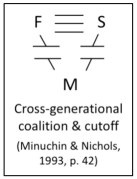
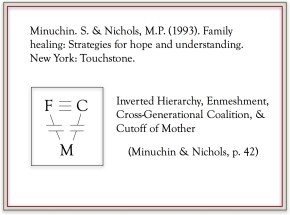
Family Systems Therapy:  The child expressing attachment-related family pathology surrounding divorce is being triangulated into the spousal conflict through the formation of a cross-generational coalition with the allied parent against the targeted parent, resulting in an emotional cutoff of the child’s relationship with the targeted parent (Bowen; Haley; Minuchin).  Family systems therapy fully describes and captures the pathology of a child rejecting a parent surrounding divorce.

The renowned family therapist, Salvador Minuchin, provides a structural family diagram minuchin cross-gen diagramfor the pathology of a cross-generational coalition and emotional cutoff in his 1993 book, Family Healing, with Michael Nichols, and both Minuchin and Jay Haley, another preeminent figure in family systems therapy, describe the process of a cross-generational coalition

From Haley:  “The people responding to each other in the triangle are not peers, but one of them is of a different generation from the other two… In the process of their interaction together, the person of one generation forms a coalition with the person of the other generation against his peer.  By ‘coalition’ is meant a process of joint action which is against the third person… The coalition between the two persons is denied.  That is, there is certain behavior which indicates a coalition which, when it is queried, will be denied as a coalition… In essence, the perverse triangle is one in which the separation of generations is breached in a covert way.  When this occurs as a repetitive pattern, the system will be pathological.” (Haley, 1977, p. 37)

From Minuchin:  “An inappropriately rigid cross-generational subsystem of mother and son versus father appears, and the boundary around this coalition of mother and son excludes the father… The parents were divorced six months earlier and the father is now living alone… Two of the children who were very attached to their father, now refuse any contact with him. The younger children visit their father but express great unhappiness with the situation” (Minuchin, p. 61-62; p. 101)

A child rejecting a parent represents an “emotional cutoff” in the parent-child relationship (Bowen).  The preeminent family systems therapist, Murray Bowen, links the family pathology of an emotional cutoff to unresolved trauma in the family.  The unresolved trauma leads to poor differentiation of psychological boundaries, and ultimately to an emotional cutoff in a family relationship to balance the psychological over-involvement (enmeshment; the absence of psychological differentiation) in another relationship within the family.

The high-conflict divorcing family is having difficulty transitioning from the prior intact family structure that was united by the marriage, to the new separated family structure united by the children because of the pathological processing of sadness by the narcissistic-borderline parent.  The narcissistic-borderline personality pathology of the allied parent is instead processing sadness surrounding the failed marriage and divorce as excessive anger, hostility, and blame directed toward the other spouse.  The pathological processing of sadness as anger and blame is being transferred to the child through the pathogenic parenting of the narcissistic-borderline parent.  

Family systems therapy fully understands, describes, and captures the family pathology surrounding a child’s rejection of a parent following divorce, and the addition of professional information sets regarding the attachment system and personality disorder pathology substantially enhances the fullness of the clinical psychology description of the pathology.

Complex Trauma:  The child’s rejection of a parent following divorce represents the trans-generational transmission of attachment trauma from the childhood of an allied narcissistic-borderline parent to the current family relationships, mediated by the personality disorder pathology of the allied narcissistic-borderline parent, which is itself a product of this parent’s childhood attachment trauma.

The divorce triggered the concurrent activation of two sets of representational networks in the attachment networks of the brain, one created in the childhood attachment trauma of the narcissistic-borderline parent, instantiated in the schema expectation pattern (internal working model) of “abusive parent”/”victimized child”/”protective parent,” and a second set of representational networks in the attachment system for the current family relationships. 

The simultaneous activation of two representational networks results in a psychological fusion of these networks.  In the mind of the narcissistic-borderline parent, the other parent becomes – psychologically to the narcissistic-borderline parent – the supposedly “abusive parent” from the childhood attachment trauma of the narcissistic-borderline parent, while the current child becomes, in the mind of the narcissistic-borderline parent, psychologically equivalent to the “victimized child” of this parent’s childhood attachment trauma (the trauma reenactment narrative), which allows the narcissistic-borderline parent to then self-adopt and conspicuously display the coveted role as the supposedly all-wonderful “protective parent” in the trauma reenactment narrative.

It is all, however, a false trauma reenactment narrative born in the childhood attachment trauma of the narcissistic-borderline parent. The targeted parent is not “abusive,” the child is not being “victimized,” and the allied narcissistic-borderline parent is not a “protective” parent.

The creation of the false trauma reenactment narrative into the current family relationships is achieved by psychologically coercing and manipulating the child into adopting the supposedly “victimized child” role relative to the targeted parent.  Once the child adopts the false role of the supposedly “victimized child,” this role immediately identifies the targeted parent into the supposedly “abusive parent” role, and allows the narcissistic-borderline parent to self-adopt and conspicuously display the coveted role as the all-wonderful “protective parent.”

The combination and integration of four domains of professional psychology fully captures and explains the attachment-related family pathology involved in a child rejecting a normal-range parent following divorce.

Curriculum

The foundational curriculum for professional competence in the assessment, diagnosis, and treatment of attachment-related family pathology surrounding divorce includes:

John Bowlby: attachment system
Salvador Minuchin: family systems therapy
Aaron Beck: personality disorder pathology
Mary Ainsworth: attachment system

Theodore Millon: personality disorder pathology
Otto Kernberg: personality disorder pathology
Murray Bowen: family systems therapy
Jay Haley: family systems therapy
Bessel van der Kolk: complex trauma
Marsha Linehan: personality disorder pathology
Alan Sroufe: attachment system
Daniel Stern: neuro-relationship development
Peter Fonagy: Intersubjectivity
Edward Tronick: Intersubjective relationship development
Bruce Perry: developmental trauma

These are among the most preeminent figures in professional psychology.  The knowledge they represent is the foundational knowledge of professional psychology.  This curriculum is required for professional competence in the assessment, diagnosis, and treatment of attachment-related family pathology surrounding divorce.

This knowledge is not optional.  This knowledge is a requirement of professional competence in the assessment, diagnosis, and treatment of attachment-related family pathology surrounding divorce.  This knowledge represents professional standard of practice in clinical psychology.

The Return of Clinical Psychology

The standards of practice for forensic psychology are substantially below those for clinical psychology.  In forensic psychology, there is no pathology-related foundational knowledge required for professional competence.  Forensic psychologists are allowed to apply, misapply, or not apply – any, some, or none of the established foundational knowledge of professional psychology in their assessment, diagnosis, and treatment of pathology… including the established DSM diagnostic system of professional psychology.

The standards of practice for forensic psychology are substantially below those for clinical psychology.

AB-PA, an attachment-based description of attachment related pathology, grounded in personality disorder pathology, family systems therapy, complex trauma, and the professional research literature, is the application of the standard and established knowledge of professional psychology to assessment, diagnosis, and treatment of family pathology.  AB-PA represents standard of practice in clinical psychology for the assessment, diagnosis, and treatment of attachment-related family pathology.

The AB-PA pilot program for the family courts represents the return of clinical psychology to court-involved consultation, court-involved assessment of pathology, and court-involved treatment of pathology.  The goal and mission of the AB-PA pilot program for the family courts is to provide the court with the highest caliber of professional knowledge and standards of practice in professional psychology. 

Craig Childress, Psy.D.
Clinical Psychologist, PSY 18857

APA: Ethical Code Violations

Here are the two statements I made at the press conference held 6/7/18 at the National Press Club.

National Press Club Statements by Dr. Childress

The days of acceptable professional ignorance are over. The field of forensic psychology is marked by extensive professional ignorance and gross professional negligence that is destroying the lives of children and families.

My next step under Standard 1.05 of the APA ethics code, which requires me to take steps when I become aware of ethical code violations by my professional colleagues, is to file a statement of concern with the APA’s ethics committee delineating the professional concerns regarding violations of Standards 2.01a, 9.01a, 2.03, and 3.04 within forensic psychology.

Furthermore, the entire field of forensic psychology is in violation of Principle D of the APA ethics code regarding Justice:

Principle D: Justice
Psychologists recognize that fairness and justice entitle all persons to access to and benefit from the contributions of psychology and to equal quality in the processes, procedures, and services being conducted by psychologists.

To require a $20,000 to $40,000 child custody evaluation as a mandate of professional psychology’s input into the court’s child custody decision-making is to limit “access to and benefit from the contributions of psychology” to only those families who can financially afford the excessive financial cost of a child custody evaluation ($20,000 to $40,000 per evaluation), in violation of Principle D of the APA ethics code.

Furthermore to conduct child custody evaluations that have zero inter-rater reliability denies “equal quality in the processes, procedures, and services being conducted by psychologists” in violation of Principle D of the APA ethics code.

Forensic psychology is in violation of Principle D of the APA ethics code on two separate counts. Once I get home I’ll begin working on a statement of concern to the APA’s ethics committee. We are just beginning this fight.

You think my kerfluffle with the Gardnerian PAS “experts” was something, it was merely prelude. Now the real battle begins – Dr. Childress takes on forensic psychology.

Psychologists are not allowed to be ignorant and incompetent. Psychologists are not allowed to destroy the lives of children and families because of their ignorance and incompetence.

The APA is now on the clock, as of June 6, 2018.

Silence is collusion. We demand that the APA stand up and support their own ethics code by issuing a press release to that effect. With each day that the APA does NOT publish a press release supporting Standard 2.01a of the APA ethics code relative to court-involved family conflict, as demanded in Article 4 of the Petition to the APA, they are colluding with the psychological abuse of children (DSM-5 V995.51 Child Psychological Abuse, Confirmed).

On June 7, 2018 the APA has been colluding with the psychological abuse of children for one day, in violation of the APA ethics code (Principle D, Standard 1.04, Standard 1.05, and Standard 3.04).

All psychologists, including those in the APA, are required by Standards 1.04 and 1.05 of the APA ethics code to do something when they become aware of ethical code violations by other psychologists. For the APA NOT to act in response to known ethical violations within forensic psychology is to cause harm to parents and children, in violation of Standard 3.04 of the APA ethics code, to “take reasonable steps to avoid harming their clients/patients… and to minimize harm where it is foreseeable and unavoidable.

So all psychologists within the American Psychological Association organization who are now aware of the ethical code violations within forensic psychology as delineated in the Petition to the APA, are now, today and with each passing day, in violation of Standards 1.04 and 1.05 of the APA ethics code.

I am stone-cold serious.

Psychologists are not allowed by the APA ethics code to be ignorant and incompetent, and to destroy the lives of children and families because of their ignorance and incompetence.

We own the high-ground of the APA ethics code. We are going to cleanse the pathogen from the APA and restore the American Psychological Association as your rightful ally in protecting your children.

Craig Childress, Psy.D.
Clinical Psychologist, PSY 18857

Dorcy & Dr. C Seminar in Washington DC

It is with excitement and great pleasure that I announce a 4-hour seminar with Dorcy Pruter and Dr. Childress in Washington, DC on Saturday, June 9 at the Darcy Hotel, Curio Collection by Hilton.  Any hotel that includes the name, “Curio Collection” makes me smile.  Registration is through the Childress Institute for Child Development Website.

Dorcy Pruter & Dr. Childress
Parental Alienation:  Assessment, Diagnosis, Solution

Registration

A 4-hour seminar with Dorcy Pruter and Dr. Childress is guaranteed to be powerful.  There are limited seats.

I tried to keep the cost of the seminar as inexpensive as possible to cover expenses in hopes of bringing the cost within the reasonable range of parents.

The seminar will be directed toward mental health professionals and family law attorneys, but the information will be highly valuable to parents as well.  If we have only limited participation from the AFCC membership, then Dorcy and I will adjust the content more toward parents… we’ll work the room.

On Saturday, June 9th at the Darcy Hotel in Washington DC, Dorcy Pruter and Dr. Childress will present the solution to “parental alienation” from start to finish, from assessment through to solution.

If you are a mental health professional or family law attorney, you will learn about the AB-PA pilot program for the family courts in Houston, you will learn about assessment and diagnosis of attachment-related family pathology surrounding divorce, you will learn about the Contingent Visitation Schedule as a remedy solution, and you will learn about how Dorcy and her coaches bring solutions to restoring a healthy family and authentic child.

If you are a parent, you will learn about the steps that are needed to solve the pathology in your family, from obtaining proper mental health assessment, to seeking court orders for the components of the solution, to collaborating with mental health professionals in achieving the solution. 

And then there’s the Higher Purpose Parenting class offered by Dorcy… a solution that does not involve therapists or attorneys.  Dorcy will describe this class and how parents can reunite with their children despite the pathology of the allied parent.  Pretty impressive stuff.

Dorcy & Dr. Childress, 6/9/18 at the Darcy Hotel in Washington DC.  Solution, from start to finish.  Guaranteed powerful information.

Craig Childress, Psy.D.
Clinical Psychologist, PSY 18857


AB-PA Pilot Program: The Highest Caliber of Professional Practice

The AB-PA pilot program for the family courts will provide the Court with the highest caliber of professional knowledge and professional standards of practice. The highest caliber.

If any aspect of an attachment-based model of “parental alienation” is not at the highest caliber of professional knowledge and professional standards of practice, then I fully expect and invite professional critique and criticism.

When the Court turns to professional psychology for consultation, for assessment of pathology, and for treatment of pathology, it should expect and receive the highest caliber of professional knowledge and professional standards of practice.  

If you are a mental health professional who will be seeking to work with the AB-PA pilot program for the family courts as this model begins to be replicated as a standard of practice in jurisdictions beyond Houston, you are expected to bring you’re A-game.  Nothing less is acceptable.

AB-PA is a scaffolding of professional knowledge until we achieve the required standard of professional knowledge and professional standards of practice across all court-involved mental health professionals.  We will start with AB-PA, but then AB-PA will gradually fade away, replaced by the actual knowledge from the actual source material within professional psychology, Bowlby, Minuchin, Beck, Bowen, Millon, Kernberg, Haley, Linehan, Haley, Perry, van der Kolk, Fonagy, Stern, Sroufe, Tronick, and all of the scientific literature surrounding the attachment system, narcissistic/borderline personality pathology, and complex trauma in childhood – will all be required reading for standards of professional practice.

Required reading:  My 40-page reference list for AB-PA is online (Dr. Childress Personal Reference List).  If you are a court-involved mental health professional working with attachment-related pathology, start with this reference list.  Start with Bowlby regarding the attachment system and attachment pathology, expand to Minuchin, Bowen, and Haley regarding family systems pathology, and extend this into Beck, Millon, Kernberg, and Linehan regarding personality pathology.  Then move into the research literature, particularly the research literature linking attachment pathology to personality disorder pathology.  

If you are a mental health professional and this seems like a lot of work… then go away.  You are not of the professional caliber required to provide services through the AB-PA pilot program for the family courts.  AB-PA is a scaffolding of knowledge, it is not a replacement for knowledge.

John Houseman: The Paper Chase -1 – Be Prepared to Work

The days of tolerance for professional ignorance and incompetence are over.  This is NOT about the comfort level of court-involved mental health professionals, this is NOT about the comfort level of the American Psychological Association, this is NOT about the comfort level of the Association of Family and Conciliation Courts – this is about solving pathology, attachment-related family pathology surrounding divorce. 

It is about providing the Court with the highest caliber of professional knowledge and professional standards of practice in psychological consultation, court-involved assessment of pathology, and court-involved treatment of pathology.

We have been led into, and have become mired in, profound professional ignorance and incompetence by the conceptually lazy and indolent construct of “parental alienation” and by the passivity and indolence of professional psychology generally surrounding court-involved mental health, and it will take some time for mental health professionals working within the AB-PA pilot program to catch up on their reading list.  They have a lot to learn, and we need that knowledge today… right now.

AB-PA and the diagnostic workup of Foundations provide a scaffolding during this catching up period.  The scaffolding diagnostic framework of AB-PA is not a replacement for the core knowledge, Bowlby, Minuchin, Beck, Bowen, Millon…

Once we have returned to standard and established constructs and principles of professional psychology and professional standards of practice, then AB-PA as a construct will disappear into Bowlby, Minuchin, Beck and the scientifically established ground of professional psychology.  There is no such thing as AB-PA, it is Bowlby, Minuchin, Beck, and the standard and established constructs and principles of professional psychology.

Any mental health professional who claims that AB-PA is “new” or that AB-PA is “Dr. Childress’ work” is simply displaying their profound ignorance of actual constructs and principles in professional psychology; Bowlby, Minuchin, Beck.  If they don’t know Bowlby, Minuchin, and Beck, then what I’m saying may sound “new” to them.  AB-PA is not “new,” they’re just ignorant.

Bowlby, Minuchin, Beck.

Do you really want to display your ignorance to John Housman? 

John Houseman: Paper Chase – 2 – Engaging the Material

Nothing about AB-PA is Dr. Childress. I am just a clinical psychologist.  AB-PA is diagnosis.  Foundations is a diagnostic treatise on the pathology, explaining the origins of three incredibly disparate, highly unusual and unlikely child symptoms by grounding the description of these symptoms into a full diagnostic treatise on the origins of these symptoms in attachment pathology, personality pathology, family systems pathology, and complex trauma.

None of these constructs are Dr. Childress, they are all fully established and scientifically supported domains of information (information sets) within professional psychology – Bowlby, Minuchin, Beck.

Because something is “new” to you does not make it new, it simply means you’re ignorant.  Don’t be ignorant.  Preventing the destruction of the lives of children, ending the psychological abuse of children, is depending on you NOT being ignorant.

No AB-PA Certified mental health professional is ignorant.  On May 22, 23, and 24th I will be providing seminars in Houston to ensure that.  We will then have monthly online clinical case consultation groups within the AB-PA pilot program for the family courts to provide additional application knowledge regarding the principles of standard and established constructs and principles.

Then… once this is completed,… then the work begins for the mental health professional. AB-PA is not the end… it’s the start of professional knowledge and professional competence.  We will then build on this foundation to create the highest standard of professional knowledge and professional standard of practice.

Nothing less than the highest standards of professional knowledge and professional practice is acceptable.  Because the children need this, because the court requires this, and because our moral compass as professionals compels this.

If you are a mental heath professional and you are not willing to acquire the knowledge, go away.  Go work with some other form of pathology.  Do NOT work with attachment-related family pathology surrounding divorce.

My 40-page reference list is on my website. If you are a mental health professional working with attachment-related family pathology surrounding divorce and have NOT read every book and article on that reference list… why not?  You don’t think knowledge about pathology is necessary to solve pathology?

Paper Chase Scene – 3 – Professional Caliber Work

Dr. Childress:  From a professional psychology perspective, we will start with the knowledge of the attachment system, then we’ll work our way into personality disorder pathology, then family systems therapy, and then complex trauma within the family.

If you are a mental health professional who does not want to learn this material.  Go away.  Go work with some other pathology.  Do not work with attachment-related family pathology surrounding divorce.  If you are a mental health professional who is lazy or indolent.  Go away.  Go work with some other pathology.  I am stone-cold serious.

John Houseman Paper Chase – 4 – Here’s a Dime

Unfortunately, I could only find a poor quality YouTube for this scene, and it ends one sentence too soon.  

Here is the complete dialogue:

Charles W. Kingsfield Jr.:  Mr. Hart, here is a dime. Take it, call your mother, and tell her there is serious doubt about you ever becoming a lawyer.

James T. Hart: [pause, as he is leaving the room] You… are a son of a bitch, Kingsfield!

Charles W. Kingsfield Jr.:  Mr. Hart! That is the most intelligent thing you’ve said today.  You may take your seat.

If you are passive, go away.  If you have fire, if you are willing to work, if excellence is the only caliber of professional practice acceptable to you, stay… learn.

Professional Standards of Practice

We are returning to the standard and established constructs and principles of professional psychology.  In Houston Texas, the AB-PA pilot program for the family courts will establish a baseline of professional knowledge required and professional standards of practice expected in the assessment, diagnosis, and treatment of pathology.

The court has a right to expect the highest caliber of professional knowledge and standards of practice in consultation, court-involved professional assessment, and court-involved treatment of pathology.

Parents and children have the right to expect the highest caliber of professional knowledge and standards of practice in assessment, diagnosis, and treatment of child and family pathology.

Nothing less is acceptable.

Dr. Childress, you are a son of a bitch.  That is the most intelligent thing I’ve heard so far. So let’s sit down and get to work, because there are kids and families whose lives are being destroyed, and who deserve and require the highest caliber of professional knowledge and standards of practice

Clinical Leadership

The AB-PA pilot program for the family courts uses a clinical treatment team model (because this represents the highest caliber of professional practice), and leading this clinical team in Houston is Jayna Haney, MS.

I am excited and immensely pleased that Jayna Haney, MS is providing this leadership for the clinical team of the AB-PA pilot program for the family courts.  She is EXACTLY the type of high caliber professional who will bring solution.  What the AB-PA pilot program for the family courts provides is the proper framework of establishment psychology from which to work.

Jayna Haney is Advanced Certified in AB-PA through three days of seminars she took with me last November, and he has also trained directly with Karen Woodall.  I couldn’t imagine a better mental health professional to lead the clinical team in the AB-PA pilot program for the family courts.

Jayna Haney, MS is currently the clinical coordinator for the treatment team in Houston, and I am hopeful she will accept the position of Clinical Director for the AB-PA program for the Houston family court system once the structure for the pilot program is in place.

Jayna Haney is immensely smart and capable.  She is fully aware of the pathology in its various presentations and displays.  I am exceptionally pleased that she will be directing the clinical psychology team of the AB-PA pilot program.

Craig Childress, Psy.D.
Clinical Psychologist, PSY 18857


Pruter: Higher Purpose Parenting

I just finished the nine-week Higher Purpose Parenting course from Dorcy Pruter.  I am immensely impressed by the quality of her professional work and for what she’s accomplished.  Dorcy does stuff that I didn’t think was possible… until I see her do it.  Oh.  I get it.   Wow.  That’s really impressive.

I’m a clinical psychologist who knows a lot of psychology stuff.  Everything Dorcy says in Higher Purpose Parenting is true, and I can support everything she says at a professional level of explanation.  What’s truly impressive is that I’ve never seen these particular constructs woven together in this way. 

As a clinical psychologist, her weaving of constructs was like being on a roller coaster, I recognized every single construct she was using, but holy cow I’ve never seen them arranged in that pattern and at that speed.  Whooosh, hold on psychologists, you’re in for a conceptual ride.

It’s skill based.  Dorcy teaches skills which, when used, will create certain types of change.  The skills Dorcy teaches are catalysts, and very interesting catalysts that activate extremely powerful change agents. 

She starts with some highly powerful skills, which leads into opening important change factors, and she finishes with spiritual skill sets that will open amazing change processes.  And I repeat, everything Dorcy says in Higher Purpose Parenting is true, and I can explain it all at a professional level of analysis.

The thing is, I’ve never seen anything like what Dorcy does and has accomplished.  From my world of clinical psychology (normal carbon-based life forms), what Dorcy does is a silicon-based life form.  It is unlike anything I’ve seen.  And it is absolutely true, and she’s accomplished something incredibly impressive.

Professional psychology needs to become aware of what Dorcy Pruter is doing.  It is different, and it is impressive.  It is catalytic.  Professional psychology heals.  We use synthesizing meme-structures.  Dorcy teaches skills.  She uses catalytic meme-structures.

Catalytic meme-structures are extremely powerful but very hard to construct, because catalysts work in sequence and if any aspect of the sequencing of catalysts is wrong, the whole thing crashes and zero happens.

But if the catalytic meme structures are correct and in the proper sequence, look out.  Catalytic meme-structures can be incredibly powerful change agents.  Much faster and more complete than healing meme structures.  With catalytic meme-structures, healing takes place, but not in the same way.  It’s a mindfulness, transformative kind of understanding insight healing. 

Professional psychology needs to see this.  We can’t do this yet.  The mind of professional psychology is going to be disoriented at first.  Once it processes what she’s doing, I suspect they’re going to be highly intrigued, and interested in exploring other possible applications of a catalytic approach to change. 

I can’t wait until I have the chance to serve as a conceptual conduit from what Dorcy is doing with her workshops to professional psychology.  I’m a clinical psychologist.  I know a lot of psychology stuff.  Professional psychology is going to be impressed by what Dorcy has accomplished.  There will be haters, no doubt.  Always are.  And Dorcy has her beloved flying monkeys.  And she goes into spiritual meme structures, which can always generate controversy no matter.

And what Dorcy Pruter has accomplished is truly impressive professional work.  Congratulations, Dorcy.  Impressive work.

Craig Childress, Psy.D.
Clinical Psychologist, PSY 18857

AB-PA Pilot Program: Foundations

In my younger days I used to work in the construction industry, hanging drywall.   The construction of any structure occurs in phases and is based on a plan, a blueprint. 

In building any structure, we begin by laying the foundation.  Upon this foundation, the framing of the structure is then built.  As the framing is constructed, the electricians and plumbers weave in their infrastructures.  Then the drywall is hung which constructs the functional spaces of the structure.  The structure is then completed by installing the doors, windows, and roofing.

The structure for the AB-PA pilot program for the family courts begins with the blueprint, the plan, and will be constructed in integrated phases. 

First, we lay the foundation in the standard and established, scientifically grounded, constructs and principles of professional psychology.   This will occur with the three AB-PA Certification seminars on May 22, 23, and 24, and it will continue throughout the project.  The AB-PA pilot program for the family courts is based on the standard and established, scientifically grounded, constructs and principles of professional psychology.

The AB-PA Certification seminars frame the structure for the treatment team, the pairing of an AB-PA Certified family therapist with an AB-PA Knowledgeable amicus attorney to stabilize family pathology and ensure the family’s successful transition to a normal-range separated family structure.

Within the professionally and scientifically grounded structure of the AB-PA pilot program, we then construct the inner structure of professional knowledge and expertise, the professional skill sets, of the AB-PA pilot program for the Court;  

1.)  Treatment Focused Assessment Protocol: A structured and standardized six-session treatment focused assessment protocol for attachment-related pathology surrounding divorce,

2.)  Contingent Visitation Schedule: A defined and structured Strategic family systems intervention for stabilizing pathogenic parenting in high-conflict divorce.

The next phase in the development of the AB-PA pilot program structure is to create the “rooms” comprised of the actual clinical care, consisting of monthly online clinical consultation groups that build the treatment team. 

The AB-PA pilot program for the family courts will rely on a treatment team clinical care model.  This is a critical aspect of the AB-PA pilot program for the family courts, the creation of a treatment team approach.  This improves all aspects of clinical care and development of professional expertise.

Finally, we add the doors and windows to our structure, the program evaluation research component of the project.

There is also a house paint and landscaping phase of the pilot program for the family courts.  This represents partnerships with local area universities for additional research projects regarding high-conflict family pathology, and clinical internship training programs for building the next generation of professional knowledge and expertise.

Baseline of Professional Knowledge

The AB-PA pilot program for the family courts creates a baseline of professional knowledge and competence in the assessment, diagnosis, and treatment of attachment-related family pathology surrounding divorce.  We then build upon this structure.

The goal of the AB-PA pilot program is to provide the Court with the highest caliber of professional expertise in clinical psychology; assessment, diagnosis, and treatment.   Decisions within the AB-PA pilot program are based on current scientific foundations and established constructs and principles of professional psychology.

Ultimately, the highest caliber of professional knowledge is expected in four domains of professional psychology:

The Attachment System:  Bowlby and the research literature on the attachment system.

Personality Disorder Pathology:  Beck, Millon, Linehan, Kernberg and the research literature on personality disorder pathology (including the linkages of personality disorder pathology to attachment pathology).

Family Systems Therapy:  Bowen, Minuchin, Haley, and the family systems literature in professional psychology.

Complex Trauma: Perry, van der Kolk, and the research literature on the origins and impact of complex trauma in childhood.

These are grounded domains of professional knowledge with established and defined professional information sets directly relevant and applicable to the assessment, diagnosis, and treatment of attachment-related family pathology surrounding divorce.

The days of tolerance for professional ignorance and incompetence are over.  The Courts deserve the highest caliber of professional knowledge and expertise from professional psychology, and it is the obligation of professional psychology to provide the highest caliber of professional expertise to the Court.  The goal of the AB-PA pilot program will be to provide the Court with this professional knowledge and professional skill.

Court-Involved Clinical Psychology

The AB-PA pilot program for the family courts in Houston represents the return of clinical psychology to court-involved professional practice.

Child custody evaluations are over-broad in their referral question, are arbitrary and lack scientific validity, and deny equal access to justice by being prohibitively expensive ($20,000 – $40,000 per assessment).

A foundational axiomatic principle of assessment in clinical psychology is to always assess to the referral question.  A well-formulated referral question for assessment defines and focuses the assessment procedures.  A focused referral question also substantially improves the psychometic qualities of the assessment procedure.

The referral question from the Court is NOT what the child custody time-share should be.  The information to answer such an over-broad referral question is not available from professional psychology that would allow for an answer. 

The only scientifically and theoretically supported answer from professional psychology would be for shared 50-50% custody based on the equal valuation of all four primary parent-child relationships; mother-son, mother-daughter, father-son, father-daughter.  Each of these relationships is unique, each is critical to healthy child development, they are each of equal value, and none of these relationship types are expendable.

Based on an equal valuation of all four primary parenting types (father-son, father-daughter, mother-son, mother-daughter), the only supported professional opinion would be for shared 50-50% custody visitation time-share in all cases except child abuse.  There is no scientific or theoretical justification for giving primacy to any of these relationship types over any other.

The referral question from the Court is not about the custody visitation time-share schedule.  The Court can exercise its normal-range judgement for cases where a deviation from a professional recommendation for a 50-50% custody visitation time-share is warranted.

The issue before the Court is what orders are needed to resolve the high family conflict that is creating excessive litigation and destructive family processes.  The referral question from the Court to professional psychology is to identify which parent is creating the child’s attachment-related pathology, and what are the treatment implications?

This is a much more focused and targeted referral question that is fully within the scope of clinical psychology to answer.  A structured and standardized six-session treatment focused assessment protocol for attachment-related pathology surrounding divorce can provide the Court with this answer.

Based on the family data from the treatment focused assessment, the Court can make data-driven decisions regarding the course of action.  If significant pathology is identified in the treatment focused assessment (documented on the Parenting Practices Rating Scale and the Diagnostic Checklist for Pathogenic Parenting for Court review), then an AB-PA treatment team can be constructed by pairing an AB-PA Certified stabilizing family therapist with an AB-PA Knowledgeable amicus attorney.  The role of the AB-PA Knowledgeable amicus attorney is to serve as the interface between the stabilizing family therapist and the Court.

Treatment Team

The AB-PA Certified mental health professionals in the pilot program for the family courts will participate in monthly online Clinical Case Consultation groups of approximately six mental health professionals.  Each mental health professional will be expected to present at least one case during the year of case consultation groups.  In addition, all intake assessments will be reviewed within the Clinical Case Consultation group.  The amicus attorneys can participate in Clinical Case Consultation groups as warranted (for example, when a particular patient is being staffed in the consultation group).

The treatment team model in clinical psychology helps standardize and improve assessment, diagnosis, and treatment, the treatment team model of case consultation improves clinical decision-making, and the treatment team model in clinical psychology fosters the acquisition of professional knowledge and professional skill sets.

Foundations

The AB-PA pilot program for the family courts serves as the ground foundation on which to build the highest caliber of scientifically based professional practice and professional expertise.

We build any structure by first laying the foundation.  The foundation for the AB-PA pilot program in the family courts are the standard and established constructs and principles of professional psychology, including established professional standards of practice in clinical psychology for assessment, diagnosis, and treatment.

We can absolutely solve attachment-related family pathology surrounding divorce, once we return to the standard and established constructs and principles of professional psychology.

Craig Childress, Psy.D.
Clinical Psychologist, PSY 18857