AB-PA Pilot Program: Foundations

In my younger days I used to work in the construction industry, hanging drywall.   The construction of any structure occurs in phases and is based on a plan, a blueprint. 

In building any structure, we begin by laying the foundation.  Upon this foundation, the framing of the structure is then built.  As the framing is constructed, the electricians and plumbers weave in their infrastructures.  Then the drywall is hung which constructs the functional spaces of the structure.  The structure is then completed by installing the doors, windows, and roofing.

The structure for the AB-PA pilot program for the family courts begins with the blueprint, the plan, and will be constructed in integrated phases. 

First, we lay the foundation in the standard and established, scientifically grounded, constructs and principles of professional psychology.   This will occur with the three AB-PA Certification seminars on May 22, 23, and 24, and it will continue throughout the project.  The AB-PA pilot program for the family courts is based on the standard and established, scientifically grounded, constructs and principles of professional psychology.

The AB-PA Certification seminars frame the structure for the treatment team, the pairing of an AB-PA Certified family therapist with an AB-PA Knowledgeable amicus attorney to stabilize family pathology and ensure the family’s successful transition to a normal-range separated family structure.

Within the professionally and scientifically grounded structure of the AB-PA pilot program, we then construct the inner structure of professional knowledge and expertise, the professional skill sets, of the AB-PA pilot program for the Court;  

1.)  Treatment Focused Assessment Protocol: A structured and standardized six-session treatment focused assessment protocol for attachment-related pathology surrounding divorce,

2.)  Contingent Visitation Schedule: A defined and structured Strategic family systems intervention for stabilizing pathogenic parenting in high-conflict divorce.

The next phase in the development of the AB-PA pilot program structure is to create the “rooms” comprised of the actual clinical care, consisting of monthly online clinical consultation groups that build the treatment team. 

The AB-PA pilot program for the family courts will rely on a treatment team clinical care model.  This is a critical aspect of the AB-PA pilot program for the family courts, the creation of a treatment team approach.  This improves all aspects of clinical care and development of professional expertise.

Finally, we add the doors and windows to our structure, the program evaluation research component of the project.

There is also a house paint and landscaping phase of the pilot program for the family courts.  This represents partnerships with local area universities for additional research projects regarding high-conflict family pathology, and clinical internship training programs for building the next generation of professional knowledge and expertise.

Baseline of Professional Knowledge

The AB-PA pilot program for the family courts creates a baseline of professional knowledge and competence in the assessment, diagnosis, and treatment of attachment-related family pathology surrounding divorce.  We then build upon this structure.

The goal of the AB-PA pilot program is to provide the Court with the highest caliber of professional expertise in clinical psychology; assessment, diagnosis, and treatment.   Decisions within the AB-PA pilot program are based on current scientific foundations and established constructs and principles of professional psychology.

Ultimately, the highest caliber of professional knowledge is expected in four domains of professional psychology:

The Attachment System:  Bowlby and the research literature on the attachment system.

Personality Disorder Pathology:  Beck, Millon, Linehan, Kernberg and the research literature on personality disorder pathology (including the linkages of personality disorder pathology to attachment pathology).

Family Systems Therapy:  Bowen, Minuchin, Haley, and the family systems literature in professional psychology.

Complex Trauma: Perry, van der Kolk, and the research literature on the origins and impact of complex trauma in childhood.

These are grounded domains of professional knowledge with established and defined professional information sets directly relevant and applicable to the assessment, diagnosis, and treatment of attachment-related family pathology surrounding divorce.

The days of tolerance for professional ignorance and incompetence are over.  The Courts deserve the highest caliber of professional knowledge and expertise from professional psychology, and it is the obligation of professional psychology to provide the highest caliber of professional expertise to the Court.  The goal of the AB-PA pilot program will be to provide the Court with this professional knowledge and professional skill.

Court-Involved Clinical Psychology

The AB-PA pilot program for the family courts in Houston represents the return of clinical psychology to court-involved professional practice.

Child custody evaluations are over-broad in their referral question, are arbitrary and lack scientific validity, and deny equal access to justice by being prohibitively expensive ($20,000 – $40,000 per assessment).

A foundational axiomatic principle of assessment in clinical psychology is to always assess to the referral question.  A well-formulated referral question for assessment defines and focuses the assessment procedures.  A focused referral question also substantially improves the psychometic qualities of the assessment procedure.

The referral question from the Court is NOT what the child custody time-share should be.  The information to answer such an over-broad referral question is not available from professional psychology that would allow for an answer. 

The only scientifically and theoretically supported answer from professional psychology would be for shared 50-50% custody based on the equal valuation of all four primary parent-child relationships; mother-son, mother-daughter, father-son, father-daughter.  Each of these relationships is unique, each is critical to healthy child development, they are each of equal value, and none of these relationship types are expendable.

Based on an equal valuation of all four primary parenting types (father-son, father-daughter, mother-son, mother-daughter), the only supported professional opinion would be for shared 50-50% custody visitation time-share in all cases except child abuse.  There is no scientific or theoretical justification for giving primacy to any of these relationship types over any other.

The referral question from the Court is not about the custody visitation time-share schedule.  The Court can exercise its normal-range judgement for cases where a deviation from a professional recommendation for a 50-50% custody visitation time-share is warranted.

The issue before the Court is what orders are needed to resolve the high family conflict that is creating excessive litigation and destructive family processes.  The referral question from the Court to professional psychology is to identify which parent is creating the child’s attachment-related pathology, and what are the treatment implications?

This is a much more focused and targeted referral question that is fully within the scope of clinical psychology to answer.  A structured and standardized six-session treatment focused assessment protocol for attachment-related pathology surrounding divorce can provide the Court with this answer.

Based on the family data from the treatment focused assessment, the Court can make data-driven decisions regarding the course of action.  If significant pathology is identified in the treatment focused assessment (documented on the Parenting Practices Rating Scale and the Diagnostic Checklist for Pathogenic Parenting for Court review), then an AB-PA treatment team can be constructed by pairing an AB-PA Certified stabilizing family therapist with an AB-PA Knowledgeable amicus attorney.  The role of the AB-PA Knowledgeable amicus attorney is to serve as the interface between the stabilizing family therapist and the Court.

Treatment Team

The AB-PA Certified mental health professionals in the pilot program for the family courts will participate in monthly online Clinical Case Consultation groups of approximately six mental health professionals.  Each mental health professional will be expected to present at least one case during the year of case consultation groups.  In addition, all intake assessments will be reviewed within the Clinical Case Consultation group.  The amicus attorneys can participate in Clinical Case Consultation groups as warranted (for example, when a particular patient is being staffed in the consultation group).

The treatment team model in clinical psychology helps standardize and improve assessment, diagnosis, and treatment, the treatment team model of case consultation improves clinical decision-making, and the treatment team model in clinical psychology fosters the acquisition of professional knowledge and professional skill sets.

Foundations

The AB-PA pilot program for the family courts serves as the ground foundation on which to build the highest caliber of scientifically based professional practice and professional expertise.

We build any structure by first laying the foundation.  The foundation for the AB-PA pilot program in the family courts are the standard and established constructs and principles of professional psychology, including established professional standards of practice in clinical psychology for assessment, diagnosis, and treatment.

We can absolutely solve attachment-related family pathology surrounding divorce, once we return to the standard and established constructs and principles of professional psychology.

Craig Childress, Psy.D.
Clinical Psychologist, PSY 18857


My Professional Background

The AB-PA pilot program for the family court begins May 22, 23, and 24 in Houston, Texas.  It represents the solution to attachment-related family pathology surrounding high-conflict divorce.

How can I be so sure?  Because nothing about the pilot program is Dr. Childress.  Everything is standard and established professional clinical psychology.

We can absolutely solve attachment-related family pathology surrounding divorce, once we return to the standard and established constructs and principles of professional psychology.

Introduction to the Court:  Clinical Director

I will soon be working collaboratively with the court system in Houston.  When I testify as an expert witness for the Court, my testimony typically begins with the attorney reviewing my qualifications as an expert.

I wish to take a blog post to introduce myself to the Court surrounding the AB-PA pilot program.

This is not my first time putting something like this together.  Two similar projects I’ve done in the past are my Clinical Director experiences:

FEMA/Department of Justice:  This project involved developing a national model for the mental health assessment of juvenile firesetting behavior in collaboration with fire agencies.  I worked closely with an internationally recognized expert in juvenile firesetting behavior, Dr. Kenneth Fineman, and an organizational psychologist, Dr. Brett Patterson, to develop a national model for a structured and standardized mental health assessment protocol for juvenile firesetting behavior, including an initial screening of risk factors by fire agencies.  This project was funded through FEMA and the Department of Justice.

Early Childhood Assessment and Treatment Center:  As Clinical Director for an early childhood assessment and treatment center, I developed the structured assessment and treatment protocols for trauma impacted children in the foster care system.  The clinic was operated under the auspices of California State University, San Bernardino’s (CSUSB) Institute for Child Development and Family Relations, and included integrated assessment and treatment coordination with Loma Linda University’s occupational therapy department and the University of Redlands Truesdail Center for Communicative Disorders, both of whom provided senior staff and trainees on site to the clinic.

As part of this early childhood treatment clinic, we also developed and implemented a teacher training program for preschool teachers regarding child development and intervention with children presenting behavior problems in the classroom.  This extended to providing training opportunities to undergraduate students at CSUSB, beginning with their providing childcare at the clinic’s parenting education classes, progressing to providing therapeutic childcare at the clinic itself, and leading to advanced training to provide in-classroom support services to children in the preschool system. 

If you look on my resume, that’s what all the preschool teacher trainings were about.  We first recruited undergraduate students from CSUSB to serve as childcare staff at our parent training courses.  In return for the student’s time, we offered a series of seminars to them on child development, including pathology in early childhood.  We then recruited the best of these childcare staff to serve as therapeutic childcare staff at our clinic, and we provided these students with an even more advanced set of educational seminars.  The best of these therapeutic childcare staff we then recruited to serve as paid para-professional staff to provide direct support services to children in the classroom or directly in the foster home placement.  These trained para-professional student aides were supervised by senior clinical staff on individual cases.

Clinical Research Foundation

I have also worked with a variety of high-level clinical research projects over the years:

UCLA Schizophrenia:  For a major portion of my early career development I coordinated the research arm of a multi-faceted longitudinal clinical research project on schizophrenia at UCLA with Dr. Keith Nuechterlein.  I understand how major clinical research projects are structured and how they operate.  I was also trained to diagnostic reliability on the Brief Psychiatric Rating Scale (BPRS), an 18-item seven-point symptom inventory, and for nearly 15 years I participated in annual inter-rater reliability standardization training on diagnostic symptom identification and rating provided through the Diagnostic Unit at the Brentwood VA. 

I know what symptom features look like across 18 standard symptoms in professional psychology, each symptom rated along a seven-point scale.  I also know what inter-rater reliability training looks like.

UCLA Prader-Willi Syndrome:  Also earlier in my career, I was involved in a research project on Prader-Willi Syndrome, a genetic disorder that results in severe pediatric over-eating and obesity, cognitive deficits, and potential mental retardation.  I was not responsible for developing the assessment protocol for this project.  My role with this project was to administer a structured and standardized assessment protocol, including the Structured Clinical Interview for the DSM (SCID). The SCID is a structured clinical interview assessment protocol for diagnosis of pathology.  The SCID is a long and thorough structured assessment instrument that is often used in clinical research projects to establish and confirm diagnosis.

CHLA Cognitive Remediation in Pediatric Cancer Patients:  While at Children’s Hospital of Los Angeles, I participated in a clinical research project on the cognitive remediation of attention deficits in children with neurologically involved cancer treatments (brain surgery or chemotherapy affecting the cerebrospinal fluid; “intrathecal” chemotherapy).  This was a multi-site research project involving the top pediatric cancer programs in the country, headed by Children’s Hospital of Philadelphia Center for Childhood Cancer Research.  While I was with this project, I traveled to the University of Texas, MD Anderson Childhood Cancer Center for training in a standardized assessment and treatment protocol for attention deficits in pediatric cancer patients.

UCI Child Development Center Preschool ADHD:  This was a collaborative project between Children’s Hospital of Orange County (CHOC) and the University of California, Irvine Child Development Center (UCI-CDC; James Swanson, Ph.D.) on the identification and remediation of attention deficits in preschool-age children.  I was the lead clinical psychologist on this project, hired through the CHOC part of the collaboration.  We developed a comprehensive parenting training program across several counties for families of preschool age children.  Layered into this program was a research intervention component for the cognitive remediation of attention deficits using a computerized intervention.  We also developed a teacher training component for preschool teachers in Functional Behavioral Analysis.

Clinical Psychologist

I’m an old clinical psychologist who received his foundational training in behavioral psychology as an undergraduate at UCLA.  I might be one of the few remaining clinical psychologists who learned the principles of behavior therapy from teaching a rat to press a lever in the laboratory.  Behavior is controlled by the cue, not the consequence.

Since my early professional career as a behavior therapist, I have extended my psychotherapy skill set into humanistic-existential psychology, psychoanalytic psychotherapy, and family systems therapy.  My primary model of therapy for children is family systems therapy.

I have taught courses at the graduate level in:

Assessment and Treatment Planning
Diagnosis and Psychopathology
Psychometrics of Assessment
Research Methodology
Models of Psychotherapy
Child Development

I fully understand the content from each of these domains of professional practice.

I understand how to develop and implement clinical intervention programs.  

I know how to integrate a clinical intervention program into high-level research collaborations with university partners. 

I understand how to develop and implement structured and standardized assessment protocols that are consistent with the highest standards of professional clinical psychology, and with the requirements of structured research protocols.

Attachment Pathology:  I have a strong professional background in attachment-related pathology from my role as Clinical Director for an early childhood assessment and treatment center.  Early childhood is the formative period for the “internal working models” of attachment bonding.  It is essential for early childhood mental health professionals to have a strong professional understanding for the attachment system, it’s formation, functioning, and characteristic dysfunctioning.

In addition, our clinic dealt primarily with children in the foster care system who had been exposed to childhood trauma (or neuro-developmental damage from prenatal exposure to drugs and alcohol).  Child abuse severely damages attachment bonding and the development of schemas (“internal working models”) within the attachment system.  I understand what trauma looks like and how it affects attachment bonding and the attachment system.  This also means that I know what trauma DOESN’T look like, when the attachment-related pathology is a false construction of a parent weaponizing a child in the spousal conflict.

My doctoral degree is in Clinical Psychology from Pepperdine University.  The doctoral program at Pepperdine University is a strong and substantial program for education and training in clinical psychology.

The Court System

You’ll note that none of my foundational professional background is with high-conflict divorce in the court system.  That domain of professional expertise began approximately a decade ago when I entered private practice.  It was when I entered private practice that I encountered first hand the attachment-related pathology commonly called “parental alienation” in the popular culture.

As a clinical psychologist, I do not recognize the pathology of “parental alienation” as an established clinical pathology.  In my view, it is a common culture term used to describe a particular type of attachment-related family pathology surrounding divorce.  In my clinical psychology work, I prefer to rely solely on the standard and established constructs and principles of professional psychology.

I am a clinical psychologist.  The role of a clinical psychologist is to solve pathology, whether that pathology is juvenile delinquency, childhood attachment problems, childhood trauma, or spousal and family conflicts.  The solution to all forms of pathology is the same, through the application of the standard and established, scientifically grounded, constructs and principles of professional psychology to the solution.

For the past decade I have worked toward providing a clinical psychology solution to the attachment-related family pathology surrounding high-conflict divorce.  This solution is available through the application of standard and established psychological constructs and principles, including established professional standards of practice, to the assessment, diagnosis, and treatment of attachment-related family pathology surrounding divorce.

I am the author of:

An Attachment-Based Model of Parental Alienation: Foundations

The Assessment of Attachment-Related Pathology Surrounding Divorce

Strategic Family Systems Intervention for AB-PA: Contingent Visitation Schedule

The Narcissistic Parent: A Guidebook for Legal Professionals Working with Families in High-Conflict Divorce

The Petition to the APA

I have presentations available online for viewing regarding attachment-related family pathology surrounding divorce:

Master Lecture Series; California Southern University.
Theoretical Foundations of Attachment-Based Model of “Parental Alienation.” 
July 18, 2014; Irvine, CA.

Master Lecture Series; California Southern University:
An Attachment-Based Model of “Parental Alienation”: Diagnosis and Treatment.
November 21, 2014; Irvine, CA.

Legislature Briefing.  Pennsylvania State Legislature; House Children and Youth Committee:
Solutions to High-Conflict Divorce in the Family Court.
November 15, 2017; Harrisburg, PA

I have made additional presentations, such as a 6/1/17 seminar at the annual convention of the Association of Family and Conciliation Courts on an attachment-based model of “parental alienation,” only these additional seminars are not available online for viewing.

I recently presented with Clarke Young, a family law attorney, at the California Association for Licensed Professional Clinical Counselors on 4/20/18 regarding:

Emerging Career Opportunities for LPCCs in Family Law: Parent Alienation Testing, Orders and Treatment in BPD/NPD Custody Proceedings.

This seminar was filmed and should be available for viewing online within the next several weeks.

I am scheduled to present on 6/20/18 at the EFCAP Congress (European Association for Forensic Child and Adolescent Psychiatry, Psychology, and other involved Professions) in Venice, Italy regarding:

An Attachment-Based Model of Parental Alienation: Solutions for the Family Court

The AB-PA pilot program for the family courts will provide the necessary professional knowledge and skill sets to the Court that are needed to solve attachment-related family pathology surrounding high-conflict divorce.

Craig Childress, Psy.D.
Clinical Psychologist, PSY 18857


Three Symptoms

“When someone seeks,” said Siddhartha, “then it easily happens that his eyes see only the thing that he seeks, and he is able to find nothing, to take in nothing because he always thinks only about the thing he is seeking, because he has one goal, because he is obsessed with his goal. Seeking means: having a goal. But finding means: being free, being open, having no goal.”       — Hermann Hesse, Siddhartha


Diagnosis is not seeking, diagnosis is following, diagnosis is discovering.

The goal of clinical assessment is to follow the symptom pattern to discover the cause.  In court-involved mental health, the findings of the assessment should be carefully documented in the patient record.  

The goal of clinical assessment is not to “find” something, like ADHD or autism or bipolar disorder.  The goal of clinical assessment is to follow the symptoms into the pattern that discloses the cause, discloses the ADHD diagnosis or the bipolar diagnosis.  As a clinical psychologist, I don’t care what pathology is identified through the assessment.  We will fix whatever it is. 

We simply need an accurate diagnosis in order to develop an effective treatment plan.  In clinical psychology, we follow the symptoms into the pattern that discloses the diagnosis.

Diagnostic Prediction

The application of standard and established constructs and principles to a set of symptoms is called diagnosis.  A description of pathology using the standard and established constructs and principles of professional psychology is called a diagnostic model; it explains why we see a particular symptom pattern.

The diagnostic model of attachment-based “parental alienation” (AB-PA) makes a prediction about the child’s symptom pattern.  AB-PA predicts the presence of three disparate, extremely rare, and seemingly unconnected child symptoms:

1.)  Attachment system suppression toward a normal-range parent,
2.)  Specific personality pathology in the child’s symptom display,
3.)  An encapsulated persecutory delusion.

If these symptoms are not present in the child’s symptoms, then the assessment and diagnosis follows the symptoms wherever they lead to discover the cause. 

However, if these three a-priori predicted symptoms of AB-PA are present in the child’s symptom display, they need explanation.

How does a child acquire this specific set of three highly unusual and disparate symptoms?

How does a child develop an attachment bonding rejection pathology toward a normal-range and affectionally available parent? 

AND…

AND…  How does the same child develop five specific narcissistic personality traits expressed specifically toward a parent?  AND…

AND… How does the same child develop an encapsulated persecutory delusion about the normal-range parenting of a normal-range parent?  This symptom is impossible to explain other than AB-PA.

If these three symptoms are present, they require an explanation.  An attachment-based model for the pathology of “parental alienation” surrounding divorce not only explains these symptoms, it predicts these specific symptoms.

The presence of these three symptoms in the child’s symptom display confirms the diagnostic model that makes this prediction. 

Each of these symptoms is exceedingly rare generally, and exceptionally rare in children.  Attachment bonding rejection from a child toward a normal-range parent is essentially unheard of beyond the age of 18 months, except in severe cases of child abuse such as incest or severe physical abuse.  Personality disorder pathology is also extremely unusual in a child.  An encapsulated persecutory delusion toward a normal-range parent is not only rare, it is impossible to explain outside of the pathology of AB-PA.  There is no method by which a child acquires an encapsulated persecutory delusion regarding a normal-range parent except through the pathology of AB-PA (a cross-generational coalition with an allied parent against the targeted parent).

Not only does a Bowlby-Minuchin-Beck model of attachment-based “parental alienation”  explain the presence of these three disparate and unusual symptoms in the child’s symptom display, a Bowlby-Minuchin-Beck diagnostic model predicts these symptoms.

The presence of these three symptoms in the child’s symptom display is confirmatory evidence for the diagnostic model that predicts these symptoms.

Assessment leads to diagnosis, and diagnosis guides treatment.

It begins with assessment.  Three symptoms.

Craig Childress, Psy.D.
Clinical Psychologist, PSY 18857

Scientifically Grounded Professional Practice

“The good thing about science is that it’s true whether or not you believe in it.” ― Neil deGrasse Tyson

We are returning to the ground foundation of science to solve the attachment-related family pathology of a child rejecting a parent surrounding divorce.

There is no such thing as AB-PA.  What AB-PA does is simply integrate the current scientific knowledge of professional psychology in order to diagnose attachment-related pathology surrounding divorce.

AB-PA is Bowlby, and Beck, and Millon, and Kernberg, and Minuchin, and Haley, and Bowen, and Fonagy, and Stern and all of the scientifically grounded research in professional psychology.

AB-PA is not the moon.  AB-PA is the finger pointing at the moon.

We are returning to the foundational ground of science to solve an attachment-related pathology that emerges surrounding divorce. 

Neil deGrasse Tyson: “The good thing about science is that it’s true whether or not you believe in it.”

Can the scientifically grounded foundational knowledge of professional psychology solve attachment-related family pathology surrounding divorce?  Absolutely, without a doubt. 

Then why aren’t we solving it? 

A: Because of professional ignorance and incompetence.  It’s as simple as that.  The mental health professionals who are assessing, diagnosing and treating attachment-related family pathology surrounding divorce are simply ignorant and incompetent regarding the scientifically established constructs and principles of professional psychology – Bowlby, Minuchin, Beck – and in the professional practice of assessment and differential diagnosis.

Professional Knowledge

Five domains of scientifically grounded fields of professional psychology – five information sets drawn from the scientifically grounded research in professional psychology – are required to solve attachment-related family pathology that emerges surrounding divorce:

The Attachment System:  The attachment system is the neurological brain system that governs all aspects of love and bonding throughout the lifespan, including grief and loss.  There is substantial scientifically grounded research surrounding the nature and functioning of the attachment system.

Principle Professional Figures: Bowlby, Ainsworth, Main, Lyons-Ruth, Bretherton, Shroufe.  There is a substantial scientific research and professional literature foundation describing the attachment system.

Personality disorders:  Personality disorders are stable constellations of maladaptive psychological traits that affect relationships, behavior, and daily functioning.

Principle Professional Figures:  Beck, Millon, Kernberg, Linehan.  There is a substantial research and scientifically grounded professional literature regarding personality disorder pathology.

Family systems therapy:  Family systems therapy is one of the four primary schools of psychotherapy (the others being psychoanalytic therapy, cognitive-behavioral therapy, and humanistic-existential therapy).  Family systems therapy is the ONLY school of  psychotherapy that provides treatment models for solving current family relationships. All of the other schools of psychotherapy only provide models for individual psychotherapy, not family therapy.

Principle Professional Figures:  Bowen, Minuchin, Haley, Madanes, Satir, Goldenberg.  There is a substantial scientifically grounded research and professional literature for family system therapy.

Intersubjectivity:  The “intersubjective” brain system is a neurologically based (mirror neurons) primary motivational system of the brain responsible for creating the psychological connection of a shared psychological state.  The scientific study of the relationship systems of attachment and intersubjectivity are closely associated, with considerable linkages, cross-pollination, and associations of constructs.

Principle Professional Figures:  Stern, Tronick, Trevarthan, Fonagy, Stolorow, Siegel. There is a substantial research and professional literature foundation in the scientifically grounded field of intersubjectivity.

Complex Trauma:  The field of complex trauma contains extensive scientific literature on the impact of relationship-based complex trauma on the developing brain of the child.  The literature and scientific research surrounding complex trauma is closely linked to the literature and scientific research on the attachment system, since parent-created trauma will substantially impact the love-and-bonding system of the brain; the attachment system

Principle Professional Figures:  Perry, van der Kolk. There is a substantial research and professional literature foundation surrounding complex trauma.

Acquiring Professional Knowledge

There are a variety of ways that a mental health professional can acquire the professional knowledge and competence needed to assess and diagnose attachment-related pathology surrounding divorce.  I have made my 40-page AB-PA reference list available on my website.  Reading the material on that reference list is one way. 

Reference List of Dr. Childress

Start with Bowlby, Minuchin, Millon, Beck, and Kernberg.  Then expand into Lyons-Ruth and disorganized attachment, Stern and Tronick on intersubjectivity, Linehan on personality disorder pathology, and Minuchin, Haley, and Bowen regarding family systems therapy.  Goldenberg and Goldenberg provide a nice summary of family systems therapy and its constructs.

Look to the research literature on the attachment origins of personality pathology, Fonagy is particularly valuable.  Van der Kolk on developmental trauma and the trans-generational transmission of trauma is also particularly valuable.

The pathology of concern is called “pathological mourning” (Bowlby, 1980).  It’s being caused by the psychological collapse of self-structure organization in a narcissistic/(borderline) parent (Beck; Millon; Linehan) triggered by the rejection and abandonment of the spousal attachment figure through the divorce. 

The characterological structure of the narcissistic/(borderline) parent is inherently unable to process the sadness, grief, and loss surrounding the divorce (the loss of the attachment-figure), and is instead translating “feelings of sadness and mournful longing” into “anger and resentment loaded with revengeful wishes” (Kernberg, 1977).

In response to the collapse of the narcissistic/(borderline) personality structure triggered by the inherent spousal rejection and abandonment of divorce, the narcissistic/(borderline) personality parent triangulates the child (Bowen, 1978, Minuchin, 1974; Juni, 1995) into the spousal conflict through the formation of a cross-generational coalition with the child against the targeted parent (Minuchin, 1974; Haley, 1977).

The loss of psychological boundaries discussed by Minuchin as an “enmeshed relationship” involves the “intersubjective field” described by Stern, Tronick, Fonagy, Siegel.  In his seminal work describing family systems, Bowen describes that poor “differentiation” of psychological boundaries within the family, originating from unprocessed “multigenerational trauma,” represents the causal factor in creating “emotional cutoffs” in families.

This is all standard and established, scientifically supported professional literature.  The fact that this scientifically grounded information is not being applied to the solution of attachment-related pathology surrounding divorce speaks more to the ignorance and incompetence of the mental health professionals than it does to our inability to solve pathology.  We can absolutely solve this pathology, once we return to the standard and established constructs and principles of professional psychology.

The issue is knowledge, professional level knowledge.  Mental health professionals can acquire the necessary knowledge and competence in a variety of ways.  My personal AB-PA reference list is available (Dr. Childress: AB-PA Reference List). 

What I do in Foundations is to pull together all of the relevant scientifically established information from professional psychology and apply it to the attachment-related family pathology of a child rejecting a parent surrounding divorce.  Foundations and the attachment-based description of the pathology it provides makes it easier for mental health professionals to acquire broad basic levels of professional knowledge and competence necessary to solve the pathology.

But AB-PA is not the moon, it is not the scientifically grounded knowledge of professional psychology itself.  AB-PA merely points to the moon.  AB-PA simply applies the already existing scientifically grounded knowledge of professional psychology to the attachment-related family pathology of a child rejecting a parent surrounding divorce.

“The good thing about science is that it’s true whether or not you believe in it.”

Science: Verifiable Predictions

The thing that I like about science is that it is verfiable.  Scientifically established constructs provide predictions that are testable.

AB-PA is a scientifically based model of pathology and it makes a verifiable prediction:

Verifiable Prediction: Weaponization of the child into the spousal conflict by a narcissistic/(borderline) personality parent creates a constellation of three disparate, distinctive, and otherwise impossible to explain symptoms;

1)  Attachment system suppression toward a normal-range and affectionally available parent,

2)  Narcissistic personality disorder traits in the child’s symptom display (the “psychological fingerprints” of control by a narcissistic/(borderline) parent);

3) An ecapsulated persecutory delusional belief evidenced in the child’s symptom display regarding the child’s supposed “victimization” by the normal-range parenting of the targeted parent.

This represents a verifiable or refutable prediction made by AB-PA.  Are these three disparate symptoms found in the child’s symptom display?  Look.  See if they are there.  Test the prediction.  Are these three symptoms evident in the child’s symptom display?

This is called the scientific method.  Collect evidence to test the prediction.

If these three symptoms are present in the child’s symptom display… then this set of symptoms requires explanation.  AB-PA not only explains the symptoms – it predicts exactly this symptom pattern.

This is called scientifically based practice.  The model makes a verifiable or refutable prediction.  Evidence is collected, and the prediction is either confirmed or disconfirmed.  Scientifically based practice.

The thing that I like about science is it is provable.  It produces predictions that can be tested and verified.  Are these three symptoms present in the child’s symptom display?  Testable.  Provable.

AB-PA Pilot Program for the Family Courts

We are now beginning the process of actualizing the solution provided by scientifically grounded professional practice.  The AB-PA pilot program for the family courts is designed to solve the attachment-related family pathology of “parental alienation” as defined through the scientifically established constructs and principles of professional psychology;

Family Systems Clinical Definition:  The child’s triangulation into the spousal conflict through the formation of a cross-generational coalition with an allied parent against the targeted parent, resulting in an emotional cutoff in the child’s relationship with the targeted parent.

Attachment System Clinical Definition:  The trans-generational transmission of attachment trauma from the childhood of the allied narcissistic/(borderline) parent to the current family relationships, mediated by the personality disorder pathology of the allied parent that is itself a product of this parent’s childhood attachment trauma.

Notice that I did not rely on any construct called “parental alienation” in either of these professional-level clinical descriptions of pathology.  We are returning to the standard and established – scientifically validated – constructs and principles of professional psychology.

We can absolutely solve this pathology once we return to the standard and established constructs and principles of professional psychology.  The AB-PA pilot program for the family courts does this.   The goal of the AB-PA pilot program for the family courts is to provide the Court with the highest caliber of professional knowledge and expertise in solving attachment-related family pathology surrounding divorce. 

Scientifically grounded professional practice.

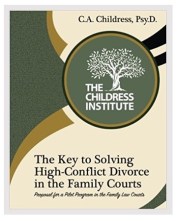
Craig Childress, Psy.D.Pilot program booklet cover
Clinical Psychologist, PSY 18857

The Key to Solving High-Conflict Divorce in the Family Courts: Proposal for a Pilot Program in the Family Law Courts

Assessment:
The Assessment of Attachment-Related Pathology Surrounding Divorce

Two booket coversRemedy:
Strategic Family Systems Intervention for AB-PA: Contingent Visitation Schedule


Everything is Seen

This pathology hides.  It’s power comes from concealment.

The antidote is light.  Everything in the open, everything disclosed.  No secrets. 

This is the time.  We know what the pathology is and we need to make it stop.  Now.  Today.  No excuses.  Professional psychology can absolutely solve this pathology.  It requires professional knowledge and expertise, but we can absolutely solve it.

So why aren’t we?  A: Because of profound and rampant professional ignorance and incompetence in the assessment, diagnosis, and treatment of attachment-related family pathology surrounding divorce.

Clinical Definition 1: Family Systems

The child’s “triangulation” into the spousal conflict through the formation of a “cross-generational coalition” with one parent against the other parent, that results in an “emotional cutoff” in the child’s relationship with the targeted parent.

Clinical Definition 2: Attachment Trauma

The trans-generational transmission of attachment trauma from the childhood of a narcissistic/(borderline) parent to the current family relationships, mediated by the personality disorder pathology of the parent that is itself a product of this parent’s childhood attachment trauma.

June 6-9, we are taking your voice to the American Psychological Association.  You have the right to professional knowledge and competence in the assessment, diagnosis, and treatment of your children and families.  We are asking that the APA become your ally in achieving that.

APA & Washington, D.C.

I am beginning my outreach to the American Psychological Association asking to schedule an appropriate handoff of the Petition to the APA to a representative of the APA. 

The Board of Directors for the American Psychological Association is meeting June 8-12.  I am respectfully requesting of the APA the possibility of a meeting with a representative from the Board of Directors to hear your voice, 17,817 strong and growing, as carried by Wendy and Rod, with my professional support.

Professional decorum typically keeps negotiations private.  However, not with this pathology.  This  pathology hides in concealment and darkness, and it’s malevolent.  With this pathology, everything must be in the open, everything must be entirely visible.  When everything is in the open, the pathogen can be seen.

I am therefore blogging the outreach letter I sent to the American Psychological Association requesting a meeting June 6-9th to receive the Petition to the APA.  I sent it to several contacts identified by Howie and to the entire Board of Directors.

Letter to the APA:


I am a clinical psychologist and APA member.  I am also the author of the Petition to the American Psychological Association posted to Change.org in January, 2018.  The Petition to the APA currently has over 17,000 signatures since January, 2018.

Petition to the APA

During the first week of June (6/6 through 6/9), a delegation comprised of myself and two parent and child advocates, Wendy Perry and Rod McCall, will be traveling to the APA offices in Washington, D.C. to present this Petition to the APA.   The voices of thousands of parents are reaching out to the APA for help.

Wendy Perry is a leading parent and child advocate for families involved in post-divorce conflict surrounding child custody, and Rod McCall is a parent-child advocate and speaker, having lost his son to a murder-suicide by the mother because of this devastating family pathology surrounding divorce and child custody.

We are reaching out to the APA at this time to explore planning and scheduling for a meeting with a representative of the American Psychological Association during this period from June 6-9 to receive the Petition to the APA. 

We are aware that the Board of Directors for the APA is meeting from June 8-12 in Washington, D.C., and, if possible, we would respectfully request to meet with a representative of the Board of Directors, either on June 7th prior to the start of the BoD meeting (to limit our intrusion into the scheduled agenda for the BoD), or on June 8th the first day of the BoD meeting if this is gauged to be more appropriate.

We are asking that this request for a meeting be forwarded to the appropriate representatives within the American Psychological Association to discuss scheduling for our delivery of the Petition to the APA during the first week of June.

Thank you for your cooperation, and we look forward to working with the American Psychological Association.

Craig Childress, Psy.D.
Clinical Psychologist, PSY 18857

Wendy Perry
Parent & Child Advocate

Rod McCall
Parent & Child Advocate

Asking for Your Support

Wendy Perry, Rod McCall, and I are in the midst of planning our trip to Washington, D.C. to deliver the Petition to the American Psychological Association, bringing your voice to the APA and calling on them to become your allies in solving the pathology of “parental alienation.”

We have a question for you…

Do you, the community of parents fighting for your children, want us to hold a press conference when we arrive in Washington?

I’d strongly recommend it. 

The power of the Petition to the APA is in the content of the petition introduced into the structure of the APA.   But media attention and focus on the pathology of “parental alienation” is an important weapon in our fight for your children, and our Washington, D.C. trip provides a valuable opportunity to begin generating this media attention.

I would strongly recommend a press conference to begin our trip to Washington.

The problem is… Wendy, Rod, and I cannot financially afford to put on a press conference.  We need help.  To put on a press conference will cost $500 for a room at the National Press Club and an additional $3,000 for a press consultant to help us get the press to the press conference. 

With all of the other financial expenses that Wendy, Rod, and I are personally incurring surrounding our trip to Washington, we simply don’t have the money to create a press conference.  We need your support.

If you want a press conference for your voice in Washington and with the APA, you will need to help us finance it.  We need your help.

I have formed a nonprofit 501c3, The Childress Institute for Child Development, with the goal of bringing education, training, and solution to the pathology of “parental alienation” in high-conflict divorce.  Working with my attorney, The Childress Institute for Child Development is now available to accept donations to support its work.

Childress Institute for CD LogoThe Childress Institute for Child Development: Donations

We are asking for your help in funding a press conference.  If The Childress Institute for Child Development receives enough donations, then we will hire a press consultant ($3,000) and schedule a room at the National Press Club ($500), and we will host a press conference for your voice.

If we don’t receive enough donations, then we will figure that a press conference is not something that the community of parents is interested in.

Additional Funding:

The Childress Institute for Child Development would also like to host an Erasing Family event on Friday evening in Washington, D.C.  The documentary Erasing Family is an important voice for parents and children caught in the pathology of “parental alienation.”  Supporting the documentary is exceedingly valuable and important.

The Association of Family and Conciliation Courts (AFCC), the major legal-psychological professional organization involved in child custody, is holding its annual convention in Washington, D.C. during the period of our trip to Washington.  The Childress Institute for Child Development will be purchasing a vendors table at the AFCC convention ($750), paid for by me personally. 

We would like to use this forum of The Childress Institute for Child Development table at the AFCC convention to drive the family law attorneys, child custody evaluators, and court-involved therapists to an Erasing Family event on Friday evening.  At the Erasing Family event, the legal and psychological professionals will be treated to clips from the documentary, and cocktail party access to Dorcy and I for professional-level cocktail party discussion, professional dialogue, and conversation.

What we want to achieve is to make watching the documentary Erasing Family a requirement of professional responsibility when it is released, for all family law attorneys, guardians ad litem, minors counsels, child custody evaluators, and court-involved therapists.  Promoting a Friday evening Erasing Family event to the AFCC convention is immensely valuable in achieving this goal.

Our goal in Washington with the APA is also to schedule a meeting with representatives of the APA’s Board of Directors while we are in Washington.  The APA’s Board of Directors is meeting from June 8-12 (we are in Washington from June 6-9, overlapping with the BoD meeting).

In addition to increasing the awareness of the AFCC, we would also like to make watching of the documentary Erasing Family a requirement of professional responsibility for the Board of Directors for the APA.  Erasing Family is your voice, the voice of parents and children caught in the devastating family pathology of “parental alienation.”  We would like to provide the Board of Directors of the APA with complimentary tickets to the Friday evening (June 8th) Erasing Family event.

We will also be scheduling meetings with our congressional representative’s offices while we are in Washington.  We would like to encourage the congressional staffers we meet with to also come to the Erasing Family event, to increase the knowledge of congressional representatives regarding the devastating family pathology of “parental alienation.”

If parents choose to fund a press conference, then promoting the upcoming release of the documentary, Erasing Family, will also go a long way in our next phase of enlisting media attention to the pathology of “parental alienation.”

A Friday evening Erasing Family event is immensely valuable for a variety of reasons.  The problem again is financing.  Wendy, Rod, and I cannot afford to personally finance such an event (location and appetizer nosh).  We need your help.

Your contributions to The Childress Institute for Child Development will go toward funding this Friday evening Erasing Family event, allowing us to keep ticket prices to the event reasonable ($25) rather than a barrier to attendance ($150) to cover expenses.  Tickets to the Erasing Family event at $25 sold through an ipad at the Childress Institute for Child Development vendors table at the AFCC convention, and provided as complimentary to the Board of Directors of the APA and to congressional staffers, will encourage the greatest level of participation from family law attorneys, child custody evaluators, and court-involved therapists (the nominal cost encourages commitment to attend and provides us with a head count for the event).

We need your help.  If The Childress Institute for Child Development receives enough donations from the community of targeted parents, then we will pay for the Erasing Family event.  Otherwise, we cannot personally afford to finance such an event.

This is your voice.  We need your help.

Personal Note

On a personal note, I am deeply appreciative of both Wendy Perry and Rod McCall in agreeing for come with me to Washington, D.C. to deliver the Petition to the APA.  They are doing so at their own personal expense.  Their hotel and airfare costs are not inconsequential for them at a personal level.

I would like to use any additional money that may be collected by The Childress Institute for Child Development surrounding the Washington trip to help Wendy and Rod with their travel expenses.  They are traveling to Washington to represent your voice and the voice of your children.  Helping them with travel expenses is the right thing to do.

Donations

The time is now.  We are on the battlefield for your children and families now.  We need your support.

If you, the community of targeted parents, want a press conference for your voice, then we need your help in funding it.

If you, the community of targeted parents, want an Erasing Family event on Friday night for family law attorneys, child custody evaluators, court-involved therapists, the Board of Directors for the APA, and congressional staffers, then we need your help in funding it.

If you, the community of targeted parents, want to provide support to Wendy and Rod in representing your voice to the APA, to the AFCC, and to Congress, then we need your help.

I established The Childress Institute for Child Development specifically to serve as the organizing core in education, training, and solution for the attachment-related family pathology of “parental alienation” in high-conflict divorce.  Funding a press conference, funding an Erasing Family event in Washington, D.C., and supporting travel for parent-child advocates carrying your voice and the voice of your children, is consistent with the mission and goals of The Childress Institute for Child Development.

Please consider making a financial contribution to The Childress Institute for Child Development.  Whatever you can afford, $25, $50, more if you can. 

I know fighting the pathology of “parental alienation” is expensive for parents.  I know you’ve spent thousands and thousands of dollars fighting against the lies and trying to restore the healthy emotional and psychological development of your children.  I understand.

I am also asking you to consider where the solution is.  Did the money spent on attorneys lead to a solution?  Did the money spent on “reunification therapy” result in a solution?

Supporting a press conference, Erasing Family event, and travel for your parent-child representatives to speak your voice in Washington, D.C. will lead to a solution.  Please join us in solutions.

The Washington, D.C. trip is the empowerment of voice, your voice.  It is time.  We are on the battlefield for your children and families now, to end this pathology for all children everywhere.  Please consider our request for your support.Childress Institute for CD Logo

The Childress Institute for Child Development:
Donations

Craig Childress, Psy.D.
Clinical Psychologist, PSY 18857

Prove me wrong…

To my professional colleagues…

The field of professional psychology surrounding high-conflict divorce is rife with professional ignorance and incompetence. 

Prove me wrong.  I dare you.  I double-dog dare you.  Go ahead, prove me wrong.

Because you know what?  I’m not wrong.  The field of professional psychology surrounding high-conflict divorce is rife with professional ignorance and incompetence.

A Bowlby-Minuchin-Beck description of attachment-related family pathology surrounding divorce identifies four domains of professional knowledge required for professional competence:

The attachment system;

Personality disorder pathology;

Family systems pathology;

Complex trauma.

The vast majority of mental health professionals who are assessing, diagnosing, and treating attachment-related family pathology surrounding divorce do NOT possess the professional knowledge required for competence.

Prove me wrong. 

You can’t.  Because I’m right.  This needs to change.

High-conflict divorce surrounding child custody is not a legal problem, it’s a professional psychology problem.  Interpersonal family conflict is not illegal, it’s unhealthy… and it’s solvable through professional psychology.

The abject failure of professional psychology in solving the attachment-related family pathology of parent-child bonding and in helping the family to successfully adjust to a new and healthy post-divorce separated family structure is then spilling into the legal system through continual litigation of family conflict.

The attachment-related family pathology of “parental alienation” is NOT a legal issue, it is a professional psychology issue.  It only becomes a legal issue because professional psychology is failing in its obligation to solve the pathology. 

Why is professional psychology failing in its responsibility to solve pathology?  Because of professional ignorance and incompetence. 

Prove me wrong.

Trauma Informed Care

The pathology of “parental alienation” (Bowlby-Minuchin-Beck; AB-PA) is a trauma pathology

Clinical Definition:  Prominent attachment-related pathology surrounding divorce represents the trans-generational transmission of attachment trauma from the childhood of an allied narcissistic/(borderline) parent to the current family relationships, mediated by the personality pathology of the parent that is itself a product of this parent’s childhood attachment trauma.

The attachment-related family pathology of “parental alienation” (Bowlby-Minuchin-Beck; AB-PA) is a trauma pathology.  This pathology requires “trauma-informed care” in assessment, diagnosis, and treatment. 

Failure to possess the professional knowledge required for trauma-informed assessment, diagnosis, and treatment of attachment-related family pathology surrounding divorce represents practice beyond the boundaries of professional competence, in violation of Standard 2.01a of the APA ethics code. 

If professional ignorance of trauma-informed care leads to harm to the child and parent in their bonding following divorce, such as by preventing or delaying their bonding through inadequate assessment, inaccurate diagnosis, and ineffective treatment, then this would be a violation of Standard 3.04 of the APA ethics code.

To my professional colleagues… prove me wrong.

Because if I’m not wrong – and I’m not – then things need to change, and change quickly.  Causing harm to clients, potentially irrevocable harm to children and families, because of professional ignorance and incompetence is entirely unacceptable.

We are done tolerating professional ignorance and incompetence.  Those days are over.  All mental health professionals will be held accountable for the professional knowledge and expertise required to SOLVE pathology.

Trauma informed care.

Professional-level knowledge and expertise in:

The attachment system;

Personality disorder pathology;

Family systems pathology;

Complex trauma.

The world is changing.  Professional ignorance and incompetence are no longer acceptable.

Craig Childress, Psy.D.
Clinical Psychologist, PSY 18857

Siege

I tend to think visually and in imagery.  I see our current situation as a battle, a siege of the citadel that is the American Psychological Association.

We have drawn up our forces on the plains before the citadel.  We are laying siege to the citadel of the APA.  We are reclaiming the APA as an ally of targeted parents and children in solving the pathology of “parental alienation” (defined through a Bowlby-Minuchin-Beck model; AB-PA).

The key element of a siege to to draw up one’s troops to surround the fortress, and then just remain there.  Don’t go anywhere.  That’s all there is to it.   It takes time, but eventually the citadel will fall.

The Petition to the APA is a siege engine, a trebuchet if you will.  The united voice of parents is the trebuchet.  Article 3 of the Petition to the APA contains some mighty big boulders, violations of the APA ethics code.  Standard 2.01a Boundaries of Competence is a mighty big boulder.  Standard 9.01a Competent Assessment is a mighty big boulder.  Standard 3.04 Harm to the Client is an absolutely huge big boulder.

We are going to use the trebuchet of your voice, your signatures to the Petition to the APA, to batter the walls of the citadel with the  boulders of Standard 2.01a, Standard 9.01a, and Standard 3.04.

By relying solely on established professional constructs and principles, a Bowlby-Minuchin-Beck model defining attachment-based parental “parental alienation” (AB-PA) activates Standards 2.01a, 9.01a, and 3.04 of the APA ethics code.  We are now going to leverage the Ethical Principles of Psychologists and Code of Conduct of the American Psychological Association to achieve widespread professional knowledge and competence in the assessment, diagnosis, and treatment of attachment-related family pathology surrounding divorce.

We are going to rid the field of professional ignorance and incompetence, and the remaining mental health professionals will know what they’re doing, they will be knowledgeable and competent, and they will be able to resolve the family pathology of attachment-based “parental alienation.”

We are laying siege to the APA.  The American Psychological Association is your rightful ally in achieving a solution to your family”s deep tragedy and struggles.  Professional psychology can absolutely solve this pathology, once we return to the standard and established constructs and principles of professional psychology.

Bowlby, Minuchin, Beck, Millon, van der Kolk…

Clinical Psychology: Assessment leads to diagnosis, and diagnosis guides treatment.

We are drawing up our forces at the walls of the citadel (17,570 signatures to the Petition and rising).  We will identify our allies and we bring our allies to the battlefield before the walls of the APA. 

And we won’t leave.  The delivery of the Petition to the APA is just the arrival of the trebuchet on the battlefield.  We will continue to batter the walls of the APA with Standards of the APA ethics code…

Until they listen, and until they act. 

And we will impress upon them that there is urgency.  Every day that passes without a solution is one day too long.  There is immense suffering and lost childhoods.  There is urgency.

With a siege, we engage the citadel and we just don’t leave.  The citadel of the APA will fall to you, and the APA will become your ally in solving the pathology.  You are more powerful than you know.

The Walls

A year ago, an assault began on the walls of the APA.  Many have been participating in the assault on the walls of the APA, but two notables deserve mention, Howie Dennison and Jason Hofer. 

It was primarily through Jason’s efforts, with assistance, that the first petition to the APA was written a year ago.  I wasn’t involved in creating or writing this petition and I was impressed by both the concept and its execution.  The scholarship in this first petition by Jason and colleagues was excellent and extensive.

Howie has been a relentless advocate in developing his relationships with the people in power at the APA.  The APA is an organization, it doesn’t attend to a person.  A person is shunted into the bureaucracy.  A person isn’t heard.  So it’s all the more remarkable that Howie has made himself heard.  He has been pleasantly relentless in his assault on the walls of the APA.

We actually own the walls of the APA thanks to Howie and Jason.  We still don’t have the APA as your ally, the citadel has yet to fall, but we have the walls.  It is entirely possible and it is my complete expectation that the APA will become your ally in relatively short order.

On June 6-9 we are bringing up the siege engines.  There is a chance, and it is my hope, that we will be welcomed by the APA as allies in solving the pathology of attachment-based “parental alienation.”

Breaking the Siege

In most sieges, the besieged citadel draws into its fortifications and tries to outlast the siege.  In some cases, however, the beleaguered citadel may try to break the siege by attacking, either from the citadel itself or through a relieving force from the outside.

There is a possibility this may occur in our siege of the APA. 

If this attack occurs, it will likely be directed toward me.  An attack from within the citadel will be the APA’s concern regarding my allegations of ethical violations toward professional colleagues.  An attack by a relieving force from the outside will be to say that this is a “new theory” of Dr. Childress that needs to be “investigated.”

For the attack from the citadel, the allegations of ethical misconduct by psychologists contained in the Petition to the APA are consistent with my professional obligations under Standards 1.04 and 1.05 to take appropriate action “when psychologists believe that there may have been an ethical violation by another psychologist” (Standard 1.04).

APA Standard 1.05: Reporting Ethical Violations
If an apparent ethical violation has substantially harmed or is likely to substantially harm a person or organization and is not appropriate for informal resolution under Standard 1.04, Informal Resolution of Ethical Violations, or is not resolved properly in that fashion, psychologists take further action appropriate to the situation. Such action might include referral to state or national committees on professional ethics, to state licensing boards, or to the appropriate institutional authorities.

It is my professional judgement as a clinical psychologist, that the appropriate institutional authority to refer these 17,579 parents regarding the rampant and unchecked professional ignorance and incompetence being displayed by professional psychologists is to the American Psychological Association, and that the “further action appropriate to the situation” is to formalize that voice from parents into a Petition.

I am fulfilling my professional obligations under Standard 1.04 and 1.05 of the APA ethics code.  I’m fine.

As for the attack from outside forces trying to relieve the siege, none of this is Dr. Childress.  This is Bowlby, and Minuchin, and Beck, and Haley, and Millon…  Are they saying that they want to investigate Bowlby?  Minuchin?  Beck?  Because none of this is Childress.

Poof.  That attack vanishes.  Because none of this is Childress.

Diagnosis is the application of standard and established constructs and principles of professional psychology (Bowlby, Minuchin, Beck) to a set of symptoms.  Diagnosis.  AB-PA is not a theory, it’s diagnosis; the application of standard and established constructs and principles to a set of symptoms.

They will be unable to break the siege.  We won’t go anywhere.  As the trebuchet of your voice begins hurtling boulders of Standards 2.01a, 9.01a, and 3.04 against the walls of the APA, we will look to increase the media’s attention to your voice, and to the continuing reluctance of the APA to help you solve the pathology.

The Walls Are Ours

However, we may not need to enact a long protracted siege of the APA, because Howie and Jason and their colleagues have already taken the walls of the APA.  The people at the APA know of us.

Their response last year to the assault on the walls was to “deflect into committee” – they said they’d develop a “working group” to look into the research.   It’s been over a year and there is no progress on a working group.  That dodge is done.  They can’t use it again this time.

What the assault on the walls by Howie, Jason, and others did was to expose and use up the APA’s “deflect to committee” defense against doing anything.  They’ve already used that dodge last year.  One year later, no change.  We are now on much stronger ground demanding concrete and immediate action (Article 4: Remedy 1).

It is possible, and it is my hope, that the APA will recognize the legitimacy of your voice and the issues, and that the APA will take active and concrete steps to help you in finding solution (Article 4: Remedies 2 & 3).  I fully expect the APA to become your ally in relatively short order.

If not, then the trebuchet will begin the assault on the walls.  We’re not going anywhere until there is change, until there is a solution for all children and all families.

Craig Childress, Psy.D.
Clinical Psychologist, PSY 18857


Venice Seminar: Saturday 6/23/18

I am pleased and excited to announce that I will be presenting a full-day 6-hour seminar in Venice, Italy on Saturday 6/23/18.

This six-hour seminar on Saturday is separate and additional to the one-hour seminar I will be presenting at the EFCAP Congress.  The EFCAP Congress runs from Wednesday through Friday, 6/20 – 6/22. 

On Saturday, 6/23, in collaboration with Peter Knudsen, Director of Bps Jurisfirma and Bpm Parental Alienation Awareness EU, I will be presenting an additional 6-hour seminar at the Park Hotel Ai Pini on the assessment, diagnosis, and treatment of attachment-related pathology surrounding divorce and the solution for the family court system.

Venice Seminar Flyer: Assessment, Diagnosis, and Treatment of Attachment Related Pathology Surrounding Divorce: Solutions for the Family Court System

I am excited by this opportunity to present a substantial seminar in Europe. 

This full-day seminar will cover:

Foundations: The professional foundations in the attachment system, family systems pathology, and personality disorder pathology for an attachment-based model of “parental alienation.”

Diagnosis: The core and expanded symptoms of attachment-based “parental alienation” in high-conflict divorce.

Assessment Protocol: The structure and clinical content for a six-session clinical assessment protocol.

Treatment:  The treatment considerations for resolving attachment-related family pathology surrounding divorce.

Contingent Visitation Schedule: A Strategic family systems intervention for the treatment of ongoing attachment-related family pathology following divorce.

Family Court Solution: The framework for a structured and standardized approach to solution in the family court system for all cases of attachment-related family pathology surrounding divorce.

This will be a professional education seminar of substance and importance. 

Craig Childress, Psy.D.
Clinical Psychologist, PSY 18857


Washington, DC: Media Statements by Dr. Childress

June 6-9, Wendy Perry, Rod McCall, and I will be traveling to Washington, D.C. to deliver the Petition to the APA:

Change.org: search term “parental alienation”

The Petition to the APA

These are the statements I am prepared to provide to the media in my professional capacity as a clinical psychologist.

According to Dr. Childress…

 1.)  Children are not weapons

Children are not weapons, children should never be used as weapons in their parents’ spousal conflicts.

But that’s exactly what’s happening.  Professional psychology and the family courts are allowing, and indeed rewarding, parents who use their child as a weapon in the divorce.

Children have the right of childhood to love both parents, and to receive the love of both parents in return.

We are here to give all children that right, a healthy and normal childhood of love and affection with both parents.

2.)   Professional ignorance and incompetence

Families are being destroyed, childhoods are being destroyed, by rampant and unchecked professional ignorance and incompetence in professional psychology and the family courts, and no one is stopping the destruction of children and families.

The loving bond of shared affection between children and parents is being systematically destroyed by the spiteful malevolence of the other parent in revenge for the divorce, and professional psychology is allowing it, in fact, colluding with it.

We are asking for the help of the APA in upholding standards of professional practice in professional psychology, its own documented standards of professional practice.

Professional-level knowledge and professional competence in assessment, diagnosis, and treatment of children and families is the right of all parents and children.  We are asking the APA’s support in our achieving that right for all parents, all families, and all children.

3.)  Financially motivated corruption in professional psychology

Professional psychology in the family courts is corrupt.  The mental health professionals in the family courts are financially feeding off of the suffering of children and families without ever solving anything. 

Professional psychology in the family courts is a corrupt financial system of failed professional practices.  Professional psychology knows this, and there is a conspiracy of silence in professional psychology to allow their continued feeding off of the suffering of families.

We are seeking the APA’s help in cleansing the corruption that is rampant throughout professional psychology in the family court system.  We are seeking standards of professional practice, consistent with the APA’s ethical code governing the practice of all psychologists.

It is the obligation of professional psychology to provide children and families with solution and healing through competent professional practice.  We are here to end the corruption in the family court system that feeds off of the suffering of families while never providing solution.

4.)   Abandoning children to child abuse

Alienating the child from the love of a parent is child abuse.  It is psychological child abuse.

Intentionally and malevolently destroying the child’s healthy bond of love and affection to a parent, to exact a spousal revenge for the divorce, is child abuse, psychological child abuse.

Professional psychology and the family courts are colluding with and supporting the psychological abuse of children.

We are here to end the psychological abuse of children.  We are here to restore children’s loving bonds of shared affection with both parents.

Children have the right to love, and to be loved.  We are here to protect the children from the psychological child abuse of “parental alienation” in divorce. 

Children are not weapons.  Children have the right of childhood to love both parents, and to receive the love of both parents in return.

This is my voice as a clinical psychologist.  Wendy and Rod will bring the voice of parents and children to Washington, D.C… 17,482 signatures on the Petition to the APA brings the voice of parents and families to Washington, D.C.

Craig Childress, Psy.D.
Clinical Psychologist, PSY 18857