AB-PA Has Teeth

In a comment to my recent Facebook post regarding Moving Forward, a targeted parent lamented that mental health professionals refuse to assess for the attachment-related pathology of AB-PA.  In this lamentation, the parent alleged that AB-PA has “no teeth” to compel professional competence.

I thought my response to this parent may be more broadly of interest, so I am making it as a blog post.


AB-PA most definitely has teeth.

Accountability

The reason I spent nearly seven years researching and developing a description of the pathology from entirely within standard and established psychological constructs and principles is so that ALL mental health professionals can now be held accountable.  The rampant professional incompetence that has been allowed to flourish unchecked for 30 years by the Gardnerian model of PAS  – MUST END.

The APA ethics code requires professional competence (Standard 2.01a.).  Mental health professions are not allowed to be incompetent.

Professional Competence

But in order to activate Standard 2.01a of the APA ethics code, the pathology must be defined entirely through standard and established constructs and principles to which all mental health professionals can be held accountable.

So that’s what I set about doing, precisely to hold mental health professionals accountable.  With the publication of Foundations in which I define the pathology – in detail – entirely from within standard and established constructs and principles of professional psychology, the seeds of accountability were planted.  All it requires to actualize the solution is for these seeds of accountability to grow into the tree of change.

The tree is growing.

Professional-to-Professional Consultation

I recently provided consultation to an attorney, and then at the request of the attorney I provided professional-to-professional consultation to the psychologist who was treating the family.

The treating psychologist entirely understood the nature of the pathology.  After our professional-to-professional consultation, this psychologist indicated that he was going to formally diagnose the family pathology as V995.51, Child Psychological Abuse, and he would then file a suspected child abuse report with child protective services to discharge his “duty to protect.”

A few weeks later, I was contacted by the attorney.  Child protective services was investigating a complaint of child psychological abuse.  The attorney was wondering how to handle this investigation by child protective services in a way that would be most productive to enacting a solution to the family pathology.

This following excerpt is from my email response to the attorney:


<Attorney>

The solution is building.  The issue you’re running into is that the solution is only part of the way here.

Step 1:  The mental health professional makes an accurate DSM-5 diagnosis of V995.51 Child Psychological Abuse based on their assessment using the Diagnostic Checklist for Pathogenic Parenting.

Step 2:  The mental health professional then discharges his or her “duty to protect” by filing a report with child protective services.

Step 3:  Child protective services then employs the same assessment criteria (i.e., the three diagnostic indicators of pathogenic parenting) and confirms the diagnosis made by the mental health professional.

Step 4:  Child protective services then removes the child from the psychologically abusive parent and places the child in “kinship care” with the normal-range and affectionally available targeted parent.

The problem is that we are currently at Steps 1 and 2 of the solution.  I am educating mental health professionals regarding the attachment-based pathology, and I am consulting with them on its assessment and diagnosis.

I have not yet reached the third and fourth steps in the solution of educating the child protective services system.  So I don’t expect them to know what to do with these cases.

But as these cases begin to increasingly flow into the child protective services system, child protective services will increasingly be confused and bewildered. They will begin researching why these cases are coming to them from mental health professionals with confirmed DSM-5 diagnoses of V995.51 Child Psychological Abuse.

When they talk to the referring mental health professional, this referring professional will mention me.  At some point, after receiving multiple referrals from mental health professionals that include a confirmed DSM-5 diagnosis of Child Psychological Abuse, the child protective services will contact me and request training in AB-PA.  We then move into Steps 3 and 4.

Once the CPS system is trained, we will have all four steps in the solution in place.

Targeted parents will no longer need to go to trial to prove “parental alienation” in court.  Instead, an attorney can seek a court-order for a “treatment-focused assessment” in cases of attachment-related pathology surrounding divorce (a child rejecting a parent).

This treatment-focused assessment will produce a confirmed DSM-5 diagnosis of V995.51 Child Psychological Abuse, and a report to the Court and a report to CPS.

CPS will investigate and will provide an independently made confirming second diagnosis of Child Psychological Abuse.

If CPS places the child in kinship care with the normal-range targeted parent, then the attorney returns to court to obtain appropriate follow-up court orders for the treatment-related change in custody and covering the ultimate reunification of the child with the abusive parent (with proper safeguards to ensure that the abuse does not resume once contact is restored).

If CPS confirms the diagnosis but defers changing custody to the pending court case for resolution, then the attorney returns to court with two independently made confirmed diagnoses of Child Psychological Abuse and seeks appropriate court orders for remedy.

But we’re not there yet.  Next year, 2018, hopefully.  Maybe 2019.  Unfortunately we’re still in the process of educating everyone (at this point the mental health professionals at Steps 1 and 2) in achieving this solution.  By 2020, everything will be solved.


Returning to the blog…

The solution is coming.  It’s no longer a matter of IF a solution occurs.  With the introduction of AB-PA (Foundations) the issue has now become HOW SOON the solution arrives.

Notice in the email to the attorney I projected the solution will be achieved in 2018, perhaps 2019.  That’s because I am a single clinical psychologist working alone to change the entire mental health system.  Big system… little me, working alone.

The Gardnerian PAS experts are withholding their help.  It’s a turf-battle thing for them.  They would rather try to remain “experts” in Gardnerian “parental alienation” – a model that has offered no solution in over 30 years, than lend their aid to creating a solution that does not involve Gardnerian PAS.  They have not brought their banners to the battlefield.

We are left on our own to fight this battle to enact the solution.

But you, the targeted parents – authentic parents who love your children dearly – I could use your help to bring about the solution as quickly as we can achieve it.  I don’t want to wait until 2018 or 2020.  We can’t afford to wait.  Each day that passes without the solution is one day too long.

This needed to be solved yesterday.  Because of that, I am working as hard as I can to speed the solution’s arrival as fast as I possibly can.  That’s why I’m not writing journal articles yet.  They take too long to write and get published, and they have only a minimal real-world impact.  My time right now is better spent in other areas.  That’s why I’m taking such an assertive stance with the Gardnerian PAS experts, because their withholding of support for the paradigm shift slows the achievement of the solution.

I don’t mind being an annoying pain-in-the-behind if that’s what it takes to bring this nightmare of “parental alienation” to an end.  I will poke, prod, push, rail, irritate, annoy, and shout, if that’s what it takes to achieve the solution.  It’s not about me.  It’s about you and your children.  This nightmare that you’re going through must end.  And it must end as fast as is humanly possible to achieve.

For your part… you be kind.  Be relentless, but be kind. You must fight against the false narrative that you are too “angry and controlling.”  Be kind, but be relentless in your expectation of professional competence.

I am available for a professional-to-professional consultation with any mental health professional who seeks it (not the targeted parent, it must be with the involved mental health professional) .  All the mental health professional has to do is send me an email with the heading Professional Consultation.

Understanding Your Power

The American Psychological Association actually cares about your suffering.  Really, they do.  They just don’t know what to do about it because your prior advocates with them, the Gardnerian PAS experts, were trying to force them to accept an untenable “new form of pathology” model for defining the pathology.

In AB-PA, I have listened to the constructive feedback from the APA and I have provided them with a compromise solution that can both end your suffering while still maintaining professional standards for defining the pathology.  That’s what AB-PA is designed to do.  It’s designed to end the internecine debate within professional psychology and reunite professional psychology into a single unified voice to protect your children.

I have empowered you with AB-PA.  I urge you to live into your new power.  The helpless disempowerment of your trauma, as you have watched your beloved children become distorted by the pathology of “parental alienation,” and the emotional and psychological abuse you’ve endured from a non-responsive mental health system that does not recognize the severity of the pathology and a legal system mired in delays and ineffective solutions have lulled you into a trauma-induced slumber of your powerless victimization.

You are not a victim anymore. AB-PA empowers you, the child’s authentic and protective parent.

Gardnerian PAS gave up your power.  In proposing a “new form of pathology” it froze the mental health system response in endless internal arguments and division.  Gardnerian PAS separated you from what should be your natural allies in the domestic violence and child abuse protection advocates, who actually began to argue against you and against the construct of “parental alienation.”  In taking us off the path of professional diagnosis, Garnerian PAS has allowed rampant professional ignorance and incompetence to flourish unchecked.

AB-PA has returned your power to you. All that’s needed is for the paradigm to shift.

It is time to awaken from the imposed slumber of your helplessness and enter into your power.  Come together and become an unstoppable force for change.

The pathogen seeks to keep you alone and isolated.  I have seen the “source code” for this in the pathogen’s meme-structure – the themes by which it distorts and controls.  It seeks to isolate you from allies because in your isolation you are powerless against its lies. You scream the truth, but no one listens.  By keeping you isolated and alone, it can inflict it’s trauma.

I urge you to rise up and live into your power. Come together, join together.  Bring voice – and more.  Bring power.  AB-PA has teeth.

In one voice you were powerless.  In 100 you regain your voice.  In 1,000 you enter your power.  In 10,000 you become an unstoppable force for change.  Become an unstoppable force for change.

Moving Forward

Teeth

The Gardnerian definition of the pathology as a “new form of pathology” represents a failed paradigm.  Just look around you at the current state of professional incompetence in assessment, diagnosis, and treatment.  The current situation is what the Gardnerian PAS model gives us; rampant professional incompetence and 30 years of continual division and debate within professional psychology.

The Gardnerian PAS model is a failed paradigm.  Scoreboard.

AB-PA defines the pathology entirely through standard and established constructs and principles that define domains for required professional competence in assessment and diagnosis:

Attachment theory

Personality disorder pathology

Family systems therapy

The three diagnostic indicators of AB-PA are all established and accepted forms of pathology in professional mental health:

Attachment system symptoms

Personality disorder traits

An encapsulated persecutory delusion

Because AB-PA defines the pathology entirely from within standard and established psychological constructs and principles and uses diagnostic indicators that are fully established, defined, and standard symptoms in mental health, all mental health professionals can now be held accountable for conducting an appropriate assessment and for making an accurate diagnosis of the attachment-related family pathology of a child’s cross-generational coalition with a narcissistic/(borderline) parent surrounding divorce.

Notice that I did not use the term “parental alienation” – to recover your lost power within professional psychology, we must use the proper terms to activate Standard 2.01a of the APA ethics code.

Mental health professionals CANNOT be held accountable to “parental alienation.”  The construct of “parental alienation” is NOT a defined construct in clinical psychology.

The Diagnosis of Unicorns

This is important to fully understand.  Gardnerian PAS and the construct of “parental alienation” offers no solution.  We must switch to AB-PA to achieve the solution.

AB-PA is specifically designed to expose the pathogen from it’s veil of concealment and to hold mental health professionals accountable for making an accurate diagnosis of the family pathology.  When we use AB-PA, we are able to stand on the rock-solid Foundations of established psychological constructs and principles, which then leads to three definitive diagnostic indicators of the pathology, codified into a simple and easy-to-use checklist for the assessing mental health professional.

Foundations is the spear that defines the pathology using standard and established constructs and principles.  The diagnostic indicators are the head of the spear, cutting through the hidden manipulation of the pathology of the narcissistic/(borderline) personality parent.  The Diagnostic Checklist for Pathogenic Parenting is the tip of the spear, penetrating professional incompetence in assessment and diagnosis.

All mental health professionals CAN be held accountable to AB-PA because all of the constructs and principles used in defining the pathology of AB-PA are standard and established constructs and principles of professional psychology, and all three of the diagnostic indicators of AB-PA are standard and established symptoms that are fully accepted in professional psychology and are fully within the scope of practice for mental health assessment by all mental health professionals.

Assessment

For a mental health professional to refuse to even assess for the three diagnostic indicators of the pathogenic parenting surrounding attachment-related pathology in the family would likely represent a violation of Standard 9.01a of the APA ethics code which states:

9.01 Bases for Assessments
(a) Psychologists base the opinions contained in their recommendations, reports and diagnostic or evaluative statements, including forensic testimony, on information and techniques sufficient to substantiate their findings.

If the mental health professional has not even assessed for the attachment-related family pathology of a cross-generational coalition of the child with a narcissistic/(borderline) parent (notice I didn’t say “parental alienation – you must use the correct professional terms), then they have not based their opinions and recommendations – including diagnostic statements and forensic testimony – on “information and techniques sufficient to substantiate their findings,” in violation of Standard 9.01a of the APA ethics code.

Again, this is important to understand… If you try to hold the mental health professional accountable for assessing “parental alienation,” you will fail.

You MUST use the proper professional terminology provided by AB-PA.  Attachment-related pathology.  Triangulation.  Cross-generational coalition.  Pathogenic parenting.  These are standard and established – fully accepted – psychological constructs and principles in professional psychology.  With these constructs you have power.  With these constructs you become dangerous to professional ignorance and incompetence

AB-PA has teeth.  Under explicit ethical code standards of practice, mental health professionals are not allowed to be incompetent in their assessment, diagnosis, and treatment.

Professional Competence

If a mental health professional refuses to assess for the pathology, I would suggest that the targeted parent begin to lay the “paper trail” relative to this refusal in preparation for filing a licensing board complaint against the mental health professional.

Be kind – always be kind.  But expect professional competence in the assessment, diagnosis, and treatment of your family.

In laying the paper trail, read “Letter to the Stranger.”  In a polite and short letter to the mental health professional:

Document – briefly yet meaningfully – your deep and abiding love for your child, and your deep heartbreak and suffering.

Document your request that the mental health professional assess for the attachment-related pathology of a cross-generational coalition with a narcissistic/(borderline) parent (notice I did not say “parental alienation” – you must use the correct terms).

Document your request that the mental health professional consult with Dr. Childress, a recognized expert in the attachment-based pathology of a child’s rejection of a parent following divorce (notice I did not say “parental alienation”)

Document that you provided the mental health professional with my booklet Professional Consultation, or my letter Professional-to-Professional Consultation, or my handout on the Attachment-Related Pathology of Parental Alienation.

Perhaps within the community of targeted parents you can come together to write some template letters to therapists that can be shared with each other.

For that mater, what if targeted parents agreed to write letters of support for each other to involved mental health professionals, so that a request from a targeted parent for group support could result in hundreds of letters flowing in to the mental health professional asking for this professional to please document the child’s symptoms using the Diagnostic Checklist for Pathogenic Parenting and to please consult with Dr. Childress regarding the pathology.

The pathogen seeks to keep you alone and isolated.  I’ve read the meme-structure in its “source code” that does this.  I urge you to come together.  Work for each other.  Fight for each other.

Alone you are powerless.  In 100 you have reclaimed your voice.  In 1000 you have reclaimed your power.  In 10,000 you become an unstoppable force for change

Moving Foward

Be kind.  Be relentless, but always be kind.

In documenting your requests, you are writing the letter to the mental health professional in order establish the paper-trail documentation for your upcoming licensing board complaint against the mental health professional for violation of Standard 9.01a (and possibly for a violation of Standard 2.01a regarding boundaries of professional competence, and possibly for a violation of Standard 3.04 regarding harm to the client, and possibly for their failure in their “duty to protect”).

Possible Causes of Action

You are writing the Letter to the Stranger; documenting; establishing the paper trail.  Be brief.  Be reasonable.  Be kind.

Refusal to Assess

If the mental health professional refuses to assess for the pathology of pathogenic parenting involving a cross-generational coalition of the child with a narcissistic/(borderline) personality parent (notice I did not say “parental alienation” – you must use the proper professional terms to regain your power), despite all of your respectful and pleasantly kind requests for cooperation, then you may need to file a licensing board complaint.

Sample Complaint Letter Template

Will this help in obtaining better professional care in your specific case?  Probably not.  If you are working with an ignorant and incompetent mental health professional who refuses to even assess for pathology, then you’re in trouble from the start.

But in filing a licensing board complaint you are taking the proper actions relative to professional ignorance and intransigent incompetence.  You are also helping other targeted parents who may follow after you with this mental health professional.

Targeted parents need to come together to put ALL mental health professionals on notice that you will no longer accept negligent professional ignorance and incompetence in the assessment, diagnosis, and treatment of your families.

ALL mental health professionals need to understand that they will – with 100% certainty – face a licensing board complaint if they fail to assess for the attachment-related pathology of a child’s cross-generational coalition with a narcissistic/(borderline) personality parent (notice I did not say “parental alienation”).

Now imagine for a second, that you have made respectful and pleasantly cooperative requests asking for a formal assessment and documentation of the child’s symptoms using the Diagnostic Checklist for Pathogenic Parenting, and the mental health professional has steadfastly refused to even assess for the symptoms,…

… and imagine that you then request a meeting with this mental health professional and provide this mental health professional with the letter you intend to send to the licensing board (that you create specific to your situation using the Sample Complaint Letter Template),…

… and imagine that you calmly, politely, and oh-so-kindly inform the mental health professional that you are asking one last time for assessment and documentation of the child’s symptoms, and if the mental health professional refuses then you will be left no alternative than to send this letter and your supporting documentation to the licensing board…

… what do you imagine the mental health professional’s response will be?

Be kind.  Always be kind. But also know this, AB-PA has teeth.  It most definitely has teeth.

Will the mental health professional suddenly be cooperative and competent?  Probably not.  If they are that arrogant and incompetent, you are already in lots of trouble.  But you are also empowered to confront professional incompetence.  You no longer have to simply accept professional incompetence.

Be kind.  Be relentless, but always be kind.

Oh, and by the way, I am always happy to talk to this mental health professional.  You don’t need to debate professional competence with them.  I’m more than happy to do that for you.  Simply direct them to me: drcraigchildress@gmail.com

Parent: “Well, that may be true Mr./Ms. Therapist, but I’m asking that you consult with Dr. Childress and you can raise that issue with him.”

Totally fine by me.

If you file a licensing board complaint, will the licensing board do anything? Maybe not.  We cannot control what the licensing board does.  What we can control is to ensure that all ignorant and incompetent mental health professionals who refuse to even assess for the pathology are aware that they will – with 100% certainty – face a licensing board complaint from the targeted parent.

We are putting ignorant and incompetent mental health professionals in a position of playing Russian roulette with their career.  Did the licensing board to anything this time?  No?  Lucky you.  How about this time?  No?  Lucky you again.  How about this time?…

Or they can simply assess for the pathology using the Diagnostic Checklist for Pathogenic Parenting.  If they don’t find the pathology, that’s fine.   Just do the assessment and document the results of the assessment in the patient record.

Together – United for Change

You are all in this together.  We cannot solve this for any one family, until we solve it for all children and all families.

We want to make the path of professional ignorance and incompetence very dangerous for them; while at the same time we have made the path of knowledge and competence very easy – all they have to do is simply complete the Diagnostic Checklist for Pathogenic Parenting and document the results in the patient record, and then they will be entirely safe from the targeted parent filing a licensing board complaint.

In addition, in filing licensing board complaints against individual mental health professionals who refuse to even conduct an assessment of the child’s symptoms, we are putting pressure on the APA to do something (i.e., to convene a high-level conference of experts in attachment theory, personality pathology, family systems therapy, and childhood trauma, to produce a white paper on the issue) to provide leadership and guidance regarding the assessment of this attachment-related family pathology.

If the APA does nothing, if the APA remains silent in protecting children from the pathogenic parenting of narcissistic and borderline personality parents, then the child’s loving and authentic parent, the targeted parent, will have no other choice in fulfilling their obligation to protect their children from Child Psychological Abuse by the narcissistic/(borderline) ex-spouse than to seek professional competence in assessment – case-by-individual-case – through seeking enforcement of Standard 9.01a – case-by-individual-case.

AB-PA has teeth.  It most definitely has teeth.

By returning us to the path of professional diagnosis, AB-PA empowers targeted parents.  It is time to wake up from your trauma-imposed slumber of helplessness.  You are helpless no more.  You are armed and dangerous to professional incompetence.

I am just a single lone psychologist in Southern California.  You are thousands of parents fighting for your children.  I have armed you with AB-PA.  I have laid out the roadmap to the solution.

If you leave it to me to solve, it will take me another couple of years because I am just a single lone psychologist in Southern California.  If you bring your thousands of voices – and your power – to the battlefield, who knows how quickly we can accomplish the solution.

Craig Childress, Psy.D.
Clinical Psychologist, PSY 18857

Internationally

What about internationally?  I hear you.

My current focus is on shifting the approach in the U.S. that will then provide the leadership guidance to mental health systems in other countries.

But why wait for me?  You can start this process. The key is to return to the path of standard and established psychological principles and constructs to define the pathology (Foundations).  Then hold mental health professionals in your country accountable to the Standards of professional competence laid out in the professional ethics codes in your countries (Professional Competence).

Be kind.  You want to avoid being characterized as being “too angry and aggressive.”  Be kind.  Be relentless, but always be kind.

Find some allies in professional mental health in your countries who are willing to work with the AB-PA model, and who can carry the voice of the paradigm shift in your countries.

I also have two online seminars available through the Master’s Lecture Series of California Southern University.

Parental Alienation: An Attachment-Based Model (7/18/14)

Treatment of Attachment-Based Parental Alienation (11/21/14)

Since AB-PA is based entirely in standard and established psychological principles of the attachment system and personality disorder pathology, there is absolutely zero reason for any professional psychology system that is even remotely near 21st century standards not to properly assess and accurately diagnose the pathology.  Zero reason.

The pathology is essentially “disordered mourning” surrounding the divorce, with the “primary case” being the narcissistic/(borderline) parent who is then transferring this parent’s pathological mourning to the child through manipulative and exploitative parenting practices.

From John Bowlby:  “The deactivation of attachment behavior is a key feature of certain common variants of pathological mourning” (p. 70)

Bowlby, J. (1980). Attachment and loss: Vol. 3. Loss: Sadness and depression. NY: Basic Books.

From Otto Kernberg:  “They [narcissists] are especially deficient in genuine feelings of sadness and mournful longing; their incapacity for experiencing depressive reactions is a basic feature of their personalities.  When abandoned or disappointed by other people they may show what on the surface looks like depression, but which on further examination emerges as anger and resentment, loaded with revengeful wishes, rather than real sadness for the loss of a person whom they appreciated.” (p. 229)

Kernberg, O.F. (1975). Borderline conditions and pathological narcissism. New York: Aronson.

From John Bowlby:  “Disturbances of personality, which include a bias to respond to loss with disordered mourning, are seen as the outcome of one or more deviations in development that can originate or grow worse during any of the years of infancy, childhood and adolescence.” (Bowlby, 1980, p. 217)

John Bowlby and Otto Kernberg are preeminent figures in professional psychology.  And look at the dates of those statements, 1975 and 1980.  Forty years ago.   This is not new stuff.

Internationally, if your mental health system is even remotely modern, there is absolutely zero reason for it not to recognize the pathology and properly diagnose the pathology.

The only reason they’re not recognizing and properly diagnosing the pathology is because they’re trying to recognize and diagnose something called “parental alienation” proposed by Richard Gardner.  The moment we return to standard and established constructs and principles, the proper diagnosis (pathological mourning transmitted to the child through the manipulative and exploitative parenting practices of a narcissistic/(borderline) parent, who is the “primary case” of disordered mourning) becomes immediately available

I’ve even cited the Standards in some of your countries related to boundaries of competence:

Professional Competence

You need to find a mental health professional in your country who is willing to voice the need for professional competence… or you can wait for me to solve it in the U.S. and then invite me over to your country.  But why wait for me?  Start the ball rolling.  Professional competence.
Moving Forward

A recent comment to my Facebook page by a parent asked what needs to be done to “keep things moving.” I thought my response might be more broadly of interest, so I am turning my response into a full post on my Facebook and blog pages.


1)  Assessment

We need to have all mental health professionals assess for the three symptom features listed in the Diagnostic Checklist for Pathogenic Parenting.

Diagnostic Checklist for Pathogenic Parenting

All three of these symptom features are standard forms of symptom pathology (attachment pathology, personality disorder traits, encapsulated persecutory delusion), so there is absolutely zero reason for any mental health professional to refuse to even assess for these symptom features.

I recently met jointly with two activist attorneys here in the Southern California area regarding how to begin creating the solution within the legal system. They both completely understand the strategy.

We need to get a proper assessment using the Diagnostic Checklist for Pathogenic Parenting, and since all three of these symptoms are standard and established psychological constructs and principles, there is absolutely zero reason that a court-involved mental health professional should refuse to assess for these symptoms.

The mental health professional doesn’t even need to agree with AB-PA (although I don’t see any reason for them not to agree), they still have no reason whatsoever for refusing to even assess for these three standard and established symptoms.

So the attorneys will be developing this request into Court orders for assessment. They will also be trying to obtain Court orders for a treatment-focused assessment.

That is step 1, we need to get ALL mental health professionals to assess for the three symptom indicators on the Diagnostic Checklist for Pathogenic Parenting (attachment pathology, personality disorder symptoms, and an encapsulated persecutory delusion). Even if the mental health professional doesn’t find these symptoms, at least it is documented and the targeted parent can enter a dialogue about what factors in the symptom display of the child are missing.

Remember, I’m willing to provide a professional-to-professional consultation with any mental health professional – (my consultation has to be with the mental health professional, not with the targeted parent). All the mental health professional needs to do to request a professional-to-professional consultation with me is send me an email with the heading Professional Consultation.

I even have a 50-page booklet, Professional Consultation, that can be given to the mental health professional

Amazon.com: Professional Consultation

Remember, always be kind. Don’t allow yourself to feed the false narrative of you being “angry and controlling.”  Be kind.  Be relentless, but be kind.  Always be kind.

We also would like all mental health professionals to document their assessment of the parenting practices of the targeted parent using the Parenting Practices Rating Scale. We can’t compel this, but we really want to encourage the documentation of the mental health professional’s assessment of the parenting of the targeted parent.

Parenting Practices Rating Scale

Too often the targeted parent is critiqued for parenting that is supposedly “contributing” to the child’s angry-hostile rejection. We want this clearly documented – documented; a key construct in the solution. This will allow targeted parents to understand specifically what aspects of their parenting are the focus of treatment and need to change (in the mental health professional’s opinion) in order to see changes in the child’s behavior. This becomes integral into an evidence-based approach to treatment.

Treatment plans and documentation, that’s what we want.

2)  Documenting the Parent-Child Relationship

This is not integral for the change, but I recommend this step.

Targeted parents should begin documenting their child’s behavior when the child is in their care using the Parent-Child Relationship Rating Scale (note that there is also an “Excessive Texting” version of this rating scale).

Parent-Child Relationship Rating Scale

Parent-Child Relationship Rating Scale (Excessive Texting Version)

Again, this is about evidence-based decision making. These completed parent rating scales can be provided to mental health professions as documentation of the parent-child relationship issues from the parent’s perspective. These ratings can also be incorporated into parent-child therapy as a discussion aid in therapy by seeking to understand the ratings of the parent and reach consensus among the parent, child, and therapist relative to the child’s behavior and the treatment goals.

Documentation of symptoms.  Evidence-based decision making.  Clear treatment plans.  This is what we’re trying to achieve.

3) The American Psychological Association

We need to continue to advocate with the APA to change their position Statement on Parental Alienation Syndrome to recognize and incorporate the existence of a second model of the pathology – AB-PA – that is based entirely within standard and established constructs and principles of professional psychology.

Notice how the Statement of the APA has been co-opted by the domestic violence protection advocates. An official Statement about “parental alienation” should be about the pathology in your family, the Statement should belong to you. It’s time we take back the focus of the discussion, it’s about “parental alienation.”

We would like the APA to convene a high-level conference of experts in attachment theory, personality pathology, family systems therapy, and childhood trauma to consider the issues surrounding high-conflict divorce and attachment-related pathology, leading to a white paper on the issue.

We are also seeking two things from the change in the APA Position Statement:

1.) Acknowledgement of the Pathology – a formal recognition that the pathology exists, using whatever label-name for the pathology they like – attachment trauma pathology surrounding divorce; a cross-generational coalition; “parental alienation” – whatever they want to call it – just acknowledge that it exists

2.)  Special Population Status – a designation of the children and families evidencing attachment-related pathology surrounding divorce as representing a “special population” requiring specialized professional knowledge and expertise to competently assess, diagnose, and treat.

From my understanding, the APA is in the process of forming a working group on the issue of… something – I don’t have information on the actual topic area for this working group. But there appears to be some movement on this. The APA needs to hear from you.

I’d recommend a brief one to two-page letter to the APA. Letters are stronger than emails. If you send an email, be very brief in the email section and direct the reader to the attached one to two-page letter. In your letter, be brief and concise in describing your loss and your heartbreak, and describe the lack of response from professional psychology. The details of the case are less important than the tragedy of your heart.

Psychologists respond to pain and suffering. We want to end pain and suffering. That’s why we chose to become psychologists. Show the APA your pain and suffering, and ask for their help in restoring your beautiful and loving authentic children to you.

Don’t use the construct of Gardnerian PAS. The APA does NOT like the Gardnerian construct of a “new form of pathology.” Use constructs like the narcissistic and borderline personality pathology of the ex-spouse, triangulation of the child into the spousal conflict by the ex-spouse, and the cross-generational coalition of the child with your ex-spouse.

You can also reference the work of Brian Barber on psychological control – his book was published by the APA.

Barber, B. K. (Ed.) (2002). Intrusive parenting: How psychological control affects children and adolescents. Washington, DC: American Psychological Association.

From Chapter 2 of Barber’s Book: “Psychological control refers to parental behaviors that are intrusive and manipulative of children’s thoughts, feelings, and attachment to parents. These behaviors appear to be associated with disturbances in the psychoemotional boundaries between the child and parent, and hence with the development of an independent sense of self and identity.” (Barber & Harmon, 2002, p. 15)

From Chapter 3 of Barber’s Book “The central elements of psychological control are intrusion into the child’s psychological world and self-definition and parental attempts to manipulate the child’s thoughts and feelings through invoking guilt, shame, and anxiety. Psychological control is distinguished from behavioral control in that the parent attempts to control, through the use of criticism, dominance, and anxiety or guilt induction, the youth’s thoughts and feelings rather than the youth’s behavior.” (Stone, Buehler, and Barber, 2002, p. 57)

You can even reference the Dark Triad personality:

Introducing the Dark Triad

You can note the research linking the Dark Triad personality to high-conflict communication, revenge-seeking against intimate partners, lies and deception, and the absence of empathy.

4)  Updating Child Abuse Reporting Laws

An accurate diagnosis of the pathology of AB-PA leads directly to a DSM-5 diagnosis of V995.51 Child Psychological Abuse, Confirmed.

With regard to amending child abuse reporting laws, we want to add a piece in child abuse reporting laws that specifically states that a DSM-5 diagnosis of child psychological abuse made by a mental health professional is reportable under mandated reporting laws.

This makes the professional responsibility of the mental health professional explicit: assess for psychological child abuse (pathogenic parenting) and if it is present, file a child abuse report.

Legislative Amendment to Address the Family Pathology of “Parental Alienation”

Conclusion

These are the four areas I would urge for “moving things forward.”

In April, Dorcy Pruter and I will be presenting at a Symposium in Texas.

Symposium; Dallas, TX – 4/29/17

In June, Dorcy Pruter and I will be presenting at the annual convention of the Association of Family and Conciliation Courts (AFCC), the major legal-psychological professional organization.

AFCC Presentaton: Boston, MA – 6/1/17

Just the other week, I was slated to provide expert testimony in a case. The involved mental health professional contacted me at the request of the attorney for a professional-to-professional consultation on assessment. I sent the mental health professional an email describing a treatment-focused assessment protocol:

Treatment-Focused Assessment Protocol

Following the professional-to-professional consultation email, the attorney contacted me and said my expert testimony was no longer needed because the involved mental health professional had conducted the assessment and made an accurate diagnosis of the pathology. That’s exactly how it should work.

The involved mental health professional sent me a brief follow-up email in which he said:

“Thank you Thank you, The information is very helpful.”

We are making progress.  We are moving forward.  We will not stop until all of your authentic and loving children are back in your arms.

I urge targeted parents to come together into a single voice for change. You are all in this together. We cannot solve this pathology in any one case, in your individual family, until we solve it for all children and all families. You are all in this together.

In one voice you are powerless. In 100 you have reclaimed your voice. In 1000 you have reclaimed your power. In 10,000 you become an unstoppable force for change.  Join us.  Join together.

Craig Childress, Psy.D.
Clinical Psychologist, PSY 18857

Differential Diagnosis of Parent-Child Conflict

In a comment to my Facebook page, a parent asked about the process of diagnosis.  I thought my response might be more broadly of interest, so I responded as a full post on my Facebook page, and I’m also responding here on my blog.


Patient Identification

The patient is the child.  It is the child’s symptoms that are of concern relative to treatment.  Our goal is to ensure that the child has a normal-range and developmentally healthy childhood.

The second component of the patient is the parent-child relationship, since a healthy and affectionally bonded parent-child relationship is centrally important to the healthy emotional and psychological development of the child.

Children have a right to love both parents, and they have the right to receive the love of both parents in return.  So in addition to alleviating any child symptoms of pathology in order to restore the child to a healthy developmental trajectory, we also want to (if possible) establish a normal-range and healthy affectional bond between the child and both parents.

Differential Diagnosis

Diagnosis involves a process called “differential diagnosis” in which all possibilities for creating the child’s symptoms are initially on the table, and then we begin to narrow down the possible causal factors through a systematic collection of information that begins to rule-in some diagnostic possibilities and rule-out others, until we reach only one possible diagnosis that would explain the child’s symptoms.

Each type of pathology has a characteristic pattern of symptoms.  The goal of differential diagnosis is to systematically collect information on the pattern of symptoms that will lead to an accurate diagnosis of the cause.

Possible Cause 1:  Inherent Child Difficulties

The cause of the child’s symptoms may be some factor inherent to the child, such as ADHD, autism-spectrum issues, or neuro-developmental problems such as emotional regulation difficulties.  So one set of assessment inquiries will be to systematically collect information to rule-in or rule-out possible inherent child issues related to the child’s symptom presentation.

Typically in the family conflict surrounding divorce, a few questions in this area will be sufficient to rule out ADHD and autism-spectrum pathology (although I have seen cases of high post-divorce family conflict and co-occurring autism or ADHD issues with the child – typically diagnosed by another mental health professional long before my assessment of the post-divorce family conflict).

Inherent child emotional regulation problems may be a factor in post-divorce parent-child conflict, but a set of questions about school behavior (consistency of symptom display across settings) and prior history of explosive-angry outbursts can typically rule-out this inherent-child cause of the post-divorce parent-child conflict.

Possible Cause 2:  Problematic Parenting by the Targeted Parent

The next set of differential diagnostic possibilities is that the parent-child conflict is being caused by problematic parenting of the targeted parent, and perhaps a co-contributing factor is the child’s problematic response to the problematic parenting of the targeted parent (called circular causality – the parent’s behavior produces the child’s behavior, which then produces the parent’s behavior, which then produces the child’s behavior, which then… and who knows exactly where it all began – a chicken-egg sort of original causality – but it’s just going around-and-around; circular causality).

This assessment benefits from a specific type of diagnostic inquiry called the “behavior-chain sequence” (Assessing the Behavior Chain in Parent-Child Conflict) in which both parties are asked to describe, step-by-step, the interaction sequence during prior incidents of parent-child conflict.

Behavior-chain interviews are a standard form of inquiry in a particular type of behavioral therapy called Applied Behavioral Analysis.  We start by asking what was going on just prior to the beginning of the conflict, where was everyone, what was each person thinking and doing?  Then we walk through step-by-step (parent-child-exchange by parent-child-exchange) how the conflict began, how it progressed, how it ended, and what happened after it ended.  The entire “behavior-chain” of interactions before, during, and after an incident of conflict.

Behavior chain interviewing is critical for assessing causality in the parent-child conflict surrounding high-conflict divorce – and it is essential for assessing the attachment-related pathology of AB-PA.  All mental health professionals who are assessing attachment-related pathology surrounding divorce need to employ the behavior-chain assessment technique of Applied Behavioral Analysis.

Possible Cause 3:  Problematic Parenting by the Allied and Supposedly “Favored” Parent

This type of problematic parenting is called “triangulating” the child into the spousal conflict (commonly called “putting the child in middle” of the spousal conflict) through the formation of a “cross-generational coalition” of the child with the allied parent against the other parent.

Triangulation and the formation of a cross-generational coalition are abundantly described and defined in the family systems literature – Bowen; Haley; Minuchin.  A Wikipedia search on these preeminent family systems therapists and the construct of triangulation can provide a description of this pattern of family conflict.

The preeminent family systems therapist, Jay Haley, provides a definition of the cross-generational coalition.

“The people responding to each other in the triangle are not peers, but one of them is of a different generation from the other two… In the process of their interaction together, the person of one generation forms a coalition with the person of the other generation against his peer. By ‘coalition’ is meant a process of joint action which is against the third person… The coalition between the two persons is denied. That is, there is certain behavior which indicates a coalition which, when it is queried, will be denied as a coalition… In essence, the perverse triangle is one in which the separation of generations is breached in a covert way. When this occurs as a repetitive pattern, the system will be pathological.” (Haley, 1977, p. 37)

There is also a characteristic pattern of symptoms associated with a cross-generational coalition, particularly the constructs of an “inverted hierarchy” and the absence of “stimulus control” over the child’s behavior by the targeted parent’s behavior. I describe these constructs in my essay:

Stimulus Control and Identifying Inauthentic Parent-Child Conflict

The family pathology of a child’s triangulation into the spousal conflict through the formation of a cross-generational coalition with one parent against the other parent can range from mild to moderate to severe, and can occur in both intact families and divorced families.

The attachment-related pathology of AB-PA represents a subset of triangulation and cross-generational coalition that includes the addition of parental personality pathology to the cross-generational coalition.

The addition of parental narcissistic and/or borderline personalty pathology to the cross-generational coalition with the child transmutes an already pathological cross-generational coalition into a particularly malignant and virulent form in which the child seeks to entirely terminate the child’s relationship with the normal-range and affectionally available targeted parent.

This is because of the “splitting” pathology associated with the narcissistic and borderline personality (extreme polarization of perception) which requires that the ex-spouse must also become an ex-parent; the ex-husband must become an ex-father, the ex-wife must become an ex-mother.  This is a neurologically imposed imperative of the splitting pathology on the narcissistic/(borderline) parent’s perception of family relationships.  This distorted parental perception surrounding family relationships after divorce is then transferred to the child’s perception through the aberrant and distorted (manipulative and exploitative) parenting practices of the allied narcissistic/(borderline) parent in a cross-generational coalition with the child.

The addition of this form of parental personality pathology to the cross-generational coalition creates a set of three distinctive and definitive diagnostic indicators in the child’s symptom display for this specific type of attachment-related family pathology.

No other pathology in all of mental health will display this characteristic set of child symptoms.  Not authentic child abuse trauma; not problematic parenting by the targeted parent.

No other pathology in all of mental health will display this characteristic set of symptom identifiers. 

Try it.  Try to come up with an explanation for ALL THREE diagnostic indicators.  Not just one or two, but all three at the same time.

Authentic Child Abuse Trauma:  How does child abuse trauma produce a haughty and arrogant attitude and sense of entitlement in the child (diagnostic indicator 2)?

Problematic Targeted Parent:  How does problematic parenting by the targeted parent produce an encapsulated persecutory delusion in the child? (diagnostic indicator 3).

Try it.  Try to come up with an explanation for ALL THREE diagnostic indicators. 

No other pathology in all of mental health will display this characteristic set of ALL THREE child symptoms.  Not authentic child abuse trauma; not problematic parenting by the targeted parent.  The only way to arrive at this set of three diagnostic indicators is through a cross-generational coalition of the child with a narcissistic/(borderline) parent (Foundations).

That’s how the child is acquiring the five narcissistic personality traits.  The child doesn’t have a narcissistic personality.  It’s the allied parent who has the narcissistic personality.  The child is acquiring these distorted beliefs through the influence on the child by a narcissistic/(borderline) parent.

I call diagnostic indicator 2 the “psychological fingerprints” in the child’s symptom display that reveals the influence on the child’s beliefs by a narcissistic parent.  We cannot psychologically control a child without leaving “psychological fingerprints” of our control in the child’s symptom display.  Diagnostic indicator 2 represents the “psychological fingerprints” of control of the child by a narcissistic/(borderline) parent, and assessing for the five narcissistic personality traits of diagnostic indicator 2 represents “dusting for fingerprints” of the psychological control of the child by a narcissistic/(borderline) parent.

Diagnostic Checklist for Pathogenic Parenting

If all three of these diagnostic indicators of pathogenic parenting associated with AB-PA are NOT all present in the child’s symptom display, then whatever is going on in the family conflict, it is NOT AB-PA.

If all three of these symptoms are NOT present in the child’s symptom display, then we have ruled out AB-PA as a causal explanation.  Differential diagnosis.

If, on the other hand, all three of these characteristic symptoms ARE evidenced in the child’s symptom display, then the ONLY possible explanation is AB-PA.  No other pathology in all of mental health will produce this characteristic pattern of child symptoms.  Not the trauma of authentic child abuse.  Not problematic parenting by the targeted parent.

For example, a child who has experienced authentic child abuse from the targeted-rejected parent will NOT exhibit a haughty and arrogant attitude toward the abusive parent, nor will the child exhibit a sense of entitlement relative to the abusive parent.  So the child will NOT meet diagnostic indicator 2 for AB-PA.

In addition, the behavior-chain line of questions will have established the abusive-problematic parenting of the targeted-rejected parent, so the child’s belief in the child’s “victimization” is true, so the child will not meet diagnostic indicator 3 of AB-PA.

So an authentically abused child will NOT meet two of the three criteria of AB-PA.  Diagnostically, it’s not even close. 

Plus, the attachment system (diagnostic indicator 1) also looks different in authentic child abuse than from a cross-generational coalition with a narcissistic/(borderline) parent, but this is a technical issue that I won’t get into here (I’ll reserve that discussion for a later time).

In addition, diagnostic indicator 1 has a Secondary Criterion of Normal-Range Parenting by the targeted parent, which would not be met if the parenting practices of the targeted parent are authentically abusive – so actually, an authentically abused child will not meet ANY of the three diagnostic criteria of AB-PA.

Parenting Practices Rating Scale

This means that the three diagnostic criteria of AB-PA can quickly and efficiently rule-out false allegations of “parental alienation.”  So anyone who is worried about potential false allegations of “parental alienation,” it’s really simple, just apply the three diagnostic indicators of AB-PA.  In false allegations of “parental alienation” the child’s symptoms will not evidence all three indicators of AB-PA, so “parental alienation” is ruled-out.

Assessment Leads to Diagnosis

That’s the process of differential diagnosis.  All diagnoses are initially on the table, and then we systematically collect information to rule-in and rule-out various alternatives.

The focus is always on the child’s symptoms since we want to ensure that the child has a normal-range and developmentally healthy childhood free of pathology.  When there is substantial parent-child conflict, we want to make sure that this conflict is effectively resolved and that the parent-child relationship returns to a normal-range of affectional bonding so that the child can benefit from receiving the love of both parents.  If the child is being physically, sexually, or psychologically abused, then we want to take steps to ensure the child’s protection.

To make the conflict go away, we must first establish the cause of the conflict, 1) possible inherent issues with the child, such as ADHD, 2) potential problematic parenting by the targeted parent and possible circular causality, and 3) potential problematic parenting by the allied parent in a cross-generational coalition with the child against the other parent – or possibly some combination of two or all three of these factors.

Every form of pathology has a characteristic pattern of symptoms.

Diagnosis involves a systematic approach to identifying (and documenting) the pattern of child symptoms so that we can determine the cause, which then leads to our treatment plan for addressing the cause.

The Diagnostic Checklist for Pathogenic Parenting and the Parenting Practices Rating Scale are simply means for documenting the symptom features in the family as a process of differential diagnosis.

Assessment leads to diagnosis, and diagnosis guides treatment.

Craig Childress, Psy.D.
Clinical Psychologist, PSY 18857

Parental Alienation Symposium: Dallas, TX 4/29/17

On April 29, 2017,  I will be the keynote speaker at the:

Parental Alienation Symposium 2017:

Solutions for Professionals and Families

I’ll be speaking along with Dorcy Pruter, Rod McCall, Shelbie Michaels, Rebecca Bradley, and Eric Ransleben on the solutions to “parental alienation” across the spectrum of systems.

In my talk, I intend to address practical solutions in three areas:

The Mental Health System:  The mental health assessment, diagnosis, and treatment of the attachment-related family pathology of “parental alienation.”

The Legal System:  Approaches for attorneys in collaborating with mental health professionals in obtaining the necessary professional documentation for presentation to the Court.

The Family System:  What targeted parents can do while waiting for the solution; how to respond to the alienated child’s hostility and rejection.

CPS Social Workers:  I also urge child protection social workers to attend to learn what is coming in the mental health assessment and diagnosis of psychological child abuse.  As AB-PA becomes the standard of care for the assessment and diagnosis of the attachment-related pathology of “parental alienation,” more and more mental health professionals will be filing child abuse reports with child protection agencies based on a confirmed DSM-5 diagnosis of V995.51 Child Psychological Abuse.

It is time for children’s protective services to begin considering how they will respond to these reports from mental health professionals that include a confirmed DSM-5 diagnosis of V995.51 Child Psychological Abuse.

I have a lot of material to cover at this symposium in a short period of time.  I do not intend to waste your time with tired lamentations of how bad things are, and worn-out complaints about how we wish change would happen.  We are creating the change.  Now.

From 8:45 to 10:00, I’m scheduled to present the opening Keynote address, Real Solutions to Parental Alienation – Now.  In this talk I’m planning to focus on the treatment-focused assessment protocol for mental health professionals (with a description of the behavior-chain assessment format), and on approaches to the interface of attorneys with the mental health professionals to obtain the necessary psychological documentation for presentation to the Court.

Court-involved therapists, child custody evaluators, and attorneys will be interested in the information contained in this talk.

From 1:15 to 2:15, I’m scheduled to present For Therapists: Treating the Attachment-Related Pathology of Parental Alienation.  This is going to be a very interesting therapist-to-therapist presentation on how to resolve the attachment-related pathology of “disordered mourning” created by a narcissistic/(borderline) parent in a cross-generational coalition with the child.

Toward the end of this talk, based on a deeper-level understanding for the attachment-related pathology of “disordered mourning,” I am going to discuss how the targeted parent can respond to the child’s angry-hostile rejection prior to achieving the protective separation period necessary for treatment and recovery.

AB-PA is going to replace Gardnerian PAS as the professional-level definition for the attachment pathology of a child rejecting a normal-range and affectionally available parent following divorce.  A treatment-focused assessment protocol using the Diagnostic Checklist for Pathogenic Parenting and the Parenting Practices Rating Scale is going to become the professional standard of practice in assessing and diagnosing attachment-related pathology surrounding divorce.

On April 29, 2017, I will describe the roadmap for this fundamental change in how we address the family pathology of “parental alienation.”

Court-involved therapists, child custody evaluators, and child protection social workers will find the content of what I discuss valuable.  Legal professionals working with the family pathology of “parental alienation” will find the content of what I discuss valuable.  Targeted parents will find the content of what I discuss valuable.

If you cannot be at this Symposium, not to worry (too much).  This is just the start.  The changes we will be discussing on April 29 will be rolling into the mental health and legal systems generally.  AB-PA is an accurate description of the pathology from within standard and established psychological principles and constructs.  There is nothing for establishment mental health to accept or reject, because all of the pathology-constructs have ALREADY been accepted.

I’m working with therapists and attorneys across the country one-on-one to create these changes.  Symposiums and presentations to larger groups speeds the process, but the change is coming.  It is no longer a matter of “if only” – it has now become a matter of “how soon.”

Craig Childress, Psy.D.
Clinical Psychologist, PSY 18857

Parental Alienation in Romania and Other Countries

I recently received a request from Mr. Adrian Bota in Romania on behalf of the Association Against Parental Abuse requesting my assistance in their efforts to have “parental alienation” formally recognized as a form of child abuse.  Apparently they are making some progress in Romania, but not yet enough.

His specific request of me was to:

“Please send us any of your work which can support the urgency of the intervention needed to escape from this form of child abuse and to set the custody accordingly.  Without these measures and without the corrective power of the State, we cannot protect our children.”

I have also periodically been contacted by targeted parents in other countries, both from English-speaking and non-English speaking countries, seeking my help and support for their efforts to end the family pathology of “parental alienation” in their countries.  I fully recognize the international nature of this form of attachment-related family pathology, and my thoughts generally are to focus my efforts on correcting the mental health system in the United States with the goal of changes within the U.S. mental health system acting as the first domino of influence in changing the response of mental health systems in other countries.

But if I can be of any specific assistance in the meantime, I’m more than happy to be as helpful as I can be.   The following is my email reply to Mr. Bota.  My reply to him may also be more broadly applicable to the efforts of targeted parents in other countries seeking to end the family nightmare of “parental alienation” in their countries, so with the permission of Mr. Bota and the Association Against Parental Abuse in Romania I am turning my email to him into a full blog post.


Dear Mr. Bota,

I will assist your efforts in any way I can.

The primary resource is my book, Foundations.  Unfortunately for the use of the book in foreign settings, the book is written in English and is fairly long and dense in its descriptions of the pathology, so it is unlikely to be read by politicians.  What it does do, however, is serve as the professional foundation for the origins of the three diagnostic indicators and the assessment protocol.

What you will likely want to focus on in my work is the treatment-focused assessment protocol, and the two assessment instruments that are used in this protocol:

These assessment instruments are both posted on my website and are in the public domain.  You have my permission to translate them into Romanian if that is helpful to you.  Please simply specify in a footnote that “Dr. Childress has not reviewed the content of this translation for accuracy.”  If you choose to translate these instruments into Romanian, you may want to put the name of the translator under my authorship name (Translated by So-n-So).  If there are technical terms that you would like to ask me to explain a little more fully to aid in the translation, please feel free to contact me.

The formal handout for the treatment-focused assessment protocol is also on my website. 

Since the Treatment-Focused Assessment Protocol handout is also on my website, it too is in the public domain and you have my permission to translate it into Romanian, with the caveat that you specify on this translation that I have not reviewed the translation for accuracy, and again you may wish to specify the person or group responsible for the translation.

I am currently in the process of publishing my second book, Diagnosis.  Until this book is published, the diagnostic indicators and Associated Clinical Signs used in the Diagnostic Checklist for Pathogenic Parenting are described in Chapter 4 of my book, Essays on Attachment-Based Parental Alienation, and I have made a pdf of Chapter 4 available on my website. 

Since this chapter is on my website and is from a blog post of mine on 11/3/15 (Diagnosis of Parental Alienation), the content from Chapter 4 of Essays is similarly in the public domain.  If you want to translate this Chapter into Romanian, that would also be fine with me with the caveat that you indicate in a footnote that I have not reviewed the translation for accuracy (and you may want to specify the person or group responsible for the translation).

For documenting and monitoring the child’s symptoms prior to and during treatment (an ABA single-case evidenced-based treatment design), I recommend using the Parent-Child Relationship Rating Scale available from my website.  As with the other forms, you have my permission to translate this form into Romanian as well.

Best wishes,

Craig Childress, Psy.D.
Clinical Psychologist, PSY 18857

AFCC Presentation: June 1, 2017

It’s confirmed and set:

Thursday, June 1 from 3:30 – 5:00 at the Annual Convention of the Association of Family and Conciliation Courts (AFCC).

Workshop 29 – An Attachment-Based Model of Parental Alienation: Diagnosis and Treatment

Presenters:  Craig Childress & Dorcy Pruter

The solution is here. 

The trans-generational transmission of “disordered mourning,” mediated by the personality pathology of a narcissistic/(borderline) parent in a cross-generational coalition with the child against the targeted-rejected parent.

“The deactivation of attachment behavior is a key feature of certain common variants of pathological mourning” (Bowlby, 1980, p. 70; emphasis added).

Bowlby, J. (1980). Attachment and loss: Vol. 3. Loss: Sadness and depression. NY: Basic Books.

The attachment system is the brain system that governs all aspects of love and bonding throughout the lifespan, including grief and loss. 

The suppression of a child’s attachment bonding motivations toward a normal-range and affectionally available parent is fundamentally an attachment-related pathology.

The solution is here.  June 1, 2017 from 3:30 – 5:00.  Boston.

I am going to focus on diagnosis during my potion of the talk.  So far, I have been relatively quiet about the Associated Clinical Signs.  In Boston, June 1, from 3:45 to 4:30, I am going to unpack the origins of each of these 12 Associated Clinical Signs.  Diagnosis is recognizing the complete pattern of symptoms. 

The High Road Protocol

What’s more, for everyone who wants to know how the High Road protocol achieves a restoration of the child’s normal-range attachment bonding motivations within a matter of days, we will explain the High Road protocol and we will explain how it accomplishes what it does.

Several years ago, when Dorcy first approached me to review her High Road to Family Reunification protocol, I was working on a model for “reunification therapy” (Reunification Therapy: Treating “Parental Alienation”; Childress, 2014).  Dorcy approached me after a conference we both attended and said she disagreed with my position that restoration of the child’s normal-range attachment bonding motivations would require six months to a year of therapy, and she said that she could restore the child’s normal-range attachment bonding motivations within a matter of days.

I’m a clinical psychologist.  I do psychotherapy.  I teach models of psychotherapy at the graduate level.  Needless to say, I was skeptical.  There is not a model of psychotherapeutic change out there that can restore a child’s normal-range attachment bonding motivations within a matter of days.  Yet I knew enough to know what I don’t know (if that makes sense), so I withheld judgement until Dorcy and I met in my office a few weeks later to allow me to review the content of her protocol.  A meeting planned for 2-hours became a 6-hour discussion.

Within the first 30 minutes of reviewing the content of her protocol I immediately recognized how she achieves a restoration of the child’s normal-range attachment bonding motivations within a matter of days – typically about the middle of the second day, sometimes into the third day, then – pop – the attachment system reactivates.  No force.  No focus on the past.  No blame.  A gentle solution-focused approach that simply involves watching videos (videos that activate normal-range empathy, compassion, and critical thinking skills) and family workshop activities teaching structured problem-solving and family communication skills.  But it’s the sequence… I see how this works… first…. and then… and then… and pop – the attachment system reactivates.  Okay, I get it.

I teach models of psychotherapy.  I know models of psychotherapy.  Any form of psychotherapy will require six months to a year of treatment to reorient the child to the child’s distorted grief response surrounding divorce.  No form of psychotherapy could restore the normal-range functioning of the child’s attachment bonding motivations within a matter of days.

But the High Road protocol is not a form of psychotherapy.  

As a clinical psychologist, I am excited to present to professional psychology an alternative model of change – a catalytic rather than integrative model of change.

Professional psychology emerged from Freud’s “talking cure” that sought to resolve the person’s deep inner conflicts.  Then differing models of psychotherapy developed from within differing schools for creating change, cognitive-behavioral models of change are based on principles of behavior change discovered with lab animals, humanistic-existential models of personal growth are based in life’s larger meaning, and family systems models of change recognize children’s behavior as embedded in the surrounding family context of relationships. 

But the High Road protocol uses none of these approaches.  It is an entirely different universe of change.  A gentle step-wise sequence of catalytic change in the brain systems surrounding the attachment system, the brain systems of empathy, compassion, and critical thinking (executive function).  Step-by-gentle-step, the High Road protocol activates normal functioning in these surrounding brain systems… and then – pop – the normal-range functioning of the attachment system reactivates.  Bonding, love, tears.  The grief resolves.  All fixed.

On June 1, 2017, Dorcy has agreed to present her protocol in a way that allows the audience to understand, aided by my descriptive commentary, how it achieves what it achieves.  We will walk, step-by-step, through the protocol structure leading to the “pop” – the restoration of the child’s normal-range attachment-bonding motivations.

One of my excitements as a clinical psychologist is that I recognize that this type of catalytic-change approach – which is unlike anything we do in psychotherapy – is applicable to other life-issues beyond attachment-related issues.  The proper catalytic steps in the proper sequence can restore the normal-range functioning of previously dysfunctional “software patterns” in these brain systems.

June 1, 2017; 3:30 – 5:00.  Boston.  Workshop 29.

An Attachment-Based Model of Parental Alienation: Diagnosis and Treatment

Presenters:  Craig Childress & Dorcy Pruter

The solution to the attachment-related pathology of AB-PA… and the beginnings of a very interesting dialogue within professional psychology regarding catalytic-transformative solution-focused interventions.

Craig Childress, Psy.D.
Clinical Psychologist, PSY 18857

Treatment-Focused Assessment Protocol

I have  been working with several different attorneys recently who are trying to obtain an appropriate treatment-focused assessment for their clients’ children who are experiencing the attachment-related pathology of AB-PA (the trans-generational transmission of disordered mourning from the allied parent to the child through the formation of a cross-generational coalition of the allied parent with the child against the targeted-rejected parent).

In response to the needs of these attorneys, I have written a formal description of the recommended treatment-focused assessment protocol, and I have been in consultation with the court-involved psychologists regarding the implementation of this assessment protocol. 

With the possibility that this recommended treatment-focused assessment protocol may be more broadly helpful to other targeted parents and other attorneys seeking to secure a proper treatment-focused assessment, I have posted this description to my website:

Recommended Treatment-Focused Assessment Protocol


Child Custody or Family Therapy

Divorce is not the end of the family.  Divorce is the end of the marriage, but the family continues because of the children. 

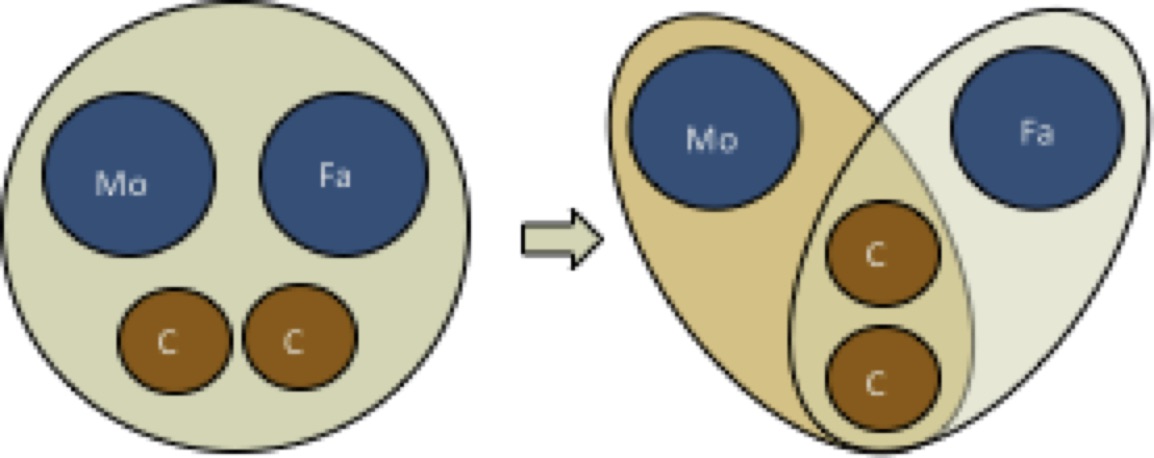
Divorce simply involves a shift in the family structure from an intact-family structure that is united by the marriage, to separated-family-diagramsa new separated-family structure that is now united by the children, through continuing co-parenting duties and by the bonds of shared affection between the children and both parents.

In high-conflict divorce, the family is having difficulty making this transition from an intact family structure united by the marriage to the new separated family united by the children through the ongoing bonds of shared affection between the children and both parents.

The “splitting” pathology of the narcissistic/(borderline) parent cannot accommodate to ambiguity.  In the mind of the narcissistic/(borderline) parent the now ex-spouse must also become an ex-parent as well — the ex-wife must become an ex-mother, the ex-husband must become an ex-father.  This is a neurologically imposed imperative of the splitting pathology of the narcissistic/(borderline) parent.

When the splitting pathology of the narcissistic/(borderline) parent is added to the family systems pathology a cross-generational coalition, the already pathological cross-generational coalition is transmuted into a particularly virulent and malignant form that seeks to entirely terminate the other parent’s relationship with the child.

The pathological parenting of the allied narcissistic/(borderline) parent is forcing the child to choose sides in the inter-spousal conflict surrounding the divorce.  In the mind of the narcissistic/(borderline) parent, achieving full-custody possession of the child represents a “prize to be won” by whichever parent is deemed to be the “better parent” in their spousal-divorce.

However, the child is not a “prize to be awarded” to the supposedly “better parent” – this is an entirely wrong conceptual framework for understanding child custody.

Children benefit from a complex relationship with both parents.  Child custody is not a “competition” between the parents over who is the “better parent” to determine which parent should be awarded the “custody prize” of the child. Children benefit from a complex relationship with both parents.

Except in cases of abusive parenting practices, there is no theoretical or research foundation in professional psychology that would allow us to determine who represents the “better parent.”  Parents differ in their approaches.  That’s okay.  Children love both parents and want the love of both parents in return.  That’s normal.  Children benefit from a complex relationship with both parents.  That’s the reality.

In all cases except child abuse, the recommendation from professional psychology should be for a 50-50% custody time-share. There is no basis in the professional scientific or research literature that would allow professional psychology to differentiate between the potential impact of alternative custody time-share options.

If the parents wish to collaboratively work out a different time-share arrangement, that is their right as parents.  But from a professional psychology perspective, there is no theoretical or research foundation that would allow professional psychology to predict the future in any specific situation and determine the relative outcomes from a 60-40% timeshare as compared to a 70-30% timeshare as compared to an 80-20% timeshare as compared a 50-50% timeshare.  There are too many exceedingly complex variables.

Except in cases of child abuse, the only professionally responsible recommendation for custody time-share from all mental health professionals is for a 50-50% custody time-share based on the foundational principle that children benefit from a complex relationship with both parents.

A child’s rejection of one parent following divorce and the child’s non-compliance with court orders for custody time-share visitation is a treatment-related issue, not a child custody issue. 

Professional psychology should offer the court guidance regarding the treatment needs of the family that are required to help the divorcing family successfully transition from its prior intact-family structure united by the marriage to its new separated-family structure united by the children. 

Problems in the family’s transition from an intact-family structure to a separated-family structure following divorce are a treatment-related issue, not a child custody issue.

The allied narcissistic/(borderline) parent is framing the issues as custody-related because of the false belief that the child represents a “prize” in the spousal conflict, to be awarded to whichever spouse is deemed to be the “better parent.”

This false belief in the “child-as-a-prize” to be awarded to the “better parent” is an oft cited argument by the narcissistic/(borderline) parent in these custody disputes; that the other parent “was not an involved parent” prior to the divorce and so should not have equal time-share with the child following the divorce; or that the other parent is not a “good parent” so they don’t “deserve” to have the child in the post-divorce world.

However, the child is NOT a “prize” to be awarded. 

Children love both parents and want the love of both parents in return.  Children benefit from complex relationships with both parents. 

In all cases except child abuse, custody time-share should be awarded 50-50% unless the parents cooperatively agree to a different alternative time-share agreement.

The reason the treatment-related issues within the family become a custody-related conflict is because the narcissistic/(borderline) parent is trying to “win” complete possession of the child (it is a neurologically imposed imperative of the splitting pathology that the ex-spouse must also become an ex-parent; the ex-wife must become an ex-mother, the ex-husband an ex-father).  

The child represents a narcissistic prize, a symbol of their victory and superiority, and a weapon to “destroy” the “potential enemy” of the ex-spouse.

“The need to control the idealized objects, to use them in attempts to manipulate and exploit the environment and to “destroy potential enemies,” is linked with inordinate pride in the “possession” of these perfect objects totally dedicated to the patient.” (p. 33)

Kernberg, O.F. (1975). Borderline conditions and pathological narcissism. New York: Aronson.

When professional psychology colludes with this false belief that the role of the assessing mental health professional is to determine the “winner” of the “better parent” competition who will then be awarded the “custody prize” of the child, then professional psychology becomes co-opted into the pathology.

Children love both parents and want to be loved by both parents in return.

Children benefit from a complex relationship with both parents.

Helping the family successfully transition from the prior intact-family structure to the new separated-family structure following divorce is a treatment-related issue, not a child custody issue.

Professional assessments should assist the court in determining the treatment-related needs of the family, not determining the “winner” of the “child custody prize” in the spousal “competition” for the child created by the pathology of the narcissistic/(borderline) parent.

What’s Hard to Understand?

For the life of me, I can’t figure out what’s so hard for mental health professionals to understand about all of this?  Granted, the pathology is complex, but its also relatively simple because it is always exactly the same.  Understanding psychopathology is what mental health professionals do for a living.  It shouldn’t be that hard for them to understand since I have defined the attachment-related pathology in detail across multiple levels of analysis:

Family Systems Level:

At the family systems level, the pathology reflects the inability of the family to transition from an intact-family structure to a separated family structure because of the failure of the narcissistic/(borderline) personality structure to process the grief, loss, and sadness surrounding divorce. The child is being triangulated into the spousal conflict through a cross-generational coalition with the allied-fragile parent against the other parent in order to stabilize the family system in its dysfunctional transition to a new separated family structure.

The attachment-related pathology of a child’s rejection of a normal-range and affectionaly available parent following divorce represents the trans-generational transmission of pathological mourning (Bowlby) from the allied narcissistic/(borderline) parent to the child through the formation of a cross-generational coalition (Haley; Minuchin) with the child against the other parent.

Personality Disorder Level – Splitting:

The addition of parental splitting pathology from a narcissistic/(borderline) parent to the cross-generational coalition with the child transmutes an already pathological cross-generational coalition into a particularly virulent and malignant form that seeks to entirely terminate the child’s relationship with the other parent.  

The splitting pathology of the narcissistic/(borderline) personality cannot accommodate to ambiguity.  Following divorce, the ex-husband must also become an ex-father; the ex-wife must also become an ex-mother.  This is a neurologically imposed imperative of the splitting pathology.

Personality Disorder Level – Projective Displacement of Abandonment-Rejection:

The narcissistic/(borderline) parent is triangulating the child into the spousal conflict as a means to stabilize the collapsing personality structure of the narcissistic/(borderline) parent in response to the inherent rejection and abandonment surrounding divorce.  The narcissistic/(borderline) parent is using the child’s induced rejection of the other parent to projectively displace onto the other spouse the core rejection and abandonment fears of the narcissistic/(borderline) parent.

“I’m not the rejected person (spouse) – you are.  I’m not the inadequate person (spouse), you are.  The child is rejecting you because of your inadequacy as a parent (as a person; (spouse) – you’re the inadequate one, not me.  The child is choosing me because I’m the all-wonderful, perfect, and ideal parent (person).  The child will never abandon me.  You’re the abandoned one; you’re the inadequate and rejected person (spouse), not me.”

Attachment System Level

At its deeper substrate in the attachment networks of the allied narcissistic/(borderline) parent, the pathology represents the trans-generational transmission of attachment trauma from the childhood of the narcissistic/(borderline) parent to the current family relationships, mediated by the personality disorder pathology of the parent that is itself a product of this parent’s childhood attachment trauma.

This trans-generational transmission of attachment trauma is in the schema pattern of “abusive parent”/”victimized child”/”protective parent” that is contained in the internal working models of the narcissistic/(borderline) parent’s attachment networks.  It is a false drama – a kabuki theater of display – played out in a false trauma reenactment narrative born in the childhood attachment trauma of the narcissistic/(borderline) parent, a childhood attachment trauma that was responsible for creating the fragile personality structure of the narcissistic/(borderline) parent.

My goodness gracious, how many differing yet interlocking ways, across multiple levels of analysis, do I need to describe the pathology?

Furthermore, I have identified the extensive research literature surrounding the psychological control of the child:

“Psychological control refers to parental behaviors that are intrusive and manipulative of children’s thoughts, feelings, and attachment to parents.” (Barber & Harmon, 2002, p. 15).

The essential impact of psychological control of the child is to violate the self-system of the child.” (Barber & Harmon, 2002, p. 24).

“Rather than telling the child directly what to do or think, as does the behaviorally controlling parent, the psychologically controlling parent uses indirect hints and responds with guilt induction or withdrawal of love if the child refuses to comply.  In short, an intrusive parent strives to manipulate the child’s thoughts and feelings in such a way that the child’s psyche will conform to the parent’s wishes.” (Kerig, 2005, p. 12)

“In order to carve out an island of safety and responsivity in an unpredictable, harsh, and depriving parent-child relationship, children of highly maladaptive parents may become precocious caretakers who are adept at reading the cues and meeting the needs of those around them. The ensuing preoccupied attachment with the parent interferes with the child’s development of important ego functions, such as self organization, affect regulation, and emotional object constancy.” (Kerig, 2005, p. 14)

“Parental psychological control is defined as verbal and nonverbal behaviors that intrude on youth’s emotional and psychological autonomy.” (Stone, Buehler, & Barber, 2002, p. 57)

“The central elements of psychological control are intrusion into the child’s psychological world and self-definition and parental attempts to manipulate the child’s thoughts and feelings through invoking guilt, shame, and anxiety. Psychological control is distinguished from behavioral control in that the parent attempts to control, through the use of criticism, dominance, and anxiety or guilt induction, the youth’s thoughts and feelings rather than the youth’s behavior.” (Stone, Buehler, & Barber, 2002, p. 57)

In his book, Intrusive Parenting: How Psychological Control Affects Children and Adolescents, published by the American Psychological Association, Brian Barber and his colleague, Elizabeth Harmon, identify over 30 empirically validated studies documenting the psychological control of children.

I have also identified the research that links the Dark Triad personality comprised of 1) Narcissistic personality traits, 2) Psychopathic personality traits, and 3) Machiavellian manipulation to,

High-Conflict Patterns of Communication:

Horan, S.M., Guinn, T.D., and Banghart, S. (2015). Understanding relationships among the Dark Triad personality profile and romantic partners’ conflict communication. Communication Quarterly, 63, 156-170.

Seeking Revenge in Intimate Relationships:

Giammarco, E.A. and Vernon, P.A. (2014). Vengeance and the Dark Triad: The role of empathy and perspective taking in trait forgivingness. Personality and Individual Differences, 67, 23–29

Rasmussen, K.R. and Boon, S.D. (2014). Romantic revenge and the Dark Triad: A model of impellance and inhibition. Personality and Individual Differences, 56, 51–56 

Lying, Manipulative Fabrication, and Deception:

Jonason, P.K., Lyons, M. Baughman, H.M., and Vernon, P.A. (2014). What a tangled web we weave: The Dark Triad traits and deception. Personality and Individual Differences, 70, 117–119

Baughman, H.M., Jonason, P.K., Lyons, M., and Vernon, P.A. (2014). Liar liar pants on fire: Cheater strategies linked to the Dark Triad. Personality and Individual Differences, 71, 35–38

The Absence of Empathy:

Jonason, P. K. and Krause, L. (2013). The emotional deficits associated with the Dark Triad traits: Cognitive empathy, affective empathy, and alexithymia. Personality and Individual Differences, 55, 532–537

Wai, M. and Tiliopoulos, N. (2012). The affective and cognitive empathic nature of the dark triad of personality. Personality and Individual Differences, 52, 794–799

And to Attachment-Related Pathology:

Jonason, P.K., Lyons, M., and Bethell, E. (2014). The making of Darth Vader: Parent–child care and the Dark Triad. Personality and Individual Differences, 67, 30–34

I have developed a simple checklist for the documentation of child symptoms that are created by the pathogenic parenting of a narcissistic/(borderline) parent who is transferring this parent’s own disordered mourning to the child:

The Diagnostic Checklist for Pathogenic Parenting

I have developed a simple rating scale for documenting the normal-range or problematic parenting of the targeted-rejected parent:

Parenting Practices Rating Scale

I have developed a simple relationship rating scale for ongoing treatment-related documentation of the child’s symptoms to facilitate evidence-based documentation and treatment:

Parent-Child Relationship Rating Scale

In Foundations I have elaborated, in great detail, an attachment-based description of the pathology from within each of three distinct levels of analysis, 1) the family systems level, 2) the personality disorder level, and 3) the attachment system level, as well as integrating the description across all three levels, with the attachment system level creating the personality disorder level, and the personality disorder level creating the family systems level.  In Foundations, I also describe in detail the distorted relationship-based communication processes by which the child’s rejection of the targeted parent is created.

I have now described a structured Treatment-Focused Assessment Protocol.

Child Protection

At its core, pathogenic parenting is a child protection issue – not a child custody issue.

Pathogenic parenting that is creating significant developmental pathology in the child (diagnostic indicator 1), personality disorder pathology in the child (diagnostic indicator 2), and delusional-psychiatric pathology in the child (diagnostic indicator 3), in order to meet the emotional and psychological needs of the parent represents a DSM-5 diagnosis of V995.51 Child Psychological Abuse, Confirmed.

Assessment leads to diagnosis, diagnosis guides treatment.

Craig Childress, Psy.D.
Clinical Psychologist, PSY 18857

Barber, B. K. (Ed.) (2002). Intrusive parenting: How psychological control affects children and adolescents. Washington, DC: American Psychological Association.

Barber, B. K., & Harmon, E. L. (2002). Violating the self: Parenting psychological control of children and adolescents. In B. K. Barber (Ed.), Intrusive parenting (pp. 15-52). Washington, DC: American Psychological Association.

Kerig, P.K. (2005). Revisiting the construct of boundary dissolution: A multidimensional perspective. Journal of Emotional Abuse, 5, 5-42.

Stone, G., Buehler, C., and Barber, B. K.. (2002) Interparental conflict, parental psychological control, and youth problem behaviors. In B. K. Barber (Ed.), Intrusive parenting: How psychological control affects children and adolescents. Washington, DC.: American Psychological Association.

Assessing for the Dark Triad Personality

Research on personality pathology has identified a set of three co-occurring toxic personality traits that have received the label of the Dark Triad personality because of the severe toxicity of these personalities:

Narcissistic Personality Traits

Psychopathic Personality Traits

Machiavellian Manipulation

A borderline personality variant of the Dark Triad personality has also been identified in the research literature, the Vulnerable Dark Triad, consisting of:

Vulnerable Narcissism

Psychopathic Personality Traits

Borderline Personality Traits

The Dark Triad Personality:

“First cited by Paulhus and Williams (2002), the Dark Triad refers to a set of three distinct but related antisocial personality traits: Machiavellianism, narcissism, and psychopathy.  Each of the Dark Triad traits is associated with feelings of superiority and privilege.  This, coupled with a lack of remorse and empathy, often leads individuals high in these socially malevolent traits to exploit others for their own personal gain.”  (Giammarco & Vernon, 2014, p.  23)

The Vulnerable Dark Triad Personality:

“In the current study, we posit the existence of a second related triad – one that includes personality styles composed of both dark and emotionally vulnerable traits… The members of this putative vulnerable dark triad (VDT) would include (a) Factor 2 psychopathy, (b) vulnerable narcissism, and (c) borderline PD (BPD).” (Miller, Dir, Gentile, Wilson, Pryor, & Campbell, 2010, p. 1530)

Research on the Dark Triad personality has linked it to a particular set of high-conflict styles of communication, referred to in the communication literature as The Four Horseman of conflict communication.  According to Horan, Guinn, and Banghart (2014):

“How individuals communicate during conflict is important, and the previously reviewed studies reinforce that personality is important in understanding this process.  Four conflict messages that have received academic attention are contempt, criticism, stonewalling, and defensiveness.

Contempt involves “statements that come from a relative position of superiority… “You’re an idiot’”;

Criticism entails “stating one’s complaints as a defect in one’s partner’s personality… “You always talk about yourself. You are so selfish’”;

Stonewalling describes “the listener’s withdrawal from interaction;”

“and defensiveness describes self-protection in the form of “righteous indignation or innocent victimhood (Gottman, 1993, p. 62).”

“Collectively, these conflict messages are known as The Four Horsemen.” (Horan, Guinn, & Banghart. 2015, 159; emphasis added)

The research literature has established the existence of the Dark Triad and Vulnerable Dark Triad personalities:

Research has linked the Dark Triad personality to The Four Horsemen of high-conflict communication:

Horan, S.M., Guinn, T.D., and Banghart, S. (2015). Understanding relationships among the Dark Triad personality profile and romantic partners’ conflict communication. Communication Quarterly, 63, 156-170.

To vengefulness in romantic relationships:

Giammarco, E.A. and Vernon, P.A. (2014). Vengeance and the Dark Triad: The role of empathy and perspective taking in trait forgivingness. Personality and Individual Differences, 67, 23–29

Rasmussen, K.R. and Boon, S.D. (2014). Romantic revenge and the Dark Triad: A model of impellance and inhibition. Personality and Individual Differences, 56, 51–56 

To lying and manipulative deception:

Jonason, P.K., Lyons, M. Baughman, H.M., and Vernon, P.A. (2014). What a tangled web we weave: The Dark Triad traits and deception. Personality and Individual Differences, 70, 117–119

Baughman, H.M., Jonason, P.K., Lyons, M., and Vernon, P.A. (2014). Liar liar pants on fire: Cheater strategies linked to the Dark Triad. Personality and Individual Differences, 71, 35–38

To attachment-related pathology:

Jonason, P.K., Lyons, M., and Bethell, E. (2014). The making of Darth Vader: Parent–child care and the Dark Triad. Personality and Individual Differences, 67, 30–34

To the absence of empathy:

Jonason, P. K. and Krause, L. (2013). The emotional deficits associated with the Dark Triad traits: Cognitive empathy, affective empathy, and alexithymia. Personality and Individual Differences, 55, 532–537

Wai, M. and Tiliopoulos, N. (2012). The affective and cognitive empathic nature of the dark triad of personality. Personality and Individual Differences, 52, 794–799

And to the core of evil:

Book, A., Visser, B.A., and Volk, A.A. (2015). Unpacking ‘‘evil’’: Claiming the core of the Dark Triad. Personality and Individual Differences 73 (2015) 29–38.

Given the research-linked association of the Dark Triad personality to high-conflict forms of communication, all court-involved child custody evaluators and court-involved therapists working with families evidencing high-conflict patterns of communication surrounding divorce should assess for the possible presence of the Dark Triad and Vulnerable Dark Triad personality pathology within the family.

Self-report personality assessment measures have been developed to assess for the component personality traits of the Dark Triad personality:

Narcissistic Personality Inventory (NPI; Raskin & Hall, 1979),

Machiavellianism (MACH-IV; Christie & Geis, 1970)

Subclinical psychopathy (Self-Report Psychopathy Scale-III; Williams, Paulhus, & Hare, 2009). 

Self-report measures have also been developed to specifically assess for the Dark Triad personality constellation:

Short Dark Triad (SD3) scale (Jones & Paulhus, 2014). 

Research on the core personality characteristics uniting the Dark Triad personality constellation has also associated the Dark Triad with low scores on scale H (Honesty-Humility) on a prominent personality assessment, the HEXACO Personality Inventory:

Low H scale on HEXACO Personality Inventory (Book, Visser, & Volk, 2015; Lee, & Ashton, 2012). 

The assessment difficulty with all of these self-report scales of the Dark Triad personality is that the Dark Triad personality parent may not accurately self-report on his or her belief systems when there might be negative consequences for this self-disclosure.

An alternative method for potentially identifying the possible presence of the Dark Triad personality within the high-conflict family is to have each parent rate the other parent on these personality pathology scales (such as the SD3).  While this approach runs the counter-risk of a motivated desire by each spouse to present the other spouse in an over-pathologized way, this alternative approach of “informant rating” nevertheless could identify the potential presence of a Dark Triad personality parent which could then be followed-up with additional relevant data collection through clinical interviewing by asking each parent to provide specific examples of the other parent’s personality trait.

What is important – what is essential – given the evidence-based association of the Dark Triad personality with The Four Horsemen of high-conflict communication is:

1.)  The essential importance of professional expertise in assessing and identifying the Dark Triad and Vulnerable Dark Triad personalities in high-conflict families surrounding divorce;

2.)  The essential importance of court-involved child custody evaluators and court-involved therapists to conduct a proper assessment for the potential presence of the Dark Triad and Vulnerable Dark Triad personalities in ALL cases of high-conflict divorce.

In cases of attachment-related pathology surrounding divorce, in which a child is rejecting a relationship with a parent, this assessment for the Dark Triad and Vulnerable Dark Triad personality should be in addition to the recommended assessment protocol for attachment-related pathology surrounding divorce (Assessment Protocol):

Assessment leads to diagnosis, diagnosis guides treatment.

Professional Competence

All psychologists are required by Standard 9.01a of ethics code of the American Psychological Association to conduct an assessment sufficient to “substantiate their findings”:

9.01 Bases for Assessments
(a) Psychologists base the opinions contained in their recommendations, reports and diagnostic or evaluative statements, including forensic testimony, on information and techniques sufficient to substantiate their findings.

If the mental health professional has NOT assessed for the pathology of pathogenic parenting and has NOT assessed for the possible presence of the Dark Triad and Vulnerable Dark Triad personality as potentially causing the high-conflict relationships within the family, then this mental health professional has NOT based their diagnostic or evaluative statements, including forensic testimony, on “information and techniques sufficient to substantiate their findings,” and they are therefore likely in violation of Standard 9.01a of the APA ethics code.

Children and families evidencing attachment-related pathology surrounding high-conflict divorce warrant the professional designation as a “special population” requiring specialized professional knowledge and expertise to competently assess, diagnose, and treat. The domains of relevant pathology needed to competently assess, diagnose, and treat this special population of children and families are:

  • Attachment-Related Pathology:  Including disordered mourning, goal-corrected motivation, insecure attachment characteristics, and the the trans-generational transmission of attachment trauma;
  • Personality Disorder Pathology:  Including the Dark Triad and Vulnerable Dark Triad personality pathology, and the negative influence of parental personality disorder pathology within family relationships surrounding divorce (including role-reversal relationships, psychological boundary violations, and use of the child as a “regulatory object” to stabilize the parent’s emotional and psychological state);
  • Family Systems Pathology:  Including triangulation, cross-generational coalitions, homeostatic balance, and emotional cutoffs;
  • Trauma Pathology:  Including the effects of child abuse and domestic violence.

Failure to possess the necessary professional knowledge and expertise to competently assess, diagnose, and treat this special population of children and families may represent a violation of Standard 2.01a of the APA ethics code requiring professional competence:

2.01 Boundaries of Competence
(a) Psychologists provide services, teach and conduct research with populations and in areas only within the boundaries of their competence, based on their education, training, supervised experience, consultation, study or professional experience.

If emotional and psychological harm then befalls the child or parent as a result of the mental health professional’s violation of Standards 9.01a and 2.01a of the APA ethics code, then this may represent an additional violation of Standard 3.04 of the APA ethics code prohibiting harm to the client:

3.04 Avoiding Harm
(a) Psychologists take reasonable steps to avoid harming their clients/patients, students, supervisees, research participants, organizational clients, and others with whom they work, and to minimize harm where it is foreseeable and unavoidable. 

Assessment leads to diagnosis, diagnosis guides treatment. Mental health professionals are expected to conduct an appropriate assessment that leads to diagnosis in order to guide treatment.

Craig Childress, Psy.D.
Psychologists, PSY 18857

References


Horan, S.M., Guinn, T.D., and Banghart, S. (2015). Understanding relationships among the Dark Triad personality profile and romantic partners’ conflict communication. Communication Quarterly, 63, 156-170.


Baughman, H.M., Jonason, P.K., Lyons, M., and Vernon, P.A. (2014). Liar liar pants on fire: Cheater strategies linked to the Dark Triad. Personality and Individual Differences, 71, 35–38.

Book, A., Visser, B.A., and Volk, A.A. (2015). Unpacking ‘‘evil’’: Claiming the core of the Dark Triad. Personality and Individual Differences 73 (2015) 29–38.

Christie, R. C., & Geis, F. L. (1970). Studies in Machiavellianism. New York: Academic Press.

Giammarco, E.A. and Vernon, P.A. (2014). Vengeance and the Dark Triad: The role of empathy and perspective taking in trait forgivingness. Personality and Individual Differences, 67, 23–29.

Jonason, P. K. and Krause, L. (2013). The emotional deficits associated with the Dark Triad traits: Cognitive empathy, affective empathy, and alexithymia. Personality and Individual Differences, 55, 532–537.

Jonason, P.K., Lyons, M. Baughman, H.M., and Vernon, P.A. (2014). What a tangled web we weave: The Dark Triad traits and deception. Personality and Individual Differences, 70, 117–119.

Jonason, P.K., Lyons, M., and Bethell, E. (2014). The making of Darth Vader: Parent–child care and the Dark Triad. Personality and Individual Differences, 67, 30–34

Jones, D.N. and Paulhus, D.L. (2014). Introducing the Short Dark Triad (SD3): A Brief measure of dark personality traits. Assessment, 21, 28-41.

Lee, K., and Ashton, M. C. (2012). The H factor of personality: Why some people are manipulative, self-entitled, materialistic, and exploitative —and why it matters for everyone. Waterloo, Canada: Wilfrid Laurier University Press.

Miller, J.D., Dir, A., Gentile, B., Wilson, L., Pryor, L.R., and Campbell, W.K. (2010). Searching for a Vulnerable Dark Triad: Comparing Factor 2 psychopathy, vulnerable narcissism, and borderline personality disorder. Journal of Personality, 78, 1529-1564.

Paulhus, D. L., & Williams, K. M. (2002). The dark triad of personality: Narcissism, Machiavellianism, and psychopathy. Journal of Research in Personality, 36, 556–563.

Raskin, R. N. and Hall, C. S. (1981). The narcissistic personality inventory: alternative form reliability and further evidence of construct validity. Journal of Personality Assessment, 45, 159–162.

Rasmussen, K.R. and Boon, S.D. (2014). Romantic revenge and the Dark Triad: A model of impellance and inhibition. Personality and Individual Differences, 56, 51–56. 

Wai, M. and Tiliopoulos, N. (2012). The affective and cognitive empathic nature of the dark triad of personality. Personality and Individual Differences, 52, 794–799.

Williams, K. M., Paulhus, D. L., & Hare, R. D. (2007). Capturing the four-factor structure of psychopathy in college students via self-report. Journal of Personality Assessment, 88, 205-219.

Professional-to Professional Consultation: Assessment Protocol

I recently completed a professional-to-professional Skype Consultation with a psychologist, and I wrote the psychologist a follow-up email providing assessment-protocol resources. I thought this email follow-up with resources might be more broadly helpful, so I am making it available here on my blog as well.

The psychologist with whom I consulted appeared to absolutely get it.  She indicated that she will be making the DSM-5 diagnosis of V995.51 Child Psychological Abuse, Confirmed and will be filing a suspected child abuse report with CPS.  She also indicated that she is likely to be terminating therapy under Standard of 10.10 of the APA ethics code which requires that therapy be terminated if it is likely to be harmful to the child (making the child a “psychological battleground” between the goals of therapy to restore the child’s normal-range development, and the countervailing goals and pressure placed on the child by the allied narcissistic/(borderline) parent to create and maintain the child’s symptomatology), or terminating therapy if the therapy is not likely to be effective. 

This psychologist indicated that she intends to write a discharge summary with this DSM-5 diagnosis and the decision to terminate therapy under Standard 10.10 of the APA ethics code until a protective separation of the child from the psychologically abusive allied parent is enacted that will allow therapy to proceed without harming the child because of the countervailing pressures placed on the child by the allied narcissistic/(borderline) parent for the child to remain symptomatic.

Is CPS likely to do anything?  Probably not.  Will the Court issue an order for a protective separation period from the psychologically abusive parent that will allow therapy to restore the child’s normal-range development while not simultaneously turning the child into a “psychological battleground” between the goals of therapy and the countervailing goals of the narcissistic/(borderline) parent to create and maintain the child’s symptomatic rejection of the other parent?  Who knows.

But this is absolutely the correct professional course of action in cases of AB-PA.   The pathology of AB-PA is a child protection issue, not a child custody issue.  Assessment leads to diagnosis, and diagnosis guides treatment.

All mental health professionals have an ethical obligation under Standard 10.10 of the APA ethics code to terminate therapy that is either harmful to the client (the “psychological battleground” issue), or when therapy is not likely to be effective (therapy that does not seek change but that simply colludes with the continuation of the pathology).

If all mental health professionals follow their professional standards of practice and decline to treat without the necessary protective separation of the child from the psychologically abusive parent, this will clearly communicate to the legal system what is needed.  Declining to treat AB-PA without first obtaining the necessary protective separation of the child from the psychologically abusive parent (a DSM-5 diagnosis of V995.51 Child Psychological Abuse, Confirmed) is the ethical obligation of all psychologists under Standard 10.10 of the APA ethics code.

Pathogenic parenting that is creating significant developmental pathology in the child (diagnostic indicator 1), personality disorder pathology in the child (diagnostic indicator 2), and delusional-psychiatric pathology in the child (diagnostic indicator 3) in order to meet the emotional and psychological needs of the parent represents a DSM-5 diagnosis of V995.51 Child Psychological Abuse, Confirmed.

Pathogenic parenting is not a child custody issue; it is a child protection issue.

The following is my email follow-up after a professional-to-professional consultation.  In this follow-up email I provide the psychologist with my recommended resources for a standard-of-practice assessment in all cases of attachment-related pathology surrounding divorce:


Hello Dr. <name>

It was a pleasure to speak with you the other day. I am attaching some assessment resources that you may find helpful.

The first is a Diagnostic Checklist for Pathogenic Parenting (this is also available on my website) that identifies the symptoms we discussed. I typically recommend that therapists complete this brief checklist and place it in the patient record as documentation of the child’s symptoms of concern. Once the symptoms are documented, mental health professionals can then rely on the support provided through my book An Attachment-Based Model of Parental Alienation: Foundations for the diagnosis of the pathology.

I am also including a companion piece for the Diagnostic Checklist for Pathogenic Parenting, Chapter 4 from my book Essays that describes the three diagnostic indicators and the 12 Associated Clinical Signs.

I am also attaching a related measure that I recommend as part of a standard assessment protocol for attachment-related pathology surrounding divorce, the Parenting Practices Rating Scale. This is a brief rating scale of therapist determinations regarding the parenting practices of the targeted-rejected parent (although it can also be applied to the parenting of the allied parent if there is sufficient information on which to make these ratings).

The role of the Parenting Practices Rating Scale is to document the broadly normal-range parenting of the targeted parent (Levels 3 and 4; a Permissive to Authoritarian Dimension Rating of 25-75). It can also be used as a treatment-related tool for discussion with the targeted parent to identify areas of parenting concern.

A third potential instrument in the treatment of attachment-related pathology surrounding divorce is the Parent-Child Relationship Rating Scale used by the targeted parent to document daily relationship quality with the child. Collaboratively completing the Parent-Child Relationship Rating Scale during joint parent-child sessions can also be used as a treatment-related tool in these parent-child sessions as a discussion prompt regarding their relationship by seeking to reach consensus on relationship quality over the intervening period between sessions.

I have modified the Parent-Child Relationship Rating Scale (attached) to include a 5th item on the rating scale of Texting & Phone Call Cooperation (Parent-Child Relationship Rating Scale – Texting Modification) based on what we discussed regarding the child’s excessive texting and phone contact with the allied parent when the child is with the targeted parent.

Best wishes

Craig Childress, Psy.D.
Psychologist, PSY 18857

Why is AB-PA vs PAS Important?

Why is the dispute between the AB-PA model and the PAS model important?

It has to do with which set of diagnostic indicators is used in diagnosing the pathology.  This is key – this is fundamental – to the solution.

Gardnerian PAS provides a set of eight symptom identifiers that do not lead to the solution.  They are too vague and they allow mental health professionals too much latitude to NOT diagnose the pathology.   Furthermore, the Gardnerian 8 symptoms do NOT lead to a definition of “parental alienation” as psychological child abuse.

For thirty years we’ve been using the Gardnerian 8 symptom identifiers (or some variant of them) and they have given us precisely the situation we have right now – no solution.

When I set out a decade ago to create the solution (I’ve been working on the solution for 10 years – I didn’t just begin my work on this), I first analyzed in detail what the problem was.  I then set about constructing the solution to the problem.

The response of the mental health system to this form of attachment-related pathology is broken. As a result, the mental health system is not giving accurate feedback to the legal system that would allow the legal system to act with the decisive clarity necessary to solve this form of attachment-related pathology in the family (a protective separation period of the child from the pathogenic parenting of the narcissistic/(borderline) parent during the active phase of the child’s treatment and recovery).

The reason the mental health system is broken is because of profound and extensive professional incompetence in assessing, diagnosing, and treating this form of attachment-related, personality disorder, and family systems pathology.  In order to achieve a solution, we must first clear out the extensive professional incompetence surrounding the assessment and diagnosis of this pathology, and reestablish professional standards of practice for professional competence in the assessment, diagnosis, and treatment of this attachment-related family pathology.

Gardnerian PAS Allows Incompetence

Why is there such rampant professional incompetence?  Because Gardnerian PAS allows it. That is important to understand.

By proposing that the attachment-related pathology of “parental alienation” is a “new form of pathology,” unique in all of mental health – a new syndrome – Gardnerian PAS does not rely on established constructs and principles to define domains of professional competence necessary for the assessment, diagnosis, and treatment of the pathology.

The Gardnerian PAS model allows professional incompetence.  Don’t believe me?  I could explain in detail why this is, but I have a much simpler way to show how Garnerian PAS allows professional incompetence to thrive.  For thirty years – 30 years – we’ve had the Gardnerian PAS model.  Look at the degree of professional incompetence that surrounds us.  I rest my case.  Gardnerian PAS allows professional incompetence.

Among sports fans there is an airtight argument to shut-down shoulda-woulda-coulda arguments following games… Scoreboard.  Which means look at the scoreboard and see who won and who lost.  Gardnerian PAS.  Thirty years – 30 years.  Scoreboard. 

Gardnerian PAS is a failed paradigm.

The solution is to re-define the attachment-related pathology of “parental alienation” using standard and established constructs and principles of professional psychology that will then allow us to define domains of professional competence to which ALL mental health professionals can be held accountable.

Once the pathology is defined using standard and established constructs and principles, we can then identify a set of definitive diagnostic indicators from within these established constructs and principles that can be used to definitively diagnose “parental alienation” 100% of the time, and we can then develop a standard of practice assessment protocol to which ALL mental health professionals can be held accountable.

So that’s what I set about doing.

AB-PA is the result.  AB-PA provides a definition of the attachment-related, personality disorder related, family systems pathology of “parental alienation” from entirely within standard and established constructs and principles, that then defines domains of professional competence required for ALL mental health professionals who are assessing, diagnosing, and treating this form of attachment-related, personality disorder related, family systems pathology.

What’s more – and this is key – a set of 3 definitive diagnostic indicators of the pathology are derived from AB-PA that can be used to establish a standard of practice for ALL mental health professionals in the assessment and diagnosis of the pathology.  Solution.

No other pathology in all of mental health will produce this specific set of all three diagnostic indicators other than the attachment-related, personality disorder related, family systems pathology I describe in Foundations.

Since AB-PA is based entirely within standard and established constructs and principles, all mental health professionals can now be held ACCOUNTABLE under standards for professional competence (Standard 2.01a of the APA ethics code), and all psychologists MUST ASSESS for the attachment-related pathology of AB-PA under standards for professional competence (Standard 9.01a of the APA ethics code regarding Assessment).

They do not have a choice.  This, too, is critical to understand… they do not have a choice.  If they fail to assess for the attachment-related pathology of AB-PA in cases of attachment pathology surrounding divorce, or if they fail to possess the required domains of knowledge necessary for professional competence, then they are in violation of APA ethical code Standards and are vulnerable to licensing board complaints.  Accountability for professional competence.

Gardnerian PAS does not allow us to hold mental health professionals accountable.  Again, don’t believe me?  Let me explain.  In Gardnerinan PAS we’re trying to hold them accountable for professional competence in Gardnerian PAS, with its slippery 8 diagnostic indicators and mild-moderate-severe forms of a supposedly unique new form of pathology unrelated to any other pathology in all of mental health.  That’s impossible to do.  Just look around you and you see the result.

They maybe-kind-of make the diagnosis of “parental alienation” sometimes, but not always, and not definitively, and then even if they say there’s “parental alienation” they don’t know what to do about it and they recommend “reunification therapy” that goes on for years with no result.  That’s all a product of Gardnerian PAS.  Scoreboard.

For thirty years – 30 years – we’ve had the Gardnerian PAS model.  Look at the degree of professional incompetence that surrounds us.  I rest my case.  Gardnerian PAS allows professional incompetence.  We cannot hold mental health professionals accountable to be experts in Gardnerian PAS.  As much as we may wish we could… we can’t.  It is not possible.  30 years.  Scoreboard.  Done.  Let’s move on.

Q:  But doesn’t establishment psychology have to first accept AB-PA as a model for the pathology?

A:  No.  And this is important to understand.  Establishment psychology has ALREADY accepted the constructs of the attachment system, personality disorder pathology, and family systems pathology.  There is NOTHING for establishment psychology to accept or reject.  All of the component pathologies of AB-PA have ALREADY been accepted.

That’s the whole point of defining the pathology using standard and established constructs and principles (a procedure called “Diagnosis”).

Gardner didn’t do a proper diagnosis of the pathology.  Instead, he opted for a conceptually lazy way out by proposing an entirely new form of pathology with a set of entirely new and unique symptom identifiers unlike any other pathology in all of mental health.  That’s just bad diagnosis.

The “we need to be accepted” way of thinking is a false Gardnerian PAS way of thinking born in Gardner’s proposal of a “new form of pathology.”  Everyone is living in a dream created by Gardner’s “new form of pathology.”  Wake UP!  There is NO new form of pathology.  All we have to do is properly diagnose the pathology using standard and established constructs and principles of professional psychology.

Wake UP!  There is no “new form of pathology.”  Wake UP!

If we are proposing a “new form of pathology” – a new syndrome – then, yes, this proposal for a “new form of pathology” needs to be accepted.  But AB-PA is NOT proposing a new form of pathology.

Get it?   Break free of Gardnerian thinking.  There is NOTHING for establishment psychology to accept or reject.  It’s simply a matter of obtaining an accurate diagnosis of the attachment-related pathology from within standard and fully established forms of existing pathologies within mental health.

Wake UP!  It’s just a matter of diagnosis.  No new pathology.  Just diagnosis – using standard and established, fully accepted constructs and principles of professional psychology.  Diagnosis.

When Gardner skipped the step of diagnosis he took everyone off the path of professional psychology and led everyone into the weeds, and brambles, and overgrowth that we’ve been slogging through for 30 years. 

Diagnosis is the application of standard and established constructs and principles to a set of symptoms.  In proposing a “new form of pathology,” Gardner skipped the step of diagnosis, and in doing so he led everyone down the wrong path, a path away from professional standards of practice and into a world of professional incompetence. 

AB-PA puts us back on the path of correct and proper professional practice; the diagnosis of pathology using standard and established constructs and principles.  NO “new form of pathology” proposals involving eight uniquely created new symptoms developed specifically for this supposedly “unique new form” of pathology.

Stop it!  There is no new form of pathology unique in all of mental health.  It’s just a matter of properly diagnosing the pathology using standard and established constructs and principles of professional psychology.  

AB-PA corrects Gardner’s diagnostic sloppiness.  This pathology is NOT a “new form of pathology.”  Gardner simply did not employ the necessary professional rigor to properly diagnose the pathology using standard and established constructs and principles.  AB-PA corrects Gardner’s diagnostic error.  AB-PA diagnoses the pathology by applying standard and established constructs and principles to a set of symptoms.  Because AB-PA is NOT proposing a “new form of pathology,” there is NOTHING for establishment psychology to accept or reject because everything has ALREADY been accepted.

Get it?  Wake UP!  Break free of the conceptual limitations imposed by thirty years of Gardnerian PAS.  There is NOTHING to accept or reject.  All of the component pathologies of AB-PA have already been accepted.  Through AB-PA, all mental health professionals can now be held ACCOUNTABLE for domains of knowledge necessary for professional competence and, most importantly, for an established standard of practice in the assessment of the pathology – the three diagnostic indicators that definitively identify this form of attachment-related, personality disorder related, family systems pathology.

Standard of Practice

Once we achieve the paradigm shift from the Gardnerian PAS model to the attachment-related model of AB-PA , ALL mental health professionals MUST administer the Diagnostic Checklist for Pathogenic Parenting in all cases of attachment-related pathology surrounding divorce.  Not because I say so, or because we ask them to.  They must do it as a matter of professional competence in attachment-related pathology, personality disorder pathology, and family systems pathology surrounding this form of attachment-related, personality disorder, and family systems pathology.

The only thing standing in the way is that they don’t yet know that a second model of AB-PA exists.

We cannot force mental health professionals to be competent in “parental alienation.”  We CAN, however, force them to be competent in the attachment system, and we CAN force them to be competent in personality disorder pathology, IF – IF – we define the pathology ENTIRELY in terms of the attachment system and personality disorder pathology.  Get it?

The paradigm shift to AB-PA will achieve a defined standard of practice in the assessment and diagnosis of “parental alienation,” and will achieve a defined standard of practice in the required domains of knowledge (attachment system expertise, personality disorder expertise, family systems expertise, trauma expertise) necessary for professional competence in assessing, diagnosing, and treating this pathology.  We get rid of professional incompetence.  Ta-da.

But what Happens to Gardnerian PAS?

Notice, that NONE of these domains of required professional competence (the attachment system, personality disorder pathology, family systems constructs, and trauma), include expertise in Garderian PAS.  Can you see now why the Gardnerian PAS experts are so resistant to the change to AB-PA?  They are fighting for their own status as “experts.” 

Once the paradigm shift occurs, it won’t be enough simply to be a self-proclaimed expert in Gardner’s eight unique symptom identifiers of PAS, they will actually have to expand their knowledge and become experts in the attachment system, experts in personality disorder pathology, experts in family systems theory, and experts in trauma.  There will be no such thing as “parental alienation” from a professional point of view. 

From a professional point of view, the construct of “parental alienation” disappears and becomes the attachment-related pathology of pathological mourning manifesting in pathogenic parenting by an allied parent in a cross-generational coalition with the child.  Notice I didn’t use the term “parental alienation” in any of that definition of the pathology.  I used only defined and fully established constructs in professional psychology.

The Gardnerian PAS experts hate me because I am taking away their domain of expertise. They just want AB-PA to go away.  They don’t even want to acknowledge that AB-PA exists because the mere existence of an attachment-based definition of the pathology using standard and established constructs and principles takes away their domain of expertise.

If they had the chance, I am certain that they would like to destroy me and destroy AB-PA.  Not a doubt in my mind.  Luckily for me, they can’t do it because I’m standing on the rock-solid Foundations of established psychological principles and constructs of professional psychology.  So they are left merely to fume and fluster in their desire to destroy me and negate AB-PA.

But make no mistake, they hate me.  They do not want AB-PA to become the standard of practice because they are desperately trying to hold on to their relevance as “experts.”  That’s the back-story on all of this AB-PA versus PAS controversy.  That’s why Dr. Bernet wrote an essay entitled, “Old Wine in Old Skins” trying to make the argument that AB-PA is just a version of PAS.  They don’t want to acknowledge that there is a new model for the pathology that takes away their “expert” status. 

That’s why Amy Baker and the Gardnerians produced a set of Guidelines for how to determine a “bona fide parental alienation expert.”  They feel threatened that their status as “experts” is being imperiled by me through AB-PA, so they are trying to reassert that they are the “bona fide” experts in “parental alienation” (unlike this upstart, Dr. Childress and his AB-PA model).  That’s the back-story on all of this.

And that’s why Linda Gottlieb wrote her article-essay thingy claiming that “Science Discovers PAS and Declares it to be Psychological Child Abuse” in which she made such a prominent point of saying what a great “scientist” Richard Gardner was, and how an “overwhelming consensus” of “parental alienation” experts accept Gardner’s 8 symptom identifiers.  That’ the back-story on what they’re trying to do. They are desperately trying to nullify AB-PA in order to hold on to their positions as experts in “parental alienation.”

Do you want evidence of this?  How many times do they reference me or AB-PA in their professional work?  Zero.  I am like Lord Voldemort to them; he-who-shall-not-be-named. 

There are four major scientific advances to be found in AB-PA:

  • Linking the pathology to the disorganized attachment of the “alienating” parent – which is then linked to the narcissistic and borderline personality pathology in the parent.  This is a huge conceptual advance with profound implications.  Yet they ignore even mentioning it.
  • The trans-generational transmission of attachment trauma through a false trauma reenactment narrative of “abusive parent”/”victimized child”/”protective parent.”  Again, this is a huge conceptual advance in it’s explanatory capability for the false allegations of abuse.  Yet they ignore even mentioning it.
  • The induction process is NOT through “badmouthing” the other parent, it is through manipulating the child into adopting the false trauma reenactment role as the “victimized child” in the trauma reenactment narrative.  Again, this is a huge conceptual advance in explaining how the pathology is produced in the child and in explaining the presence of the encapsulated persecutory delusion (diagnostic indicator 3) in the child.  Yet they ignore even mentioning it.
  • The neurologically-based description of the addition of spitting pathology to the cross-generational coalition that leads to a neurologically imposed imperative for the narcissistic/(borderline) parent to make the ex-spouse an ex-parent.  The ex-husband MUST become an ex-father, the ex-wife MUST become an ex-mother.  This is a neurologically imposed imperative of the splitting pathology.  This is huge.  Yet they ignore even mentioning it.

These are four major scientific advances in our understanding of the “parental alienation” pathology found in AB-PA.  Major conceptual advances.  And they are all completely ignored by the Gardnerian PAS experts as if they didn’t even exist.   I am their Lord Voldemort – he-who-shall-not-be-named.

Why don’t they want to discuss these major advances in defining the pathology?  Because they just want AB-PA to go away.  Dr. Bernet, in his “Old Wine in Old Skins” article even overtly said that there was nothing new in AB-PA.  It was just a version of PAS.  What?  That’s absurd.  Dr. Bernet and the Gardnerian PAS experts want AB-PA to go away.  They want to bury it so it never sees the light of day.  That is why I am he-who-cannot-be-named.  The mere mention of me or AB-PA gives life to AB-PA, and they desperately want AB-PA to just die in obscurity.

The Gardnerian PAS “experts” are no allies.

Diagnostic Indicators

But the issue is NOT which model defines the pathology – the issue is which set of diagnostic indicators is used to diagnose the pathology:

The 3 definitive diagnostic indicators of AB-PA, or

The 8 symptom indicators of Gardnerian PAS

THAT is the question. 

Since the three diagnostic indicators of AB-PA are grounded in the Foundations of established and fully accepted psychological principles and constructs, we can now hold ALL mental health professionals accountable to an established standard of practice in the assessment and diagnosis of this form of attachment-related pathology.

The use of the Gardnerian 8 symptom indicators of PAS, on the other hand, give us exactly the situation we have right now.  For thirty years we’ve been using the Gardnerian 8 symptoms of PAS and this is what they have given us – no solution whatsoever.  The Gardnerian 8 symptoms ALLOW professional incompetence.

Again, don’t believe me?  One word: Scoreboard. 

30 years.  No solution.  Rampant professional incompetence. Scoreboard.

It’s not just about which model is used to define the pathology, it’s about which set of diagnostic indicators are used to diagnose it. 

So here is another vital point to understand:

When we re-frame the pathology away from the construct of “parental alienation” that is used in Gardnerian PAS, over to the construct of pathogenic parenting used in AB-PA, look what happens:

Pathogenic parenting that is creating significant developmental pathology in the child (diagnostic indicator 1), personality pathology in the child (diagnostic indicator 2), and delusional-psychiatric pathology in the child (diagnostic indicator 3) in order to meet the emotional and psychological needs of the parent represents a DSM-5 diagnosis of V995.51 Child Psychological Abuse, Confirmed.

There.  Right there.  That is the solution.  See it?

The AB-PA definition of the pathology leads to the 3 diagnostic indicators, which then leads directly to the DSM-5 diagnosis of V995.51 Child Psychological Abuse, Confirmed.

There.  Right there.  That is the solution.

But in order to achieve this solution, we must switch from the Gardnerian definition of the pathology and its 8 symptom identifiers over to the AB-PA definition of the pathology and its 3 diagnostic indicators. Get it?

Adding Descriptions

If the Gardnerians wish to add Gardnerian PAS to AB-PA, that’s fine by me.  Just SWITCH to the three diagnostic indicators of AB-PA so we can get the DSM-5 diagnosis of V995.51 Child Psychological Abuse, Confirmed that is available through AB-PA. 

My goodness, if they want to add a theory that “alienating parents” are products of Atlantis created by ancient aliens, fine by me… Just SWITCH to the three diagnostic indicators of AB-PA so we can get the DSM-5 diagnosis of V995.51 Child Psychological Abuse, Confirmed.

One critique I sometimes hear is that AB-PA doesn’t address mild and moderate cases.  So what.  Let’s solve the severe cases and then we can solve the mild and moderate cases.  Holy cow people.  You’re going to wait on solving the severe cases until we also solve the mild and moderate cases?  That’s absurd.  Besides, the mild and moderate cases are just standard cross-generational coalitions without the addition of parental personality disorder pathology.  Easy-peasy.

Ahhh, but there’s a problem for the Gardnerians in switching to the three diagnostic indicators of AB-PA.  The three diagnostic indicators are ONLY available through the AB-PA model.  They’re not available through the PAS model.  So while they can ADD the PAS model to AB-PA, they nevertheless have to accept the AB-PA model in order to get the three diagnostic indicators that define the pathology as a DSM-5 diagnosis of V995.51, Child Psychological Abuse, Confirmed. 

And the moment they accept the AB-PA model, the domains of expertise switch to the attachment system and personality disorder pathology, not Gardnerian PAS, and since they are only experts in Gardnerian PAS they immediately cease to be experts.  Wow.  Now that’s a problem for them.  If they switch to the three diagnostic indicators of AB-PA, then they immediately cease to be experts in “parental alienation” because they have to accept an AB-PA model in which the construct of “parental alienation” disappears into standard and established constructs and principles.

Quite the professional dilemma for them.  What will they do?  That’s been the question they’ve been facing for several years now.  I’ve known it, and they’ve know it.  I provided ample opportunity for them to join me in enacting the solution.  They’ve had ample opportunity to switch to the three diagnostic indicators of AB-PA that immediately – immediately – provide the DSM-5 diagnosis of V995.51 Child Psychological Abuse, Confirmed.

But what is their choice?  None of them has switched to the three diagnostic indicators of AB-PA, none of them even acknowledges that AB-PA exists, and most recently Linda Gottlieb creates an article-essay thingy falsely claiming that “Science Discovers PAS and Declares it Psychological Child Abuse.”

They are trying to co-opt the claim that PAS is Psychological Child Abuse.  That would be fine if it were true.  But it’s not.  It’s a lie.  Science has not “discovered” PAS.  That’s absurd.  30 years.  Nor has science declared that PAS is psychological child abuse.  That is simply false.  It is a lie.

So why did Linda Gottlieb say this?  Because they are threatened by the fact – the true fact – that the three diagnostic indicators of AB-PA lead directly to a DSM-5 diagnosis of V995.51 Child Psychological Abuse Confirmed.

Pathogenic parenting that is creating significant developmental pathology in the child (diagnostic indicator 1), personality pathology in the child (diagnostic indicator 2), and delusional-psychiatric pathology in the child (diagnostic indicator 3) in order to meet the emotional and psychological needs of the parent represents a DSM-5 diagnosis of V995.51 Child Psychological Abuse, Confirmed.

If they adopt the three diagnostic indicators of AB-PA then they cease to be experts in “parental alienation.” So what do they do?  They make up a lie that PAS also leads to a diagnosis of Child Psychological Abuse.  It doesn’t.

They have decided they would rather try to remain experts in “parental alienation” than switch to the three diagnostic indicators of AB-PA that provide an immediate DSM-5 diagnosis of V995.51 Child Psychological Abuse.  That’s the relevance (and backstory) of Ms. Gottlieb’s recent article-essay thing in which she claims that “Science Discovers PAS and Declares it to be Psychological Child Abuse.”  They’ve decided to try to find some way of making PAS be a DSM-5 diagnosis of child abuse because come hell or high water, they will NOT adopt AB-PA which provides an immediate DSM-5 diagnosis of V995.51 Child Psychological Abuse, Confirmed.

But here’s the problem with what Ms. Gottlieb did.  In making the false claim that science declares PAS to be Psychological Child Abuse (as if wishing made it so), Ms. Gottlieb muddies the waters with regard to establishment mental health.  Establishment psychology hears something like that and says that’s ridiculous. 

Establishment Psychology: “There go those “parental alienation” crackpots again, making false claims that science has declared “parental alienation” to be psychological child abuse.”

Then, when we present to establishment mental health the true diagnosis, that the three diagnostic indicators of AB-PA are a DSM-5 diagnosis of V995.51 Child Psychological Abuse, we will be dismissed as just making the false PAS claim.  So it will take us an additional year or longer to clear up the confusion caused by Ms. Gottlieb, requiring us to explain to establishment psychology that AB-PA is not PAS, and that the claim of AB-PA is true, whereas the other claim regarding PAS is false.  In writing her article-essay thingy making the false claim that science declares PAS is Child Psychological Abuse, Ms. Gottlieb threatens to delay the solution to “parental alienation” by a year or more by muddying the waters with false claims.

All so that the Gardnerians can try to remain relevant and hold on to their self-assigned roles as “experts” in “parental alienation.”

That is the back-story.

Pathogenic parenting that is creating significant developmental pathology in the child (diagnostic indicator 1), personality pathology in the child (diagnostic indicator 2), and delusional psychiatric pathology in the child (diagnostic indicator 3) in order to meet the emotional and psychological needs of the parent represents a DSM-5 diagnosis of V995.51 Child Psychological Abuse, Confirmed.

Right there.  That is the solution.  But it is only available through the three diagnostic indicators of AB-PA.

Why is AB-PA / PAS Important?

The solution to the attachment-related pathology of “parental alienation” is found in the set of diagnostic indicators we use to diagnose the pathology.  THAT’s why the debate surrounding which model is adopted is critical.  It’s not about how many angels can dance on the head of a pin, it’s about which set of diagnostic indicators are we using to diagnose the pathology.

Because AB-PA is based entirely within established constructs and principles of professional psychology, we can hold ALL mental health professionals ACCOUNTABLE (using established ethical Standards for professional competence) regarding their assessment and diagnosis of the standard and established forms of attachment-related and personality disorder related family pathology.

In proposing a “new form of pathology” – a new syndrome – Gardner took everyone away from established standards of practice in professional psychology – specifically the established professional practice standard for professional diagnosis (the application of established and accepted constructs and principles of professional psychology to a set of symptoms.).

AB-PA leads us out of the brambles and overgrowth and returns us BACK to the proper path of professional psychology.

Assessment leads to diagnosis.  Diagnosis guides treatment.

A proper assessment of the pathology using the three diagnostic indicators of AB-PA will lead us directly to a proper DSM-5 diagnosis of V995.51 Child Psychological Abuse, Confirmed.

Simple.  There is the solution.  Right there.  And this solution is available immediately. Right now.  Today.  This instant.

I don’t care if the Gardnerians ADD Gardnerian PAS to AB-PA, or add ancient alien theories, or theories that link “parental alienation” to a race of underground reptoids.  It doesn’t matter to me one bit.  Just switch to the three diagnostic indicators of AB-PA that immediately give us – every targeted parent and every mental health professional working with this form of attachment-related pathology – the immediate DSM-5 diagnosis of V995.51 Child Psychological Abuse.

Pathogenic parenting that is creating significant developmental pathology in the child (diagnostic indicator 1), personality pathology in the child (diagnostic indicator 2), and delusional psychiatric pathology in the child (diagnostic indicator 3) in order to meet the emotional and psychological needs of the parent represents a DSM-5 diagnosis of V995.51 Child Psychological Abuse, Confirmed.

But instead of switching, we are watching the Gardnerians twist themselves into knots to the point of making false and misleading statements, trying to somehow make Gardnerian PAS lead to a diagnosis of Child Psychological Abuse.  It can’t be done.  If it could be done, I’d be fine with that.  There would have been no need for me to spend the last 10 years working out the solution provided by AB-PA.  But Gardnerian PAS does not lead to a diagnosis of Child Psychological Abuse.  Gardnerian PAS leads us nowhere.

Scoreboard.

If the Gardnerian PAS experts are so desperate for a DSM-5 diagnosis of Child Psychological Abuse, all they have to do is switch to an AB-PA definition of the pathology and they immediately have it.  No need to twist themselves into all sorts of convolutions trying to make Gardnerian PAS into a form of Child Psychological Abuse.  Just switch to AB-PA.  Poof.  Done deal.

But no.  Absolutely not.  Why not?  Because then they also have to accept AB-PA and they will cease to be “experts” in “parental alienation,” because they are only experts in Gardnerian PAS.

Let there be no misunderstanding.  The Gardnerian PAS experts hate me.  They want to destroy me and kill AB-PA.  They want AB-PA to go away and never see the light of day.  They are no allies.  I’ve known this for quite a long time now.  But it’s time to bring this out into the open because we are entering a new phase in the solution.

My battle will soon be with the pathogen itself, as represented by its allies in establishment psychology.  I suspect that Dr. Silbert and Dr. Meier may be leading this opposition, but I will not pick a fight with them if they don’t pick a fight with me.  I absolutely 100% understand the concerns of Dr. Silbert and Dr. Meier and of all of the authentic child abuse and domestic violence protection advocates.  I listened to their valid concerns and I have addressed them in AB-PA.

Dogs exist.  And cats exist.  The existence of dogs does not nullify the existence of cats.  Both authentic child abuse trauma AND the psychological decompensation of parental narcissistic and borderline personality pathology surrounding divorce exist.  The diagnostic indicators of AB-PA will differentiate dogs from cats 100% of the time.  Our goal is to protect all children, 100% of children, 100% of the time from all forms of child abuse, physical, sexual, and psychological.

I will not be entering with any preconceived notions regarding conflict with Drs. Silbert or Meier, or others who seek to protect children from authentic child abuse.  I have worked in the foster care system.  I understand what child abuse looks like up close and personal.  I understand the legitimate concerns of mental health professionals regarding protecting children from child abuse.  Dogs exist.

Cats also exist.  Narcissistic and borderline personality pathology exists, and narcissistic/borderline personality pathology is particularly vulnerable to collapse in response to rejection and abandonment, which are exactly the circumstances surrounding divorce.

PAS is a bad model for a pathology.  I absolutely understand the legitimate concerns of professional psychology with regard to the PAS model.  AB-PA resolves these concerns.  AB-PA is based entirely within standard and established constructs and principles of professional psychology.  What’s more, AB-PA is true.

AB-PA affords us the opportunity to end the rift in mental health surrounding the pathology of “parental alienation” and bring mental health back together again into a single voice to protect all children, 100% of children, 100% of the time from all forms of child abuse, physical, sexual, and psychological.

I am willing to work collaboratively with everyone seeking to solve the legitimate attachment-related pathology of “parental alienation.”  The allies of the pathogen will reveal themselves as we move toward the solution.

For all targeted parents, you will know which model a professional is using by the diagnostic indicators they use to diagnose the pathology; the 3 diagnostic indicators of AB-PA or the 8 symptom identifiers of Gardnerian PAS. 

If they are using the 8 symptoms of Gardnerian PAS, this is just more of the same.  Thirty years; no solution. 

If they are using the 3 diagnostic indicators of AB-PA, then they are on the forefront of scientific advancement and are on the leading edge of enacting the solution.

Pathogenic parenting that is creating significant developmental pathology in the child (diagnostic indicator 1), personality pathology in the child (diagnostic indicator 2), and delusional-psychiatric pathology in the child (diagnostic indicator 3) in order to meet the emotional and psychological needs of the parent represents a DSM-5 diagnosis of V995.51 Child Psychological Abuse, Confirmed.

That is the solution.  Right there.  This set of diagnostic indicators emerges from AB-PA and is only available from the AB-PA model.

The time is now.  The solution is available now.  The battle to reclaim your children is now.  Join us in moving forward.

Craig Childress, Psy.D.
Psychologist, PSY 18857