Conversations on Competence

I just posted an additional set of professional-to-professional YouTube Conversations, 8.01 – 8.04.

This sub-set series is entitled, Conversations on Competence.

These video segments are designed for me to speak directly to my professional colleagues regarding issues surrounding professional competence in the assessment and diagnosis of attachment-related pathology surrounding divorce.

This series, Conversations on Competence, along with the core series, Professional-to-Professional Conversations with Dr. Childress, offer targeted parents another potential education resource for enlightening ignorant and incompetent mental health professionals.

8.01 Conversations on Competence: Domains of Professional Competence

8.02 Conversations on Competence: Violations of Competence

8.03 Conversations on Competence: Licensing Board Complaints

8.04 Conversations on Competence: Risk Management

The core Professional-to-Professional Conversation with Dr. Childress series, along with the two Assessment Protocol Recommendation segments (4.01 Assessing the Targeted Parent; 4.02 Assessing the Allied Parent) form the platform for building professional competence and professional standards of practice in the assessment of attachment-related pathology surrounding divorce.

Introducing the Conversations on Competence series may help build professional appreciation for the importance of professional competence and for standards of professional practice in the assessment of attachment-related pathology surrounding divorce.

Our adversary is ignorance, our weapon is knowledge.

Craig Childress, Psy.D.
Clinical Psychologist, PSY 18857
Professional-to-Professional YouTube Series

I just posted a YouTube video series for mental health professionals in which I discuss the assessment and diagnosis of attachment-related pathology surrounding divorce.

The discussion content is at a professional-level.

Opening:  In this opening segment I describe the series as a conversation with my colleagues in professional psychology, and then I do a little professional housekeeping in returning our professional-level discussion to standard and established constructs and principles of professional psychology.

1 – Intake Assessment:  This segment describes the importance of the intake assessment and begins to walk through the collection of information from the initial intake assessment, identifying the presenting problem of a “child rejecting a parent surrounding divorce” as fundamentally an attachment-related pathology, and then identifying the three sets of symptoms; hostile-conflict symptoms, excessive anxiety symptoms, attachment-related symptoms.

2 – Conflict Symptoms: This segment walks through the conflict symptoms, identifying the narcissistic personality traits being displayed by the child in the parent-child conflict, leading to a discussion surrounding the inauthenticity of this symptom feature and its cause in the cross-generational coalition with an allied narcissistic/(borderline) parent.

3 – Anxiety Symptoms:  This segment walks through the excessive anxiety symptoms sometimes displayed by the child in attachment-related pathology surrounding divorce.  Child anxiety symptoms surrounding attachment-related pathology require assessment for “dangerousness” from the targeted parent.  If the dangerousness of the targeted parent is ruled out as a causal factor by the assessment, then the inauthentic features of this excessive anxiety display are described and the role of the allied parent in creating the child’s excessive anxiety is identified.

4 – Attachment Symptoms: This segment provides information on the inauthenticity of attachment symptoms that involve a child rejecting a parent.  This segment describes how the attachment system (a neurologically embedded primary motivational system of the brain) functions, and how it characteristically dysfunctions, explaining why and how these child symptoms of attachment pathology are inauthentic to how the brain and the attachment system actually works.

5 – DSM-5 Diagnosis:  This segment takes the information from the prior segments and discusses the appropriate DSM-5 (and ICD-10) diagnosis for the pathogenic parenting pathology.  This segment identifies the DSM-5 diagnosis of V995.51 Child Psychological Abuse as the appropriate categorical diagnosis for the pathogenic parenting evidenced in this type of attachment-related family pathology.

6 – Splitting: This segment discusses the origins of the splitting pathology in disorganized attachment (polarization of perception: all-good/all-bad), resulting in a neurologically imposed imperative for functional consistency in the brain networks of the narcissistic/(borderline) parent, in which the ex-spouse must also become an ex-parent; the ex-husband must become an ex-father, the ex-wife must become an ex-mother in order to maintain the neurologically imposed consistency of the “splitting” pathology embedded in the neurological networks of the brain.

7 – A Request: This segment concludes the conversation with a personal request from Dr. Childress to clinical mental health professionals to begin conducting an appropriate and adequate assessment of attachment-related pathology surrounding divorce, and to begin documenting their adequate assessments as a standard of professional practice.

In the final segment of this professional-to-professional conversation, I also urge my clinical psychology colleagues (clinical psychologists and family therapists) to begin fulfilling their standard of practice child protection obligations by making the DSM-5 diagnosis of V995.51 Child Psychological Abuse for this type of attachment-related family pathology.  Pathogenic parenting that is creating significant psychopathology in the child is a DSM-5 diagnosis of Child Psychological Abuse, and all mental health professionals have an established professional obligation – called a “duty to protect” – that mandates our role in the protection of children from child abuse.

We are going to bring standards of professional practice to the clinical assessment of attachment-related family pathology surrounding divorce.  (notice I did not say “parental alienation”).

I don’t know how long this will take, but established standards of professional practice in the assessment of attachment-related pathology surrounding divorce are on their way.

Establishing professional standards of practice begins with establishing a semi-structured and flexibly standardized protocol for the assessment of attachment-related pathology surrounding divorce (notice I did not say “parental alienation”).

We are also going to establish standards of professional practice for the professional knowledge-base needed by mental health professionals for professional competence in the assessment, diagnosis, and treatment of attachment-related pathology surrounding divorce (notice I did not say “parental alienation”).

By defining the pathology entirely within standard and established constructs and principles of professional psychology, AB-PA established defined domains of knowledge required for professional competence:

The Attachment System
Personality Disorder Pathology
Family Systems Therapy
Complex Trauma

Failure to possess a professional-level knowledge in these four domains of scientifically and professionally grounded knowledge when assessing, diagnosing, and treating attachment-related family pathology that involves the psychological collapse, and subsequent dysfunctional stabilization, of a narcissistic/(borderline) parent surrounding divorce would likely represent practice by the mental health professional that is beyond their boundaries of professional competence.

Craig Childress, Psy.D.
Clinical Psychologist, PSY 18857


An Example of Professional Competence in an Initial Assessment of Pathology:

As an example of what a professional standard of practice looks like for an initial intake assessment and documentation protocol, I have provided an example from the field of early childhood mental health:

Early Childhood Mental Health Intake Assessment Form

The assessment of attachment-related pathology surrounding divorce will not require anything as involved and detailed as this example of an intake form from the field of early childhood mental health, and the content of information collected during the initial intake assessment would be different in many ways from the information collected by an early childhood initial intake assessment, but I am providing this initial intake assessment form from early childhood mental health as an example of what standard of practice for an initial intake assessment looks like in other fields of professional psychology.


In Chapter 11 of Foundations, I provide my recommended reading list for establishing a ground of professional competence:

From Foundations: “Recommendations for professional literature of vital importance for the development of professional expertise in this area would include:

Bowlby, J. (1969). Attachment and Loss: Vol. 1. Attachment. NY: Basic Books.

Bowlby, J. (1973). Attachment and Loss: Vol. 2. Separation: Anxiety and Anger. NY: Basic Books.

Bowlby, J. (1980). Attachment and Loss: Vol. 3. Loss: Sadness and Depression. NY: Basic Books.

Fonagy, P., Target, M., Gergely, G., Allen, J.G., and Bateman, A. W. (2003). The developmental roots of Borderline Personality Disorder in early attachment relationships: A theory and some evidence. Psychoanalytic Inquiry, 23, 412-459.

Fonagy P. and Target M. (2005). Bridging the transmission gap: An end to an important mystery in attachment research? Attachment and Human Development, 7, 333-343.

Fonagy, P., Luyten, P., and Strathearn, L. (2011). Borderline personality disorder, mentalization, and the neurobiology of attachment. Infant Mental Health Journal, 32, 47-69.

Lyons-Ruth, K., Bronfman, E. and Parsons, E. (1999). Maternal frightened, frightening, or atypical behavior and disorganized infant attachment patterns. In J. Vondra & D. Barnett (Eds.) Atypical patterns of infant attachment: Theory, research, and current directions. Monographs of the Society for Research in Child Development, 64, (3, Serial No. 258).

Main, M. and Hesse, E. (1990). Parents’ unresolved traumatic experiences are related to infant disorganized attachment status: Is frightened and/or frightening parental behavior the linking mechanism? In M.T. Greenberg, D. Cicchetti, & E.M. Cummings (Eds.), Attachment in the preschool years: Theory, research, and intervention (pp. 161–182). Chicago: University of Chicago Press.

van IJzendoorn, M.H., Schuengel, C., and Bakermans-Kranenburg, M.J. (1999). Disorganized attachment in early childhood: Meta-analysis of precursors, concomitants, and sequelae. Development and Psychopathology, 11, 225–249.

Kerig, P.K. (2005). Revisiting the construct of boundary dissolution: A multidimensional perspective. Journal of Emotional Abuse, 5, 5-42.

Macfie, J. Fitzpatrick, K.L., Rivas, E.M. and Cox, M.J. (2008). Independent influences upon mother-toddler role-reversal: Infant-mother attachment disorganization and role reversal in mother’s childhood. Attachment and Human Development, 10, 29-39

Macfie, J., McElwain, N.L., Houts, R.M., and Cox, M.J. (2005) Intergenerational transmission of role reversal between parent and child: Dyadic and family systems internal working models. Attachment & Human Development, 7, 51-65.

Pearlman, C.A. and Courtois, C.A. (2005). Clinical applications of the attachment framework: Relational treatment of complex trauma. Journal of Traumatic Stress, 18, 449-459.

Prager, J. (2003). Lost childhood, lost generations: the intergenerational transmission of trauma.  Journal of Human Rights, 2, 173-181.

Shaffer, A., and Sroufe, L. A. (2005). The developmental and adaptational implications of generational boundary dissolution: Findings from a prospective, longitudinal study. Journal of Emotional Abuse. 5(2/3), 67-84.

Sroufe, L. A. (2005). Attachment and development:  A prospective, longitudinal study from birth to adulthood, Attachment and Human Development, 7, 349-367.

Bacciagaluppi, M. (1985). Inversion of parent-child relationships: A contribution to attachment theory.  British Journal of Medical Psychology, 58, 369-373.

Benoit, D. and Parker, K.C.H. (1994). Stability and transmission of attachment across three generations. Child Development, 65, 1444-1456

Brennan, K.A. and Shaver, P.R. (1998). Attachment styles and personality disorders: Their connections to each other and to parental divorce, parental death, and perceptions of parental caregiving. Journal of Personality 66, 835-878.

Bretherton, I. (1990). Communication patterns, internal working models, and the intergenerational transmission of attachment relationships. Infant Mental Health Journal, 11, 237-252.

Sable, P. (1997). Attachment, detachment and borderline personality disorder. Psychotherapy: Theory, Research, Practice, Training, 34(2), 171-181.

Cassidy, J., and Berlin, L. J. (1994). The insecure/ambivalent pattern of attachment: Theory and research. Child Development, 65, 971991.

Mikulincer, M., Gillath, O., and Shaver, P.R. (2002). Activation of the attachment system in adulthood: Threat-related primes increase the accessibility of mental representations of attachment figures. Journal of Personality and Social Psychology, 83, 881-895.

Tronick, E.Z. (2003). Of course all relationships are unique: How co-creative processes generate unique mother-infant and patient-therapist relationships and change other relationships. Psychoanalytic Inquiry, 23, 473-491.

van der Kolk, B.A. (1987). The separation cry and the trauma response: Developmental issues in the psychobiology of attachment and separation. In B.A. van der Kolk (Ed.) Psychological Trauma (31-62). Washington, D.C.: American Psychiatric Press, Inc.

van der Kolk, B.A. (1989). The compulsion to repeat the trauma: Re-enactment, revictimization, and masochism. Psychiatric Clinics of North America, 12, 389-411

van Ijzendoorn, M.H. (1992) Intergenerational transmission of parenting: A review of studies in nonclinical populations.  Developmental Review, 12, 76-99

Holmes, J. (2004). Disorganized attachment and borderline personality disorder: a clinical perspective. Attachment & Human Development, 6(2), 181-190.

Lopez, F. G., Fuendeling, J., Thomas, K., and Sagula, D. (1997). An attachment-theoretical perspective on the use of splitting defenses. Counseling Psychology Quarterly, 10, 461-472.

Raineki, C., Moriceau, S., and Sullivan, R.M. (2010). Developing a neurobehavioral animal model of infant attachment to an abusive caregiver.  Biological Psychiatry, 67, 1137-1145.

Cozolino, L. (2006): The neuroscience of human relationships: Attachment and the developing social brain. WW Norton & Company, New York.

Siegel, D. (1999). The developing mind: Toward a neurobiology of interpersonal experience (New York: Guilford Press, 1999)

Iacoboni, M., Molnar-Szakacs, I., Gallese, V., Buccino, G., Mazziotta, J., and Rizzolatti, G. (2005). Grasping the intentions of others with one’s own mirror neuron system. Plos Biology, 3(3), e79.

Kaplan, J. T., and Iacoboni, M. (2006). Getting a grip on other minds: Mirror neurons, intention understanding, and cognitive empathy. Social Neuroscience, 1(3/4), 175-183.

Fraiberg, S., Adelson, E., and Shapiro, V. (1975). Ghosts in the nursery. Journal of the American Academy of Child and Adolescent Psychiatry, 14, 387–421.

Millon. T. (2011). Disorders of personality: introducing a DSM/ICD spectrum from normal to abnormal. Hoboken: Wiley.

Beck, A.T., Freeman, A., Davis, D.D., and Associates (2004). Cognitive therapy of personality disorders. (2nd edition). New York: Guilford.

Kernberg, O.F. (1975). Borderline conditions and pathological narcissism. New York: Aronson.

Moor, A. and Silvern, L. (2006). Identifying pathways linking child abuse to psychological outcome: The mediating role of perceived parental failure of empathy. Journal of Emotional Abuse, 6, 91-112.

Trippany, R.L., Helm, H.M. and Simpson, L. (2006). Trauma reenactment: Rethinking borderline personality disorder when diagnosing sexual abuse survivors. Journal of Mental Health Counseling, 28, 95-110.

Rappoport, A. (2005). Co-narcissism: How we accommodate to narcissistic parents. The Therapist.

Carlson, E.A., Edgeland, B., and Sroufe, L.A. (2009). A prospective investigation of the development of borderline personality symptoms.  Development and Psychopathology, 21, 1311-1334.

Juni, S. (1995).  Triangulation as splitting in the service of ambivalence. Current Psychology: Research and Reviews, 14, 91-111.

Barnow, S. Aldinger, M., Arens, E.A., Ulrich, I., Spitzer, C., Grabe, H., Stopsack, M. (2013). Maternal transmission of borderline personality disorder symptoms in the community-based Griefswald Family Study. Journal of Personality Disorders, 27, 806-819,

Dutton, D. G., Denny-Keys, M. K., and Sells, J. R. (2011). Parental personality disorder and its effects on children: A review of current literature.  Journal of Child Custody, 8, 268-283.

Fruzzetti, A.E., Shenk, C. and Hoffman, P. (2005). Family interaction and the development of borderline personality disorder: A transactional model.  Development and Psychopathology, 17, 1007-1030.

Garety, P. A. and Freeman D. (1999) Cognitive approaches to delusions: A critical review of theories and evidence. The British Journal of Clinical Psychology; 38, 113-154.

Hodges, S. (2003). Borderline personality disorder and posttraumatic stress disorder: Time for integration? Journal of Counseling and Development, 81, 409-417.

Levy, K.N. (2005). The implications of attachment theory and research for understanding borderline personality disorder. Development and Psychopathology, 17, p. 959-986

Stepp, S. D., Whalen, D. J., Pilkonis, P. A., Hipwell, A. E., and Levine, M. D. (2011). Children of mothers with Borderline Personality Disorder: Identifying parenting behaviors as potential targets for intervention. Personality Disorders: Theory, Research, and Treatment. 1-16.

Svrakic, D.M. (1990). Functional dynamics of the narcissistic personality. American Journal of Psychiatry. 44, 189-203.

Widiger, T.A. and Trull, T.J. (2007). Plate tectonics in the classification of personality disorder: Shifting to a dimensional model. American Psychologist, 62, 71-83.

Minuchin, S. (1974). Families and family therapy. Harvard University Press.”

(Foundations: Childress, 2015, p. 344-351)


Alternatively, Foundations brings all of this information together into a coherent and comprehensive explanatory model for attachment-related pathology surrounding divorce.

A Single Voice

Targeted parents and their children need us to solve this.  This is an immensely tragic and serious pathology of the highest order.  There is no room for professional egos in solving this.  Leave your ego at the door.  Bring your A-game.  Nothing less is acceptable.

AB-PA is not Dr. Childress.  The solution available through AB-PA is not Dr. Childress.  There are larger forces at work here.  AB-PA is the catalyst for change.  I am a conduit bringing forth the catalyst for change.

The catalytic agent is the return to the path of established professional psychology by using only the constructs and principles from standard and  established professional psychology to define the pathology.

Standing on the foundational ground of established professional psychology, we can establish defined standards of practice.

My role is to catalyze this change, this return to standard and established professional psychology.  No “new forms of pathology” proposals.  My role in this regard is to blow up the “Bridge on the River Kwai” (Gardnerian PAS) so that we can win the war.

This is part of a larger flow.  My role is to generate the catalytic agent.  I have accomplished my role.

The next phase is to actualize the solution.  There are many who will have a role in actualizing the solution – Dorcy, Wendy, Dwilene, you.

My role is shifting now into becoming the resource to be used in the change process.

But this is not about me.  This is larger than Dr. Childress.  I fully understand that.  This is all part of a larger flow within the universe that leads to a solution for these families and children.  The time is now.  The battle to recover these children is now.  We have everything we need.

We are fundamentally changing how the mental health system and the legal system respond to high-conflict divorce and child custody.  Massive systems-wide change, in the U.S. and everywhere.  That is a huge undertaking.  Far larger than Dr. Childress.  I’m just a lone clinical psychologist in Southern California.

I generated the “information-structures” needed to catalyze the change, the return back to standard and established professional practice.  That was my role.  This new phase of actualizing the solution requires all of us – working together – toward the same goal… a solution.

I cannot fulfill my role as the catalytic agent of change if I bring my ego to this.  If this becomes about Dr. Childress, it will distort and fail.  I suspect that the universe brought me AB-PA because it knows that it had formed me to the point in my spiritual-psychological development where the gift of AB-PA would not adversely distort my ego.  As an old clinical psychologist with Joseph Campbell overtones, I recognize that there is a source of all things, and I understand that I am not that source.

I do what I do, I let my work enter the universe, and allow the universe to manage the unfolding.  My responsibility is to my authenticity in doing what I do, my responsibility is to act with integrity, and my responsibility is to always bring my A-game.

With “parental alienation,” the ONLY thing I care about is solving the pathology as quickly as is humanly possible, and we solve the pathology as quickly as is humanly possible when all mental health professionals speak with a single voice.

Returning to the foundations of standard and established constructs and principles brings the solution.  I am asking that all mental health professionals come together to support the return to standard and established principles and constructs of professional psychology.  We need to leave our egos at the door, these children and families need us to leave our egos at the door and for us to come together into a single unified voice for change.

Let’s get to work on solving this.

The primary issue we need to address is the massive level of professional ignorance and incompetence in professional psychology.  We must get a handle on the professional ignorance and incompetence.

The ground foundation for establishing standards of professional practice is in the assessment process.  If we want to establish professional competence, we begin by establishing a structured and standardized assessment protocol (semi-structured; flexibly standardized).

AB-PA isn’t about Dr. Childress.  AB-PA is functional.  It’s a practical tool.

AB-PA provides the impetus for a system-wide re-examination from ALL mental health professionals regarding how attachment-related pathology surrounding divorce is assessed and diagnosed.

Let that settle in for a second. AB-PA is practical.  AB-PA is a tool towards a goal.  The goal is professional competence.  AB-PA, by its very nature, will require ALL of professional psychology to re-examine how attachment-related pathology surrounding divorce is assessed and diagnosed.

Then, from this opportunity, we are going to weave into the assessment procedure a structured and standardized assessment protocol to establish a ground of professional competence.

To achieve a standard of practice in assessment, we need two things:

Diagnostic Structure: A clear diagnostic formulation that will support a structured and standardized assessment protocol (semi-structured; flexibly standardized).

Structured Documentation: The structured and standardized documentation of the information collected from the assessment protocol (semi-structured; flexibly standardized).

The categorical three-symptom diagnostic structure of AB-PA provides the requirements for a clear and structured diagnostic framework that will support a structured and standardized assessment protocol.

The assessment documentation instruments for AB-PA provide the structured and standardized documentation at the core of a structured and standardized assessment protocol (semi-structured; flexibly standardized).

A critical lynch-pin focal point in the assessment is the change to the construct of pathogenic parenting – we are assessing for pathogenic parenting (patho=pathology; genic=genesis; creation).  Pathogenic parenting is the creation of significant psychopathology in the child through aberrant and distorted parenting practices (we are returning to standard and established constructs and principles).

The Diagnostic Checklist and the Parenting Practices Scale provide the structured and standardized documentation of the assessment data.

The Parenting Practices Rating Scale documents the potential pathogenic parenting of the targeted-rejected parent (Categories 1 and 2; indicating severely problematic parenting).

The Diagnostic Checklist for Pathogenic Parenting documents the potential pathogenic parenting of the allied and supposedly “favored” parent (a cross-generational coalition with a narcissistic/(borderline) personality parent).

That is the core of a structured and standardized assessment protocol.

The structured and standardized AB-PA assessment protocol (semi-structured; flexibly standardized) can be delivered through a structured and standardized six-session Treatment-Focused Assessment protocol (semi-structured; flexibly standardized).

See how, step-by-step, we are constructing a standard of practice in the assessment of attachment-related pathology surrounding divorce.

“What if people want to add to or change the protocol?”

A:  There’s a saying, a camel is a horse built by a committee.

I am going to move forward with the core assessment protocol offered by AB-PA. Once we have a standard of practice established for the assessment of attachment-related pathology surrounding divorce, we can adjust, modify, adapt as warranted. First things first. Establish a standardized and structured assessment protocol (semi-structured; flexibly standardized).

Domestic Violence Assessment: I would fully support a Domestic Violence component to a structured and standardized assessment (semi-structured; flexibly standardized) of attachment-related pathology.  A proposal for a Domestic Violence assessment protocol will need to come from expertise in that domain, and from the collaborative consultation among that professional expertise.

I am professionally familiar with domestic violence, primarily surrounding its trauma impact on children.  Within the AB-PA assessment framework, domestic violence is identified on the Parenting Practices Rating Scale:

Level 1- Item 6: Domestic Violence Exposure.
Level 2 – Items 7; 8; 11 are additional surrounding indicators identifying concern.

A Level 1 or 2 rating of the targeted parent would rule-out AB-PA because the parenting practices of the targeted parent are not normal-range.

Should mental health professionals assess for domestic violence?  An unqualified yes.  The information issue surrounding domestic violence is managed within AB-PA, but domestic violence is not the primary goal of the AB-PA assessment protocol.

Once we have a standard of practice established for the assessment of attachment-related pathology surrounding divorce, we can adjust, modify, adapt as warranted.  First things first.  Establish a standardized and structured assessment protocol (semi-structured; flexibly standardized).

AB-PA will create the need for a system-wide review of how attachment-related pathology surrounding divorce is to be assessed.  That’s the function of AB-PA.  We need everyone to work with us on enacting that function of AB-PA, creating a system-wide review of how attachment-related pathology surrounding divorce is assessed.

Through this opportunity created by AB-PA, we will establish a structured and standardized assessment protocol (semi-structured; flexibly standardized) that will provide a ground expectation for professional competence in assessment.

Building system-wide professional competence unrolls in a spiral, we’ll keep circling back with rounds of adaptive solutions built around a basic core – the need for a structured and standardized assessment protocol (semi-structured; flexibly standardized).

First things first, step-by-step.   We need to establish a structured and standardized assessment protocol for attachment-related pathology surrounding divorce.  We need to establish a ground foundation for professional competence.

AB-PA Certification

All of the information for conducting a structured and standardized assessment for AB-PA is out there.  Mental health professionals do not need to be “certified” to conduct a semi-structured and flexibly standardized assessment for the pathology described by AB-PA.

AB-PA Certification is not a requirement for expertise, I think of it as a verification of expertise.

AB-PA Certification is a specific statement from me.  I am verifying that this mental health professional possesses a specific skill set:

1.)  Foundational Knowledge:  This mental health professional is verified to possess a foundational core of knowledgeable regarding the attachment system, personality disorder pathology, family systems therapy, and complex trauma relevant to assessing, diagnosing, and treating attachment-related pathology surrounding divorce.

2.) Treatment-Focused Assessment Protocol:  This mental health professional has the required knowledge to conduct a structured and standardized six-week Treatment-Focused Assessment protocol (semi-structured; flexibly standardized).

3.) Treatment-Focused Report:  This mental health professional can generate a structured and standardized treatment-focused report for the Court regarding the presence or absence of AB-PA (a semi-structured; flexibly standardized report).

4.) Documentation:  The results of the Treatment-Focused Assessment protocol will be documented using the Diagnostic Checklist for Pathogenic Parenting and the Parenting Practices Rating Scale.

The Diagnostic Checklist will assess for potential pathogenic parenting by the allied parent in a cross-generational coalition with the child.

The Parenting Practices Scale will assess for pathogenic parenting by the targeted-rejected parent.

Treatment recommendations will be data-driven.

Both documentation instruments will be provided to the Court in  appendix to the Treatment Focused Assessment report.

5.)  Contingent Visitation Schedule:  This mental health professional has the knowledge and training necessary to construct and implement a Contingent Visitation Schedule Strategic family systems intervention.

6.)  Long-Term Family Stabilization:  This mental health professional has the knowledge resources necessary to provide long-term stabilization for high-conflict families.

AB-PA Certification serves as the foundational ground for an established standard of practice regarding the assessment and diagnosis of attachment-related pathology surrounding divorce.

Notice I did not say, “parental alienation.”  We are returning to standard and established constructs and principles ONLY – no “new forms of pathology” proposals.

Again, think of this like a spiral.  We will keep spiraling around the core, improving and adapting over time.  But first things first.  Let’s establish the core.

The mere existence of AB-PA requires a system-wide review of the procedures for assessing and diagnosing attachment-related pathology surrounding divorce.  Through this review, we will establish a structured and standardized assessment protocol (semi-structured; flexibly standardized).

I’m asking all mental health professionals to join us in achieving the systems-wide review of how attachment-related pathology surrounding divorce is assessed.

I’m asking all mental health professionals to join us in achieving a structured and standardized assessment protocol that ensures a foundational ground for professional competence.

Join us in a single voice for professional competence.

Craig Childress, Psy.D.
Clinical Psychologist, PSY 18857

Amy Baker

Amy?  Amy Baker?

Hi Amy.  You’re probably aware that I’m trying to entice Karen Woodall to become AB-PA Certified this fall with an offer to train her up on the Conflict Coding System, and then to support her as we bring a structured and standardized AB-PA assessment protocol to the British mental health system.

As I was writing to Karen, I kept thinking about what a wonderful research instrument the Conflict Coding Scale could be.  If we were to collect lots and lots of ratings from families in high-conflict divorce, I wonder what the distribution of codes would be?  I suspect we’ll get a lot of cross-generational coalitions, but what would be really interesting is if we found some correlational strands that cohesively held together – sets or stings of associated conflict codes.  Maybe we could identify a code pattern for high-conflict divorce and begin to unravel its features.

You know, I’m putting together this pilot program for the family law courts that teams an AB-PA Certified mental health professional with an AB-PA Knowledgeable amicus attorney.  We could wind up getting lots and lots of court-involved high-conflict families coming through these pilot programs.

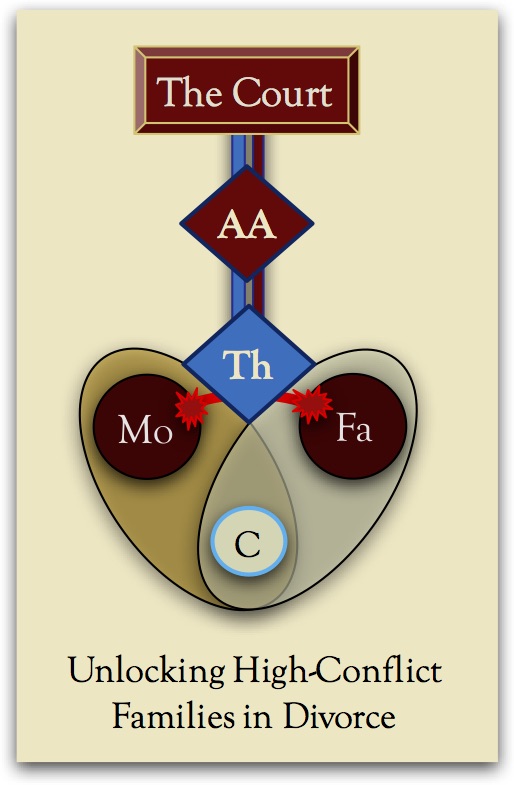
The Key Solution process starts with an assessment.  When the Court encounters a case of “attachment-related pathology” surrounding divorce, the Court, at its discretion, orders a Treatment-Focused Assessment from an AB-PA Certified mental health professional.

If the Treatment-Focused Assessment recommends the construction of an AB-PA Key Team, then the Court can appoint a new and different AB-PA Certified mental health professional to be teamed with an AB-PA Knowledgeable amicus attorney.  This Key team will be tasked with stabilizing all psychological-family issues surrounding the family’s transition from the prior intact family structure to a healthy separated family structure.

Everything about the Key Solution is data driven – evidence based.  The Diagnostic Checklist, the Parenting Practices Scale, and for ongoing treatment monitoring; The Parent-Child Relationship Rating Scale.

As we get these pilot programs in place, we’ll be looking for local-area university faculty partners to collaborate on the program evaluation research component of the pilot program, that is once we get these Key Solution pilot programs up and running.  First things first.  But I was thinking that you might want to partner on the research side when we reach that point? Whaddya think?

We could get you the data from these pilot programs once they’re up.  That’s gonna be a choice research population; clearly defined.

Entry Criteria:  Attachment-related pathology surrounding high-conflict divorce.

Operational Definition: Court referral to the Key Solution pilot program.

Consider if we also collected the Conflict Coding Scale on every family.  At the end of the six-session Treatment-Focused Assessment, the AB-PA Certified mental health professional could provide a summary Conflict Code for the family.  Doing that would help summarize the assessment findings, and it would generate lots and lots of Conflict Codes for a defined population of families.

I figure as we open a Key Solution Pilot Program in a region, we will team with an area university.  There will be data generated intrinsically to the pilot program, and I can also envision the collaboration with a local university faculty generating its own independent collaborative research project, with its own separate protocol of research related measures.

The families in the Key Solution family court programs could represent an important population for research on high-conflict families.

Back when I worked as a research associate with the clinical research project at UCLA many years ago, we had a 16-hour intake assessment battery with schizophrenic patients.  It was a big, national-level research project at UCLA.  We had so many collaborators, each with his or her assessment protocol – 16 hours of testing.

I was just a minion back then at that stage of my career, picture me as one of those little yellow critters, yep, that was me.  A minion.  I was responsible for managing all aspects of the data collection and data processing side of the project – all the data systems.  I gained incredibly valuable experience on the practicalities of running a large-scale research project.

We used to collect a lot of data at intake, remission, relapse, one-year and at various time and symptom intervals after that.  Longitudinal research.  Our location was in the UCLA medical complex, but we sent the data over to our Westwood VA collaborators; the “stat lab” located at the VA complex.  The VA was also the home of the diagnostic unit.  The VA stat lab and diagnostic unit collaborated with a whole bunch of projects, not just ours.

So you and I could collaborate kinda like that if you want, once we get the pilot projects up and running I could send the data to you as a collaborating research investigator.  We could add research measures as well, pending IRB approval.  For my part, I want to add the H scale of the HEXACO, it’s associated with the Dark Triad personality.  That’s how 16-hour intake assessment protocols begin… “let’s add just the one more, just one more, this one’s really important…”  But the H scale of the HEXACO is really important.

Throw some research measures into the mix… Bill Bernet’s new splitting scale perhaps, or something you’ve got… I’m fine with that.  Make the argument to add the measure and we can do that.  I’m even fine with the final author position on any research articles generated – Baker, Childress, fine by me..

Just thinkin’…

Craig Childress, Psy.D.
Clinical Psychologist, PSY 18857

Bill Bernet:  think about this… if you and I were collaborating on an article for DSM-6 revisions as a Trauma Stressors disorder (with the Shared Psychotic Disorder criteria), the AB-PA Key Solution pilot programs could provide us with a valuable research population for establishing the foundations for our case.

AB-PA is not the Moon

This is about professional competence.  All we are seeking is basic professional competence.

If a mental health professional is assessing, diagnosing, and treating an attachment-related pathology surrounding divorce, it is incumbent upon that professional to be professionally competent in the attachment system, what the attachment system is, how it functions, and how it characteristically dysfunctions.

If a mental health professional is assessing, diagnosing, and treating personality disorder pathology that is being expressed in the family, it is incumbent upon that professional to be professionally competent in the origins of personality pathology, its characteristic display, and the influence of parental personality pathology on family relationships.

If a mental health professional is assessing, diagnosing, and treating family pathology, it is incumbent upon that professional to be professionally competent in the family systems constructs of homeostasis, triangulation, and coalitions.

This is just a matter of basic professional competence.  We are just asking for basic professional competence.

AB-PA is not a new theory.  AB-PA is simply a return to the standard and fully established, fully accepted, scientifically validated constructs and principles of professional psychology.  It may seem “new” to some, but that’s only because they are ignorant of the standard and established, scientifically supported and scientifically validated constructs and principles of professional psychology.

If someone asks you for the peer reviewed research for AB-PA, give them my 40-page reference list.  That is the peer reviewed research for AB-PA.

Dr. Childress AB-PA reference list

Anyone who is asking for the “peer reviewed research” for AB-PA is simply exposing their ignorance for the standard, peer reviewed, and fully established information in professional psychology – Bowlby, Beck, Millon, Minuchin, and on and on.

Q:  “Dr. Childress, where in your reference list does it talk about AB-PA?”

On page 70 in Bowlby’s 1980 book on the attachment system and loss;

“The deactivation of attachment behavior is a key feature of certain common variants of pathological mourning.” (Bowlby, 1980, p. 70)

Based on the work of Bowlby – BASED on the work of Bowlby – AB-PA says that the child’s rejection of the parent is a variant of “pathological mourning” with the allied parent and child surrounding the divorce.

Q:  “AB-PA links the child’s rejection of the targeted parent – the “deactivation of attachment behavior” – to the personality disorder pathology of the parent.  Where in your reference list does it talk about the linkage of personality pathology to pathological mourning?”

On page 217 of his book on loss and mourning, Bowlby (1980) links disordered mourning to disturbances in personality formation.

 “Disturbances of personality, which include a bias to respond to loss with disordered mourning, are seen as the outcome of one or more deviations in development that can originate or grow worse during any of the years of infancy, childhood and adolescence.” (Bowlby, 1980, p. 217)

In the separate field of personality disorder pathology, Kernberg (one of the preeminent figures in narcissistic and borderline personality pathology) links the pathology of the narcissistic personality to disordered mourning;

“They [narcissists] are especially deficient in genuine feelings of sadness and mournful longing; their incapacity for experiencing depressive reactions is a basic feature of their personalities.  When abandoned or disappointed by other people they may show what on the surface looks like depression, but which on further examination emerges as anger and resentment, loaded with revengeful wishes, rather than real sadness for the loss of a person whom they appreciated.” (Kernberg, 1977, p. 229)

AB-PA isn’t me, it’s Bowlby and Kernberg who said these things.  I didn’t say these things.  Bowlby said these things.  Kernberg said these things.  Not me.

Asking for peer-reviewed research for AB-PA is asking for the peer-reviewed research of Bowlby and Kernberg, and Beck, and Millon.  Bowlby said these things, not me.  If you have a problem with AB-PA, take it up with Bowlby because he’s the one who said it.

AB-PA is the finger pointing at the moon, it is not the moon.

AB-PA says that the pathology of a child’s rejection of a parent following divorce is called a “cross-generational coalition.”  I didn’t say this, Salvador Minuchin says this;

“An inappropriately rigid cross-generational subsystem of mother and son versus father appears, and the boundary around this coalition of mother and son excludes the father.  A cross-generational dysfunctional transactional pattern has developed.” (Minuchin, 1974, p. 61-62)

“The parents were divorced six months earlier and the father is now living alone… Two of the children who were very attached to their father, now refuse any contact with him.  The younger children visit their father but express great unhappiness with the situation.” (Minuchin, 1974, p. 101)

“The boundary between the parental subsystem and the child becomes diffuse, and the boundary around the parents-child triad, which should be diffuse, becomes inappropriately rigid.  This type of structure is called a rigid triangle… The rigid triangle can also take the form of a stable coalition.  One of the parents joins the child in a rigidly bounded cross-generational coalition against the other parent.” (Minuchin, 1974, p. 102)

I didn’t say this.  Minuchin said this.  If you have a problem with AB-PA, don’t take it up with me, take it up with Minuchin because he’s the one saying it.  If you want peer-reviewed research, then ask Minuchin for the peer-reviewed research for what he says, because he’s the one saying it.

This isn’t me saying this, this is Bowlby and Kernberg and Minuchin saying this.  AB-PA is nothing new.  It’s all just standard and established knowledge in professional psychology.

It only SEEMS new to some people because they are ignorant.  They don’t know Bowlby, and Kernberg, and Millon, and Haley, and Minuchin.  Because if they have this knowledge – this standard and established knoweldge from professional psychology – then they know the scientifically established ground for AB-PA.

If AB-PA as a construct vanished tomorrow, it would still be here.  Bowlby, Beck, Kernberg, Minuchin, Haley.  Nothing new.

The psychological fusion between the child and the allied parent, the “enmeshed” relationship, the shared psychological state of the child and the allied parent, that’s described by the preeminent researchers in psychological development and the neuro-development of the brain, Daniel Stern and Edward Tronick;

“Our nervous systems are constructed to be captured by the nervous systems of others.  Our intentions are modified or born in a shifting dialogue with the felt intentions of others.  Our feelings are shaped by the intentions, thoughts, and feelings of others.  And our thoughts are cocreated in dialogue, even when it is only with ourselves.  In short, our mental life is cocreated. This continuous cocreative dialogue with other minds is what I am calling the intersubjective matrix.” (Stern, 2004, p. 76)

“In response to their partner’s relational moves each individual attempts to adjust their behavior to maintain a coordinated dyadic state or to repair a mismatch.  When mutual regulation is particularly successful, that is when the age-appropriate forms of meaning (e.g., affects, relational intentions, representations) from one individual’s state of consciousness are coordinated with the meanings of another’s state of consciousness — I have hypothesized that a dyadic state of consciousness emerges.” (Tronick, p. 475, 2003)

This isn’t me saying this, this is Stern and Tronick saying this.  If you have a problem with this, take it up with Stern and Tronick, they have a massive research base of evidence supporting their statements.

AB-PA is not Dr. Childress, it’s not “new.”  AB-PA is all just standard and scientifically established knowledge in professional psychology.  Want the peer reviewed research for AB-PA.  Sure, no problem:

Dr. Childress AB-PA reference list

I’ve made it even easier.  For anyone who is asking about peer reviewed research support for AB-PA, on my website is a Checklist of Component Pathology.  Simply identify what part of AB-PA you’d like more peer reviewed research support for, and I’d be glad to provide it.

If they’d like the peer-reviewed support for all of AB-PA:

AB-PA Reference List

All we are asking for is professional competence in standard and established areas of professional psychology.  That’s all.

That’s not a lot to ask for, competence.  Basic competence.

In fact, professional competence is a right of all clients that is guaranteed to them by all professional ethics codes.  Professionally competent assessment, diagnosis, and treatment is the RIGHT of all targeted parents and their children (Standard 2.01a of the APA ethics code).

AB-PA is leading us out of the world of mythical “new forms” of pathology and we are returning to the path of scientifically established constructs and principles of professional psychology.  No unicorns, no mermaid songs.  We are returning to the world of science and professional psychology.

The data sets from Bowlby, Beck, Millon, Kernberg, Linehan, Minuchin, Haley, Bowen, Stern, Tronick, van der Kolk and the surrounding scientific literature can fully describe and solve the attachment-related pathology of a child rejecting a parent surrounding divorce.

We don’t need “new and unique” forms of pathologies.  We are returning to established professional practice, we are returning to a scientifically grounded professionally established foundation.  No unicorns, no mermaid songs.

AB-PA is established fact.  Why?  Because there is no such thing as AB-PA.  It is Bowlby, and Millon, and Beck, and Haley, and Minuchin, and Kernberg and all of the already scientifically established fact of professional psychology.  Poof.  There is no AB-PA, there is only Bowlby, and Beck, and Kernberg, and…

The finger pointing at the moon is not the moon.

Jason Hofer completely understands:

From Jason Hofer: “AB-PA is not the solution. The PAS mindset is “one model to solve them all,” but that is not what AB-PA brings to the table.

The solution is the psychological knowledge behind AB-PA.  Attachment theory, family systems theory, personality disorders, all of it.  When a therapist has all of that knowledge they can use all of it to make whatever diagnosis is necessary, whether it leads to AB-PA or something else.

The usefulness of the knowledge behind AB-PA far, far outweighs the usefulness of AB-PA itself.  If you were to have a therapist study everything found in the reference section of “Foundations”, but not read “Foundations” itself, I guarantee they’ll be able to make the right diagnosis that child psychological abuse is taking place.  That’s the beauty of it.  The finger pointing at the moon is not the moon.  The solution to PA is not AB-PA.  AB-PA points to the solution, but it is not the solution in-and-of itself.

The real solution is having therapists with a deep understanding of all of the psychological components that make up AB-PA.  Whether they *use* AB-PA itself or not doesn’t really matter.  All AB-PA provides is a well-thought out way to use all that knowledge to make a certain specific type of diagnosis.  So, AB-PA may not account for all the subtler cases, but the knowledge required to use AB-PA certainly does, and then some.”

You are absolutely correct Jason.  You get it.  That is spot-on, 100% accurate.

There is absolutely zero reason why all mental health professionals everywhere should not join us in our call for all mental health professionals to be professionally competent in the standard and established, fully accepted, fully scientifically validated constructs and principles of professional psychology.

There is no AB-PA.  The finger pointing at the moon is not the moon.

“Look everyone… the moon” (Bowlby, Beck, Millon, Kernberg, Minuchin, Haley…)

Craig Childress, Psy.D.
Clinical Psychologist, PSY 18857

Bowlby, J. (1980). Attachment and loss: Vol. 3. Loss: Sadness and depression. NY: Basic.

Kernberg, O.F. (1975). Borderline conditions and pathological narcissism.. New York: Aronson.

Minuchin, S. (1974). Families and Family Therapy. Harvard University Press.

Stern, D. (2004). The Present Moment in Psychotherapy and Everyday Life. New York: W.W. Norton & Co. (emphasis added)

Tronick, E.Z. (2003). Of course all relationships are unique: How co-creative processes generate unique mother-infant and patient-therapist relationships and change other relationships. Psychoanalytic Inquiry, 23, 473-491.

Conflict Coding System

Hey Karen,

Since I’ve had the Conflict Coding Scale stuff out, I thought I’d try it on a recent consultation case I had.  It was for a 10-year-old child with lots of factors involved, ADHD, early childhood adoption, problematic over-indulgent parenting, and a moderate cross-generational coalition with dad against mom.

There were three other mental health professionals involved, all of whom produced reports for the Court.  They were disagreeing with each other about how much the “parental alienation” from the father was contributing to the child’s behavior problems generally and with mom.

One of the three mental health people sought my consultation and I reviewed her redacted report, along with the other two redacted reports from the other mental health professionals, so I had a fair amount of data from three separate mental health sources.

It was a complicated case with multiple factors.  So once I had formulated my opinion based on the data, I decided to try the Conflict Coding Scale to describe my opinion.  Here’s what it looked like:

Primary Origin Code:
PCC-03: 01 Child/Parent Vulnerability: Attachment Insecurity

(mother: attachment bond failure post-adoption)
(father: overindulgent parenting fostering insecurity)

Secondary Factors Codes:
PCC-00: 02 Empathic Failure: Narcissistic Failure of Parental Empathy

(father over-indulgent)

PCC-02: 04 PCC-02: 03 Child Vulnerabilities: Regulation Stability

Child anger regulation challenges
Child motivational-behavioral impulsivity

PCC-04: 01: 01 Parent Vulnerability: Withdrawn/Disengaged

Emotionally distant, disengaged, neglectful (father)

PCC-05: 02 Family Systems: Child Triangulation – Parent-Child Coalition Against Parent

(father-child alliance against mother)


So “alienation” (a cross-generational coalition) is present and is a factor, but it’s not a prominent factor within the context of all the other stuff, at least not in my opinion based on the data that I reviewed.  The cross-generational coalition is number 5 on my list of causative factors.

Dad’s parenting is problematic (leading to Secondary Factors 1, 3, and 5).  However, the primary issue is the child’s failure to achieve a secure attachment bonding post-adoption, and this leads to the child’s inherent regulation challenges (Secondary Factor 2) and contributes to the formation of the cross-generational coalition with the distant/disengaged father as a means of improving attachment bond security with the emotionally distant and disengaged father.

Now imagine if the other three mental health professionals ALSO completed the coding scale regarding their opinions.  They may not identify the attachment bond failure post-adoption and they may possibly have different orderings for the factors – differing opinions about the Primary Origin cause of the conflict and the hierarchy of Secondary Factors.

What the Conflict Coding System brings is clarity.

If I’m consulting with the other three mental health professionals and we had all completed the coding scale, immediately we have clarity in our professional-to-professional dialogue.  The causative diagnostic formulation for each of the involved mental health professionals would be clear, even if they disagree on the Primary Origin or the hierarchy of Secondary Factors.  At least these differences of assessment-judgement are clear.  Each mental health professional’s causative diagnostic thinking is clear and documented.

One mental health professional may emphasize the cross-generational coalition as being more significant in creating the child’s symptom pathology, another may emphasize the child’s inherent vulnerabilities of ADHD and impulse control problems.  And this would be immediately clear from the Conflict Coding form.  Then we can discuss the data on which our various interpretations of causal factors are based, and we could reach a rough consensus of opinion on the Primary Origin causal factor and a broad set of Secondary Factors influencing the parent-child conflict.

The Coding System is just a tool.  It’s to be used.  For example, in our consensus diagnosis we may decide to list two Primary Origin codes because persuasive arguments can be made that doing so best captures the nature of the family’s pathology.  It’s a tool to be used to bring clarity.  But it’s just a tool.  It’s flexible.  At the same time, it gains its value from bringing the clarity of structure to dialogue.  So we don’t want to stray too far from the structure in our flexibility.

Clarity.   The Conflict Coding System brings clarity.

Now imagine for a second if everyone in the British mental health system used the Conflict Coding System to document their conclusions regarding the causes of the parent-child conflict surrounding divorce.  If your interpretation differed from some other mental health professional’s interpretation, it would immediately be clear as to why.  It would immediately be clear what factors you’re identifying and what factors the other mental health professional is identifying, and each of your respective weighting for those factors would be clear and documented.  Documentation.

You and the other mental health professional can then discuss the data each of you is using to reach your pathology identification opinions, and your relative weightings of the various factors.  Professional-to-professional consultation.

It’s a good coding system for parent-child conflict, and it brings considerable clarity to the professional-to-professional dialogue surrounding parent-child conflict.  I think this coding system will ultimately become a standard of practice for all child custody related evaluations.  At the end of the Child Custody Evaluation report, the evaluator will provide his or her Conflict Code for the child’s symptoms.

Clarity.

Then, if another mental health professional, such as a therapist for the family, disagrees with the conclusions reached in the custody-related evaluation, this therapist can provide an alternate Conflict Code work-up based on the data from therapy (a second opinion), and it immediately becomes clear what factors are leading to the professional disagreement.  One of the mental health professionals is placing more weight on some factors and less weight on others, or they are identifying entirely different causal origins for the conflict pathology in the family.

The family symptom data supporting the various pathology identifications and relative weightings can then be professionally described and discussed.

Clarity.

When dealing with complicated complex pathology, clarity is a good thing.

November 19th from 5:00 to 6:00, an addendum seminar in the Conflict Coding System.  You can then take this coding system back to England.  You and your clinical psychologist will be the ONLY mental health professionals in England trained to do the Conflict Coding System (excepting other potential November seminar attendees).

Then unleash me into the British mental health system to advocate that ALL mental health professionals use the Conflict Coding System as a standard of practice in documenting their evaluations of parent-child conflict surrounding divorce.

Where-oh-where will the British mental health system obtain training in the Conflict Coding System?  A: From an Advanced Certified AB-PA mental health professional who is trained in the Conflict Coding System.  You and your clinical psychologist can train the other mental health professionals in England in the use of the Conflict Coding System.

Now look what we’ve accomplished by working together.  The entire British mental health system is coming to YOU and your clinical psychologist for training.  I think that would be a good thing, don’t you?  The entire British mental health system involved in high-conflict divorce is coming to you to be trained.  Sounds good to me.

They are coming to be trained in the Conflict Coding System.  So you have to teach them that system so they can use it in their assessments, and if later they have a question about how to use it, they can consult with you and your psychologist on the interpretation of various symptom features – “How would you code this, Karen?”

I think the British mental health system asking you for direction and advice in their assessments, that would be a good thing.  Don’t ya think, Karen?

We are going to give all targeted parents and their children a standard of practice for the assessment of the pathology in their families, families in Iowa, and in New Jersey, and in Europe, and South Africa.  Everywhere.  We are going to give all of these families a standard of practice for the assessment of the pathology in their families.

I’m leveraging the data sets of Bowlby and Beck and Millon and Kernberg and Minuchin and Haley and Bowen to move establishment psychology into creating a semi-structured and flexibly standardized assessment protocol – a standard of practice assessment protocol.

Don’t you see the advantages of our working together Karen?

But if the British mental health system doesn’t know about AB-PA, then they won’t need to develop a structured and standardized assessment protocol as a standard of practice.  If they don’t need to develop a structured and standardized assessment protocol, then they won’t need to come to Karen to be trained in a structured and standardized assessment protocol.

If, however, the British mental health system is aware of AB-PA and wants the features of AB-PA (the Contingent Visitation Schedule; the Conflict Coding System), then they have to come to Karen for training.  The entire British mental health system coming to Karen for training is a good thing.

But the entire British mental health system is turning to Karen for training because of AB-PA.  You must train them in AB-PA.  You can add to AB-PA.  You can add all the beautiful ponies that you want to AB-PA, as long as you provide the baseline training in the AB-PA assessment protocol.

In return for training them in the AB-PA assessment protocol, the entire British mental health system will be turning to you for training and expert consultation.  Sounds good to me.

But none of this will happen if the British mental health system doesn’t even know that AB-PA exists.  No one will come to Karen for training in the Conflict Coding System, and no one will turn to Karen for professional consultation on how complex cases should be coded.

Stop fighting me and work with me.  The entire British mental health system involved in high-conflict divorce seeking training and consultation from Karen Woodall is a good thing.  Oh, but in order for that to happen, you must teach them the AB-PA model, not the Gardnerian PAS model, and you are insisting that only the Gardnerian PAS data set be used in reaching a solution.

Dang.  That’s too bad.

Come on Karen, if you turn down the opportunity to become Advanced Certified in AB-PA then I’ll train someone else to be the AB-PA Advanced Certified mental health professional for England (and this may be happening already).  And instead of coming to you for training and consultation, the entire British mental health system involved with high-conflict divorce will turn to the other AB-PA Advanced Certified mental health professional for training and consultation.

I’ve been contacted by mental health professionals from Great Britain and the Continent inquiring about the AB-PA Advanced Certification training in November.  AB-PA will be coming to Europe.  No doubt about it.  You can be on the cutting edge of this change, leading in the training and professional expertise.  Or you can watch as others assume roles of training and leadership.

The Conflict Coding System is choice, Karen.  It’s a structured and standardized way of describing clinical judgements regarding the origins of the parent-child conflict.  It brings substantial clarity to the professional-to-professional discussions of family pathology and the attributed causes for the parent-child conflict.  I suspect that the Conflict Coding System will become a standard of practice for all child custody related evaluations involving parent-child conflict.

Beyond the categorical causal-diagnostic work-up, the Conflict Coding System ultimately creates the treatment plan.  The Primary causal factor becomes the organizing core for the treatment plan, followed by each of the Secondary Factors in order of hierarchy – from most important to least causal – with the treatment plan addressing and resolving each causal factor as the treatment unfolds.

Come on Karen.  November 19th 5:00-6:00, Conflict Coding Seminar with Dr. C.  Let’s have the entire British mental health system coming to you for training and consultation.

Oh, but dang.  The British mental health system doesn’t even know about AB-PA.  Too bad.

Craig Childress, Psy.D.
Clinical Psychologist, PSY 18857

Dr. Bernet, join me.

The world is changing, Dr. Bernet.

If the Gardnerian PAS “experts” want to maintain leadership for the solution, you MUST describe the path to the solution that you envision so we can make a reasoned and considered decision on our path going forward.

In the absence of a proposed path to solution from the Gardnerian PAS “experts,” they forfeit their leadership.

It is unreasonable to ask that targeted parents and their children follow the leadership of the Gardnerian PAS “experts” with no description of how following that leadership will solve the pathology for these families – solve it for them with their specific families, right here and right now.

In the absence of a solution from the Gardnerian PAS “experts” – the AB-PA diagnostic model is going to assert itself into the leadership position of solving the pathology.  I have described the path to a solution using the AB-PA diagnostic model:

The Solution:  A Return to Professional Practice

The Solution:  The Dominoes

The ONLY relevant argument is how do we achieve a solution – now – for these parents and their children.

How many angels can dance on the head of a pin discussions are not relevant.  The solution is the only relevant issue.

Gardnerian PAS is a failed diagnostic paradigm.  Thirty years, Dr. Bernet – you’ve had 30 years to produce results from your Gardnerian PAS diagnostic model.  Look around you Dr. Bernet.  No solution.

Thirty years is more than generous.  It is a failed diagnostic paradigm.

You’ve had a full and complete opportunity to present your case – all of your research, all of your arguments – to establishment psychology with the revision to the DSM-5 diagnostic system in 2013.

I want to point out that I could have attacked the Gardnerian “new form of pathology” approach back then, but I didn’t.  I didn’t do anything back in 2011-2013 that would undermine your efforts to get “parental alienation” into the DSM.  I stood aside and I did nothing to hinder your full and complete opportunity to alter the DSM diagnostic system to include the term “parental alienation.”

What was the result of your full and complete opportunity to influence professional psychology?  Zero impact.  Nothing.  No mention of the construct of “parental alienation” anywhere in the DSM-5 diagnostic system.  Even in the V-Codes, where a reference to the “parental alienation” construct would have been fully appropriate in V61.29 Child Affected by Parental Relationship Distress.  No mention.  Nothing.

The Gardnerian PAS diagnostic model has had a full and complete opportunity to solve the pathology.  Thirty years is more than enough time to demonstrate the ability of a diagnostic model to solve the pathology, and you have had a full and complete opportunity to influence professional psychology with the revision of the DSM-5 diagnostic system.

Gardnerian PAS is a failed diagnostic model.

I don’t care how many angels can dance on the head of a pin.

Nor do targeted parents and their children care about how many angels can dance on the head of a pin.  They need a solution.   They need a solution for their children and their families now – today

The world is going to be changing, Dr. Bernet.  I am leading us back onto the path of established professional constructs and principles.  No more “new forms of pathology” proposals.  I am returning us to the path of professional psychology.

The Solution:  A Return to Professional Practice

You and the other Gardnerian PAS “experts” have been upset that I have not paid proper homage to the “parental alienation” literature.  That is a false framing of the issue.  I have paid abundant homage to the foundational expertise in professional psychology: Bowlby, Beck, Millon, Minuchin, Kernberg, van der Kolk, Haley.

I have extensively quoted and cited these recognized and established experts in professional psychology.  I just haven’t referenced and cited you and the Gardnerian contingent of “experts.”

It’s not that I haven’t paid proper homage to expertise, it’s that I haven’t paid proper homage to all of you.  You want your narcissism fed, and you’re upset that I’m not doing that.  You want me to cite and reference the Gardnerian literature so that I validate your importance, and I don’t do that.  And that upsets you.

I am drawing on an entirely different data set to solve this attachment-related pathology.  I am not drawing on any of the data set surrounding Gardner’s proposal for a “new form of pathology unique in all of mental health.”  This is important for you to understand… I am drawing on NONE of that data set to solve this pathology.

The data set of Gardnerian PAS is not relevant to the solution using AB-PA.

Professionals cite data sets because the knowledge is relevant, not to display homage.

AB-PA is drawing on data sets from:

Attachment: Bowlby, Ainsworth, Mains, Lyons-Ruth, Bretherton, Shroufe and all of the research base on attachment.

Intersubjectivity: Stern, Tronick, Trevarthan, Stolorow, Shore, Fonagy, and all of the research base on intersubjectivity.

Personality Disorders: Beck, Millon, Kernberg, Linehan, the Dark Triad, and all of the research base on personality disorders.

Family Systems:  Minuchin, Haley, Bowen, Satir, Boszormenyi-Nagy and all of the research base on family systems.

Complex Trauma: van der Kolk, Perry, and all of the research literature on complex trauma.

I am absolutely acknowledging the professional expertise that serves as the ground for my data set.  That expertise is just not you and the other Gardnerians.

The data set of Gardnerian PAS is not relevant to the solution using AB-PA.

I’m not using you and the other Gardnerians as my data set to solve this pathology and that upsets you.  Because, according to you and your colleagues, any solution to this pathology MUST use the Gardnerian data set and must acknowledge your “expertise” in the Gardnerian data set.

When I do not use the Gardnerian data set to solve the pathology, the accusation is then leveled, “What makes Dr. Childress think he has the only solution?”

I consider that a projection.  First, it’s not my solution.  It’s Bowlby, and Beck, and Minuchin, and Millon… this isn’t Dr. Childress.

Second, I would respectfully suggest that it is you and the other Gardnerians who are insisting that the ONLY solution is through your data set – with all of you as the “experts.”  You are insisting that the ONLY solution allowable is through the Gardnerian PAS diagnostic system.

As far as I’m concerned, if you want to ADD your Gardnerian data set to the data set being used by AB-PA to solve the pathology, that’s fine with me. You can add dancing ponies with golden hair for all I care.  No worries here.

It’s just that AB-PA does not rely on any of that data set of Gardnerian PAS and dancing ponies to solve the pathology.  AB-PA can solve the pathology separately and independently from the Gardnerian PAS data set.  AB-PA can solve the pathology entirely using the data sets from Bowlby, Beck, Millon, Minuchin, Kernberg, Haley (and others).

But you can add the Gardnerian data set to AB-PA if you want.  No worries on my part.  People can add data sets from autism or fetal alcohol syndrome for all I care.  No problems with me.  Are they relevant data sets?  No.  But people can add whatever data sets they want to AB-PA and they can make their case that these data sets add something.

AB-PA uses a different data set to solve the pathology.  Stop insisting that ONLY the Gardnerian data set is allowed to solve the pathology, and that you will NOT support any other solution that does not rely on the Gardnerian PAS data set as its foundation.

From where I sit as a clinical psychologist, the data sets from attachment theory, intersubjectivity, personality disorders, family systems, and complex trauma are sufficient to solve the pathology.

If you think that there is some aspect of the pathology that is not solved by the data sets from Bowlby, Beck, Minuchin, Haley, Stern, Fonagy, Millon, van der Kolk, etc., that then requires the additional data set from Gardner, go ahead and add your data set from Gardner and make your case as to why this additional data set from Gardner is needed because the data sets from Bowlby, Beck, Minuchin, Haley, Stern, Fonagy, Millon, van der Kolk, etc., are not sufficient.

That’s fine with me.  But AB-PA relies on only the data sets from attachment, intersubjectivity, personality disorders, family systems, and complex trauma.

Dr. Bernet, I’m simply not using your preferred data set as the foundation for the solution.  Get over it.  Open your mind.  There are alternative data sets besides the Gardnerian data set that can – and will – solve the pathology, and that don’t need the Gardnerian data set to do so.

To distort the data sets from Bowlby, Beck, Minuchin, Millon, Haley, Bowen, Linehan, Kernberg, van der Kolk and all the surrounding research into just another variation of your Gardnerian data set, as you tried to do in your Old Wine essay, is absurd – and grandiose.

The data set of Bowlby, Millon, Beck, Minuchin, Haley et al., is not simply Gardnerian PAS using different words. To assert that these two diagnostic models are the same just using “different words” is absurd on its face.

Besides the data sets used to define the pathology, the two diagnostic models are worlds apart on simply a structural level.  Gardnerian PAS proposes eight unique symptom identifiers that have no association to any other pathology in all of mental health, and uses a dimensional (mild-moderate-severe) diagnostic framework, while AB-PA uses three diagnostic indicators drawn from standard forms of mental health symptom features that link into a vast amount of research and scientific literature, and AB-PA proposes a categorical diagnostic framework (present-absent).

In your Old Wine critique, Dr. Bernet, you’re essentially saying that the entire data set for AB-PA, attachment theory, the personality disorder literature, intersubjectivity, family systems therapy, complex trauma research – all of it – is merely a variation of Garnerian PAS using different words.

That’s a little grandiose there, Dr. Bernet.  I will 100% grant you that AB-PA is not Dr. Childress.  But it is not Gardner.  It is Bowlby, Beck, Minuchin, Haley, Millon… it is a different data set.  To assert that the data sets of Bowlby, Beck, Minuchin, Haley, Millon are just Garnderian PAS using “different words” is simply bizarre and grandiose, and suggests a failure of logical reasoning systems – “Everything is the same.  Everything is Gardnerian PAS.” (The Group Mind; the inhibition of reasoning and critical thinking skills involved in recognizing difference – not perceptually registering difference is necessary to form the group-mind state).

Have other Gardnerian PAS “experts” sometimes used these data sets from standard and established professional psychology?  Yes, in some cases these other data sets have been acknowledged.  I’ve read the PAS literature.  But they have always twisted the data set from the outside into conforming to the Gardnerian PAS model.  Always, the foundational data set that is being used to organize the data is Gardnerian PAS; not attachment theory, not personality pathology, not family systems therapy.  All of these other data sets are secondary to the Gardnerian PAS model in organizing the symptom information.

AB-PA changes that.  AB-PA uses NONE of the Gardnerian PAS model or data set.  AB-PA relies ONLY on the data sets from Bowlby, and Millon, and Beck, and Minuchin, and Haley, and Kernberg, and Linehan, and Bowen – all the established experts in professional psychology.

I recognize that the Gardnerians have adopted a strategy of closing ranks and scrupulously avoiding discussing AB-PA in any public way in order to avoid “legitimizing” AB-PA.  I know the Gardnerians want to ignore AB-PA so that it never sees the light of day and never provides any threat to their preferred diagnostic approach of the Gardnerian PAS model.

What you should be aware about when forming conspiracies is that emails may find their way to unanticipated people, and the more people the conspiracy grows to include, the more likely it becomes that information may leak.  I am aware of the strategy of the Gardnerians to disable the solution to the pathology provided by AB-PA.  It is abundantly evident on its face.

Since you cannot address AB-PA on the merits of the respective diagnostic models, AB-PA is a vastly superior description of pathology, the strategy for disabling the solution offered by AB-PA is to try to bury AB-PA, so it never sees the light of day.

That’s not going to be an effective strategy.  Truth will out. You might as well try to hold back the ocean.

Also, you may want to self-reflect on the strategy of trying to stop the solution to “parental alienation” offered by AB-PA – since this puts you on the same side as the pathogen.  It too wants to stop the solution offered by AB-PA.  So currently, the two forces seeking to stop AB-PA are the Gardnerian PAS “experts” and the pathogen.  I would recommend that it should give you considerable pause whenever you find yourself on the same side as the pathology in trying to prevent a solution to the pathology.

Will history look back on this period and remark how admirably you put the advancement of science and the best interests of the parents and children ahead of your own personal ego-investment in a particular diagnostic approach?  Or will the hindsight of history see you and the Gardnerian PAS “experts” as attempting to put your own personal ego-gratification of being “experts” ahead of a professional-level discussion of ideas and ending the suffering of families?

There is a wonderful scene at the end of the movie, the Bridge on the River Kwai, in which the Alec Guinness character – a British army colonel who is a Japanese prisoner of war – has built a magnificent bridge with his British troops for his Japanese captors, maintaining an esprit de corps among his British troops.

The bridge needs to be destroyed as part of the larger war effort to defeat the Japanese, and the William Holden character, an American soldier, leads a group of Allied commandoes back to the prisoner of war camp to blow up the Japanese bridge built by Alec Guinness and his troops.

In the final scenes, as Alec Guinness sees the signs that there is a plan underway to blow up the bridge, he tries to stop it.  He alerts the Japanese to the plan to blow up the bridge, and he starts disabling the dynamite placed on the bridge.  He has become so enamored of his creation, the bridge built by his troops under his leadership, that he has lost sight of the larger context of the war.

Finally, as the William Holden character dies at his feet, Alec Guinness realizes the larger context of the war and says, “What have I done.” (Bridge on the River Kwai: Final Scene)

Wonderful movie.  Well worth watching.  Seven academy awards, including best picture.

I’m William Holden, Dr. Bernet.  My role is to blow up the Gardnerian “bridge on the river Kwai” because we need to return to alternate data sets in order to solve the pathology.

You and the other Gardnerian PAS “experts” are trying to keep me from blowing up the Gardnerian “bridge on the river Kwai” that you have all constructed.  You’ve all become so enamored of the “bridge” you’ve constructed and your esprit de corps as “experts,” that you’ve lost sight of the larger goal – a solution.

But in order to defeat the pathogen, we must blow up the bridge, we must switch from the Gardnerian diagnostic model to an AB-PA diagnostic model.  We accomplish that by switching data sets for how we define and diagnose the pathology.

When the hindsight of history comes to view this period, I suspect that the Gardnerian strategy of not “legitimizing” AB-PA by withholding any professional acknowledgement of its existence is not likely to be viewed favorably in the cold light of historical reflection.  Nor will that strategy work.  It has to do with how meme-structures propagate (Dawkins: The Selfish Gene).

Trying to suppress the advancement of scientific knowledge is a fool’s errand.  It can work for a while, it can delay things.   But truth will out.

The Catholic Church tried to suppress the knowledge of Galileo through threat of “excommunication” because he broke with church dogma.  I am familiar with that strategy for trying to suppress knowledge because it disagrees with dogma.

Didn’t work.  Won’t work.

The world is changing, Dr. Bernet.  That’s just the reality.   And I would suggest that seeking to suppress knowledge by not acknowledging its existence and through a strategy of “excommunication” rather than challenging the knowledge with reasoned argument will not be viewed favorably in the cold light of historical reflection.

The diagnostic paradigm for the attachment-related pathology commonly called “parental alienation” is changing.

I’m asking for you to join me in creating this change.

You have been a stalwart and steady warrior for targeted parents through all of these years.  I saw how you tried to influence the formation of the DSM diagnostic system.  Like Alec Guinnness, who fought the psychological oppression of his Japanese captors and maintained the British esprit de corp of his troops, you have fought a heroic struggle against the pathology for many years.  Admirable.  Magnificent.

But ultimately, the Gardnerian PAS model has fatal flaws embedded within it.  You didn’t have the proper tool to solve the pathology.  I can tell you exactly what those inherent and terminal problems with the Gardnerian PAS model are – but not now.

The construct of meme-structures will help you understand a lot of things.

Dawkins: The Selfish Gene

Gardnerian PAS is a failed diagnostic paradigm.

The only issue that is relevant at a professional-level is the solution.  It is not relevant how many angels can dance on the head of a pin.

AB-PA provides a solution.

Gardnerian PAS does not.

The world is changing.

Stop fighting against AB-PA and fighting against the change it brings.  I am not the source of this change, I am merely the conduit.  There are larger forces at work here.

I would like to propose that we write two collaborative articles together, Dr. Bernet.

The first one would be a reflection on history and the future.  It would pass the torch from Gardnerian PAS to AB-PA for the solution.  We’re both a couple of old guys, Dr. Beret.  This isn’t about us.  There will be a new generation coming to take on the fight against the pathology.

AB-PA is a richer diagnostic model than the Gardnerian model because AB-PA opens wide the full data sets of attachment theory, intersubjectivity, personality disorder pathology, family systems therapy, and complex trauma.

The categorical AB-PA diagnostic framework lends itself better to “operationally defining” the construct of “parental alienation” for research purposes, and those 12 Associated Clinical Signs are jewels – both clinically and from a research perspective.

It will be impossible to prevent AB-PA from fully entering professional discussion and professional practice.  Help me to define the legacy of our fight against the pathogen to the next generation.

I propose that in the first half of a joint collaborative article, you describe the first-fight against the pathogen.  Tell us about Gardner’s courage, the malevolence of the pathology, all the research and the battle surrounding Gardnerian PAS.  Bring out whatever data sets you want and revel in it.

And then end your segment of the article by passing the torch for the solution to AB-PA.

Then let me take the second half of the article to explain that, as courageous and magnificent as Gardner may have been, he skipped the step of diagnosis; the application of standard and established constructs and principles to a set of symptoms.  Instead, he too quickly abandoned the rigors of professional practice by proposing a “new form of pathology” which led professional psychology away from the standards of professional practice regarding diagnosis; the application of standard and established constructs and principles to a set of symptoms (no “unique new forms of pathology” diagnostic proposals).

I’ll describe how AB-PA returns to the foundations of the pathology and corrects this diagnostic step skipped by Gardner.  AB-PA defines the pathology (the set of symptoms) from entirely within standard and established constructs and principles.  Here’s what AB-PA says; pathological mourning, the trans-generational transmission of attachment trauma, the addition of splitting pathology to a cross-generational coalition, we need to return to standard and established constructs and principles in our professional diagnosis of pathology, and AB-PA does this.

You and I, in a joint article, bring together both the history and the future of our efforts to solve the pathology of “parental alienation.”

Then, let’s write a second article together.  A much more interesting article.  Let’s set the stage for completing your work with the DSM diagnostic system.  Let’s set the stage for the next generation in their efforts to include the pathology of “parental alienation” into the DSM diagnostic system.

Together, you and I in a joint article, let’s make the argument to the DSM that this pathology is an attachment-trauma pathology that belongs in the Trauma and Stressor-Related section of the DSM.  In doing that, we then have a specific committee we’re targeting for support – we are forming allies within the DSM process – a new Trauma and Stressors disorder – attachment trauma – the trans-generational transmission of attachment trauma.

We will argue that the diagnosis should be nearly identical to the prior DSM-IV TR diagnosis of a Shared Psychotic Disorder.  Nearly the same identical everything.  Look how closely that DSM-IV diagnosis mirrors the pathology of “parental alienation”:

DSM IV TR Shared Psychotic Disorder

Diagnostic indicator 3 of AB-PA is the encapsulated persecutory delusion.  What do you want to bet that we will find massive amounts of overlap in the psychological process that the Shared Psychotic Disorder people were looking at for the original DSM-IV disorder, and the pathology we’re looking at with AB-PA.

The DSM system has already acknowledged in the DSM-IV that the pathology of a shared delusion exists.  They acknowledge it in DSM-5 but diagnostically bury it.  All we’ll be asking for is that they re-establish the shared delusion – just like in the DSM-IV – as a primary diagnosis in the Trauma and Stressor-Related section, and we link our reasoning to the shared delusion created by the trans-generational transmission of attachment trauma.

We can bring all of the data sets from attachment theory, intersubjectivity, personality disorder pathology, and complex trauma to our argument.

You and I are old guys, Dr. Bernet.  This DSM battle is for the next generation of mental health warriors.  But you and I could lay out the vision for how that battle can be fought and won – the trans-generational transmission of attachment trauma creating a shared delusional disorder (Trauma and Stressor-Related section of the DSM – right alongside the other attachment-related disorders).

The world is changing, Dr. Bernet.  There are larger forces at work in this.  This isn’t Dr. Childress.  I’m merely the conduit for catalyzing the change.  The only credit to me is that I’m smart enough to recognize my role in what the universe wants to do.  Join with me in creating this changed world.  Trying to stop the change is like trying to hold back the ocean by putting up your hands to stop the waves from crashing on the shore.

Join me in defining the legacy and the future of our fight with the pathogen.  Trust me, Gardner doesn’t care about his model, he just wants us to defeat the malignancy of this pathogen.  Do you know what I think Gardner would say to me?  “Go for it, Dr. C.”  I am fully convinced that Gardner is supportive of my efforts with AB-PA.  He doesn’t care about “his” model, he just wants us to defeat the pathogen and solve the pathology.  He wants us to finish what he began, he wants us to defeat the pathogen.

But in the interesting way that the universe works, we will fulfill Gardner’s legacy without Gardner’s model.  Curious, isn’t it.  But it’s not surprising to me, because that’s the way things work sometimes.

We can fulfill his wishes using AB-PA.  When we bring the full power of scientifically established data sets to the solution, we can solve the pathology for all children and all families everywhere.

Join us, Dr. Bernet.  Join me.  Let’s write two collaborative articles.  One to reflect on history and the future, and one to define for future generations the path forward to achieve formal inclusion of the pathology into the DSM diagnostic system.

Craig Childress, Psy.D.
Clinical Psychologist, PSY 18857


An Invitation to Karen Woodall

I was intrigued to learn the other day from one of Karen Woodall’s blogs that she doesn’t believe she’s professionally competent to diagnose personality disorder pathology.

From Karen Woodall: “If I suspect a personality disorder is present I will ask our clinical psychologist to evaluate this and on the basis of this outcome we will design and deliver a treatment route, often in a team setting, sometimes headed by our clinical psychologist.”

I didn’t realize that Karen relied on a clinical psychologist to “evaluate” personality disorder pathology and sometimes head your treatment team.  You know I’m a clinical psychologist.  I wonder if the evaluation of clients at your clinic might benefit from some professional-to-professional consultation between your clinical psychologist and Dr. C?

Hey, that gives me an idea Karen.  How about if you and your clinical psychologist come to the November AB-PA Certification seminars here in Pasadena.  You and your clinical psychologist could get Advanced Certification in AB-PA.  You’d be the ONLY clinic in all of England to have an AB-PA Certified psychologist on staff.

And you know what Karen?  If you have an AB-PA Certified psychologist on staff at your clinic, and if you’re documenting your assessments using the instruments of AB-PA, then you can unleash me on the British mental health system. 

Hmmm, if I’m taking on the incompetent mental health assessment of attachment-related pathology in the British mental health system, it sure would be nice to have an AB-PA Certified psychologist in England who could conduct a proper assessment of AB-PA.  Hmmm, who could that be?  Hey, I know.  There is only one clinical psychologist in all of England who is AB-PA Certified.  Go to that person and you’ll get an exceptionally good diagnostic workup.

Come on Karen.  Personal invitation from Dr. C.  Come to Pasadena with your clinical psychologist in November.  Three days – Advanced Certification in AB-PA for both you and your clinical psychologist.  Then unleash me into your mental health system.

Let me tell you a story.

Back in 2014 I was working on a model for “reunification therapy” (Reunification Therapy: Treating “Parental Alienation”) and Dorcy Pruter came up to me after a conference we both attended.  At the time, I didn’t know Dorcy.  I had heard her speak once at a conference and was impressed by what she had to say.

So Dorcy approaches me as I’m socializing with other attendees and she says, “Dr. C, love your work –wonderful-wonderful, but I disagree with you about one thing.”

Telling me I’m wrong about something, well that certainly captivates my arrogance.  “Really?” I said, “Tell me more about that.”

Dorcy continued, “You say it will take about six months to a year to treat and resolve the pathology of “parental alienation,” and I can solve it in a matter of days.”

Well that has my attention.  I am well-versed in models of psychotherapy.  There is not a psychotherapeutic approach out there that can restore the child’s attachment bonding to the targeted parent in a matter of days. 

Needless to say, I was skeptical.  But I caught myself, and held my arrogance in check.  “Really?” I replied, “Tell me more about that.”

We proceeded to talk at the cocktail event for about 10 or 15 minutes, and nothing she described would rule-out her ability to restore the child’s attachment bonding, there were no obvious disqualifiers.

She contacted me later and we set up a meeting at my office to talk further.  I planned for a two-hour meeting.  We had a six-hour meeting.

The moment she started walking me through the High Road protocol on her computer, I immediately recognized what she was doing and how she was accomplishing it.  It’s not psychotherapy.  It’s a totally different approach to change.  It’s like I’m a biologist and know all the different types of carbon-based life forms on the planet, and Dorcy walks into my office and opens up a shoebox that contains a silicon-based life form.  A critter that is unlike anything we do in psychology.

I totally understood how she does it, and I was kind of amazed and impressed.  I’d characterize the approach as elegant.  Dorcy has the solution in her hip pocket.  We started to talk about the implications.  She recognized that I had the diagnostic model, I recognized that she had the solution to restoring the child’s normal-range attachment system in just a matter of days.

From that moment on, I stopped working on a model for “reunification therapy” and I threw my full and complete support to Dorcy on the intervention side.  She has the solution in her hip pocket.

Why did I do that?  She’s not part of my “professional club.”  I’m a clinical psychologist, Dorcy is just normal.  She doesn’t even have a college degree.  Certainly she can’t compete with me and my doctorate degree – I’m a clinical psychologist for goodness sake.  And wouldn’t it be more in my personal self-interest to be a big-kahuna in therapy, creating the model for “reunification therapy”? 

None of that nonsense is relevant.  Dorcy has the solution in her hip pocket. 

Dorcy has the solution.  I’m a professional.  Done deal.  Dorcy has my full and complete support because she has the solution in her hip pocket.  The needs of my client take precedence over any motivation like personal ego stuff.

And look at my support for her since then.  I have consistently and steadfastly put my own professional credibility on the line for Dorcy.  I didn’t need to do that.  She’s not part of “my club” of clinical psychologists. 

Remember during that period when you Gardnerians started to exclude her from your club – from the “Bona Fide Experts” club – reminds me of something from Spanky and Our Gang – coming up with your shaded “bona fide” expert criteria that were biased specifically to exclude Dorcy as a “bona fide” expert – remember that? –  look how I took you all on in support of Dorcy when you tried to exclude her from “your club”:

Stark Truth

Now imagine for a second Karen, that you and your clinical psychologist became AB-PA Advanced Certified mental health professionals and started documenting your assessments of attachment-related pathology using the AB-PA assessment instruments.  Then you and I are on the same team.  You would then have my full and complete support – just like Dorcy receives my full and complete support.  Your adversaries become my adversaries. 

You can unleash me into the mental health system of Great Britain to break down all the barriers that are preventing you – an AB-PA Advanced Certified mental health professional – from doing your expert job of assessing, diagnosing, and treating pathology.

Imagine releasing me into the mental health system of Great Britain against all of the barriers you face.  You’ve seen what a staunch and formidable ally I’ve been for Dorcy.  Imagine if I was a staunch ally of Karen. 

I am extending a personal invitation to you and your clinical psychologist, Karen, for both of you to come to the November AB-PA Advanced Certification seminars.  There’s Disneyland… Universal Studios… the weather in November is better here than in most places, although it’s been getting rainier in the winter recently, I think it might be a climate change kind of thing… Come on Karen.

All you have to do is implement the standardized AB-PA assessment protocol with attachment-related pathology surrounding divorce, and document the symptoms – present or absent.  If the three diagnostic indicators of AB-PA are present, you and your psychologist make a DSM-5 diagnosis of V995.91 Child Psychological Abuse and take child protection steps.

The Courts in Great Britain aren’t going to want to protectively separate the child from the supposedly “favored” parent.  Hmmm, I wish there was some sort of compromise solution we could offer the Court in lieu of a protective separation that might get a handle on the pathology.  Hey, I know… how about the Contingent Visitation Schedule?  Ask the Court to order a Contingent Visitation Schedule

Oh, but wait… the Contingent Visitation Schedule needs an organizing family therapist to develop and implement it.  I wish we had an AB-PA Certified psychologist somewhere, because on the second day of Certification I’ll be training AB-PA Certified mental health professionals in the background, design, and implementation of the Contingent Visitation Schedule

Sooooo, if your clinical psychologist was AB-PA Certified, and we recommend a protective separation based on the confirmed DSM diagnosis of Child Psychological Abuse, and then perhaps compromise to a 6-month Response-to-Intervention trial with the Contingent Visitation Schedule

Data-driven decision making.  Document the child’s symptoms using the Diagnostic Checklist for Pathogenic Parenting – and use the Parent-Child Relationship Rating Scale for the Contingent Visitation Schedule.  Document the targeted parent’s parenting using the Parenting Practices Rating Scale.

On Day 2 of the Certification seminar, I’ll be covering each of the six sessions of the Treatment-Focused Assessment, what you’re looking for in each session and how to look for it.  Good stuff, Karen, come on – personal invite from Dr. C.

If the child has the three diagnostic indicators of AB-PA, then it’s a DSM-5 diagnosis of Child Psychological Abuse, and the situation has changed to one of child protection considerations.

If the three diagnostic indicators of AB-PA are not present, then it is something other than AB-PA.  I might consider using the Contingent Visitation Schedule as a Response-to-Intervention trial to obtain a broader range of data for diagnosis.

Come on Karen, you and your psychologist will be the only AB-PA Advanced Certified mental health professionals in all of England.  And then you can release me on the British mental health system to work toward removing all the barriers you face to accomplishing a solution for these kids and families.

Ask Dorcy what it’s like to work with me.  I’m really a teddy bear.  I’ll fight like gang-busters for my kids.  But otherwise, I’m just a cuddly softy. 

I know, I’ll sweeten the pot.  You know that parent-child conflict coding scale I offered you the other day?  I’m working that up into a book where each of the individual code types have pretty thorough work-ups.  I’m working my way through each of the subtypes using the following template:

Subgroup 05:  Child – Anxiety Regulation Challenges

Description:
Substrate:
Symptom Identifiers:
Treatment Indicators:
Potential Contributing Dynamics:

I’m not planning on rolling out the coding scale until I have the supporting pathology descriptive book in place – couple years, but if you bring your clinical psychologist to the November AB-PA Advanced Certification seminar in Pasadena, I’ll throw in a special addendum seminar on Saturday evening from 5:00 to 6:00 on just the Coding Scale.  I’ll walk everyone through it and describe each of the categories.  And then, I won’t offer this coding seminar again until the book comes out – couple years.  That way, you and your psychologist (and I guess the other attendees) will be the only ones who have been trained in the coding system.  I think you’ll like it.

Since the coding scale is in early development, you can wander to your hearts content in exploring its utility for “hybrid cases” – lots of open subtypes within the categories.  And I’m providing 6 hours of professional-to-professional post-seminar Skype consultation with the Advanced Certification.  If you or your psychologist want to touch-base with me about a diagnostic issue or about a coding issue, give me a Skype.

You and your psychologist would be the only clinic in Europe using the conflict coding system. Wait, I think I have some people from the Continent coming.  But still, you’d be right there at the start – a central hub for AB-PA in Europe.  You just have to conduct a standardized AB-PA assessment protocol and document the symptoms – if the symptoms are present, diagnose Child Psychological Abuse and shift your approach to child protection considerations.

If it’s sub-threshold to AB-PA, use your clinical discretion – consider a Response-to-Intervention trial with the Contingent Visitation Schedule to collect more diagnostic information. 

And look at those Associated Clinical Signs, Karen.  I’m telling you, those ACS are jewels.

Wouldn’t you rather have a big cuddly teddy bear friend than an old grumpy-headed version of Dr. C?

Can’t you see the advantages of a partnership? 

But I can’t partner with you because the Gardnerian 8 symptoms get in the way.  AB-PA is – and needs to be – entirely separate from the Gardnerian diagnostic model.

But you can partner with me…  You and your clinical psychologist can become AB-PA Advanced Certified mental health professionals.  You just have to use the standardized AB-PA assessment protocol instruments to document the symptoms.  I could easily see you becoming a focal hub for AB-PA in Europe.

Stop ignoring AB-PA and use it – use me.  That’s what I’m here for.

There are larger forces at work here, Karen.  AB-PA isn’t Dr. Childress.  I’m just a catalyst.  That’s my role in this tapestry.  AB-PA is Bowlby, and Kernberg, and Millon, and Beck… it’s a return to standard professional psychology.

Stop fighting me and start using me.  That’s my role in this solution.  Stop ignoring AB-PA and start using Dr. C as a resource.

Come on, Karen… November.  Ask Dorcy, I’m a teddy bear.

Craig

A Call for Unity: A Single Voice for Solution

Well, it seems like the deadline for the Gardnerian-based solution has come and gone, and all we’ve heard is crickets.

They propose no solution to “parental alienation.”

The Gardnerians have no solution using the Gardnerian PAS model except 30 more years of exactly the same thing.

I am therefore calling for unity in our fight to save the children.  We need to come together to enact the solution as quickly as we humanly can.  Targeted parents and their children need a solution.  They don’t need professionals arguing about how many angels can dance on a head of a pin. They need this pathology to stop – today.

I have posted the path to the solution that is available from enacting a change to an AB-PA diagnostic model:

Solutions: A Return to Professional Practice

Solutions: The Dominoes

We need to bring all of our voices together – all of them – into a single voice for change.  We need to stop the suffering of targeted parents and their children as quickly as we possibly can.

I am therefore calling specifically on:

Bill Bernet

Karen Woodall

Amy Baker

the Parental Alienation Study Group

and all of the Gardnerian PAS contingent of “experts” – and on everyone who wants to see the pathology of “parental alienation” come to an end – to JOIN US in advocating for a professional standard of practice using the AB-PA diagnostic model.

Join us in advocating for a professional standard of practice and standardized assessment protocol for attachment-related pathology surrounding divorce using the AB-PA diagnostic model for the pathology.

AB-PA offers a solution (The Solution series: Return to Professional Practice; Dominoes).  Gardnerian PAS does not (crickets).

I don’t care if the Gardnerians “think” their diagnostic model is better.  The issue is a solution.  We need a solution.  Targeted parents and their children need a solution.

If the Gardnerian PAS diagnostic model with its eight symptom identifiers produces NO SOLUTION – then we need to change to the AB-PA diagnostic system that leads to an immediate solution.

And everyone – everyone – should be working toward that SAME goal.

I don’t care how many angels can dance on the head of a pin.  That’s not relevant.  The ONLY thing that’s relevant is a solution – targeted parents and their children are suffering – daily.  Day-after-day their grief and suffering continues, and day-after-day we continue to lose more and more children and families to the pathology.

There is urgency.

This cannot wait, we cannot delay.  Each day that is lost can never be recaptured.

Mental health professionals – the Gardnerian PAS “experts” – need to STOP arguing about how many angels can dance on the head of a pin and they need to work WITH US – not against us – in bringing a solution – one that is achievable today – to end the suffering of targeted parents and their children.

The time has come for ALL mental health professionals – including Bill Bernet, Karen Woodall, Amy Baker, and the PASG – to endorse an AB-PA diagnostic model that provides these parents and their children with a solution – an end – to the nightmare of “parental alienation.”

Let’s put the two models for a solution side-by-side:

AB-PA:  The Solution: A Return to Professional Practice; The Solution: Dominoes

Gardnerian PAS: nothing.

Let’s now make a reasoned decision on the path moving forward.

AB-PA provides a clear and actualizable path to a solution.  Gardnerian PAS offers no solution.

It is time for ALL mental health professionals – ALL mental health professionals – to bring our voices together into one single unified voice for change – into one single unified voice for the solution to “parental alienation.”

I don’t care how many angels can dance on the head of a pin – that’s not relevant.  Each day that passes is another day lost in the lives of a loving targeted parent and child that can NEVER be recaptured. Children are only 10-years-old for a year – they are only 12-years-old for a year.  Times of love and bonding that are lost during childhood are lost forever.

Childhoods are being lost as we stand by and bicker about how many angels can dance on the head of a pin.  ENOUGH.

It is time for a solution.  It is long-past overdue for a solution.

It is time we come together into a single voice for change that will bring these targeted parents and their children a solution – today – now.

The grief of targeted parents is immense and utterly overwhelming.  Day-by day –  each day – they suffer so terribly.

We must ALL do everything we possibly can – everything we possibly can – to bring this suffering to an end as quickly as is humanly possible.

I don’t care how many angels can dance on the head of a pin. That’s not relevant. The ONLY thing that’s relevant is a solution to end the suffering of targeted parents and the psychological abuse of their children.

Delaying the solution by a single day when we possibly could have solved it is abhorrent and unacceptable.  We need to solve this as fast as we possibly can.

It is time for ALL mental health professionals to join together in a single voice for change, in a single unified voice advocating for a professional standard of practice using the AB-PA diagnostic model for the pathology:

AB-PA:  The Solution: A Return to Professional Practice; The Solution: Dominoes

Gardnerian PAS: nothing.

It is not relevant how many angels can dance on the head of a pin.  It’s not relevant if you think this or that way of diagnosing the pathology is “better” – NOT relevant.  The ONLY thing that is relevant is the solution – we MUST end the suffering.  What is the path to a solution?  That is the ONLY relevant question.

The answer:

AB-PA:  The Solution: A Return to Professional Practice; The Solution: Dominoes

Gardnerian PAS: nothing.

Both the AB-PA diagnostic model and the Gardnerian PAS diagnostic model have had full and complete opportunities to describe their respective paths to a solution.  We can now make a reasoned and considered decision on our path moving forward.

AB-PA provides a solution to targeted parents and their children that we can actualize today to end the suffering of these parents and their children today, and Gardnerian PAS offers no solution whatsoever – just 30 more years of the same.

ALL mental health professionals MUST place the needs of their clients first.  I don’t care about your dancing angels.

There is NO rational reason that would prevent us from coming together into a single voice in advocating for a professional standard of practice using the AB-PA diagnostic model for the assessment of attachment-related pathology surrounding divorce.

“Dr. Childress is wrong thinking only he has the solution.”

AB-PA:  8/6/17 – The Solution: A Return to Professional Practice; The Solution: Dominoes

Gardnerian PAS: 9/1/17 – nothing.

No, I’m not wrong.  The AB-PA diagnostic model provides a solution.  The Gardnerian PAS diagnostic model does not.

“Our model with eight diagnostic symptoms is better”

Dr. Childress: Does it lead to a solution?

“No.”

Dr. Childress:  Then your preferred approach is not relevant to a professional-level decision.  The ONLY thing that is relevant at the professional level is a solution – because a solution is in the best interests of the client.

AB-PA:  The Solution: A Return to Professional Practice; The Solution: Dominoes

Gardnerian PAS: nothing.

It is not relevant how many angels can dance on the head of a pin.  The immense grief and suffering of targeted parents as they are forced to watch helplessly as their children are psychologically destroyed and abused by the pathology of their narcissistic/(borderline) ex- MUST STOP.

It MUST stop.

That is the ONLY relevant consideration.

It is time – in fact it is long past overdue – when ALL mental health professionals who authentically want to bring the suffering of targeted parents and their children to an end, bring their voices into a single unified voice for change to a standard of practice using the AB-PA diagnostic model that provides targeted parents and their children with a solution.

AB-PA:  The Solution: A Return to Professional Practice; The Solution: Dominoes

Gardnerian PAS: nothing.

I asked the Gardnerian PAS “experts” to provide us with their proposed path to a solution by September 1, 2017 so we could make a reasoned and considered decision on our path forward.   Day-by-day the immense suffering of targeted parents and their children continues.  There is urgency.  We don’t have time to waste.

September 1 came and went.  No proposed solution from the Garnerian PAS “experts.”

It is time to bring this professional squabbling over how many angels can dance on the head of a pin to an END.  Enough!

AB-PA:  The Solution: A Return to Professional Practice; The Solution: Dominoes

Gardnerian PAS: nothing.

The reasoned and considered decision by all rational people who authentically want to bring the pathology of “parental alienation” to an end is that the path to a solution is through an AB-PA diagnostic model – because Gardnerian PAS offers no solution.

This solution will come more quickly if we unite all of our voices into a single voice for a professional standard of practice using the AB-PA diagnostic system.

Every day we lose – every day we delay – every day we spend pontificating about pinheads and dancing angels – is another day of immense suffering for targeted parents and their children.

I am calling on ALL mental health professionals – including Bill Bernet, Karen Woodall, Amy Baker and the PASG – to bring ALL of our voices into a single call for a professional standard of practice using the AB-PA diagnostic model.

AB-PA:  The Solution: A Return to Professional Practice; The Solution: Dominoes

Gardnerian PAS: nothing.

This is the ONLY rational path forward to end the suffering of targeted parents and their children.

It doesn’t matter if you think your “dancing angels” model is prettier and better.  The ONLY thing that matters is the solution – bringing an end to the immense suffering of targeted parents and their children.

AB-PA:  The Solution: A Return to Professional Practice; The Solution: Dominoes

Gardnerian PAS: nothing.

I am calling for a single unified voice.

Join us in bringing the nightmare of “parental alienation” to an end for these grieving parents and their children.

There is no rational reason not to join us in solving “parental alienation.”  From this point forward, continuing to sow division and discord that slows the solution offered by AB-PA is obstructionism.

If you are an obstructionist to the solution, then you are no ally to targeted parents and their children.  They need a solution.

The path forward into a solution is through AB-PA.

Craig Childress, Psy.D
Clinical Psychologist, PSY 18857

Never see the light of day

The Gardnerian PAS “experts” don’t want AB-PA to ever see the light of day.

They don’t care if AB-PA solves the pathology.  That’s not relevant to them.  Only they are allowed to solve the pathology.  It’s their game – it’s their pathology.  I’m the outsider.  I’m not part of their club.  How dare I come in and just solve the pathology. 

The Gardnerian PAS “experts” don’t want AB-PA to ever see the light of day.

Even through AB-PA offers tens of thousands of children and families a solution to their nightmare, the Gardnerian PAS experts are willing to sacrifice your children to the pathology rather than allow AB-PA to solve the pathology.

The Gardnerian PAS “experts” don’t want AB-PA to ever see the light of day.

The Gardnerian PAS “experts” are the (semi-conscious) colluding allies of the pathogen who are disabling the mental health system response to the pathology.  The pathogen has access to them through their narcissistic self-inflation around being “experts” and it uses this entry point to motivate them into continuing to push an abundantly flawed and completely failed diagnostic model of the pathology that will never in a million years solve the pathology.

The Gardnerian PAS “experts” don’t want AB-PA to ever see the light of day.

I find the willingness of the Gardnerian PAS “experts” to sacrifice children and families to the pathology rather than support a solution that doesn’t involve Gardnerian PAS — to be morally reprehensible.

The Gardnerian PAS “experts” don’t want AB-PA to ever see the light of day.

People complain that the system is rigged.  For family law attorneys.  For court involved mental health professionals. 

The Gardnerian PAS “experts” are part of that failed system.  Thirty years – no solution.  Why?  There’s a reason for that.  The Gardnerian PAS “experts” didn’t want a solution, they wanted to be “experts.”

I came from outside the system. Look what I did. Returned to the standard and established principles of professional psychology and diagnosed the pathology.  In 30 years, they never diagnosed the pathology using standard and established  constructs and principles of professional psychology.

They don’t want things to change. They’re “experts” and they like being “experts.”  They want everything to remain exactly as it is.

Even if that means that more children and more families are sacrificed to the pathology.

The Gardnerian PAS “experts” don’t want AB-PA to ever see the light of day.

I knew the pathogen would attack once it recognized the threat I posed to it.  The threat?  I can see it.

I had always anticipated the attack would come from the Silberg-Meier contingent of Anti-Gardnerians.  I was wrong.  It’s from the Gardnerian PAS “experts” – wow, whaddya know.

It’s the Gardnerian PAS “experts” who are the enabling allies of the pathogen.  It’s the Gardnerian PAS “experts” who are clogging up and disabling the mental health response to the pathology.

The Gardnerian PAS “experts” don’t want AB-PA to ever see the light of day.

Why are they so afraid of AB-PA?  A: They are afraid that AB-PA is going to solve the pathology – and they are right to be afraid because AB-PA will solve the pathology.

They are afraid that AB-PA will solve the pathology, so they don’t want AB-PA to ever see the light of day. 

The pathogen is afraid that AB-PA will solve the pathology, so it doesn’t want AB-PA to ever see the light of day.

Dorcy had her flying monkey overt allies of the pathogen who sought to discredit her and prevent the solution she holds from ever seeing the light of day – and I’ve got my Gardnerian “experts” covert enabling allies of the pathogen who will similarly try to prevent AB-PA from ever seeing the light of day – (somehow the image of flying Gardnerians is a little off-putting). 

The battle is now.  I’m on the battlefield with the pathogen now. 

The Gardnerian PAS experts don’t want AB-PA to ever see the light of day.

They don’t want mental health professionals to know about AB-PA, they don’t want mental health professionals to use AB-PA. 

They don’t want AB-PA to ever see the light of day.

The Gardnerian PAS “experts” and I have different goals when it comes to “parental alienation.”  I want to solve it.  They want to remain “experts.”

I am on the battlefield right now, fighting for your children.  We must achieve professional competence in the assessment, diagnosis, and treatment of your children and families. To accomplish this, we must return to the standard and established path of professional psychology.

The Gardnerian PAS model invites – invites – rampant professional ignorance and incompetence.  Want proof – look around you.  Thirty years of the Gardnerian PAS diagnostic model has given us exactly what you see. 

The Gardnerians want to bury AB-PA so that the same status quo can continue, and continue, and continue – they’re “experts” and they like being “experts.”  Everything needs to remain just the way it is.  We’re “experts” and we’re fighting a heroic fight for children and families.  Don’t disturb us by actually solving the pathology.

The Gardnerian PAS “experts” never want AB-PA to see the light of day.

I am on the battlefield right now fighting for your kids.  I am on the field right now fighting with the pathogen. 

The Gardnerian PAS “experts” never want AB-PA to see the light of day.

They would rather sacrifice more children to the pathology than allow AB-PA to solve the pathology. 

I find that morally reprehensible.

And to the pathogen that’s on the battlefield with me right now… I see you.

Craig Childress, Psy.D.
Clinical Psychologist, PSY 18857